
This article was updated in April 4, 2026 with new products and information by Mark S. Taylor
You’ve seen the numbers on the door sticker, but what do they actually mean? Understanding curb weight vs. gross weight is essential for safe driving and proper towing. Curb weight is your car empty and ready to drive. Gross weight is the total when everyone and everything is on board. We have looked at hundreds of vehicle specs, and we can break this down simply. This guide covers the definitions, formulas, and where to find the numbers. Let’s dive in.
Contents
- 1 What Is Curb Weight?
- 2 What Is Gross Weight (GVW)?
- 3 Curb Weight vs. Gross Weight vs. GVWR — Side-by-Side Comparison
- 4 How to Calculate Payload Capacity (The Formula You Need)
- 5 Where to Find Your Car’s Curb Weight and GVWR
- 6 Why These Numbers Matter for Everyday Drivers
- 7 What Happens If You Exceed Your Car’s GVWR?
- 8 Other Vehicle Weight Terms You Should Know
- 9 FAQs About Curb Weight vs Gross Weight
- 10 Bottom Line
What Is Curb Weight?
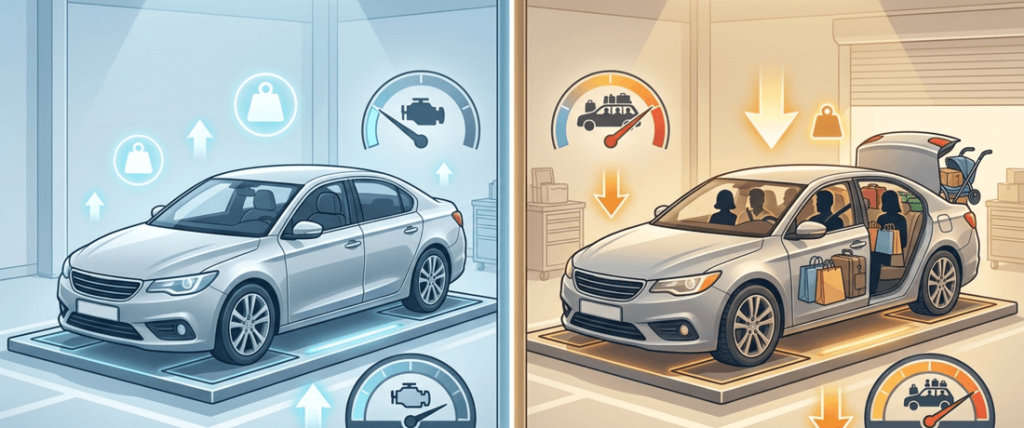
Curb weight is the weight of your car as it sits ready to drive. It includes all standard equipment and full fluids, but no passengers or cargo.
Think of it as the “empty” weight of the vehicle. It is the number you get if you drove your car onto a scale at a recycling center.
- What’s Included: The engine, body, and standard parts. It also includes a full tank of gas, oil, coolant, and brake fluid.
- What’s NOT Included: The driver, passengers, luggage, or any aftermarket parts like a tool box.
Does Curb Weight Include a Full Tank of Gas?
Yes, it does. By standard US EPA definition, curb weight always includes a full tank of fuel.
This standard helps compare cars fairly. A car with a 15-gallon tank weighs less than one with a 20-gallon tank when full. But the “curb weight” accounts for that full tank so you get a consistent number.
Curb Weight vs. Dry Weight — What’s the Difference?
Dry weight is a term used more for motorcycles or shipping. Dry weight excludes all fluids, while curb weight includes them.
Dry weight does not count gas, oil, or coolant. It is basically the weight of the car as it came off the assembly line. You rarely use dry weight for daily driving. Curb weight is the number that matters for registration and safety.
What Is Gross Weight (GVW)?
Gross weight is the actual total weight of your vehicle at any moment. It is the curb weight plus the weight of passengers, cargo, and any extra equipment.
This number changes every time you load the car. If you drive alone, the gross weight is low. If you pack the trunk with suitcases and fill the back seat with friends, the gross weight goes up.
What Is GVWR (Gross Vehicle Weight Rating)?
GVWR is the most important safety number on your door sticker. It is the absolute maximum safe operating weight set by the manufacturer.
You will find this on a yellow sticker on the driver’s door jamb. It stands for Gross Vehicle Weight Rating. This is a hard limit. It includes the car, the people, the gas, and the cargo. Never exceed this number. It is not a suggestion; it is the limit of what your car can handle safely.
Curb Weight vs. Gross Weight vs. GVWR — Side-by-Side Comparison
These terms are easy to mix up. This table shows exactly what is included in each weight term.
| Term | What It Measures | Includes Fuel? | Includes People/Cargo? | Changes Per Trip? |
|---|---|---|---|---|
| Curb Weight | Empty vehicle ready to drive | ✅ Yes | ❌ No | No |
| Gross Weight (GVW) | Total actual loaded weight | ✅ Yes | ✅ Yes | Yes |
| GVWR | Maximum safe weight limit | ✅ Yes | ✅ Yes (up to limit) | No (set by maker) |
How to Calculate Payload Capacity (The Formula You Need)
Payload capacity tells you how much stuff you can carry. You calculate payload capacity by subtracting curb weight from the GVWR.
The formula is simple: Payload Capacity = GVWR − Curb Weight
Real-World Example
Imagine you have a SUV.
- GVWR: 6,000 lbs
- Curb Weight: 4,500 lbs
- Calculation: 6,000 – 4,500 = 1,500 lbs.
Your payload capacity is 1,500 lbs. This means you can carry 1,500 lbs of people and gear. Let’s say you have a family of four. They weigh a total of 700 lbs. That leaves you 800 lbs for luggage. If you load 900 lbs of luggage, you are over the limit. This is vital for planning road trips or buying a new car. You can check our guide on towing capacity for more on vehicle limits.
Where to Find Your Car’s Curb Weight and GVWR
You do not need a calculator to guess. You can find the exact numbers on your car and in your manual.
Here are the best places to look:
- Door Jamb Sticker: Open the driver’s door. Look on the frame. You will see a yellow or white sticker. It lists the GVWR and sometimes the curb weight.
- Owner’s Manual: Flip to the “Specifications” section. It lists the weights for your specific model.
- Manufacturer Website: Look up your car’s year and model on the brand’s website.
- Window Sticker: If you are buying a new car, the Monroney label (window sticker) lists the curb weight.

Why These Numbers Matter for Everyday Drivers
You might think weight is just for truckers. Knowing your car’s weight limits keeps you safe, legal, and saves you money.
Fuel Economy
Weight kills gas mileage. A heavier curb weight means the engine works harder, which lowers your MPG.
If you keep your trunk full of heavy boxes, your gross weight is higher. Your car uses more gas to move that weight. Removing extra weight is an easy way to improve fuel economy.
Towing & Hauling
If you tow a trailer, weight is critical. Your gross weight limits how much you can safely tow behind your car.
You cannot just look at the trailer weight. You must add the trailer weight to your car’s gross weight. If you exceed the Gross Combined Weight Rating (GCWR), you risk damage.
Safety
Overloading a car is dangerous. Too much weight increases braking distance and makes the car harder to steer.
Your brakes are designed to stop the GVWR, not more. If you are overloaded, the brakes might fail or fade. The tires can also overheat and blow out.
Legal Compliance
The police can weigh your car. Commercial vehicles get fined for being overweight, but private cars can fail inspections too.
If you are in an accident and found to be overloaded, your insurance might not pay. It is considered negligence. The NHTSA provides guidelines on vehicle safety ratings which often factor in weight.
What Happens If You Exceed Your Car’s GVWR?
Do not guess with this number. Exceeding your GVWR causes mechanical failure and puts your life at risk.
Here is what can go wrong:
- Braking Distance Increases: The car won’t stop in time. The brakes will get hot and may not grab.
- Tire Blowout Risk: Tires have a max weight limit. Overloading the car puts too much pressure on them. They can explode on the highway.
- Suspension Damage: The springs and shocks can snap or bend. This leads to expensive repairs.
- Loss of Control: The car will sway. The steering will feel loose. You might roll over in a turn.
Other Vehicle Weight Terms You Should Know
There are a few other words you might see. Here is a quick glossary of common weight terms.
| Term | Quick Definition |
|---|---|
| Dry Weight | Vehicle weight without any fluids (gas, oil, coolant). |
| Unladen Weight | Similar to curb weight; weight with no load. |
| GAWR | Gross Axle Weight Rating. Max weight allowed on a single axle (front or rear). |
| GCWR | Gross Combined Weight Rating. Max weight of car + trailer combined. |
| Payload Capacity | The weight of passengers and cargo you can safely add. |
FAQs About Curb Weight vs Gross Weight
What is GVWR and where do I find it on my car?
GVWR stands for Gross Vehicle Weight Rating. You find it on a sticker located on the driver’s side door jamb. It is the maximum safe weight of the vehicle including passengers and cargo.
Can you write off 100% of a 6000 lb vehicle?
This is a tax question. Yes, vehicles with a GVWR over 6,000 lbs may qualify for specific tax deductions.
This often applies to SUVs and trucks used for business. The IRS Section 179 deduction allows business owners to deduct the full cost. Always check with a tax pro, as GVWR is the key number used, not curb weight.
Are the trucks over 10,000 lbs or under 10,000 lbs GVWR?
This matters for regulations. Trucks under 10,000 lbs GVWR are usually regulated like passenger cars.
Trucks over 10,000 lbs GVWR fall under different federal rules. They may require DOT numbers and follow stricter logbook rules.
Is 3700 lbs heavy for a car?
For a modern car, 3,700 lbs is average. It is not considered heavy; many sedans weigh between 3,000 and 3,500 lbs.
However, for a small compact car, it might be on the heavier side. For a mid-size SUV, it would be considered light.
Does curb weight include a full tank of gas?
Yes, it does. The standard definition of curb weight includes a full tank of fuel and all other fluids.
This ensures that every manufacturer lists the weight in the same way for comparison.
Bottom Line
Knowing the difference between curb weight and gross weight is vital. Curb weight is what your car weighs empty and ready to drive. Gross weight is the total once you add people and cargo. GVWR is the hard limit your manufacturer sets—never exceed it. Use the simple formula (Payload = GVWR − Curb Weight) to stay safe. It helps you avoid fines, accidents, and wear on your car. Check your door sticker today. For more help, look at our guides on reading your door jamb sticker and payload ratings.
Quick Summary
- Curb weight is the car with fluids but no people or cargo.
- Gross weight is the actual total weight of the car plus its load.
- GVWR is the maximum safe weight limit set by the factory.
- Payload Capacity is calculated as GVWR minus Curb Weight.
- You find these numbers on the driver’s side door jamb sticker.
- Overloading your car reduces safety and can cause tire or brake failure.
- Heavier cars tend to have lower fuel economy.