
This article was updated in July 13, 2026 with new products and information by Mark S. Taylor
Your hybrid vehicle won’t start, or it is exhibiting deeply erratic electrical behavior, and your mind instantly jumps to the worst-case scenario: a collapsed high-voltage traction battery. This is a severe repair bill that can easily run $2,000 to $6,000 depending entirely on the vehicle model.
Slow down. In the overwhelming majority of hybrid no-start situations, the actual culprit is simply the small, secondary 12V auxiliary battery—the exact same chemical battery type a conventional gasoline car uses, just scaled down and tucked away in an unusual cabin location.
As a technician, I have seen too many hybrid owners panic over traction battery replacement when their issue was just a dead $180 auxiliary cell. In this workshop guide, we will map out what a dying hybrid 12V battery failure symptoms looks like from the driver’s seat, review the definitive Ready-Light verification test, and trace the hidden charging loop failures that generic blogs always skip.

Contents
- 1 Symptoms of a Dying Hybrid 12V Auxiliary Battery
- 2 Is It the 12V or the Traction Battery? The 10-Second Ready-Light Test
- 3 Why Hybrid 12V Batteries Die Faster Than Conventional Cars
- 4 The Hidden Failure Point: DC-DC Converter Output
- 5 Real-World Diagnostic Case Studies
- 6 Safety Architecture: High-Voltage Segregation
- 7 4-Step DIY Battery Diagnostic Pipeline
- 8 US Automotive Repair Cost Matrix
- 9 FAQs About Hybrid 12V Battery Failure Symptoms
- 9.1 Can I jump-start a hybrid the same way as a regular car?
- 9.2 Will a bad 12V battery damage my hybrid’s traction battery?
- 9.3 How long do hybrid 12V batteries actually last?
- 9.4 Why does my hybrid show a “check hybrid system” light after a weak 12V battery?
- 9.5 Is it safe to keep driving on a 12V battery that’s starting to show symptoms?
- 10 The Bottom Line
Symptoms of a Dying Hybrid 12V Auxiliary Battery
- Total Startup Lockout: The vehicle refuses to power on at all when you depress the brake pedal and hit the Power button. You get no dashboard illumination, no chimes, and zero accessory radio function.
- Fading Key Fob Proximity Range: Keyless entry sensors stop responding entirely, or the key fob only registers when held six inches away from the door handle instead of working across the parking lot.
- The “Christmas Tree” Dashboard: The instrument cluster illuminates briefly upon startup, then immediately drops dark. Multiple warning lights (ABS, SRS, Stability Control) flicker and multiply without any logical fault pattern.
- Sluggish Power Windows and Locks: Actuators and glass regulators move at a snail’s pace right before total voltage failure.
Is It the 12V or the Traction Battery? The 10-Second Ready-Light Test
This is the fastest diagnostic differentiator you can execute without an expensive scan tool. Press the vehicle’s start button firmly and observe the instrument cluster flow closely:
The Traction Battery Signature: If the car powers up, access components activate, but the instrument cluster displays a permanent “Check Hybrid System“ warning while refusing to illuminate the green “READY” icon, the issue lies within the high-voltage traction battery pack or its isolation contactors. The traction battery almost never causes a total no-power-at-all condition.
The Dead 12V Signature: If absolutely nothing happens—completely dead cluster, no accessory power, no chimes—the 12V battery is depleted. The 12V system is responsible for waking up the hybrid control computer and closing the main high-voltage relays. Without it, the “big” battery remains entirely isolated.
Why Hybrid 12V Batteries Die Faster Than Conventional Cars
Most hybrid owners expect five to six years out of a high-quality battery and are blindsided when their hybrid’s 12V cells collapse at year three. There is an explicit engineering reason for this accelerated wear, not bad luck.
A conventional vehicle utilizes an alternator that constantly pushes a deep bulk charge into the battery whenever the engine runs. A hybrid platform completely lacks an alternator; its 12V battery is charged via a solid-state DC-DC Converter that steps down high voltage from the traction pack.
The computer operates this system on a tight efficiency curve, charging the 12V cell in brief, partial-cycling bursts. This means the auxiliary battery spends the vast majority of its operational life sitting at a partial state of charge. This chronic undercharging triggers rapid sulfation—the crystallization of lead sulfate across the internal plates—which permanently destroys the battery’s chemical capacity to hold an electrical charge.
The Hidden Failure Point: DC-DC Converter Output
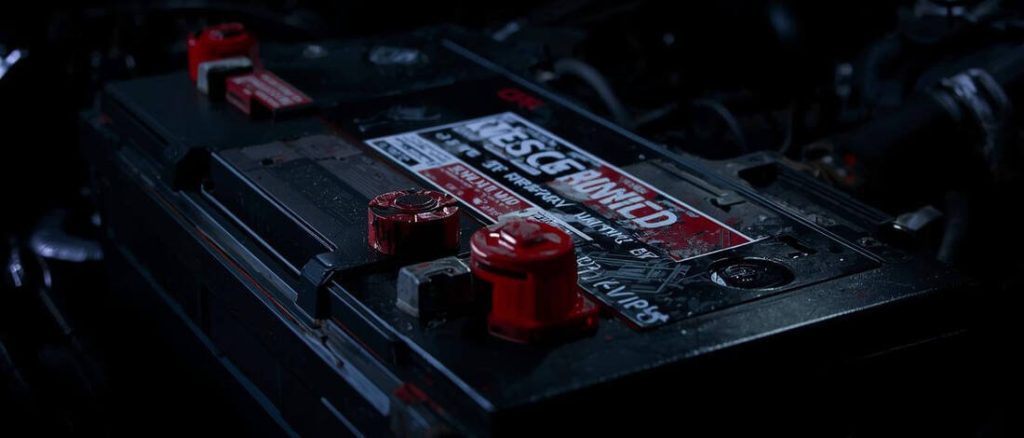
If you have already replaced your hybrid’s 12V battery and it drops dead again within a matter of months, stop buying batteries. Your issue is a failing DC-DC converter that is quietly undercharging perfectly good units into an early grave.
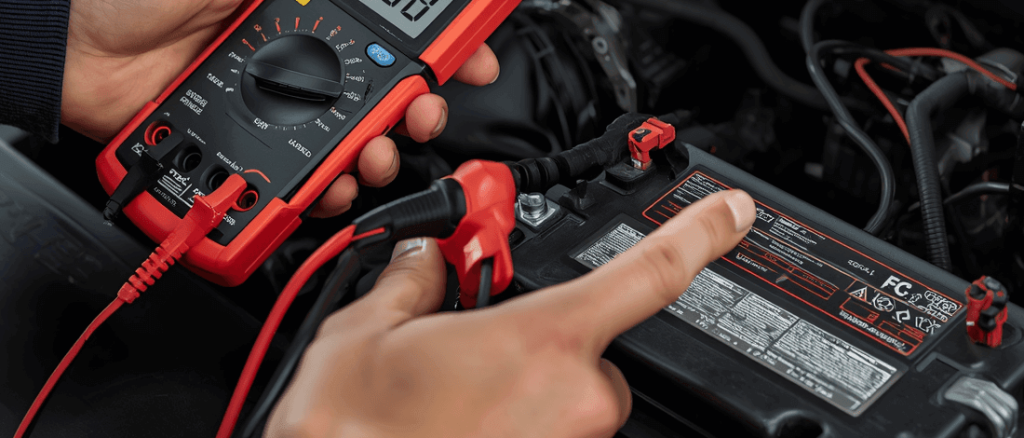
To isolate this loop, grab a digital multimeter and follow this precise technician pinpoint test:
- Switch your multimeter to the DC Voltage (20V) scale.
- With the vehicle turned completely off, back-probe the 12V terminals. A healthy resting cell should read 12.6 to 12.8 Volts.
- Start the vehicle and ensure the cluster enters absolute READY Mode (the gas engine does not need to be running; the green Ready light is the critical marker).
- Measure the voltage across the terminals again. The meter must jump to 13.5 to 14.5 Volts. This confirms the DC-DC converter is actively stepping down voltage and charging the auxiliary system. If the reading stays locked at 12.6 Volts or lower while in Ready mode, the converter’s internal regulator has failed, and no new battery will fix the vehicle.
Real-World Diagnostic Case Studies
Case 1: The Sulfated Prius Panic
A second-generation Toyota Prius was recently towed into my shop bay completely dead in the parking lot. The owner was convinced the high-voltage hybrid pack was destroyed and was pricing a $4,000 replacement in absolute panic. I opened the rear hatch, pulled the trunk access trim panel, and probed the small 12V AGM battery at rest. It read a miserable 4.2 Volts—completely sulfated due to age. The primary traction pack was perfectly healthy. We swapped the auxiliary cell for $180, and the car booted up instantly.
Case 2: The Highlander Converter Loop
A Toyota Highlander Hybrid owner came in complaining that he had burned through two high-end 12V batteries in less than fourteen months, assuming he kept getting defective units off the retail shelf. I connected an oscilloscope to the charging loop while the system sat in Ready mode. Under full accessory load (headlights and A/C on), the DC-DC converter output plummeted down to 12.8 Volts—well below the required 14-volt threshold. The internal voltage regulator inside the converter was shot. Replacing the converter module cost $650 in parts, but it was the definitive fix that stopped the constant battery destruction.
Safety Architecture: High-Voltage Segregation
Hybrids carry two entirely separate, isolated electrical networks, and understanding the boundary is critical for your safety.
- The Low-Voltage Loop (12V): This operates exactly like a standard car. It runs your radio, chassis modules, lighting, and dashboard. It is 100% safe to work on in your driveway with basic hand tools.
- The High-Voltage Loop (Traction Pack): This network carries between 200 and 650 Volts DC—enough to cause severe injury or electrocution. It is strictly identified by bright orange plastic sheathing and orange connector blocks. Never probe, touch, or cut any orange-clad cabling without specialized training, safety gloves, and an isolated high-voltage multimeter.
4-Step DIY Battery Diagnostic Pipeline
Execute this precise evaluation sequence twice a year to catch a failing auxiliary cell weeks before it leaves you stranded:
1. Execute the Resting Voltage Test: 2 min.
Ensure the hybrid has been turned off and parked for at least an hour to clear any surface charge. Probe the 12V positive and negative terminals. A healthy cell reads 12.6V to 12.8V. A reading of 12.4V or lower confirms the battery is sulfating and losing structural capacity.
2. Verify Active Charging Output: 2 min.
Start the car and confirm the green “READY” icon is illuminated on the cluster. Measure the voltage across the 12V terminals again. It must read between 13.5V and 14.5V to confirm the DC-DC converter is actively charging the cell under system loads.
3. Run a Parasitic Current Draw Audit: 5 min.
If your battery dies after sitting parked for a weekend, you have a parasitic draw. Turn the vehicle off, lock the doors, and wait 30 minutes for all computer modules to enter sleep mode. Unhook the negative battery cable and place your multimeter in series (set to DC Milliamps). A healthy hybrid should draw between 20mA and 50mA to maintain memory. Anything above 100mA confirms a module is failing to shut down, draining your system.
4. Execute a Terminal Corrosion Reset: 5 min.
Inspect the battery terminals for white or greenish copper sulfate crust. Because hybrid 12V batteries are frequently sealed inside enclosed trunks or under passenger seats, trapped vent gases accelerate corrosion. Scrub the connections clean with a stiff wire brush and a baking soda-water solution, then verify the mechanical hold-down clamp is completely snug.
US Automotive Repair Cost Matrix
| Repair / Diagnostic Vector | Average DIY Parts Cost | Professional Shop Labor Hours | Total Real-World Shop Bill |
| Standard Aftermarket 12V AGM Battery | $130 – $220 | 0.3 – 0.5 Hours | $170 – $280 |
| OEM Trunk-Mounted AGM Battery (Complex Access) | $200 – $320 | 0.5 – 0.8 Hours | $250 – $430 |
| Professional Component Isolation / Diagnostic Fee | N/A | 0.5 – 1.0 Hours | $75 – $180 |
| DC-DC Converter Module Replacement | $400 – $900 | 1.5 – 3.0 Hours | 💰 $650 – $1,300 |
FAQs About Hybrid 12V Battery Failure Symptoms
Can I jump-start a hybrid the same way as a regular car?
Mostly yes, but only using the dedicated jump-start terminal specified in your owner’s manual, not by clamping directly onto the battery in a cramped trunk-mounted location. Never let jumper cables anywhere near orange high-voltage cabling.
Will a bad 12V battery damage my hybrid’s traction battery?
No, they’re electrically isolated systems. A dead 12V will prevent the car from starting at all, but it won’t damage the separate high-voltage traction battery.
How long do hybrid 12V batteries actually last?
Typically 3 to 5 years, shorter than a conventional car battery’s 5-6 year average, because of the partial-cycling charging pattern described above. Heat exposure and infrequent driving both shorten that further.
Why does my hybrid show a “check hybrid system” light after a weak 12V battery?
The 12V powers the initial startup sequence for the entire hybrid control system, so a weak battery can cause the system to boot into a fault state during startup even though the actual hybrid components are fine. The message often clears after the battery is tested, charged, or replaced.
Is it safe to keep driving on a 12V battery that’s starting to show symptoms?
Not for long. A 12V that’s marginal can fail completely without warning, and unlike a conventional car, a dead 12V on a hybrid can leave you with zero power to unlock doors or shift out of park in some models. Test it and replace it at the first sign of the symptoms above rather than waiting for a full failure.
The Bottom Line
Always run the 10-second Ready-Light test first. A hybrid that powers up normally but exhibits erratic electrical anomalies is not suffering from a multi-thousand-dollar traction battery failure—it is screaming for a basic 12V auxiliary check. Maintain your terminal cleanliness, check your resting voltage parameters twice a year, and verify your DC-DC converter’s output early to safeguard your vehicle’s complex electrical architecture.
Powertrain Monitoring & Calibration: If your hybrid auxiliary battery replacement is complete but your dashboard continues to present underlying warning messages or fault codes during computer re-boot cycles, check our comprehensive workshop guide on How to Read Check Engine Light Codes Without a Scannerto clear historical codes. For alternative tracking dropouts across the steering geometry, read our in-depth diagnostic analysis on the Symptoms of a Bad Speed Sensor.