
This article was updated in July 14, 2026 with new products and information by Mark S. Taylor
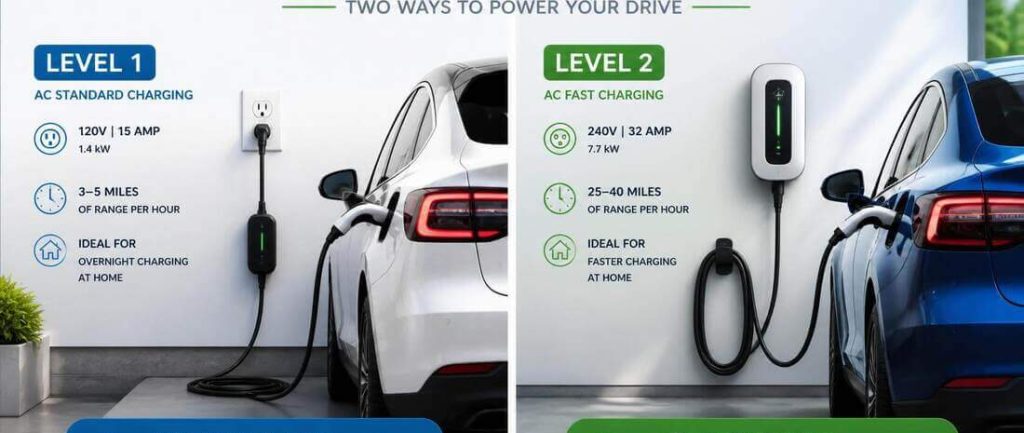
Every electric vehicle (EV) comes equipped with a basic Level 1 factory charging cable inside the trunk that plugs directly into any standard 120-volt household outlet. Upgrading to Level 2 charging, however, requires a dedicated 240-volt electrical circuit—the identical high-amperage grid your clothes dryer or electric range relies on—delivered either through a robust NEMA 14-50 receptacle or a permanently hardwired wall charging station.
The discrepancy in fueling speed between these two tiers is far from subtle. A basic Level 1 connection trickles roughly 3 to 5 miles of driving range per hour of charging, whereas a dedicated Level 2 setup blasts between 15 and 45 miles of range into the battery pack per hour.
While that performance gap initially makes a Level 2 upgrade seem like an absolute no-brainer, a deep layer of localized math—which the vast majority of mainstream automotive blogs completely ignore—proves that many urban drivers are spending thousands of dollars on electrical work they do not actually require. In this comprehensive guide, we will break down the true physics of home EVSE (Electric Vehicle Supply Equipment) units, expose the hidden onboard charger bottleneck, and map out realistic 2026 installation costs.
Contents
- 1 Level 1 vs Level 2 Infrastructure Matrix
- 2 Do You Actually Need a Level 2 System? The Daily Mileage Formula
- 3 Exposing the Hidden Bottleneck: The Onboard Charger Ceiling
- 4 Level 2 Home Installation Pathways: Scissor Scopes
- 5 Critical DIY Safety Warnings & Panel Assessments
- 6 Home EV Charging Project Cost Matrix
- 7 Long-Term Battery Management Protocols
- 8 FAQs About EV Level 1 vs Level 2 Charging
- 9 The Bottom Line
Level 1 vs Level 2 Infrastructure Matrix
| Technical Specifications | Level 1 Home Charging | Level 2 Wall Infrastructure |
| Electrical Voltage Baseline | 120V AC (Standard Outlet) | 240V AC (Dedicated Circuit) |
| Operational Amperage Window | 12 – 16 Amps | 16 – 50 Amps |
| Miles of Range Per Charging Hour | 3 – 5 Miles | 15 – 45 Miles |
| Depleted to 100% Charge Duration | 24 – 50+ Continuous Hours | 4 – 10 Accelerated Hours |
| Primary Equipment Requirements | Mobile factory cable (Included) | Dedicated EVSE Wall Unit / Plug |
| Average 2026 Installation Cost | $0 (Utilizes existing outlets) | $700 – $2,500 (Electrician Required) |
Do You Actually Need a Level 2 System? The Daily Mileage Formula
To bypass the marketing fluff surrounding high-amperage home charging units, execute this simple real-world mathematical tracking test before spending money on electrical upgrades.
A standard Level 1 mobile charger plugged into a wall outlet for a typical 10-hour overnight sleep cycle will reliably replenish between 30 and 50 miles of range. According to national commuter tracking metrics, the vast majority of daily round-trip commutes and urban errand loops total less than 40 miles per day.
This means that if your driving footprint fits within this baseline, a standard 120V outlet completely replaces your entire daily energy consumption every single night—absolutely free of installation costs.
A Level 2 home installation transitions from a luxury into a functional necessity only if you meet these three specific criteria:
- The High-Mileage Commute: Your daily round-trip driving routinely exceeds 50 miles, leaving your vehicle structurally net-negative at the end of a Level 1 overnight cycle.
- The Mid-Day Turnaround: You drive aggressively in the morning and require a rapid, mid-day top-off to execute a second long-distance loop in the afternoon.
- Restricted Charging Windows: You live in a jurisdiction where you only have access to a shared plug for 2 to 3 hours nightly, rather than a full overnight drop.
Exposing the Hidden Bottleneck: The Onboard Charger Ceiling
The absolute most common financial blunder a new EV owner commits is purchasing a premium, high-amperage 48-amp or 50-amp Level 2 charging station under the assumption that a larger unit translates to faster vehicle charging.
Your electric vehicle does not store raw AC power from the wall; it must convert it into DC energy using an internal component known as the Onboard Charger (OBC). Every vehicle platform has a strict, factory-engineered maximum kilowatt conversion cap built into its OBC—typically rated at 7.2 kW, 9.6 kW, or 11.5 kW.
The Physics Cap: If you possess a vehicle equipped with a baseline 7.2 kW onboard charger, plugging it into a premium 48-amp charging station capable of pushing 11.5 kW will do absolutely nothing to accelerate your charge duration. The vehicle’s internal management computer will immediately throttle the incoming power stream down to exactly 7.2 kW to protect its thermal parameters.
Always cross-reference your owner’s manual for your vehicle’s specific OBC amperage ceiling before purchasing an EVSE unit. Sizing your wall charger beyond your car’s processing threshold is simply throwing money away.
Level 2 Home Installation Pathways: Scissor Scopes
When upgrading your home to handle 240-volt charging, you must choose between two highly distinct mechanical pathways:
1. The NEMA 14-50 Receptacle Pathway
An electrician mounts a heavy-duty, industrial-grade 240V outlet onto your garage wall (identical to a heavy electric cooking range outlet) backed by a 50-amp circuit breaker. You then plug a portable Level 2 charging cable directly into the wall. This infrastructure offers extreme flexibility: if you move homes or the charger unit fails, you can simply unplug the EVSE and swap it out without calling an electrician back.
2. The Hardwired Installation Pathway
The charging station is structurally mounted to the wall and wired directly into the metal electrical service panel with no intermediate plug or outlet interface. Hardwiring is mechanically mandatory for any advanced charging setup drawing 40 Amps or higher (requiring a 60-amp circuit breaker). It eliminates an extra physical connection point, reducing internal thermal resistance and providing a far more weatherproof barrier for outdoor driveway arrays.

Critical DIY Safety Warnings & Panel Assessments
- The Extension Cord Fire Hazard: Never, under any circumstances, route a Level 1 or Level 2 EV charging cable through a standard household extension cord or a power strip. A continuous, high-amperage thermal load running for 10 consecutive hours will superheat thin extension cord conductors, melt plastic outer insulation jackets, and act as a verified source for devastating residential structural fires. Plug the factory cable directly into a dedicated, rigid wall box.
- The 100-Amp Panel Threshold: Older residential structures are commonly built around a legacy 100-amp main electrical service panel. Adding a dedicated 40-amp or 50-amp Level 2 charging loop onto a 100-amp main breaker leaves zero electrical headroom for your central A/C, water heater, or oven, triggering instant whole-house main breaker trips. If your home has a 100-amp service grid, you must factor in the structural cost of a comprehensive panel upgrade to 200 Amps before adding a fast charger loop.
Home EV Charging Project Cost Matrix
| Infrastructure Item / Service Scope | Average Hardware Cost | Licensed Electrician Labor | Total Estimated Project Bill |
| Factory Level 1 Charging Cable | $0 (Included with vehicle) | N/A (Plug & Play) | $0 |
| Portable Plug-In Level 2 EVSE (32A) | $300 – $650 | $300 – $1,200 (Outlet Install) | $600 – $1,850 |
| Hardwired High-Power EVSE (48A–50A) | $400 – $700 | $400 – $1,700 (Direct Panel) | $800 – $2,400 |
| Comprehensive 200A Electrical Panel Upgrade | $1,500 – $2,500 (Hardware) | Included in Service Scope | 💰 $1,500 – $4,000+ |
2026 Regulatory Note: The historical US federal tax credit under Section 30C, which previously offset 30% of residential EV charging infrastructure costs up to $1,000, officially expired on June 30, 2026. If you are installing equipment after this deadline, check your local municipal utility company directly—many regional providers continue to run isolated clean energy rebates that independent federal expirations do not compromise.
Long-Term Battery Management Protocols
To preserve the lithium-ion chemical health of your vehicle’s high-voltage battery pack over a multi-year cycle, implement these factory-approved shop guidelines:
1. Optimize Utility Time-of-Use Rate Configurations: 1 min.
Access your utility company’s online portal and review their peak vs. off-peak electricity price charts. Navigate into your vehicle’s dashboard infotainment settings and program the charging software loop to only initialize power flow during late-night off-peak hours, locking in up to a 60% drop in energy costs.
2. Establish the 80% Daily State-of-Charge Ceiling: 1 min.
Unless you are immediately embarking on a long-distance cross-country highway trip, configure your vehicle’s charging limit to terminate automatically at 80% or 90% capacity. Consistently forcing lithium-ion packs to 100% saturation under home thermal environments drastically accelerates permanent chemical capacity fade.
3. Execute Quarterly EVSE Hardware Inspections: 2 min.
Every three months, physically uncoil your charging line and inspect the rubber jacket for physical abrasions or cracks. Peer inside the handle connector block—if you observe any dark green copper oxidation on the pins, or if the plastic handle feels distinctly hot to the touch immediately after a charging cycle, shut off the breaker and have an electrician check the terminals for dangerous electrical resistance.
FAQs About EV Level 1 vs Level 2 Charging
Will Level 1 charging damage my regular household outlet?
Not if the outlet and circuit are in good condition and not shared with other high-draw devices during charging. A worn or older outlet showing signs of heat discoloration should be inspected or replaced before sustained multi-hour charging, regardless of charging level.
Can I install Level 2 charging in an apartment or condo?
Only with property owner or HOA approval, since it typically requires electrical work tied to a dedicated parking space or unit’s panel. Many apartment complexes are adding shared Level 2 stations, so check with property management before assuming you need your own install.
Is public DC fast charging the same as Level 2?
No, DC fast charging (sometimes called Level 3) is a separate, higher-power category typically found at public stations, delivering 60-plus miles of range in 20-30 minutes, but it uses different equipment and connectors than home Level 1/Level 2 charging and isn’t practical or available for home installation.
Can I take my Level 2 charger with me if I move?
Yes, if you installed a NEMA 14-50 plug-in EVSE rather than a hardwired unit, you can unplug it and take it to your next home, provided that home also has or can get a compatible 240V outlet installed.
Do I need a home electrical panel upgrade for Level 2 charging?
Only if your existing panel doesn’t have enough spare capacity for the added 30-50 amp circuit, which is more common in older homes with 100-amp service versus modern 200-amp panels. An electrician can confirm this with a load calculation before you commit to a specific EVSE amperage.
The Bottom Line
Run your home charging infrastructure decisions based on actual mileage math, not accelerated garage upgrades. If your daily round-trip commute sits comfortably below 40 miles, a standard Level 1 outlet fully replaces your energy usage overnight for free. If your mileage profile forces a Level 2 upgrade, verify your car’s explicit onboard charger ceiling first, always hire a licensed professional electrician to pull permits, and never route high-amperage charging currents through a residential extension cord.
Powertrain Monitoring & Calibration: If your alternative vehicle management systems, auxiliary modules, or onboard computer diagnostic networks display fault codes during high-amperage wall charging cycles, check our master technical guide on How to Read Check Engine Light Codes Without a Scannerto isolate hidden trouble codes. For tracking traditional engine faults or isolating fueling imbalances across hybrid drivetrains, read our in-depth diagnostic analysis on Why an Engine Runs Rich.