
This article was updated in March 10, 2026 with new products and information by Mark S. Taylor
Your car bounces like a trampoline, dives hard when you brake, and pulls to the right no matter how straight you hold the wheel. These aren’t just annoyances—they’re your suspension system signaling it needs help. Your suspension keeps your tires on the road and gives you control over the vehicle’s body. If it fails, you risk losing steering control, wearing out your tires in weeks, and damaging your brakes. This guide covers 10 critical signs of car suspension issues and shows you how to find the broken part fast. Read on to stay safe and save money on your next trip to the shop.

Contents
- 1 What Does the Suspension System Actually Do?
- 2 Shocks vs. Struts — What’s the Difference and Why It Matters
- 3 The 10 Signs of Car Suspension Issues
- 3.1 1. Excessively Bumpy, Rough, or Bouncy Ride
- 3.2 2. Nose Diving When Braking
- 3.3 3. Excessive Body Roll When Cornering
- 3.4 4. Car Pulling or Drifting to One Side
- 3.5 5. Clunking, Knocking, or Rattling Noises Over Bumps
- 3.6 6. Car Sitting Lower on One Corner or Side
- 3.7 7. Uneven or Unusual Tire Wear
- 3.8 8. Steering Feels Loose, Wandering, or Unresponsive
- 3.9 9. Leaking Fluid From Shocks or Struts
- 3.10 10. Bottoming Out — Chassis Hitting the Ground
- 4 Symptom → Specific Component Diagnostic Table
- 5 Air Suspension Special Warning Signs
- 6 The Free 60-Second Bounce Test — Do This Right Now
- 7 Is It Safe to Drive With Bad Suspension?
- 8 Suspension Repair Cost — By Component
- 9 How to Prevent Suspension Problems
- 10 FAQs About Signs of Car Suspension Issues
- 11 Bottom Line — What to Do Right Now
What Does the Suspension System Actually Do?
The suspension system is a team of parts that connects your car to its wheels. Its main job is to keep your tires firmly planted on the road while soaking up bumps and cracks. It also controls how the car body moves when you turn, stop, or speed up. Without a working suspension, your car would be dangerous to drive and very uncomfortable. The primary role of the suspension is to ensure tire contact and vehicle stability for driver safety.
This system works closely with your steering and brakes. If your shocks are bad, your brakes have to work harder. If your ball joints are loose, your steering feels shaky. Key parts include shock absorbers, struts, coil springs, and control arms. Keeping these in good shape protects your entire vehicle from road stress.
Shocks vs. Struts — What’s the Difference and Why It Matters
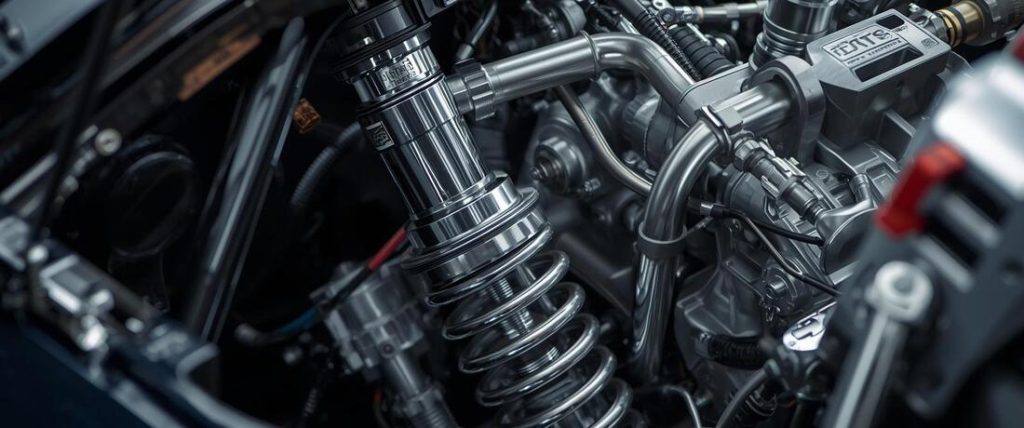
Many people use these names for the same thing, but they are different. A shock absorber only stops the car from bouncing. A strut is a structural part of the car that also holds the weight and helps with steering. Shocks are easier to change, but struts usually need a wheel alignment afterward.
| Feature | Shock Absorbers | Struts |
| Main Job | Dampen bounce | Support weight and steering |
| Location | Often rear | Often front |
| Alignment needed? | No | Yes |
| Cost (Pair) | $200 – $600 | $450 – $1,200 |
The 10 Signs of Car Suspension Issues
1. Excessively Bumpy, Rough, or Bouncy Ride
A bouncy ride is the most common sign that your shocks or struts are worn out. When these parts fail, they can no longer “grab” the spring to stop it from moving. You will feel every tiny crack in the road like a giant pothole. The car will continue to move up and down long after you hit a bump. An excessively bouncy ride is a primary indicator that your dampers have lost their hydraulic fluid or gas charge.
2. Nose Diving When Braking
If the front of your car dips toward the ground when you hit the brakes, you have “nose dive.” This happens because your front struts are too weak to hold the weight of the car as it shifts forward. This is dangerous because it makes your stopping distance much longer. You might also notice the back of the car “squatting” when you speed up. Nose diving is a sign of failed front struts that can no longer manage weight transfer.
3. Excessive Body Roll When Cornering
Does your car feel like it might tip over when you turn a corner? This is called body roll. Parts called sway bar links are meant to keep the car level during turns. If they are broken, the car will lean heavily to the outside. This reduces your tires’ grip and makes the car feel unstable. Excessive body roll while turning is a sign of worn sway bar links or bushings.
4. Car Pulling or Drifting to One Side
A car that drifts left or right while you try to go straight often has a suspension problem. Worn bushings or a bad ball joint can let the wheel move out of its correct spot. However, you should check your tire pressure and alignment first, as these are cheaper to fix. If those are fine, the suspension is the likely culprit. A vehicle pulling to one side is a symptom of worn control arm parts or a collapsed spring.
5. Clunking, Knocking, or Rattling Noises Over Bumps
Strange noises are the most helpful clues for finding a broken part. A loud “clunk” usually means a ball joint is loose or a strut mount is broken. A “rattle” on rough roads often points to a sway bar link. If you hear a “squeak” when you turn, your rubber bushings might be dry and cracked. Clunking or knocking noises over bumps are clear signs of mechanical looseness in the suspension.
6. Car Sitting Lower on One Corner or Side
Walk around your parked car and look at its height. If one corner sits lower than the others, you likely have a broken coil spring. Springs hold the car up, so when they snap, the car sags. This will ruin your tires very fast because the wheel is no longer straight. A car sitting lower on one corner is a sign of a broken or fatigued coil spring.
7. Uneven or Unusual Tire Wear
Your tires can tell you what is wrong with your suspension. If you see “cups” or scalloped dips in the tread, your shocks are letting the tire bounce too much. If the inside edge is bald, your alignment has shifted due to a bad control arm. Checking your tires once a month can save you from a major breakdown. Uneven tire wear patterns are visible proof of suspension geometry failure.
8. Steering Feels Loose, Wandering, or Unresponsive
Since the suspension holds the wheels, it is a huge part of your steering. If ball joints or tie rods wear out, they create “slop.” You might have to turn the steering wheel a lot before the car actually moves. The car may feel like it is wandering across the lane on its own. Loose or wandering steering is a sign of worn tie rod ends or ball joints.
9. Leaking Fluid From Shocks or Struts
Shocks and struts are filled with oil. If you see a wet, greasy sheen on the outside of the metal tube, the seal has popped. Once the oil leaks out, the part can no longer do its job. You should replace them before they go completely dry. Oily fluid on a shock or strut body is a sign of a failed internal seal.
10. Bottoming Out — Chassis Hitting the Ground
This is the most extreme and dangerous sign. It happens when your springs and shocks are so dead that the car has no room left to move. When you hit a bump, the frame of the car slams into the ground. This can rip off your exhaust or crack your bad oil pump. Bottoming out is a critical sign of total suspension failure that requires immediate repair.
Symptom → Specific Component Diagnostic Table
| Symptom | Most Likely Failing Part |
| Bouncing Ride | Shock absorbers or Struts |
| Nose Diving | Front Struts |
| Leaning in Turns | Sway bar links |
| Squeaking on Turns | Ball joints or Bushings |
| Clunking on Bumps | Strut mounts or Ball joints |
Air Suspension Special Warning Signs
Some luxury trucks and SUVs use air bags instead of metal springs. These systems are great for comfort but break more often. If your car sits on the ground after being parked overnight, you have a leak. You might also hear a loud “hiss” or a clicking sound from the air compressor under the hood. A vehicle that lowers itself while parked is a sign of a leaking air suspension bag.
- Chevy Silverado / GMC Sierra Z55
- Ram 1500 Active Level
- Cadillac Escalade
- Range Rover / BMW 7-Series
The Free 60-Second Bounce Test — Do This Right Now
You don’t need any tools to check your shocks. Just follow these steps:
- Park on flat ground.
- Push down hard on one corner of the car with both hands.
- Let go and watch how the car moves.
- Count the bounces.
If the car settles in 1 or 2 bounces, it is healthy. If it bounces 3 or more times, your shocks are worn. If it keeps moving, they have failed completely. This is the easiest way to test for bad shocks or struts at home.
Is It Safe to Drive With Bad Suspension?
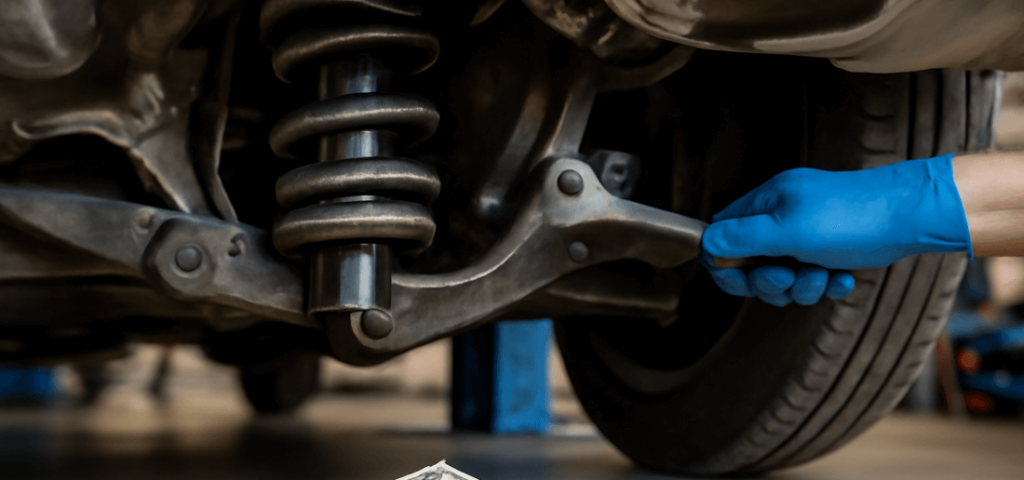
It depends on which part is broken. Worn shocks make the ride bad, but a broken ball joint is a crisis. If a ball joint snaps while you are driving, the wheel can fall off the car entirely. You will lose all steering and likely crash. If you hear loud metal noises or the car feels “loose,” get a tow. Driving with a broken ball joint or tie rod end is a high-risk safety hazard.
Suspension Repair Cost — By Component
| Part | Total Cost (Parts + Labor) |
| Shock Absorbers (Pair) | $200 – $600 |
| Struts (Pair) | $450 – $1,200 |
| Ball Joint (Single) | $150 – $400 |
| Control Arm (Single) | $150 – $600 |
| Sway Bar Links (Pair) | $80 – $250 |
| Air Spring (Single) | $300 – $800 |
Always fix these parts in pairs. If you only fix one side, the car will pull and handle strangely. For more price help, check out RepairPal or AAA’s repair guide.
How to Prevent Suspension Problems
You can make your suspension last for 100,000 miles with a little care.
- Slow down for speed bumps and potholes. High-speed hits kill ball joints.
- Rotate your tires every 5,000 miles to prevent uneven wear.
- Get an alignment once a year to keep the parts from fighting each other.
- Wash the underside of your car in winter to stop salt from eating the rubber.
- Check your bad fuel filter and bad fuel injector during your regular service to keep the whole car running right.
FAQs About Signs of Car Suspension Issues
What are the signs of car suspension issues?
The main signs are a bouncy ride, nose diving when braking, body roll, pulling to one side, clunking noises, and uneven tire wear. You might also see the car sitting low on one corner. Do the bounce test to check your shocks quickly.
How do I know if it’s the suspension or wheel alignment causing my car to pull?
Get an alignment check first. It is cheap ($75–$150). If the car still pulls after the alignment, then a suspension part like a control arm bushing is likely worn out.
How long do shocks and struts last?
They usually last between 50,000 and 100,000 miles. This depends on the roads you drive on. If you hit many potholes, they will wear out faster.
What causes uneven tire wear — is it suspension or alignment?
Cupping (scalloped wear) is usually bad shocks. Inner or outer edge wear is usually alignment or bent parts. Feathering is usually bad tie rods. Check the wear pattern to find the cause.
How much does suspension repair cost in 2026?
It varies by part. Shocks cost $200–$600. Struts cost $450–$1,200. A full overhaul can cost over $2,000. Fixing it early is always cheaper than waiting.
Bottom Line — What to Do Right Now
If your car is bouncing or clunking, don’t wait. Suspension problems only get worse and more expensive. A small clunk today can become a broken tire and a tow truck bill tomorrow. Start with the free bounce test at home. If the car fails, take it to a shop for a full check. Most shops will inspect your suspension for free when you get an oil change. For more help, see our guide on causes of an engine misfire to keep your car in top shape.
Quick Summary
- Bouncing is the #1 sign of worn shocks or struts.
- Nose diving means your front suspension is weak.
- Clunking noises mean a part is loose or broken.
- Uneven tire wear shows the wheel is not straight.
- The bounce test is the best way to check at home.
- Repairs range from $100 to over $1,000.