
This article was updated in June 28, 2026 with new products and information by Mark S. Taylor
The illumination of a dashboard Check Engine Light accompanied by diagnostic trouble codes P0420 or P0430 is a scenario that strikes fear into the wallet of any vehicle owner. In modern automotive emissions frameworks, the catalytic converter serves as the ultimate chemical purification chamber. It is designed to transform toxic combustion byproducts—specifically Carbon Monoxide (CO), raw Hydrocarbons (HC), and Nitrogen Oxides ($\text{NO}_x$)—into harmless nitrogen, carbon dioxide, and pure water vapor.
Because a brand-new factory OEM catalytic converter unit can easily command between $1,500 and $3,000 due to the surging commodity costs of the precious metals sealed inside it, retail auto parts shelves are flooded with $25 liquid “catalytic converter cleaning kits.”
The hard mechanical truth is that while targeted chemical solvents can successfully dissolve surface soot and organic carbon glaze from short-trip driving, no liquid can reverse physical structural failures. As an ASE-Certified Master Technician, I have diagnosed thousands of exhaust paths. In this comprehensive workshop guide, we will break down the precise thermodynamic boundaries of catalyst cleaning, step-by-step in-tank solvent decontamination sequences, and verified 2026 component service parameters.
Contents
- 1 The Internal Chemistry of Exhaust Catalysts
- 2 5 Definitive Signs Your Catalytic Converter Is Restricting Flow
- 3 When Catalyst Cleaning Will Work vs. Immediate Component Failure
- 4 The Safe 5-Step In-Tank Chemical Decarbonization Sequence
- 5 Exhaust System Diagnostics & Replacement Cost Matrix (2026 US Estimates)
- 6 Dangerous Exhaust Cleaning Myths to Avoid
- 7 FAQs About How to Clean a Catalytic Converter Safely
- 8 The Verdict: Spend the $25 Before Authorizing Major Overhauls
The Internal Chemistry of Exhaust Catalysts
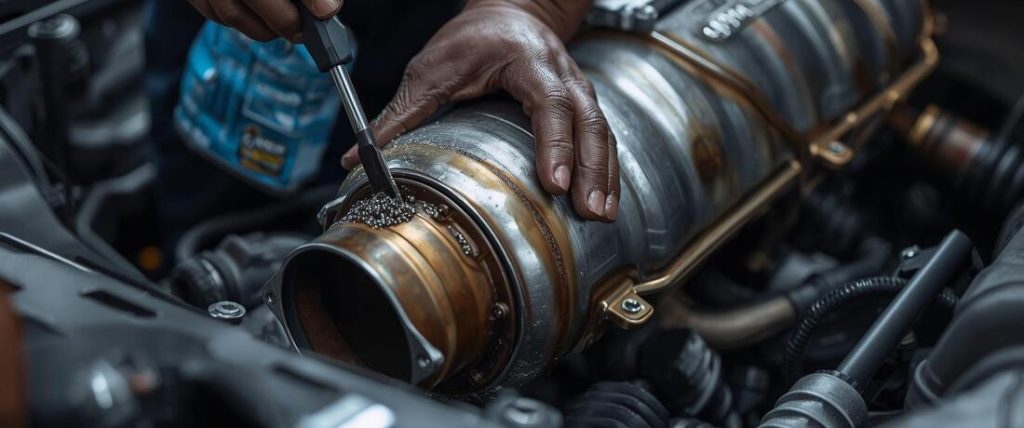
To understand why a catalytic converter clogs—and whether it can genuinely be cleaned—you must look directly inside its stainless steel shell housing. The core of the converter consists of a dense, micro-channel ceramic honeycomb block known as a monolith substrate. This matrix is lined with an ultra-thin chemical washcoat embedded with atomized precious metals: Platinum, Palladium, and Rhodium.
When your vehicle is driven exclusively on short, low-speed city trips, the exhaust system temperature never reaches its optimal catalyst light-off threshold of $500^\circ\text{F} \text{ to } 800^\circ\text{F}$. Deprived of this intense thermal energy, unburned fuel molecules cannot completely oxidize. Instead, they cool and bake into a dense layer of charcoal-black carbon soot across the honeycomb openings, choking the exhaust flow and blinding the precious metals from interacting with passing gases.

5 Definitive Signs Your Catalytic Converter Is Restricting Flow
Before investing in chemical flushes, monitor your vehicle’s performance for these five classic signatures of a fouled catalytic grid:
- Active Trouble Codes P0420 / P0430 (Catalyst Efficiency Below Threshold): This indicates that your downstream oxygen sensor’s voltage output wave has begun mirroring the fluctuating pattern of the upstream sensor, confirming that the internal chemical washcoat is fully blinded by contaminants.
- Severe Engine Power Lag and Sluggish Throttle Response: Under heavy acceleration load, the vehicle struggles to scale speed or hesitates aggressively. This occurs because the packed carbon soot creates a high exhaust backpressure block, preventing the cylinders from expelling spent gases and choking out engine volumetric efficiency.
- A Distinct Drop in Fuel Economy Metrics: Because the engine must fight intense exhaust backpressure to pump pistons upward, its operational load spikes, forcing the Engine Control Module (ECM) to command extra fuel enrichment cycles that destroy your miles-per-gallon (MPG) numbers.
- A Pungent Sulfur or Rotten Egg Odor from the Tailpipe: When the precious metal matrix becomes fully blinded or fails due to excessive soot coating, the converter loses its ability to process sulfur compounds, allowing raw hydrogen sulfide gas to escape directly into the atmosphere.
- Total Failure During State Smog and Emissions Inspections: The unoxidized gas mixture sails completely unfiltered straight past the tailpipe rim, spiking Hydrocarbon (HC) parts-per-million counters past legal regulatory cutoffs.
When Catalyst Cleaning Will Work vs. Immediate Component Failure
Automotive catalysts enter two completely separate failure states, only one of which can be resolved in a driveway:
Good Candidates for Chemical Remediation
Vehicles displaying a fresh, newly logged P0420 code driven by light carbon soot accumulation, fuel varnish from town driving, or historical misfires that have already been completely repaired with fresh spark plugs and ignition coils.
Unfixable Structural Destruction (Replacement Mandatory)
- The Metallic Core Rattle: If you strike the bottom of the converter shell lightly with a rubber mallet and hear a loud gravelly rattling noise, the internal ceramic monolith has structurally shattered or melted. No liquid chemical can repair a physically broken ceramic grid.
- Chemical Catalyst Poisoning: If your engine suffers from a severely blown head gasket leaking glycol antifreeze or worn piston rings burning heavy engine oil, the silicon or phosphorus compounds will form a vitrified glassy glaze directly over the precious metals. This chemical poisoning permanently deactivates the catalyst substrate, rendering cleaning completely useless.
The Safe 5-Step In-Tank Chemical Decarbonization Sequence
Follow this precise technician protocol to execute an in-tank solvent purge safely without inducing fuel pump cavitation or line air-locks:
1. Verify Your Base Fuel Level Match: 1 min.
Drive your vehicle until your fuel gauge registers precisely one-quarter (1/4) of a tank remaining (roughly 3 to 5 gallons of fuel depending on your vehicle’s tank size). This fuel volume provides the absolute perfect concentration ratio for commercial exhaust cleaning solvents.
2. Inject a Dedicated PEA/Solvent Exhaust Cleaner: 2 min.
Uncap your fuel filler neck. Pour an entire 16-ounce bottle of a verified, specific catalytic converter cleaner (such as Cataclean or CRC Guaranteed To Pass) straight down the fuel neck. These formulas utilize a targeted blend of xylene, acetone, and hydrotreated distillates stable enough to survive cylinder combustion and clean downstream components.
3. Execute the High-Temperature Activation Drive Cycle: 20 min.
Immediately hit the open highway. Drive the vehicle continuously at steady highway cruise speeds (55 to 65 MPH) for a minimum of 20 to 30 minutes. Do not execute stop-and-go city driving. Sustained highway loading steps up the internal catalyst temperatures right into its active chemical light-off zone, enabling the sweeping solvent vapors to chemically dissolve the baked-on carbon glaze.
4. Perform a Safe Drive Cycle Evacuation: 10 min.
Continue driving the vehicle as normal until the remaining one-quarter tank of chemically concentrated fuel is completely burned down near the empty marker line. This ensures maximum exhaust gas contact time over the fouled precious metal surfaces.
5. Refuel with Premium Top-Tier Detergent Fuel: 5 min.
Fill the fuel tank completely up to the MAX line utilizing premium high-octane gasoline certified under the TOP TIER™+ detergent standard. Connect your OBD2 scan tool, clear the stored P0420/P0430 codes out of the module memory, and monitor the downstream oxygen sensor values across the next 3 drive cycles to verify efficiency restoration.
Exhaust System Diagnostics & Replacement Cost Matrix (2026 US Estimates)
| Isolated Component / Service Option | Average DIY Parts Cost | Professional Shop Labor Cost | Total Estimated Service Bill |
| Premium In-Tank Solvent Cleaner | $20 – $35 | $0 (Driveway Task) | $15 – $35 |
| Exhaust Manifold Gasket Replacements | $15 – $40 | $80 – $140 | $95 – $180 |
| Downstream Oxygen Sensor Replacement | $45 – $120 | $70 – $120 | $115 – $240 |
| Direct-Fit Aftermarket Converter Assembly | $250 – $750 | $150 – $350 | $400 – $1,100 |
| Premium Factory OEM Catalyst Unit | $900 – $2,400 | $200 – $500 | 💰 $1,100 – $2,900+ (High precious metal index) |
Dangerous Exhaust Cleaning Myths to Avoid
The internet is flooded with highly hazardous, unscientific “off-car” catalytic converter cleaning methods that will instantly ruin your exhaust system:
- The Myth of Dawn Dish Soap Soaking: Submerging an extracted converter in a bucket of household dish soap and hot water is completely useless. Dish soap cannot dissolve hard, vitrified carbon matrix bonds. More importantly, leaving moisture trapped inside the microscopic ceramic pores guarantees that when the converter hits $800^\circ\text{F}$ on the highway, the water will flash boil into steam instantly, cracking the entire internal monolith block to pieces.
- The Danger of Raw Lacquer Thinner Flushes: Pouring industrial paint or lacquer thinner down your fuel filler neck is a severe hazard. Lacquer thinner carries an incredibly low flashpoint that can instantly scorch and warp plastic fuel pump check-valves, swell fuel lines, and trigger severe engine misfires that melt the catalyst substrate flat.
- The Fallacy of Aggressive Carburetor Spray Cleaning: Spraying aerosol carb cleaner directly down an oxygen sensor port does nothing but create a localized fire hazard. The harsh solvents volatilize instantly before ever reaching the interior faces of the converter monolith grid.
FAQs About How to Clean a Catalytic Converter Safely
Q: How to Clean a Catalytic Converter at home?
A: You put a fluid in the gas tank. Then you drive on the big road. The fluid clears the dirt out. It takes about a half hour. This clears an angry P0420 code fast.
Q: How to Clean a Catalytic Converter well?
A: The best way uses a good fluid. You add it to your gas tank. Then you drive fast for a long time. The hot gas melts the black soot. This method works great for most cars. This exhaust cleaner saves you lots of cash.
Q: Does knowing How to Clean a Catalytic Converter work?
A: It works if the part is just dirty. Fluid can wash away soft black dirt. But it will not fix a broken part. Buy a new one if the core is bad. Check for a bad rattle sound first.
Q: How long to do How to Clean a Catalytic Converter?
A: The whole job takes about one hour. You pour the fluid in the gas tank. Drive on the highway for thirty minutes. This gets the pipe very hot. The hot gas burns the dirt away fast.
Q: Can a car clear a P0420 code using How to Clean a Catalytic Converter steps?
A: It can if the root cause is gone. A long drive can fix a bad gas code. The car will run a self check. It turns off if it passes three checks. This is called passive regen.
The Verdict: Spend the $25 Before Authorizing Major Overhauls
Never allow a generic repair shop to immediately force a multi-thousand-dollar catalytic converter replacement the first time a P0420 code pops up on your dashboard. An automotive exhaust tract is a sensitive tracking loop—if your system is simply blinded by light carbon soot from short town commutes, a premium PEA-solvent in-tank cleaner paired with a sustained, high-temperature highway drive cycle can fully clean the matrix for under $30. Take your time, inspect the shell for internal physical rattles first, and always repair underlying engine misfires completely before executing any catalyst decontamination loops.
(Want to ensure your vehicle’s alternative mechanical loops, cooling networks, and engine computer diagnostics are functioning with absolute factory precision? Read our master workshop guide on How to Read Check Engine Light Codes Without a Scanner or check out The Car Buzz Official Testing and Editorial Integrity Guidelines Page).