
This article was updated in April 30, 2026 with new products and information by Mark S. Taylor
Is your car slipping, shaking, or refusing to shift? These are classic symptoms of a blown transmission — and ignoring them can turn a $500 fix into a $5,000 nightmare.
Transmission problems don’t always happen overnight. They creep up slowly, and most drivers miss the early signs. Catching them early can save you thousands of dollars and keep you safe on the road.
In this guide, you’ll learn every major warning sign, what causes transmission failure, what repairs cost, and exactly what to do next.

Quick Answer
The most common symptoms of a blown transmission are slipping gears, delayed or rough shifting, strange noises (clunking or whining), burning smell, fluid leaks, and the check engine light. If your car won’t move at all, the transmission may be completely failed. See a mechanic immediately.
Contents
- 1 What Is a Blown Transmission?
- 2 10 Clear Symptoms of a Blown Transmission
- 2.1 1. Gears Are Slipping
- 2.2 2. Delayed or Rough Shifting
- 2.3 3. Whining, Clunking, or Humming Noises
- 2.4 4. Burning Smell
- 2.5 5. Fluid Leak (Red or Brown Fluid)
- 2.6 6. Check Engine or Transmission Warning Light
- 2.7 7. Won’t Go Into Gear
- 2.8 8. Shaking or Vibrating While Driving
- 2.9 9. Dragging Clutch (Manual Transmissions)
- 2.10 10. Car Won’t Move at All
- 3 What Causes a Blown Transmission?
- 4 How Much Does a Blown Transmission Cost to Fix?
- 5 Is It Safe to Drive With a Blown Transmission?
- 6 Common Mistakes Drivers Make
- 7 Pro Tips From Mechanics
- 8 FAQs About Symptoms of a Blown Transmission
- 8.1 Q1: Can I drive my car if the transmission is slipping?
- 8.2 Q2: How do I know if it’s the transmission or engine causing rough driving?
- 8.3 Q3: How long does a transmission last?
- 8.4 Q4: What does transmission fluid look like when it’s bad?
- 8.5 Q5: Is a transmission rebuild worth it?
- 8.6 Q6: What’s the difference between a slipping transmission and a bad clutch?
- 8.7 Quick Summary
What Is a Blown Transmission?
A blown transmission means your transmission has suffered serious internal damage. It can no longer properly transfer power from the engine to the wheels.
“Blown” doesn’t always mean the entire unit is destroyed. Sometimes it means a clutch pack burned out, a solenoid failed, or a seal cracked. Other times, yes — the whole unit is done.
Either way, it’s one of the most expensive car repairs you can face.
10 Clear Symptoms of a Blown Transmission
1. Gears Are Slipping
Your car shifts into a gear, then slips back out unexpectedly. The engine revs go up, but your speed doesn’t. This is the most common and easiest-to-spot symptom.
It feels like the car “loses grip” while driving. Don’t ignore it — slipping gears are dangerous on highways.
2. Delayed or Rough Shifting
You put the car in Drive and nothing happens for a second or two. Or the shift feels harsh and jerky instead of smooth.
This usually means low fluid, a failing solenoid, or worn clutch bands. Early on, it’s fixable. Left too long, it becomes a full rebuild.
3. Whining, Clunking, or Humming Noises
A healthy transmission is nearly silent. Strange noises are a red flag.
- Whining — often a fluid issue or worn bearings
- Clunking — usually a broken mount or gear damage
- Humming — can indicate a bad torque converter
If the noise changes with gear selection, that’s a strong sign the transmission is the source.
4. Burning Smell
A burnt smell from under the hood often means your transmission fluid is overheating. Fluid breaks down when it gets too hot, losing its ability to lubricate and cool internal parts.
Once fluid burns, damage accelerates fast. Check the fluid level and condition immediately. Learn more about transmission fluid maintenance.
5. Fluid Leak (Red or Brown Fluid)
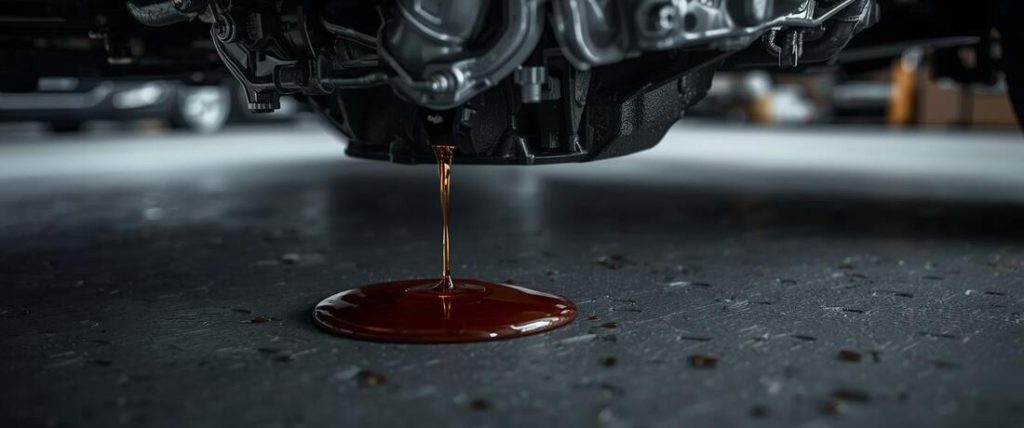
Transmission fluid is typically bright red and slightly sweet-smelling. If you see a puddle under your car — especially near the center or front — that’s a transmission leak.
As the fluid drops, internal components grind against each other. This leads to rapid damage.
| Fluid Color | What It Means |
|---|---|
| Bright red | Healthy fluid |
| Dark red / brown | Aging, needs change |
| Black / burnt smell | Severely degraded — urgent |
6. Check Engine or Transmission Warning Light
Your car’s computer monitors transmission performance. If something goes wrong, it triggers a code and lights up the dashboard.
Don’t assume it’s a minor sensor issue. A flashing check engine light combined with shifting problems almost always points to the transmission. Get the codes read at an auto parts store — most do it free.
7. Won’t Go Into Gear
You move the shifter to Drive or Reverse and the car doesn’t respond. This can happen gradually or all at once.
Common causes include low fluid, a faulty shift solenoid, or a broken linkage. In worst cases, it means complete internal failure.
8. Shaking or Vibrating While Driving
Vibration that gets worse as you accelerate — especially through gear changes — often points to transmission trouble. It can also be a U-joint or driveshaft, but the transmission should be ruled out first.
9. Dragging Clutch (Manual Transmissions)
On a manual, a dragging clutch means the clutch disc isn’t fully disengaging when you press the pedal. You’ll hear grinding when trying to shift, or the car may lurch when you put it in gear.
10. Car Won’t Move at All
This is the worst-case sign. You start the car, put it in gear, press the gas — and nothing. Complete failure.
At this stage, the transmission likely needs a full rebuild or replacement.

What Causes a Blown Transmission?
Most transmission failures share a handful of root causes:
- Low or dirty fluid — the #1 cause of transmission failure
- Overheating — often from towing too much or city stop-and-go driving
- Neglected maintenance — skipping fluid changes accelerates wear
- Hard shifting habits — slamming from Reverse to Drive while still moving
- Age and high mileage — most transmissions last 150,000–200,000 miles with proper care
Understanding common car maintenance mistakes can help you avoid expensive repairs down the road.
How Much Does a Blown Transmission Cost to Fix?
Here’s a realistic breakdown:
| Repair Type | Estimated Cost |
|---|---|
| Fluid flush | $80–$250 |
| Solenoid replacement | $150–$400 |
| Rebuild (transmission) | $1,500–$3,500 |
| Replacement (new) | $3,000–$6,000 |
| Replacement (remanufactured) | $2,000–$4,000 |
Labor alone can run $500–$1,200 depending on your vehicle and shop. Always get at least two quotes.
Is It Safe to Drive With a Blown Transmission?
No. Driving with transmission problems is risky for two reasons.
First, a slipping or failed transmission means you may lose power unexpectedly — dangerous at highway speeds or in traffic.
Second, continuing to drive accelerates internal damage. A $600 solenoid fix can turn into a $4,000 rebuild within weeks if you keep driving.
Pull over safely if symptoms appear suddenly. Have the car towed if needed.
Step-by-Step: What to Do When You Spot the Symptoms
Step 1 — Check the fluid first. Pull the dipstick while the engine is warm. Look for low level, dark color, or burnt smell.
Step 2 — Don’t ignore warning lights. Get the codes read. Write them down. This gives your mechanic a head start.
Step 3 — Note when symptoms occur. Does it slip in first gear only? Only when cold? This helps diagnose the problem faster.
Step 4 — Stop driving if symptoms are severe. Slipping, no movement, or burning smell = stop immediately.
Step 5 — Get a professional diagnosis. A transmission shop (not just a general mechanic) will give you the most accurate assessment.
Step 6 — Compare rebuild vs. replace. For high-mileage vehicles, replacement often makes more financial sense than a rebuild.
Step 7 — Ask about warranty. Any reputable shop should offer at least a 1-year/12,000-mile warranty on transmission work.
Common Mistakes Drivers Make
Ignoring early signs. Most drivers wait until the car won’t move. By then, a $300 fix has become a $3,500 repair.
Topping off with the wrong fluid. Not all transmission fluid is the same. Using the wrong type can damage seals and solenoids.
Skipping the second opinion. Transmission repairs are expensive. Always get at least two quotes.
Assuming it’s the engine. Many transmission symptoms — like sluggish acceleration or shaking — get misdiagnosed as engine problems. Insist on a transmission-specific check.
Driving on a known problem. Even a slow leak, if left alone, can drain the system completely within days.
Pro Tips From Mechanics
- Change your transmission fluid every 30,000–60,000 miles, even if your manual says “lifetime fluid.” Most mechanics disagree with that label.
- Never shift from Reverse to Drive while the car is still moving. This causes serious wear on the bands and clutch packs.
- Use a transmission cooler if you tow regularly. Overheating is the silent killer of transmissions.
- Keep a fluid check in your monthly routine. It takes 60 seconds and can prevent a $3,000 bill.
- If the car is under 100,000 miles and the fluid is healthy, a solenoid or sensor fix may be all you need.
For more expert-level car advice, check out the latest guides at TheCarbuzz.com.
FAQs About Symptoms of a Blown Transmission
Q1: Can I drive my car if the transmission is slipping?
No. A slipping transmission is unpredictable and dangerous. It can slip at the worst moment — during a merge or highway overtake. Have it inspected immediately.
Q2: How do I know if it’s the transmission or engine causing rough driving?
Engine problems usually show up as misfires, rough idle, or poor fuel economy. Transmission problems are most obvious during gear changes — slipping, clunking, delayed response, or no movement. A scan tool reading codes will usually tell you which system triggered the fault.
Q3: How long does a transmission last?
With proper maintenance, most automatic transmissions last 150,000–200,000 miles. Manual transmissions can last even longer. Neglected fluid and overheating cut that life dramatically.
Q4: What does transmission fluid look like when it’s bad?
Fresh fluid is bright red and slightly sweet. Old or burnt fluid turns dark brown or black and smells burnt. If yours looks or smells like that, change it immediately.
Q5: Is a transmission rebuild worth it?
It depends on the age and value of your vehicle. If the car is worth more than the repair cost and has low-to-moderate mileage, a rebuild makes sense. For older, high-mileage vehicles, a remanufactured replacement often offers better value.
Q6: What’s the difference between a slipping transmission and a bad clutch?
On automatics, slipping is a transmission issue — the clutch packs or solenoids are worn. On manuals, a slipping clutch is a separate component (the clutch disc and pressure plate), which is usually cheaper to fix than a transmission rebuild.
Quick Summary
- Slipping gears, rough shifts, and strange noises are the earliest and most common symptoms
- Burning smell and red fluid puddles signal urgent fluid problems
- A check engine light combined with shifting issues almost always means transmission trouble
- Driving on a failing transmission turns small fixes into major ones
- Costs range from $80 for a fluid flush to $6,000 for a full replacement
- Always get a second quote and ask for a warranty on any transmission repair
- Catching problems early can save you $2,000–$4,000