
This article was updated in June 19, 2026 with new products and information by Mark S. Taylor
If you’ve replaced your battery twice in the last year and you’re still ending up stranded, the battery is probably not the problem. The voltage regulator is worth looking at before you buy a third one.
A failing voltage regulator sits in the middle of your car’s entire electrical system. When it starts to go, nothing works the way it should — lights flicker, gauges jump, the battery dies, the engine stumbles. The frustrating part is that most of these symptoms point to three or four different parts at first glance, and it’s easy to replace the wrong one.
This article walks you through what the voltage regulator actually does, the two distinct ways it can fail, the seven symptoms each failure produces, and a simple multimeter test you can run in your driveway before calling a shop.

Contents
- 1 What Does a Voltage Regulator Do?
- 2 Two Ways a Voltage Regulator Fails — Read This First
- 3 The 7 Symptoms of a Bad Voltage Regulator
- 3.1 1. Battery Keeps Dying After Replacement
- 3.2 2. Headlights or Dash Lights Flickering — or Getting Briefly Brighter
- 3.3 3. Gauges Behaving Erratically
- 3.4 4. Battery Warning Light — Even If the Battery Tested Fine
- 3.5 5. Engine Sputtering, Rough Idle, or Stalling
- 3.6 6. Battery Is Swollen, Leaking, or Running Hot
- 3.7 7. Burning Smell or Scorched Wiring Near the Alternator
- 4 Is It the Voltage Regulator, the Alternator, or the Battery?
- 5 How to Test Your Voltage Regulator at Home
- 6 Can You Drive with a Bad Voltage Regulator?
- 7 Voltage Regulator Replacement Cost in 2026
- 8 FAQs About Bad Voltage Regulator Symptoms
- 8.1 Q: Can a bad voltage regulator kill a new battery?
- 8.2 Q: Is the voltage regulator the same thing as the alternator?
- 8.3 Q: How do I know if it’s the voltage regulator or the alternator itself?
- 8.4 Q: What voltage should my car read with the engine running?
- 8.5 Q: Can a bad voltage regulator cause a check engine light?
- 9 The Bottom Line from the Shop Garage
What Does a Voltage Regulator Do?
Your car runs on 12-volt electrical power. The alternator generates that power while the engine runs — but the raw output from an alternator isn’t clean or stable. It fluctuates with engine speed, electrical load, and temperature. The voltage regulator’s job is to take that variable output and hold it steady, typically between 13.5 and 14.5 volts, so everything from your fuel injectors to your headlights gets consistent power.
Think of it as a throttle for electricity. Too little voltage and your battery doesn’t charge. Too much and you start cooking sensitive electronics.
Here’s what most drivers don’t know: on any vehicle built roughly since the mid-1990s, the voltage regulator is not a separate part you can pull out and replace on its own. It’s built directly into the alternator housing. When the regulator fails, the repair your mechanic quotes — a new alternator — is the voltage regulator repair. The two are the same job on modern vehicles.
Older vehicles, particularly Fords, GMs, and Chryslers built before the mid-1990s, used an external regulator mounted on the fender well or firewall. Those can be replaced independently, and the repair is significantly cheaper.

Two Ways a Voltage Regulator Fails — Read This First
Most articles list voltage regulator symptoms as one group. That’s not wrong, but it’s not the full picture either.
A voltage regulator fails in one of two directions. It either stops limiting the alternator’s output and lets voltage run too high — that’s an overcharging failure. Or it stops commanding enough output and voltage runs too low — that’s an undercharging failure. The symptoms, the damage, and the urgency level are different depending on which direction it goes.
| Overcharging Failure | Undercharging Failure | |
|---|---|---|
| Voltage reading | Above 14.7V, sometimes 16V+ | Below 13.5V |
| Battery effect | Swells, leaks acid, overheats, fails fast | Sulfation, chronic drain, won’t hold charge |
| Light behavior | Briefly brighter, then burning out | Dimming and flickering |
| Urgency | High — park it soon | Moderate — you have a window |
| Expensive risk | ECM/PCM module damage | Repeated battery replacement |
| Most common in | Regulators that fail internally | Older regulators, worn brushes |
Overcharging is the one to take seriously immediately. Sustained voltage above 15V boils battery electrolyte, shortens the life of every bulb and LED on the car, and can push enough current into electronic control modules to damage them permanently. An ECM replacement on a modern vehicle can run $800–$2,000. That dwarfs the cost of the alternator that caused it.
Undercharging is more common, more gradual, and easier to catch before serious damage occurs — but it’s also the one that keeps sending people back to the parts store for another battery.

The 7 Symptoms of a Bad Voltage Regulator
1. Battery Keeps Dying After Replacement
This is the most common real-world presentation, and it’s the one that sends the most people down the wrong diagnostic path. You get a jump start, the car runs fine, you drive to the parts store, they test the battery and it passes — but three days later it’s dead again.
That parts store test is a snapshot taken when the battery is warm and freshly charged from the drive over. It doesn’t tell you whether the charging system is maintaining voltage while the engine runs. If the voltage regulator is undercharging, your battery never fully recovers between drives. You keep buying batteries for a problem that lives in the alternator.
If you’ve replaced a battery and it died again within 60 days, test the charging system before you replace it again.
2. Headlights or Dash Lights Flickering — or Getting Briefly Brighter
Flickering lights are the most visually obvious symptom and the one most drivers notice first. But there’s a detail worth knowing: the direction of the flicker tells you something about the failure mode.
Undercharging produces simple dimming — lights that fade and flicker as voltage drops. Overcharging produces a different pattern. Lights briefly get noticeably brighter before the symptom manifests — that momentary surge before the bulbs start burning out is a tell. If your headlights seem unusually bright right before they start giving you trouble, overcharging is more likely.
Either way, flickering lights on a car with no known wiring issues mean the charging system needs to be checked the same day.
3. Gauges Behaving Erratically
Your instrument cluster — speedometer, tachometer, fuel gauge, temperature gauge — is powered and controlled through the body control module (BCM). The BCM runs on stable voltage. When voltage fluctuates outside its operating tolerance, the BCM can’t read sensor inputs correctly and the gauges respond by jumping, dropping, or pegging at zero or full.
Drivers often chase this symptom by replacing gauge cluster bulbs or suspecting a bad sensor. It’s almost never the gauge itself. If multiple gauges are acting up simultaneously, that’s a voltage problem — not a cluster problem.
4. Battery Warning Light — Even If the Battery Tested Fine
The battery light (or charging system light on some vehicles) illuminates when voltage drops below a set threshold the ECM is programmed to monitor. That threshold is typically around 12.5–13V. When the regulator is undercharging, the system trips this warning.
Here’s where drivers get confused: they see the battery light, go to the parts store, the battery tests fine, they assume the light is wrong and ignore it. The battery light doesn’t mean the battery is bad. It means the charging system isn’t maintaining adequate voltage. Those are different problems.
On some modern vehicles with full charging system monitoring, voltage spikes from overcharging will also trigger the check engine light — sometimes alongside the battery light, sometimes instead of it.
5. Engine Sputtering, Rough Idle, or Stalling
This one surprises most drivers. The voltage regulator is an electrical component — what does it have to do with how the engine runs?
Modern engines rely on a web of sensors, actuators, and solenoids that all need stable voltage to function correctly. Fuel injectors fire at precise intervals timed by the ECM. If voltage is unstable, the ECM’s timing gets disrupted, fuel delivery becomes erratic, and the engine runs rough. Misfires and hesitation under acceleration can both trace back to a charging system problem.
If your car is sputtering and misfiring and the coils, plugs, and fuel system have already been checked, add a charging system test to the list before spending more money.
6. Battery Is Swollen, Leaking, or Running Hot
This is a late-stage overcharging symptom. You shouldn’t be seeing this unless the regulator has been failing high for a while. A battery under sustained overvoltage gets hot internally, the electrolyte boils, gases build up inside the case, and the casing starts to swell or deform. In severe cases the electrolyte leaks out and you’ll smell sulfur near the battery.
If your battery is physically swollen, replace it — but understand that putting a fresh battery into a system that’s still overcharging will destroy the new one in the same way. The regulator has to be fixed first.
7. Burning Smell or Scorched Wiring Near the Alternator
At voltages above 15–16V, you’re no longer looking at gradual component degradation. You’re looking at active electrical damage in real time. Components are drawing more current than they’re rated for. Insulation on wiring starts to break down. You may smell burning plastic or rubber near the alternator or battery area.
This is a pull-over-and-park-it symptom. Not a “drive it to the shop this week” symptom. If you smell burning electrical smell with the engine running, turn it off and call for a tow.
Is It the Voltage Regulator, the Alternator, or the Battery?
All three of these parts produce overlapping symptoms. A bad battery can cause hard starts and dim lights. A failing alternator can cause all the same symptoms as a bad regulator — because on most modern vehicles, the regulator is inside the alternator. And a bad regulator can kill a good battery and make the whole system look like it’s failing.
Here’s how to separate them:
| Symptom Pattern | Most Likely Cause | Test to Confirm |
|---|---|---|
| Car won’t start, battery tests below 12V | Dead/weak battery | Load test at parts store |
| Battery tests good, still won’t hold charge | Charging system (regulator/alternator) | Multimeter with engine running |
| Voltage above 14.7V with engine running | Regulator overcharging | Multimeter at 2,000 RPM |
| Voltage below 13.5V with engine running | Regulator undercharging or weak alternator | Multimeter + load test |
| Intermittent symptoms, passes parts store test | Failing regulator (intermittent) | Multimeter test under electrical load |
Parts stores test batteries and alternators for free. Those tests are useful — but they’re pass/fail at a single moment. A voltage regulator that fails intermittently or only under load can pass a static bench test and still be the problem. The multimeter test below is more likely to catch it.
How to Test Your Voltage Regulator at Home
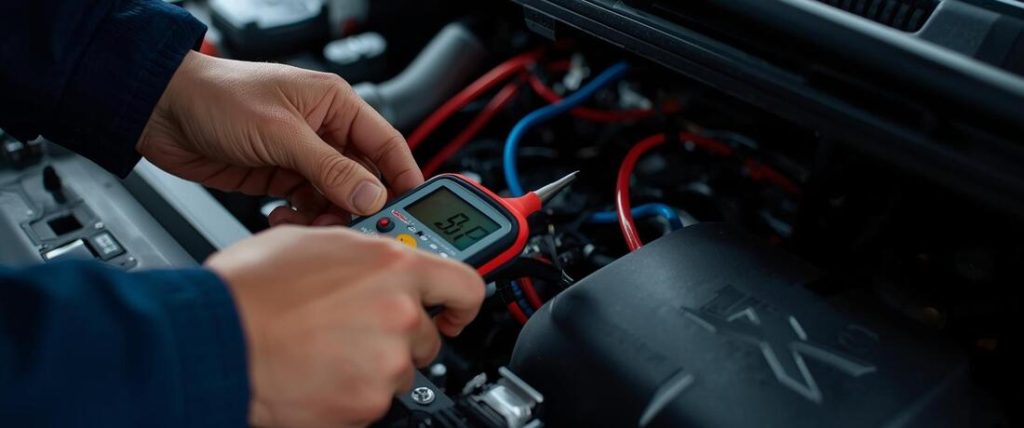
You need one tool: a digital multimeter. They’re available at any auto parts store or hardware store for $20–$30. You’re measuring DC voltage at the battery terminals under different engine conditions to see whether the charging system is holding voltage in the normal range.
Step 1 — Test the resting battery voltage
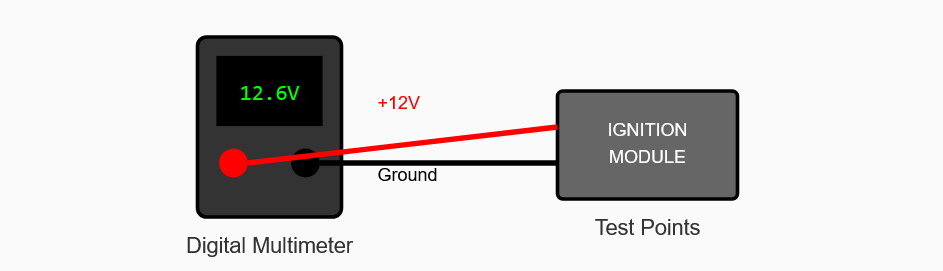
With the engine off and all accessories off, set your multimeter to DC voltage (the 20V range). Touch the red probe to the positive battery terminal and the black probe to the negative terminal. A healthy, fully charged battery reads 12.4–12.8V. If it reads below 12.2V, charge the battery first — a depleted battery will skew the results.
Step 2 — Start the engine and test at idle
Start the engine and leave all accessories off. Keep the probes in place and read the voltage. A healthy charging system at idle reads 13.5–14.5V. Below 13.5V suggests undercharging. Above 14.7V suggests overcharging.
Step 3 — Rev to 2,000 RPM and retest
Have a helper hold the engine at roughly 2,000 RPM while you read the multimeter. Voltage should remain stable in the 13.5–14.5V range. If it climbs above 14.7V as RPM increases, the regulator is likely failing to limit output. If it drops below 13.5V, it’s not commanding enough.
Step 4 — Run the load test
With the engine still at 2,000 RPM, turn on the headlights, heater fan on high, and rear defroster. Read the voltage again. Under this electrical load, voltage should still hold at or above 13.5V. A reading that drops sharply under load confirms the regulator and alternator aren’t keeping up with demand.
Step 5 — Evaluate your readings
Consistent readings of 13.5–14.5V across all three tests = charging system is healthy.
Readings above 14.7V = overcharging, regulator is failing high.
Readings below 13.5V, especially under load = undercharging, regulator or alternator issue.
Fluctuating readings that won’t stabilize = intermittent regulator failure.
If the test confirms a problem, the next step is a shop — not a parts store battery replacement.
Can You Drive with a Bad Voltage Regulator?
The answer depends on which failure mode you’re dealing with.
Undercharging: You have a limited window. The battery is slowly draining and not recovering between drives. Most drivers get a few days before the car won’t start at all. You can usually drive it carefully to a shop — but don’t let it sit overnight if you need to start it tomorrow morning.
Overcharging: Don’t push it. Continued driving while overcharging damages the battery, burns out LED lighting, and risks frying the ECM or other control modules. A replacement ECM on a late-model vehicle costs several times what the alternator costs. If your multimeter reads above 14.7V consistently, or if you can smell burning electrical smell with the engine running — park it and arrange a tow.
The one scenario where you absolutely stop driving is a burning smell, a swollen battery, or voltage readings above 16V. That’s not a “limp to the shop” situation. That’s a tow.
Voltage Regulator Replacement Cost in 2026
Before you call a shop, understand what you’re actually paying for.
On any modern vehicle — built roughly since the mid-1990s — there is no “just the voltage regulator” repair. The regulator is inside the alternator. Replacing it means replacing or rebuilding the alternator. Any quote you receive for a new or remanufactured alternator is the voltage regulator repair.
| Repair Scenario | Parts Cost | Labor | Total Estimate |
|---|---|---|---|
| External regulator only (pre-1995 vehicles) | $35–$80 | $150–$250 (1–2 hrs) | $185–$330 |
| Full alternator replacement — domestic/Japanese | $150–$400 | $200–$400 (2–3 hrs) | $350–$800 |
| Full alternator replacement — European or tight engine bay | $250–$600 | $300–$500 (3–4 hrs) | $550–$1,100 |
| Remanufactured alternator (budget option) | $100–$250 | $200–$400 | $300–$650 |
| Alternator rebuild (specialty shop) | $100–$200 (parts) | $150–$250 | $250–$450 |
A few things worth knowing before you approve the repair:
OEM alternators cost more but come pre-calibrated for your vehicle’s specific charging demands. On vehicles with smart charging systems — where the ECM actively manages alternator output — an off-brand unit can cause software compatibility issues. On standard domestic and Japanese vehicles, a quality aftermarket unit from Denso, Bosch, or ACDelco is a reasonable choice.
Remanufactured alternators carry a core charge — typically $30–$75 — that you get back when you return the old unit. Factor that into the total when comparing quotes.
If the battery was damaged by overcharging, factor in battery replacement too. An AGM battery runs $150–$300 depending on the vehicle. Replacing the alternator without replacing an overcharged AGM battery means starting the new alternator’s life with a compromised load on it.
FAQs About Bad Voltage Regulator Symptoms
Q: Can a bad voltage regulator kill a new battery?
Yes, and it does so regularly. An overcharging regulator pushes voltage above what the battery is designed to handle — AGM batteries are especially sensitive, with damage occurring above 14.7V sustained. The electrolyte boils, internal plates degrade, and the battery fails prematurely. A driver who buys three batteries in two years for the “same car” is often dealing with a regulator that nobody checked. Undercharging kills batteries differently — through sulfation, a gradual buildup of lead sulfate crystals on the battery plates that permanently reduces capacity.
Q: Is the voltage regulator the same thing as the alternator?
On most vehicles built since the mid-1990s, the voltage regulator is integrated inside the alternator. They’re not the same component, but they’re in the same housing and replaced together. On older vehicles — particularly pre-1995 Fords, GMs, and Chryslers — the regulator was external and could be replaced independently. If your mechanic quotes an alternator replacement for a voltage regulator problem on a modern car, that’s correct — not an upsell.
Q: How do I know if it’s the voltage regulator or the alternator itself?
On most modern vehicles, this distinction doesn’t matter practically — because the regulator is inside the alternator. If the charging system isn’t functioning correctly and the battery has been ruled out, the alternator assembly (which includes the regulator) is the repair. On older vehicles with external regulators, a mechanic can test the alternator output directly to determine whether the alternator’s diodes or windings are the issue versus the external regulator.
Q: What voltage should my car read with the engine running?
A healthy charging system reads 13.5–14.5V at the battery terminals with the engine running. Below 13.5V indicates undercharging. Above 14.7V indicates overcharging. These readings should remain stable at idle and at 2,000 RPM, and should hold above 13.5V even with headlights, heater, and rear defroster running simultaneously.
Q: Can a bad voltage regulator cause a check engine light?
Yes. On modern vehicles with comprehensive charging system monitoring, a voltage regulator that’s undercharging will trigger the battery or charging system warning light. Overcharging can trigger the check engine light — sometimes with a code related to the charging system voltage (P0562, P0563, or similar, depending on the make). Multiple warning lights illuminating simultaneously during normal driving is often a voltage stability problem, not multiple independent failures.
The Bottom Line from the Shop Garage
A bad voltage regulator is a master of disguise—it mimics battery failures and sensor glitches until it slowly drains your bank account one battery at a time. Run the 10-minute multimeter check before purchasing any parts. If the reading sits outside the safe 13.5V to 14.5V limits, schedule an alternator swap before a major voltage spike fries your vehicle’s expensive primary computer core.
(Want to ensure your vehicle’s secondary engine sensors, ignition blocks, and dashboard networks are running flawlessly? Read our complete technical guide on How to Read Check Engine Light Codes Without a Scanner or check out The Car Buzz Official Testing and Editorial Integrity Guidelines).