
This article was updated in May 14, 2026 with new products and information by Mark S. Taylor
Your car needs electricity to run. Not just to start — though that’s the moment you notice it most — but to power every light, sensor, fuel injector, and dashboard gauge while you drive. The charging system is what keeps that electricity flowing. It converts mechanical energy from the running engine into electrical energy, recharges your battery, and prevents every electrical component from burning out.
If you’ve ever wondered why your battery doesn’t die after the first start, or why your headlights get brighter when you rev the engine, the charging system is the answer. This guide breaks down how the charging system works — from the alternator spinning under your hood to the voltage regulator keeping everything in check.

Contents
- 1 What Does the Charging System Actually Do?
- 2 The Three Players: Battery, Alternator, and Voltage Regulator
- 3 Inside the Alternator: Where Mechanical Becomes Electrical
- 4 The Voltage Regulator: Why 14.2 Volts Is the Magic Number
- 5 Modern Smart Charging: When the Computer Takes Over
- 6 Warning Signs Your Charging System Is Failing
- 7 Battery vs. Alternator vs. Starter: Know the Difference
- 8 Can You Test the Charging System Yourself?
- 9 How Much Does Charging System Repair Cost?
- 10 FAQs About How the charging system works
- 11 The Bottom Line
What Does the Charging System Actually Do?
The charging system has two jobs: recharge the battery after starting, and supply electricity to every electrical component while the engine runs.
Think of it like a fuel system. The battery is your gas tank — it stores energy. The alternator is the gas pump bolted to your engine — it constantly refills the tank while you drive. The voltage regulator is the shut-off valve — it makes sure the tank never overfills and the pump never overwhelms the system.
Without the alternator, your battery would drain in minutes. Without the regulator, your battery would overcharge, boil over, and damage every sensitive electronic component in the car. Without the battery, you couldn’t start the car in the first place. All three parts depend on each other.
The Three Players: Battery, Alternator, and Voltage Regulator
The Battery: The Electrical Gas Tank
Your battery stores chemical energy and converts it to electrical energy on demand. A fully charged 12-volt battery actually rests at about 12.6 volts. It delivers a massive burst of current — 200 to 1,000 amps — to spin the starter motor and fire the ignition system during startup.
Once the engine is running, the battery switches to backup mode. It smooths out voltage spikes, supplies extra current during high-demand moments (like when the cooling fan kicks on), and provides power when the alternator can’t keep up.
Batteries are rated by cold cranking amps (CCA) — how much starting power they deliver in cold weather — and reserve capacity — how long they can power the car if the alternator fails.
The Alternator: The Onboard Generator
The alternator is a belt-driven generator that converts mechanical rotation into electrical current. It mounts to the engine and spins at roughly two to three times engine speed via a pulley and drive belt — usually the serpentine belt.
Inside, the alternator uses electromagnetic induction to generate power. A spinning electromagnet (the rotor) creates a changing magnetic field inside stationary wire coils (the stator). That changing field induces an electrical current in the stator windings. The faster the rotor spins, the more current is generated.
The catch? The electricity generated is alternating current (AC) — it flows back and forth. Your car’s battery and electronics need direct current (DC) — one-way flow. So the alternator passes the AC through a rectifier — a set of diodes that act as one-way valves — converting it to DC before it reaches the battery.
The Voltage Regulator: The Traffic Cop
The voltage regulator controls how much power the alternator produces. It does this by varying the electrical current sent to the rotor’s field winding. More current to the field winding creates a stronger magnetic field, which makes the alternator produce more output. Less current weakens the field and reduces output.
The regulator monitors system voltage constantly. When voltage drops — say, when you turn on the headlights — it increases field current and the alternator makes more power. When voltage rises too high, it cuts back. This happens hundreds or thousands of times per second, keeping system voltage steady.
Inside the Alternator: Where Mechanical Becomes Electrical
The Rotor: An Electromagnet That Spins
The rotor is a cylindrical assembly with copper wire windings around an iron core. When current flows through these windings, the rotor becomes an electromagnet with distinct north and south poles. Finger pole pieces extend from each end, creating multiple magnetic poles that alternate as the rotor spins.
Current reaches the rotor through two slip rings — copper bands on the rotor shaft — and carbon brushes that ride against them. This is the only physical electrical connection to the spinning rotor. When the brushes wear down, alternator output drops and the warning light may flicker.
The Stator: Stationary Coils That Generate Power
The stator surrounds the rotor like a sleeve. It contains three sets of wire windings arranged in a Y-pattern or delta-pattern. As the rotor’s magnetic field sweeps past these windings, it induces alternating current in each phase.
The three-phase design produces smoother, more consistent power than a single winding would. It also allows the rectifier to convert AC to DC more efficiently.
The Rectifier: Turning AC Into DC
The rectifier is a bridge of six diodes — electronic one-way valves — mounted on a heat sink. Each AC phase from the stator passes through two diodes. The diodes flip the negative half of each AC wave into positive territory, producing a pulsing DC output.
A diode trio — three smaller diodes — taps a small amount of this rectified current and feeds it back to the rotor’s field winding. This creates a self-sustaining loop: once the alternator starts producing power, it uses some of that power to excite its own electromagnet. That’s why an alternator needs a small initial current from the battery to get started — but once spinning, it powers itself.
The Pulley and Belt: The Mechanical Connection
The alternator pulley is driven by a rubber belt — either a dedicated V-belt on older cars or the serpentine belt on modern vehicles. A spring-loaded automatic tensioner keeps the belt tight. If the belt slips due to wear, contamination, or weak tension, the alternator slows down and output drops.
At idle, the alternator may produce only 30–40% of its rated output. At highway speeds, it reaches full capacity. That’s why your headlights may dim slightly at a stoplight but brighten when you accelerate.
The Voltage Regulator: Why 14.2 Volts Is the Magic Number
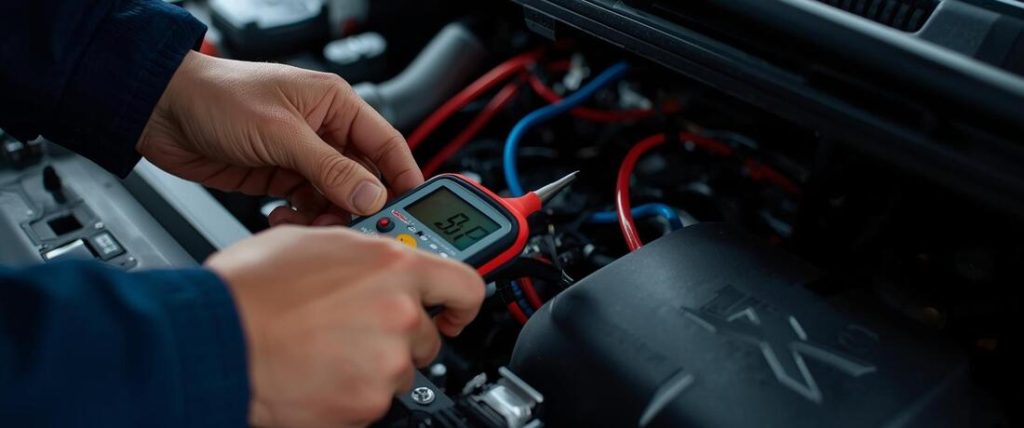
A fully charged 12-volt battery produces about 12.6 volts on its own. To push electrical current into the battery — to charge it — the charging system must produce a higher voltage than the battery already has. That’s why the regulator targets roughly 14.0 to 14.6 volts, with 14.2 volts considered ideal for most conditions.
At 14.2 volts, enough current flows through the battery to maintain a full charge without overheating the electrolyte or boiling off water. Go much higher — above 15 volts — and the battery overcharges, producing corrosive gases and potentially warping the plates. Go too low — below 13.5 volts — and the battery never fully charges, leading to sulfation and shortened life.
Modern electronic voltage regulators use transistors to switch field current on and off at high speed — up to 2,000 times per second. By varying the duty cycle (the percentage of time the field is energized), the regulator fine-tunes alternator output with precision no mechanical system could match.
Older mechanical regulators used relays and contact points that physically opened and closed. They worked but wore out, required adjustment, and responded slowly compared to transistor units.
Temperature Compensation
Battery chemistry changes with temperature. A cold battery accepts charge more slowly and can tolerate slightly higher voltage. A hot battery charges faster but needs lower voltage to prevent overcharging. Quality regulators — especially OEM units — include temperature sensors that adjust the target voltage based on battery temperature. This is why some manufacturers specify slightly different charging voltages for extreme climates.
Modern Smart Charging: When the Computer Takes Over
Since the mid-2010s, many vehicles have switched to computer-controlled charging systems. The engine control module (ECM) or body control module (BCM) communicates directly with the alternator, commanding specific output levels based on real-time conditions.
Why the complexity? Fuel economy. An alternator creates drag on the engine — roughly 1/3 horsepower at light load, but 3 to 4 horsepower at full output. By reducing alternator load during acceleration and increasing it during deceleration, the ECM saves fuel. Some systems even use regenerative braking — the alternator ramps up output during deceleration to recapture energy, similar to hybrid vehicles.
These systems also monitor battery state-of-charge more precisely. A battery current sensor measures amperage in and out of the battery. The ECM knows exactly how charged the battery is and adjusts alternator output accordingly. When you install a new battery in these vehicles, the ECM often needs a reset to relearn the new battery’s characteristics.

Warning Signs Your Charging System Is Failing
Charging system problems announce themselves clearly if you know what to watch for.
Battery Warning Light On Dashboard
The battery-shaped warning light doesn’t monitor the battery directly — it monitors system voltage. If voltage drops too low (below ~12.5V) or spikes too high (above ~15.5V), the light comes on. A flickering light often indicates an intermittent alternator or regulator problem.
Dim or Flickering Headlights
Headlights that brighten when you rev the engine and dim at idle suggest weak alternator output. In extreme cases, lights may pulse rhythmically as the voltage regulator struggles to maintain steady output.
Repeated Dead Batteries
If you’ve replaced your battery twice in two years, the battery probably isn’t the problem. A failing alternator that undercharges will kill every new battery you install. Test the charging system before buying another battery.
Car Starts Then Dies
If the car starts normally but stalls within minutes — especially with headlights or A/C on — the alternator isn’t taking over after startup. The engine runs on battery power until the battery is drained, then dies.
Overcharging Symptoms
A voltage regulator stuck in “full output” mode causes overcharging. Signs include:
- Battery case swelling or bulging
- Battery terminals corroding rapidly
- Headlight bulbs burning out frequently
- A strong sulfur (rotten egg) smell from the battery
- Voltage readings above 15 volts with the engine running
Overcharging destroys batteries and can damage sensitive electronics. Stop driving immediately if you suspect overcharging.
Belt Squeal and Burning Smell
A slipping alternator belt squeals loudly, especially under load (turning the steering wheel or switching on the A/C). A seized alternator bearing can cause the belt to smoke and even break. If you smell burning rubber and see smoke from the engine bay, shut off the engine immediately.
Strange Noises
A failing alternator bearing produces a grinding or whining noise that changes with engine speed. A rough bearing can eventually seize, destroying the belt and potentially leaving you stranded.

Battery vs. Alternator vs. Starter: Know the Difference
These three components work together but fail differently. Knowing which is which saves you from replacing the wrong part.
Table
| Symptom | Likely Culprit | Why |
|---|---|---|
| Slow crank, dim dash, starts with a jump | Battery | Battery can’t deliver enough current to spin the starter |
| Starts fine, then dies while driving; dim lights | Alternator | Alternator isn’t recharging the battery; car runs on battery until drained |
| Bright dash, single click, engine won’t turn | Starter | Battery and alternator are fine; starter solenoid or motor has failed |
| Starts with jump, runs fine, restarts later | Weak battery | Battery holds some charge but can’t start cold; alternator works |
| Starts with jump, dies shortly after | Alternator | Battery is dead; jump provides enough to start, but alternator can’t sustain |
The jump-start test: If your car starts with a jump and runs fine, the alternator is likely working. If it starts with a jump but dies within minutes, the alternator is likely bad.
Can You Test the Charging System Yourself?
You can perform basic charging system tests with an inexpensive digital multimeter. Here’s how:
Test 1: Resting Battery Voltage (Engine Off)
- Set multimeter to DC volts
- Connect red probe to positive terminal, black to negative
- A fully charged battery reads 12.6V. At 12.4V, it’s 75% charged. Below 12.0V, it’s deeply discharged.
Test 2: Charging Voltage (Engine Running)
- Start the engine and let it idle
- Voltage at the battery should read 13.5V to 14.5V
- Rev the engine to 2,000 RPM. Voltage should stay steady, typically 13.8V to 14.4V
- Turn on headlights, rear defroster, and blower fan. Voltage should remain above 13.5V
Test 3: Load Test
- With engine running and accessories on, voltage should not drop below 13.0V
- If voltage falls to 12.5V or lower under load, the alternator is weak or failing
When to see a professional: If readings are erratic, if voltage exceeds 15V, or if the battery light is on despite normal readings, you need professional diagnosis. Intermittent faults, wiring issues, and smart charging system problems require scan tools and expertise.

How Much Does Charging System Repair Cost?
Table
| Service | DIY Cost | Professional Cost |
|---|---|---|
| Battery replacement | $100–$250 | $150–$300 |
| Alternator replacement | $150–$400 (part) | $300–$800 (with labor) |
| Voltage regulator (external) | $50–$150 | $100–$250 |
| Serpentine belt replacement | $25–$75 | $75–$200 |
| Full charging system test | N/A | $50–$100 |
Costs vary by vehicle. A common four-cylinder commuter car uses a $150 alternator. A luxury V8 with a water-cooled, computer-controlled alternator can cost $600 or more for the part alone. Labor rates range from $80/hour at independent shops to $150+/hour at dealerships.
Money-saving tip: Many auto parts stores offer free charging system testing. If your battery is under warranty, test it before replacing anything else. A bad alternator can destroy a new battery, so always test the full system.
FAQs About How the charging system works
What does the charging system do?
The charging system recharges the battery after starting and powers all electrical components while the engine runs. It consists of the battery, alternator, and voltage regulator working together.
How does an alternator work?
An alternator converts mechanical energy from the engine into electrical energy. A spinning electromagnet (rotor) induces current in stationary wire coils (stator). The current is converted from AC to DC by diodes (the rectifier) before reaching the battery.
What is the difference between AC and DC in a charging system?
The alternator generates alternating current (AC) — electricity that flows back and forth. The rectifier converts this to direct current (DC) — one-way flow — which is what the battery and car electronics require.
What does a voltage regulator do?
The voltage regulator controls alternator output by varying current to the rotor’s field winding. It maintains system voltage between 13.5 and 14.5 volts, preventing both undercharging and overcharging.
Why is my battery light on?
The battery light indicates abnormal system voltage — either too low (failing alternator) or too high (faulty regulator). It does not mean the battery itself is bad, though a bad battery can trigger it indirectly.
The Bottom Line
Your charging system is the unsung electrical backbone of your vehicle. The alternator generates power, the battery stores it, and the voltage regulator keeps everything balanced. When any of these three components fails, the symptoms are unmistakable — if you know what to look for.
Modern systems have grown more complex with computer-controlled smart charging, but the fundamentals haven’t changed. Mechanical rotation becomes electrical current. AC becomes DC. Voltage stays steady. And your car keeps running.
If you notice dim lights, a battery warning light, or repeated dead batteries, test the system with a multimeter before replacing parts. A $20 meter and five minutes of testing can save you from buying a battery you don’t need — or missing an alternator problem that will strand you.
Quick Summary:
- The charging system recharges the battery and powers electrical components while driving
- Three main parts: battery (storage), alternator (generation), voltage regulator (control)
- The alternator uses electromagnetic induction to generate AC, then rectifies it to DC
- Voltage regulators maintain 13.5–14.5V; 14.2V is ideal for most conditions
- Modern smart charging systems use the ECM to improve fuel economy
- Warning signs: battery light, dim lights, dead batteries, stalling, overcharging symptoms
- DIY testing: multimeter readings of 12.6V (resting) and 13.5–14.5V (running)
- Alternator replacement: $300–$800; battery: $100–$300; belt: $75–$200
If your battery light comes on, don’t ignore it. The charging system rarely fails without warning, and early attention turns a $300 alternator replacement into a story instead of a $1,000 tow and repair bill.