
This article was updated in July 22, 2026 with new products and information by Mark S. Taylor
Your dashboard lit up with a red triangle, maybe a “check hybrid system” message, and a scan came back with a hybrid battery isolation fault — often code P0AA6. It sounds frightening, and it does deserve your attention. But here’s the honest version before you spiral: an isolation fault means your hybrid’s high-voltage system may be leaking electricity to the car’s body, which is a safety-related fault worth fixing promptly — but it does not automatically mean you need a new battery pack.
Plenty of these faults trace back to water getting into the battery area, a rubbed-through cable, or a leaking part — repairs that cost a fraction of a battery. This guide breaks down what the fault actually means, whether it’s safe to keep driving, what causes it, how it’s properly diagnosed, and what you should realistically expect to pay.
Contents
- 1 What a Hybrid Battery Isolation Fault Actually Means
- 2 Warning Signs and Symptoms
- 3 Is It Dangerous? Can You Keep Driving?
- 4 Common Causes (It’s Not Always the Battery)
- 5 How It’s Diagnosed
- 6 Why This Isn’t a DIY Job
- 7 What Problems It Causes If Ignored
- 8 Repair Cost Breakdown
- 9 How to Prevent It
- 10 FAQs About Hybrid Battery Isolation Fault (P0AA6)
- 11 Bottom Line
What a Hybrid Battery Isolation Fault Actually Means
Your hybrid runs on two separate electrical worlds. There’s the ordinary 12-volt system (lights, computers, accessories), and there’s the high-voltage system that powers the electric motor — often 200 to 400 volts or more. By design, that high-voltage system is completely isolated from the car’s metal body and the 12-volt system. Electricity is supposed to stay inside its own sealed circuit and never touch the chassis.
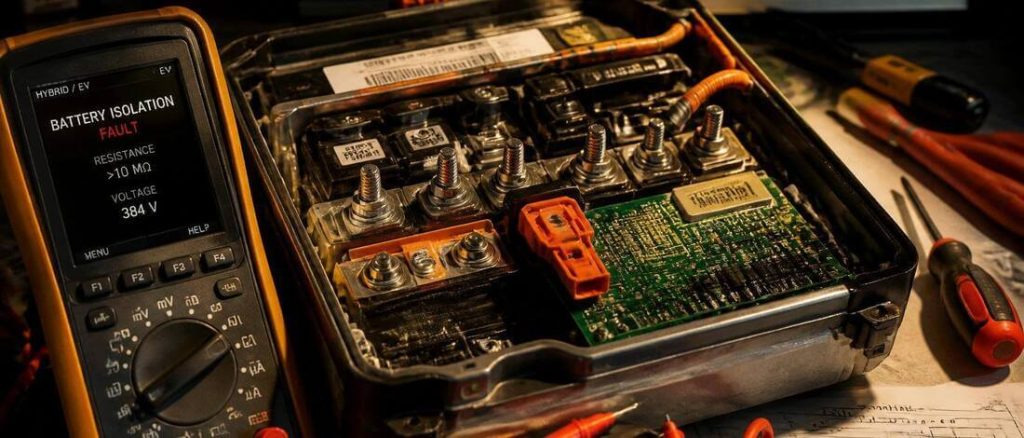
An isolation fault means that separation has broken down. The car’s monitoring system has detected that high-voltage current may be leaking toward the vehicle’s body — a path it should never take. On many vehicles this stores code P0AA6 (Hybrid Battery Voltage System Isolation Fault), and on Toyotas it’s usually paired with information code 526, followed by a second code that pinpoints where the leak is.
Think of it like a garden hose with a pinhole. Water still reaches the nozzle, but some is escaping where it shouldn’t. Your car detects that “leak” of electricity and flags it, because high voltage touching the body is a safety issue.
Warning Signs and Symptoms
Isolation faults show up in a few different ways, from barely noticeable to alarming:
Red triangle warning light — the classic “master warning” on Toyota hybrids.
“Check hybrid system” message or a similar hybrid-system warning.
The car drives normally but the light stays on. Common with minor or moisture-related faults.
Intermittent power loss. Some owners describe the car running fine for a few minutes, then cutting power and coasting to a stop, then working again after a restart.
Reduced performance or the hybrid system feeling “held back.”
The battery not charging the way it used to.
Refusal to restart. Many Toyota hybrids from 2004 on will block a restart once an isolation fault is confirmed, to keep you from driving with an active high-voltage leak.
The tricky part is the range. A steady warning light with normal driving feels minor, but it points at the same category of fault as a car that cuts power mid-drive. That’s exactly why it shouldn’t be brushed off.

Is It Dangerous? Can You Keep Driving?
This is the question that matters most, so here’s a straight answer with a clear rule.
An isolation fault is a safety-related fault because it involves high voltage potentially reaching parts of the car that should never be electrified. That said, the systems are designed with protection in mind — and unlike a 12-volt short to ground, a high-voltage short doesn’t blow fuses or start fires the same way. In many cases the car will warn you and still let you drive a short distance to get help.
Use this rule:
Steady warning light, car driving normally: You generally have a little time. Drive it straight to a hybrid specialist or dealer soon — don’t keep commuting on it for weeks.
Flashing warning lights, power loss, or the car cutting out: Stop safely and have it towed. Don’t keep driving.
After a flood, deep water, or a crash: Treat it as stop-and-tow, and don’t touch the high-voltage components — assume the system could be live.
And never open, probe, or handle the high-voltage battery, its orange cables, or connectors yourself. Those orange-sheathed components carry enough voltage to injure or kill. Leave anything hands-on to a trained technician.
Common Causes (It’s Not Always the Battery)
Here’s the part that should ease your mind a little. An isolation fault points to where high voltage is leaking, and that source is frequently something other than a failed battery pack. Common causes include:
Water or moisture intrusion. One of the most common real-world triggers. Rain, a clogged drain, or condensation reaching the battery area or the battery ECU can create a leak path. Owners often see this pop up right after heavy rain or a car wash.
Leaking or ruptured battery cells. Electrolyte escaping inside the pack can conduct current to the case. This one does point at the battery.
Chafed or damaged high-voltage cable insulation. If an orange HV cable rubs through, the exposed conductor can leak to the chassis. Often a repair, not a replacement of the whole pack.
Internal coolant leak inside the battery case. On some hybrids and EVs, coolant leaking into the pack conducts high voltage and trips the fault.
Failed system main relay / contactor. A relay not making clean contact can be read as a resistance/ground issue.
Faulty high-voltage A/C compressor. The electric A/C compressor runs on high voltage; an internal fault there can leak to ground.
Shorted traction motor or inverter fault. Less common, but a short in the motor or power electronics can set the code.
Battery management system (BMS) / battery ECU fault. Sometimes the detection electronics or a sensor is the actual problem.
So no — a P0AA6 is not an automatic death sentence for your battery. It’s a signal that something in the high-voltage system has lost its isolation, and a proper diagnosis is what tells you whether that’s a $300 cable or a battery pack.

How It’s Diagnosed
A proper isolation-fault diagnosis is methodical, and it’s worth knowing what good looks like so you’re not sold a battery on day one:
Dealer-level scan for all codes. A basic code reader may only show P0AA6. A dealer-grade tool (like Toyota’s Techstream, or a comparable professional scanner) reads the hybrid controllers and pulls the full picture, including freeze-frame data.
Get the secondary location-specific code. On Toyota, after P0AA6/526 the system runs a self-test and stores a second code that identifies which section of the high-voltage system lost isolation. Ask for it — it can save hours of diagnostic labor and points the tech straight at the culprit.
Insulation resistance test. Using a proper insulation tester (megohmmeter), the tech measures the resistance between the high-voltage system and the chassis. A reading below the manufacturer’s threshold confirms the leak and helps isolate the section.
Visual inspection. Look for water intrusion near the battery and battery ECU, corrosion, chafed orange cables, coolant inside the pack, and signs of leaking cells.
Component isolation. The tech disconnects and tests sections — battery pack, cables, A/C compressor, motor/inverter — to find which one drops the isolation reading.
The single biggest time-saver here is that secondary code. A shop that jumps to “you need a battery” without pulling it and running an insulation test hasn’t actually diagnosed your car yet.
Why This Isn’t a DIY Job
I’ll be blunt, because this one matters: a hybrid battery isolation fault is not a do-it-yourself repair. The high-voltage system carries 200–400 volts or more — enough to injure or kill. The orange cables, the battery pack, and the connectors are all live-capable, and an isolation fault specifically means voltage may already be where it shouldn’t be.
Proper diagnosis and repair require insulated high-voltage gloves, insulated tools, a manufacturer-level scan tool, an insulation resistance tester, and the training to safely de-energize the system. The only safe things an owner should do are the observational ones: note the warning lights and symptoms, check for obvious water intrusion signs from outside the battery area, and write down any codes a plug-in reader shows. Everything hands-on belongs to a qualified hybrid technician or dealer. This isn’t gatekeeping — it’s the difference between a repair bill and a hospital bill.
What Problems It Causes If Ignored
Putting off an isolation fault isn’t like ignoring a squeaky belt. Here’s what you’re risking:
Getting stranded. Intermittent faults tend to get worse. A car that coasts to a stop once will likely do it again, possibly in traffic.
The car refusing to restart. Once the fault is confirmed, many hybrids lock out a restart — potentially leaving you stuck wherever you are.
Escalating damage. A small leak from moisture or a chafed cable can worsen and take out more expensive components, turning a cheap fix into a big one.
A genuine safety risk. High voltage reaching the chassis is exactly the condition these systems are designed to prevent, and it shouldn’t be left unresolved.
Failed inspections. An active hybrid-system warning light will fail an emissions or safety inspection in many areas.
The theme: an isolation fault rarely fixes itself, and it usually gets more expensive and more inconvenient the longer it sits.
Repair Cost Breakdown
The cost swings enormously depending on the source of the leak — which is the whole reason to diagnose before you assume the worst.
| Repair | What it addresses | Typical cost |
|---|---|---|
| Professional diagnosis | Scan + secondary code + insulation test | $120–$250 |
| Moisture cleanup / drying + reseal | Water intrusion at battery area | $200–$600 |
| High-voltage cable replacement | Chafed/damaged HV cable | $300–$900 |
| System main relay / contactor | Failed relay | $400–$1,000 |
| High-voltage A/C compressor | Faulty HV compressor | $800–$2,000 |
| Hybrid battery cell / module repair | Isolated bad cells | $600–$2,500 |
| Full hybrid battery replacement | Failed/leaking pack | $2,000–$6,000+ |
Note how the bottom of that table is many times cheaper than the top. A moisture-related fault or a chafed cable can be a few hundred dollars, while a full pack is the expensive outlier. If a shop quotes a full hybrid battery before pulling the secondary code and running an insulation test, get a second opinion from a hybrid specialist. Cell/module repair is also worth asking about — it can be far cheaper than a whole new pack when only part of the battery is at fault.

How to Prevent It
You can’t prevent every isolation fault, but you can cut the odds — especially the moisture-driven ones:
Keep the battery area dry. Make sure cabin and battery vents/drains are clear, and address any water leaks into the trunk or rear seat area promptly.
Be careful with water. Avoid deep water crossings, and be cautious with pressure washers near battery vents and the rear of the cabin.
Fix leaks early. Coolant or water leaks near the battery should be handled before they reach the pack.
Address early warnings fast. A hybrid-system light caught early is often a cheaper fix than one left for months.
Service at a hybrid-competent shop. Techs who know the platform will spot chafed cables, tired seals, and moisture paths before they become faults.
FAQs About Hybrid Battery Isolation Fault (P0AA6)
Is a hybrid battery isolation fault dangerous?
It’s a safety-related fault because high voltage may be leaking toward the car’s body, so it should be fixed promptly. That said, the systems have built-in protections, and unlike a 12-volt short, a high-voltage short doesn’t blow fuses or start fires the same way. The real dangers are getting stranded and the shock risk if someone untrained handles the high-voltage components. Never touch the orange cables or battery yourself.
Can I keep driving with a P0AA6 code?
If the warning light is steady and the car drives normally, you generally have time to drive straight to a shop — but don’t keep commuting on it. If the lights flash, the car loses power or cuts out, or the fault appeared after a flood or crash, stop and have it towed.
Does an isolation fault always mean I need a new hybrid battery?
No. It often traces to water intrusion, a chafed high-voltage cable, a coolant leak, a relay, or the A/C compressor — all cheaper than a battery. Only a proper diagnosis with the secondary code and an insulation test can tell you whether the pack itself is the problem.
Why did I get this code after heavy rain?
Water intrusion is one of the most common triggers. Moisture reaching the battery area or the battery ECU can create a leak path between the high-voltage system and the chassis, setting the fault. Once it’s dried out, cleaned, and resealed, the fault often clears.
How much does it cost to fix a hybrid isolation fault?
Anywhere from a couple hundred dollars for a moisture cleanup or cable repair to $2,000–$6,000+ for a full battery replacement. Budget $120–$250 for the diagnosis that tells you which end of that range you’re in, and ask about cell/module repair as a cheaper alternative to a whole pack.
Bottom Line
Take an isolation fault seriously, but don’t panic-buy a battery. It’s a safety-related high-voltage fault that deserves a prompt, proper diagnosis — not weeks of ignoring it, and not an untrained hand anywhere near the orange cables. Get a hybrid specialist to pull the secondary location code and run an insulation resistance test. More often than you’d expect, the culprit is moisture, a cable, or a single component costing a fraction of a full pack. Let the diagnosis decide your next move.