
This article was updated in August 31, 2026 with new products and information by Mark S. Taylor
A tire pressure sensor is part of the vehicle’s Tire Pressure Monitoring System (TPMS). On vehicles using direct TPMS, sensors inside the wheel assemblies measure tire pressure and transmit that information to the vehicle. Some vehicles instead use an indirect system that estimates tire pressure through wheel-speed and other vehicle sensors.
When a TPMS sensor or its communication system develops a problem, the dashboard may display a warning light or message.
But there’s an important distinction:
A TPMS warning doesn’t automatically mean the sensor is bad.
A solid low-pressure warning usually means one or more tires are significantly underinflated. A flashing TPMS warning followed by a steady light is more consistent with a system malfunction.
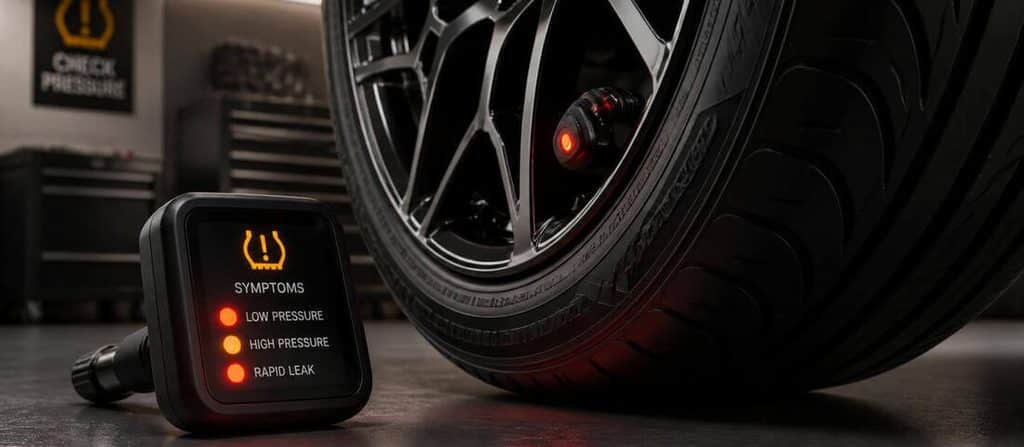
The most common tire pressure sensor symptoms include:
- TPMS warning light repeatedly returns after proper inflation
- TPMS light flashes and then remains on
- One tire’s pressure isn’t displayed
- The displayed pressure doesn’t match an accurate gauge
- One sensor stops communicating
- A TPMS warning appears after tire or wheel service
- A diagnostic scan identifies a TPMS sensor or communication fault
Before replacing a sensor, check all four tire pressures with an accurate gauge and inspect the TPMS system for stored faults.
Contents
- 1 What Is a Tire Pressure Sensor?
- 2 7 Tire Pressure Sensor Symptoms
- 2.1 1. The TPMS Light Keeps Coming Back
- 2.2 Possible causes:
- 2.3 2. The TPMS Light Flashes Then Stays On
- 2.4 Important:
- 2.5 3. One Tire’s Pressure Reading Is Missing
- 2.6 4. The Displayed Pressure Doesn’t Match Your Gauge
- 2.7 5. One TPMS Sensor Stops Communicating
- 2.8 6. The TPMS Warning Appears After Tire Service
- 2.9 7. A TPMS Scan Shows a Sensor Fault
- 3 Low Tire Pressure vs Bad TPMS Sensor
- 4 What Causes TPMS Sensor Failure?
- 5 How to Tell Which TPMS Sensor Is Bad
- 6 How to Test a Tire Pressure Sensor
- 7 Don’t Forget the Tire Itself
- 8 Can a Dead TPMS Sensor Battery Cause These Symptoms?
- 9 Can You Drive With a Bad TPMS Sensor?
- 10 Common TPMS Diagnostic Mistakes
- 11 FAQs About
What Is a Tire Pressure Sensor?
A tire pressure sensor monitors tire inflation pressure and communicates that information to the vehicle’s TPMS system.
On a direct TPMS, the sensor is associated with the wheel/tire assembly and transmits pressure information to a receiver or control module.
An indirect TPMS works differently. Instead of measuring tire pressure directly, it uses wheel-speed information and other vehicle data to detect changes associated with underinflation.
This distinction matters because an indirect TPMS vehicle may not have a traditional pressure sensor inside each wheel.
So before telling a reader to replace a “TPMS sensor,” the article should tell them to determine which type of system their vehicle uses.
7 Tire Pressure Sensor Symptoms
1. The TPMS Light Keeps Coming Back
You inflate the tires to the recommended pressure.
The warning disappears.
Then it returns later.
This can happen for several reasons.
Possible causes:
- Slow tire leak
- Nail or screw in the tire
- Leaking valve stem
- Wheel/rim leak
- Incorrect tire pressure
- TPMS sensor problem
- TPMS relearn/calibration issue
Don’t immediately replace the sensor.
NHTSA specifically recommends checking tire pressure when the warning appears because the system is intended to warn when a tire is significantly underinflated.
2. The TPMS Light Flashes Then Stays On
This is one of the strongest signs of a TPMS system problem.
A common warning sequence is:
TPMS light flashes → approximately 60–90 seconds → light stays on
NHTSA explains that this flashing-then-steady sequence can indicate that the TPMS itself isn’t functioning properly.
Possible causes include:
- Failed TPMS sensor
- Sensor communication problem
- TPMS module fault
- Incorrect sensor installation
- Sensor not learned to the vehicle
- Damaged antenna/receiver
- Spare tire or wheel configuration issue
Important:
A flashing light is different from simply having low tire pressure.
3. One Tire’s Pressure Reading Is Missing
Some vehicles display individual tire pressures on the dashboard.
If:
- Front left = 35 PSI
- Front right = 34 PSI
- Rear left = 35 PSI
- Rear right = “–“
that can indicate that the vehicle isn’t receiving valid information from that sensor.
Possible causes include:
- Dead sensor
- Sensor battery failure
- Communication problem
- Incorrect sensor
- Sensor not programmed
- Sensor not relearned
Don’t assume the sensor itself is defective until the system has been diagnosed.
4. The Displayed Pressure Doesn’t Match Your Gauge
Suppose your gauge says:
36 PSI
but the vehicle reports:
28 PSI
or:
45 PSI
A significant and repeatable discrepancy deserves investigation.
Before blaming the sensor:
- Check the gauge against a known-good gauge.
- Check the tire when cold.
- Confirm you’re checking the correct tire.
- Verify the vehicle’s recommended pressure.
- Check whether the TPMS system requires calibration/relearn.
NHTSA recommends checking tire pressure when the tires are cold and using the pressure listed on the vehicle’s tire/loading label or owner’s manual.
5. One TPMS Sensor Stops Communicating
A sensor may stop transmitting its pressure information.
You might see:
- Missing pressure reading
- TPMS warning
- Service Tire Monitor message
- Sensor fault stored in the TPMS module
A manufacturer service bulletin, for example, documents TPMS faults where a sensor reports “no signal.”
Possible causes include:
- Sensor battery failure
- Damaged sensor
- Incorrect sensor ID
- Communication problem
- Receiver/module issue
6. The TPMS Warning Appears After Tire Service
This is a particularly useful real-world symptom.
Suppose the warning appears immediately after:
- Tire replacement
- Tire rotation
- Wheel replacement
- Valve-stem work
- TPMS sensor replacement
Possible causes include:
- Sensor not relearned
- Sensor installed incorrectly
- Incorrect sensor type
- Damaged sensor
- Sensor ID not programmed
- Tire pressure not adjusted correctly
Some vehicles require a specific TPMS relearn procedure after sensors are replaced or wheel positions change.
The exact procedure is vehicle-specific.
Don’t tell readers that every vehicle simply “resets itself.”
7. A TPMS Scan Shows a Sensor Fault
A TPMS-capable scan tool can provide much more information than the dashboard warning light.
Depending on the vehicle, it may identify:
- Sensor ID
- Sensor pressure
- Sensor temperature
- Battery condition
- Communication status
- Fault codes
This is often the fastest way to determine which wheel is actually causing the problem.
A basic OBD2 code reader may not communicate with the TPMS module on every vehicle.
You need a tool that specifically supports TPMS diagnostics when the vehicle requires it.
Low Tire Pressure vs Bad TPMS Sensor
This should be the hero section of the article.
| What you observe | More likely explanation |
|---|---|
| Solid TPMS light | Low tire pressure |
| Light comes on in cold weather then disappears | Marginally low pressure/temperature effect |
| Light flashes then stays on | TPMS malfunction |
| One tire repeatedly loses pressure | Tire/wheel/valve leak |
| One pressure reading missing | Sensor/communication problem |
| Sensor reading consistently inaccurate | Sensor or system issue |
| Warning starts after wheel service | Relearn/installation/sensor issue |
| All tires correctly inflated but TPMS malfunction remains | TPMS system fault |
NHTSA notes that cold temperatures can cause a marginally low tire to fall below the warning threshold overnight, then return above the threshold as the tire warms during driving.
That’s an excellent real-world explanation to include.
What Causes TPMS Sensor Failure?
Dead sensor battery
Many direct TPMS sensors use an internal battery.
The battery isn’t normally treated like a conventional serviceable battery; when the sensor’s internal power source reaches the end of its service life, the sensor assembly may need replacement depending on the vehicle and sensor design.
Physical damage
A sensor can be damaged during:
- Tire mounting
- Tire removal
- Wheel impact
- Road debris
- Corrosion
Corrosion
Valve-stem components can corrode, particularly where road salt and moisture are common.
Incorrect sensor
An aftermarket sensor may not be compatible or properly configured for the vehicle.
Sensor not programmed/relearned
A correctly functioning sensor may still fail to communicate with the vehicle if the required registration/relearn process hasn’t been completed.
TPMS receiver/module problem
Don’t forget the vehicle side.
The sensor isn’t always the failed component.

How to Tell Which TPMS Sensor Is Bad
The most reliable approach is to combine:
Step 1 — Check all tire pressures
Use an accurate gauge.
Don’t rely only on the dashboard.
Step 2 — Inspect the tires
Look for:
- Nails
- Screws
- Cuts
- Sidewall damage
- Bulges
- Uneven wear
Step 3 — Check the TPMS display
Determine whether one tire is missing or showing an implausible reading.
Step 4 — Scan the TPMS system
Use a TPMS-capable diagnostic tool where appropriate.
Step 5 — Test the sensor
A TPMS tool can often activate/read a sensor and identify its ID and status.
Step 6 — Perform the required relearn
Follow the manufacturer’s procedure.
How to Test a Tire Pressure Sensor
This section should be practical without giving dangerous universal procedures.
Method 1: Check with a TPMS diagnostic tool
A dedicated TPMS tool can often:
- Trigger the sensor
- Read its ID
- Read pressure
- Read temperature
- Display sensor status
- Check battery condition on supported systems
Method 2: Compare sensor pressure with a gauge
Check the tire with a reliable pressure gauge.
Then compare that reading with the vehicle’s TPMS data.
Remember to account for:
- Cold vs warm tire
- Gauge accuracy
- Measurement conditions
- Vehicle-specific TPMS behavior
Method 3: Scan the TPMS module
If the dashboard indicates a system malfunction, a TPMS-capable scan tool may reveal stored faults.
Don’t Forget the Tire Itself
This is a major editorial opportunity.
A reader searching:
“tire pressure sensor symptoms”
may actually have a slow tire leak.
A tire can lose pressure because of:
- Nail/screw
- Valve stem
- Rim leak
- Bead leak
- Wheel corrosion
- Tire damage
NHTSA recommends inspecting tire pressure regularly and notes that TPMS isn’t a substitute for routine tire maintenance.
So your diagnostic sequence should always be:
Sensor → tire → valve → wheel → TPMS system
not just:
Sensor → replace sensor.

Can a Dead TPMS Sensor Battery Cause These Symptoms?
Yes—on vehicles using direct TPMS sensors with internal batteries, a depleted sensor battery can eventually prevent the sensor from transmitting normally.
The practical symptom can be:
One sensor stops reporting while the other sensors continue to work.
But exact battery-life expectations vary by sensor and vehicle, so I would not publish a universal “TPMS batteries last exactly X years” claim unless you’re citing a specific manufacturer.
That’s an important quality-control rule for your site.
Can You Drive With a Bad TPMS Sensor?
You should first determine whether the warning represents:
a TPMS malfunction
or:
actual low tire pressure.
If the TPMS warning is on, manually check the tire pressures before continuing normal driving.
NHTSA emphasizes that TPMS isn’t a substitute for regular pressure checks and that significantly underinflated tires can create safety problems.
If a tire is significantly underinflated, don’t continue driving normally just because the vehicle still feels okay.
Common TPMS Diagnostic Mistakes
Mistake 1: Assuming every TPMS light means a bad sensor
A solid light generally indicates low tire pressure.
Mistake 2: Ignoring slow leaks
A nail or valve leak can repeatedly trigger the warning.
Mistake 3: Not checking pressures manually
TPMS is a monitoring system—not a replacement for checking tires.
Mistake 4: Replacing the sensor without a relearn
Some vehicles require a specific relearn procedure.
Mistake 5: Assuming every car has four pressure sensors
Some systems use indirect TPMS rather than direct pressure sensors.
Mistake 6: Using the wrong TPMS tool
A basic OBD2 scanner may not provide TPMS sensor-level diagnostics.
FAQs About
What are the symptoms of a bad tire pressure sensor?
Common signs include a flashing TPMS light that remains illuminated, missing tire-pressure information, an incorrect pressure reading, a sensor that stops communicating, or a TPMS fault after tire or wheel service.
How do I know if my TPMS sensor is bad?
First check all tire pressures manually. If the tires are correctly inflated but one sensor isn’t reporting, is showing an implausible reading, or the TPMS system reports a sensor communication fault, the sensor or its communication circuit may be faulty.
Does a TPMS light mean a bad sensor?
No. A solid TPMS warning usually means at least one tire is significantly underinflated. A flashing warning followed by a steady light can indicate a TPMS malfunction.
Why is my TPMS light flashing?
A flashing TPMS light followed by continuous illumination commonly indicates a TPMS system malfunction rather than simply low tire pressure.
Can cold weather cause the TPMS light to come on?
Yes. NHTSA explains that marginally low tire pressure can fall below the warning threshold during cold conditions and then rise as the tires warm while driving.
Can a TPMS sensor cause a false tire pressure reading?
Yes. A faulty sensor or communication problem can cause inaccurate or missing pressure information. However, verify the pressure with an accurate gauge before diagnosing the sensor.