
This article was updated in November 25, 2026 with new products and information by Mark S. Taylor
If your car hood won’t close or only catches on the secondary safety latch, do not drive the vehicle. Common causes include an under-hood obstruction, a stuck release cable, a seized latch spring, or front-end misalignment. Check for loose items and verify the interior lever returned before arranging a shop inspection.
You lower the hood after checking your oil or washer fluid, and it bounces right back up. Maybe it grabs halfway on the safety hook, or the hood-ajar warning light stays lit on the dashboard.
Never slam the hood harder or jam a screwdriver into the latch to force it shut. A hood that pops open at speed can smash the windshield and block your forward view instantly. Check a few safe, visible items first, and call for a tow or mobile technician if the panel will not lock flush.
Contents
- 1 Primary Latch vs Secondary Safety Catch
- 2 Hood Latch Behavior-to-Cause Triage Table
- 3 6 Common Reasons a Car Hood Won’t Latch
- 4 Safe Checks You Can Do Without Tools
- 5 Can You Drive If the Hood Is Only on the Secondary Latch?
- 6 When to Call a Technician
- 7 FAQs About Car Hood Won’t Close?
- 7.1 Why does my hood close and then pop right back up?
- 7.2 Is the secondary hood latch safe enough to drive to a mechanic?
- 7.3 Can I use a screwdriver to reset a stuck hood latch?
- 7.4 Can a hood latch become misaligned after a minor fender bender?
- 7.5 Why does my hood-ajar warning light stay on when the hood looks closed?
Primary Latch vs Secondary Safety Catch
Most vehicle hood systems use two separate locking stages. The primary latch locks the hood flush with the fenders in its normal closed position. The secondary safety catch is a backup hook designed to stop the hood from flying all the way open if the primary latch releases unexpectedly.
Resting on the secondary catch never means the hood is safe to drive with. You should confirm the hood sits completely flush with the fenders and check your dashboard hood-ajar warning, though you should never rely on the warning light alone to assume the latch is secure.
Hood Latch Behavior-to-Cause Triage Table
Watch how the hood and interior release handle behave before touching any hardware. That pattern points a technician toward the exact fault area.
| What the Hood Is Doing | Most Likely Cause Area | Safe First Check |
| Bounces straight back up without catching at all | Latch stuck in released position, interior cable held open, or hard under-hood obstruction | Check the engine bay for loose caps or tools and confirm the interior release lever is pushed fully back |
| Catches halfway on the secondary hook, refuses to lock flush | Stiff or corroded primary latch pawl, raised rubber hood bump stops, or front-end misalignment | Look for unevenly raised rubber bump stops along the radiator support and inspect panel gaps |
| Closes flush, but the hood-ajar warning stays lit on the dash | Faulty hood-ajar microswitch, damaged switch wiring, or incomplete latch engagement | Pull gently upward on the front edge of the hood to confirm it is truly locked before blaming the switch |
| Interior release lever feels limp, slack, or stays pulled out | Frayed, stretched, or seized hood release cable or broken return spring | Do not yank repeatedly; arrange a shop inspection to release and service the cable assembly |
6 Common Reasons a Car Hood Won’t Latch
These fault areas help narrow down what to inspect, but a technician still needs to confirm the exact cause before replacing hardware.
- A physical obstruction in the engine bay: A forgotten wrench, rag, oil filler cap, or prop rod resting out of its clip can block the hood from dropping far enough to engage.
- A hood release cable that will not return: Rust, grime, or a frayed inner wire can hold the latch lever in the open position so the striker bounces right off.
- A corroded or sticking latch assembly: Road salt and water collect right behind the front grille, causing latch pivots and return springs to bind over time.
- Raised rubber hood bump stops: Two rubber bumpers along the front radiator support cushion the closed hood; if one was accidentally twisted too high during service, it can hold the hood just above the lock point.
- Front-end or hinge misalignment: Even a minor parking-lot bump or recent body repair can shift the radiator support, hinges, or striker loop out of alignment.
- A power-cinching latch fault: Some modern vehicles use motorized cinching latches with integrated position sensors that require a model-specific diagnostic reset rather than extra downward force.
Safe Checks You Can Do Without Tools
Turn the engine off and park on level ground before inspecting the front of the car. Keep your hands clear of the latch jaws while checking.
1. Check for Obvious Under-Hood Obstructions
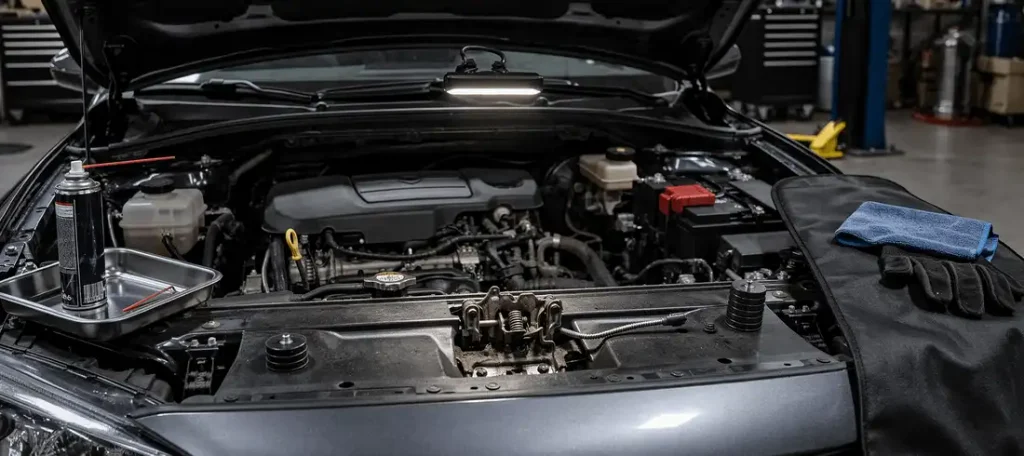
Many latch complaints happen right after routine under-hood work, such as checking fluids or opening the hood for a jump-start or battery check. Scan the top of the radiator support, battery tray, and fender edges for:
- A stray tool, flashlight, or shop rag
- An oil cap, coolant cap, or battery terminal cover sitting loose
- Leaves or twigs wedged around the latch opening
- A manual hood prop rod that missed its storage clip
- Rubber hood bump stops sitting at noticeably uneven heights on the left and right sides
2. Verify the Interior Release Lever Returned Fully
Step back to the driver’s footwell and look at the interior hood-release handle. If a sticky cable left the lever pulled partway out, gently push it all the way back to its resting stop.
If the handle feels completely slack, refuses to move, or springs back out on its own, stop pulling it. Do not pry the under-hood latch or try to trip the mechanism with a screwdriver. For example, GM Bulletin 25-NA-034 (covering specified power-cinching hood-latch systems) warns technicians not to trigger the latch with a foreign object or tool in place of the hood striker, because doing so can damage the latch or integrated sensors.
3. Inspect for Visible Damage Without Moving the Striker
Stand in front of the car and look closely at the striker loop under the hood and the latch mounted to the radiator support. Watch for heavy rust, a bent striker loop, cracked plastic around the latch, or uneven gaps where the hood meets the fenders.
Never loosen the striker bolts or bend the latch bracket to compensate for a shifted hood. After a minor impact or front-end repair, shifting the striker can hide a bent hinge or distorted radiator support instead of restoring safe latch geometry.
4. Verify Your Exact Owner’s Manual Closing Method
Automakers do not all use the same closing motion. Some vehicles require lowering the hood to a specific height and letting its weight latch it, while others instruct pressing firmly on a reinforced spot above the emblem to avoid denting thin aluminum panels.
For instance, Honda’s owner’s manual hood-closing guidance outlines model-specific lowering and release steps rather than slamming the panel shut. Check your exact owner’s manual, and stop if the hood still refuses to lock cleanly after one proper attempt.
5. Check Your VIN for Open Hood-Latch Recalls
Hood-latch corrosion and secondary-catch binding have triggered major safety recalls on specific vehicle populations in the past, such as NHTSA Recalls 16V029000 and 20V315000 on select Nissan models. Enter your 17-digit VIN in the NHTSA VIN recall lookup to see whether an open safety recall applies to your vehicle.
A clean recall check does not rule out a worn latch or cable, and an open recall still requires an authorized dealer inspection and repair.

Can You Drive If the Hood Is Only on the Secondary Latch?
No. Never drive a vehicle when the hood is resting only on the secondary catch or will not latch flush. Wind pressure at road speeds can overpower a worn or corroded secondary hook and slam the hood straight back into the windshield.
If your hood ever pops onto the safety catch or lifts while you are already driving, keep both hands on the wheel, ease off the accelerator smoothly, and look through the narrow gap beneath the raised rear edge of the hood or use your side mirrors to steer safely onto the shoulder. Turn on your hazard lights and call roadside assistance.
When to Call a Technician
Arrange professional service or a tow if any of these apply:
- The hood bounces back or catches only halfway after following your owner’s manual closing steps
- The interior release lever or cable is stuck, frayed, or feels disconnected
- The latch, striker, hinges, or front radiator support show visible rust or impact damage
- The hood-ajar warning light remains on even when the panel sits flush
- Your vehicle uses a motorized power-cinching hood latch
A technician can inspect the latch engagement, test the hood-ajar switch, verify cable travel, and check body alignment against factory specifications before replacing parts.
FAQs About Car Hood Won’t Close?
Why does my hood close and then pop right back up?
A hood that bounces back usually means the primary latch pawl is stuck in the released position, the interior release cable is holding the latch open, or an under-hood item is blocking the striker. Check for loose items and confirm the interior handle returned fully before calling a shop.
Is the secondary hood latch safe enough to drive to a mechanic?
No. The secondary catch is an emergency backup hook, not a driving lock. Highway wind load can tear a partially latched hood open without warning, so have the vehicle towed if the primary latch will not engage.
Can I use a screwdriver to reset a stuck hood latch?
No. Using a screwdriver or pry tool to trip a hood latch can bend internal springs, break hood-ajar microswitches, or damage motorized power-cinching latches. Follow your owner’s manual and let a technician inspect a stuck mechanism.
Can a hood latch become misaligned after a minor fender bender?
Yes. Even a low-speed front bump can shift the radiator support, hood hinges, or striker loop by a few millimeters, preventing the primary latch from locking cleanly. Have a body or repair shop inspect the alignment rather than loosening striker bolts yourself.
Why does my hood-ajar warning light stay on when the hood looks closed?
First, gently pull up on the front edge of the hood to confirm the primary latch actually engaged. If the hood is locked solid, the warning may stem from a faulty hood-ajar switch inside the latch, a corroded connector, or a wiring fault that needs electrical testing.
Check for obvious under-hood obstructions, confirm the interior release handle returned all the way to its stop, and follow the exact closing method in your owner’s manual. If the hood still refuses to lock flush, leave the car parked and arrange a tow so a technician can inspect the latch, cable, and alignment safely. For more practical upkeep checklists, explore our routine under-hood maintenance guides and car problem and symptom troubleshooting guides.