
This article was updated in May 19, 2026 with new products and information by Mark S. Taylor
If your car shakes when you accelerate, it’s almost always a drivetrain, engine mount, or tire issue — and in most cases, it’s not safe to ignore. The good news: the cause is usually diagnosable in under 10 minutes, and repair costs range from $50 for a tire balance to around $1,200 for a CV axle replacement.
I’ve spent 20 years as an ASE-certified master mechanic, and acceleration shakes are one of the most common complaints that roll into the shop. The frustrating part? Drivers usually wait too long. That $200 fix becomes a $1,200 repair because the vibration wears out other components faster than you’d think.
In this guide, you’ll learn where to feel for clues, what each cause looks like, what it’ll cost, and whether you need to park the car today or can drive to the shop tomorrow.

Contents
- 1 What “Car Shakes When Accelerating” Actually Means
- 2 Where You Feel the Shake Matters
- 3 Common Causes (Ranked by Likelihood)
- 4 How to Diagnose It Yourself (Before the Shop)
- 5 Can You Drive With It? (Safety Urgency Guide)
- 6 Repair Cost Breakdown (2026 Estimates)
- 7 DIY vs. Mechanic: Which Fixes Can You Handle?
- 8 Prevention Tips
- 9 FAQs About Car shakes when accelerating?
- 9.1 Why does my car only shake when accelerating uphill?
- 9.2 Why does my steering wheel shake when I hit the gas?
- 9.3 Is it safe to drive if my car shakes only during hard acceleration?
- 9.4 Can bad gas cause my car to shake when accelerating?
- 9.5 How long can I drive with a bad CV joint?
- 9.6 Why does my car shake when accelerating from a stop but smooth out at speed?
- 10 The Bottom Line
What “Car Shakes When Accelerating” Actually Means
Let’s get specific. A shake that only happens when you press the gas pedal is different from a shake at highway speed or a shake when braking.
Acceleration-only shaking is load-dependent. It happens because something in your drivetrain or engine can’t handle the torque being applied. When you coast or cruise at steady speed, the load drops — and the shake often disappears.
This distinction matters. Here’s how to tell what you’re dealing with:
- Shakes when accelerating, smooth when coasting → Drivetrain or mount issue (CV joint, axle, engine mount, transmission mount)
- Shakes at a specific speed regardless of acceleration → Tire or wheel issue (balance, bent rim, alignment)
- Shakes when accelerating AND braking → Suspension or brake issue (rotors, control arms, ball joints)
- Shakes at idle, worse when accelerating → Engine issue (misfire, bad mount)
If your shake checks the first box, keep reading. You’re in the right place.
Where You Feel the Shake Matters
This is the diagnostic shortcut most articles skip. Where the vibration travels through your body tells you which system is failing.
Table
| If You Feel It In… | Likely Cause | Urgency |
|---|---|---|
| Steering wheel | Front tires (balance, bent rim), front wheel bearings, or steering components | Moderate — schedule within a week |
| Seat or floorboard | Driveshaft, CV joints, bent axle, or rear wheel issue | Moderate to High — inspect within days |
| Gas pedal | Engine misfire or broken engine mount | High — inspect this week |
| Whole car, front end | Engine or transmission mount failure | High — possible tow situation |
| Rear of vehicle | Rear driveshaft, U-joints, or differential (RWD/AWD) | Moderate — inspect within a week |
The mechanic’s rule: Steering wheel = front of car. Seat/floor = middle or rear of car. Gas pedal = engine. This alone narrows your suspect list by half.
Common Causes (Ranked by Likelihood)
1. Worn or Failing CV Joints
Constant velocity joints transfer power from your transmission to the wheels. They’re packed with grease and protected by rubber boots. When the boot tears, grease leaks out, dirt gets in, and the joint wears fast.
What you’ll notice: A shake or shudder under hard acceleration, often accompanied by a clicking noise when turning. Front-wheel-drive cars are most susceptible. The shake usually starts subtle and gets worse over weeks.
Why it happens under acceleration: The inner CV joint handles the most torque load. When it’s worn, the joint can’t maintain smooth rotation under power — it binds and releases, creating that rhythmic shudder.
The mechanic’s take: The first thing I check when a customer says “it shakes when I hit the gas” is the CV boots. If there’s grease flung all over the inside of the wheel well, I already know the joint is cooked. Don’t let a shop sell you just a boot replacement — once the joint is dry, the damage is done. The whole axle needs to go.
2. Broken or Worn Engine Mounts
Engine mounts are rubber-and-metal brackets that hold your engine to the frame. They absorb vibration and keep the engine from shifting under torque.
What you’ll notice: Excessive vibration at idle that gets worse when you accelerate. You might hear a clunk when shifting from park to drive. In severe cases, the engine visibly shifts when you rev it.
Why it happens under acceleration: When you hit the gas, engine torque tries to twist the engine in its bay. A healthy mount absorbs that motion. A broken mount lets the engine slam against the frame — and you feel every bit of it.
The mechanic’s take: I’ve seen cars with three broken mounts where the owner thought they needed an engine rebuild. New mounts transformed the car. Always check mounts before chasing expensive engine repairs. A pry bar and 30 seconds of your time tells the whole story.
3. Bent Axle or Driveshaft
Hit a pothole hard three months ago? That impact might have bent an axle or driveshaft. The bend creates an imbalance that only shows up under load.
What you’ll notice: A rhythmic wobble that intensifies as you accelerate. It might smooth out at cruising speed but return when you pass or climb a hill. Rear-wheel-drive vehicles will feel it through the seat; front-wheel-drive through the steering wheel.
Why it happens under acceleration: A bent axle still spins, but it’s no longer perfectly centered. Under light load, the suspension can absorb the wobble. Under hard acceleration, the torque amplifies the imbalance and the shake breaks through.
4. Engine Misfire
A misfiring cylinder can’t deliver smooth power. Instead of consistent acceleration, you get jerking and shuddering.
What you’ll notice: The shake feels “electrical” — like the car is hesitating or stumbling rather than vibrating. You might see the Check Engine Light flashing (which means pull over now). The gas pedal may feel like it’s pulsing.
Why it happens under acceleration: Misfires are most noticeable under load because that’s when the engine demands the most from every cylinder. A weak spark plug or clogged injector might keep up at idle but fails when you need full power.
The mechanic’s take: If your Check Engine Light is flashing, you’re dumping raw fuel into the catalytic converter. That $20 spark plug problem becomes a $1,500 catalytic converter replacement if you keep driving. Flashing CEL = tow or drive directly to a shop. No exceptions.
5. Unbalanced or Damaged Tires
Tire issues usually cause speed-dependent shaking, not acceleration-only shaking. But there’s an exception: if a tire has a broken belt or severe flat spot, the shake can feel worse under load.
What you’ll notice: Vibration at specific speeds (often 55–70 mph) that comes and goes. You might see uneven tread wear or a bulge in the sidewall. The steering wheel shakes more than the seat.
Why it might happen under acceleration: A tire with internal damage can’t maintain its shape under the added stress of acceleration torque. The flat spot or broken belt flexes more, amplifying the shake.
6. Failing Transmission Mount
This is the cause most articles miss. The transmission mount does the same job as the engine mount — it holds the transmission steady and absorbs vibration.
What you’ll notice: Similar to engine mount failure but often accompanied by rough shifting or a “thump” when putting the car in gear. The shake might be more pronounced during hard acceleration from a stop.
Why it happens under acceleration: Front-wheel-drive cars put enormous torque through the transmission. A broken transmission mount lets the whole drivetrain shift, creating a shudder that feels like it’s coming from everywhere.

How to Diagnose It Yourself (Before the Shop)
You don’t need a lift to narrow this down. Here’s what to check in order:
Step 1: Pop the hood and look at the engine. Have a friend shift from park to drive with their foot on the brake. If the engine rocks more than an inch, you’ve got a mount problem.
Step 2: Inspect your tires. Check pressure first — uneven pressure causes shake. Then look for bulges, bald spots, or anything embedded in the tread. Spin each wheel and look for a bent rim.
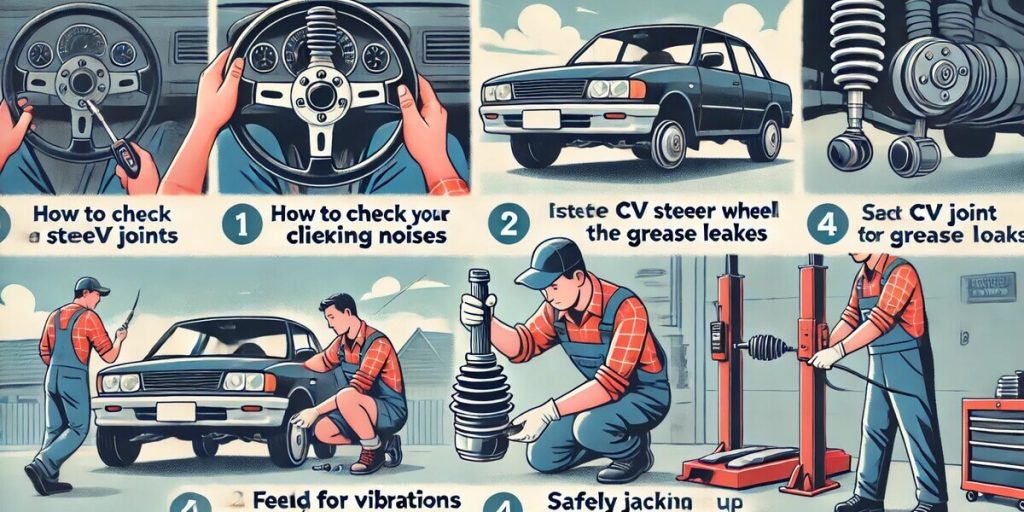
Step 3: Check the CV boots. Turn the steering wheel all the way to one side and look at the rubber boots behind the front wheels. If you see grease sprayed on the suspension, the boot is torn and the joint is failing.
Step 4: Scan for codes. A $20 OBD-II scanner from any auto parts store will tell you if there’s a misfire. Look for codes P0300 through P0304.
Step 5: The lug nut test. This sounds obvious, but I’ve seen wheels ready to fall off because a quick-lube shop didn’t torque the lug nuts. Grab your tire iron and make sure every nut is tight.
Step 6: Listen while turning. Drive slowly in a parking lot and make tight circles. Clicking or popping from the front end means CV joints.
If you find something obvious, you’ve saved yourself a diagnostic fee. If everything looks normal, it’s time for a professional inspection.
Can You Drive With It? (Safety Urgency Guide)
Table
| Severity | Cause | Can You Drive? | Action |
|---|---|---|---|
| 🔴 Stop Now | Loose lug nuts, broken engine mount, flashing Check Engine Light | No — tow it | Immediate repair required |
| 🟡 This Week | Worn CV joint, bent axle, misfire without CEL | Short trips only | Schedule within 3–5 days |
| 🟢 Soon | Unbalanced tires, minor mount wear, transmission mount | Yes, but monitor | Schedule within 2 weeks |
The hard truth: A shaking car is never “fine.” Even green-light issues wear out other components faster. That unbalanced tire will destroy a wheel bearing. That worn CV joint will snap and leave you stranded.
Repair Cost Breakdown (2026 Estimates)
Table
| Repair | Parts | Labor | Total Cost | DIY Possible? |
|---|---|---|---|---|
| Tire balance & rotation | $0–$30 | $20–$50 | $50–$80 | No — needs machine |
| Wheel alignment | $0–$50 | $80–$150 | $100–$200 | No — needs machine |
| Spark plug replacement | $30–$80 | $100–$200 | $130–$280 | Yes — easy |
| Engine mount replacement | $50–$150 | $150–$450 | $200–$600 | Moderate |
| Transmission mount replacement | $50–$130 | $150–$350 | $200–$500 | Moderate |
| CV axle replacement (one side) | $100–$250 | $150–$400 | $300–$650 | Yes — intermediate |
| CV axle replacement (both sides) | $200–$500 | $250–$600 | $500–$1,100 | Yes — intermediate |
| Bent axle/driveshaft replacement | $200–$600 | $200–$400 | $400–$1,000 | No — shop recommended |
Cost factors that move the needle:
- Vehicle make: European and luxury cars often cost 40–60% more for the same repair
- Shop type: Dealerships typically charge 30–40% more than independent shops for identical work
- Location: Labor rates range from $80/hour in rural areas to $180/hour in major cities
Money-saving tip: If you need CV axles and your car has over 100,000 miles, replace both sides at once. The labor overlap saves you money, and the other side is probably not far behind.

DIY vs. Mechanic: Which Fixes Can You Handle?
Table
| Repair | Difficulty | Tools Needed | Time | Worth DIY? |
|---|---|---|---|---|
| Spark plugs | 1/5 | Basic socket set | 30–60 min | Yes — saves $100+ |
| Tire inspection/lug nuts | 1/5 | Tire iron, pressure gauge | 10 min | Yes — free |
| Engine mount | 3/5 | Jack, jack stands, pry bar | 2–3 hours | Maybe — tight spaces |
| CV axle | 2.5/5 | Socket set, torque wrench, possibly a pickle fork | 1.5–3 hours | Yes — with a video |
| Transmission mount | 3/5 | Same as engine mount | 2–4 hours | Maybe — depends on access |
| Driveshaft/axle straightening | 5/5 | Shop equipment | N/A | No — requires machine |
The mechanic’s honest take: Spark plugs and tire checks are no-brainers. CV axles are genuinely doable in a driveway if you have basic tools and a repair manual for your specific car. Engine and transmission mounts? The work isn’t hard, but the access is miserable on some vehicles. If you’re not comfortable supporting the engine with a jack, pay the shop.
Prevention Tips
Most acceleration shakes are preventable with basic maintenance:
- Rotate and balance tires every 5,000–7,000 miles. Uneven wear is the #1 preventable cause of vibration.
- Get an alignment annually or after any hard impact. A $100 alignment prevents $600 in tire and suspension damage.
- Inspect CV boots during every oil change. A $30 boot kit replaces a $600 axle if you catch it early.
- Avoid potholes and hard curb impacts. I know — easier said than done. But that “thud” you felt three months ago is probably the root cause of today’s shake.
- Replace spark plugs on schedule. Check your owner’s manual — usually every 30,000–100,000 miles depending on plug type.
FAQs About Car shakes when accelerating?
Why does my car only shake when accelerating uphill?
This is almost always an engine misfire under load. Climbing a hill demands maximum power from every cylinder. A weak spark plug, failing ignition coil, or clogged injector can’t keep up. Get the codes scanned — you’ll likely find a P030X misfire code.
Why does my steering wheel shake when I hit the gas?
Steering wheel shake during acceleration points to the front wheels or steering components. Most likely culprits: unbalanced front tires, worn front wheel bearings, or a bent front axle. Less commonly, a failing inner CV joint on one side can transmit vibration through the steering rack.
Is it safe to drive if my car shakes only during hard acceleration?
It depends on severity. A mild shudder that’s been stable for weeks is probably a worn CV joint — driveable short-term but schedule repair. A violent shake that started suddenly could be a broken mount or loose component — get it inspected before your next highway trip.
Can bad gas cause my car to shake when accelerating?
Yes, but it’s rare. Contaminated or water-laden fuel can cause misfires under load. If the shake started right after a fill-up, try a bottle of fuel injector cleaner and a fresh tank from a different station. If it doesn’t improve in 50 miles, it’s not the gas.
How long can I drive with a bad CV joint?
You can usually drive for weeks to months on a clicking CV joint — but not safely. Once the joint starts shaking, it’s degrading fast. A failed CV joint can seize or break, causing sudden loss of power to that wheel. On a highway, that’s dangerous. Replace it within two weeks of noticing symptoms.
Why does my car shake when accelerating from a stop but smooth out at speed?
This pattern strongly suggests an engine mount or transmission mount issue. The initial torque surge from a stop puts maximum load on the mounts. Once you’re moving, the load stabilizes and the shake fades. Check for excessive engine movement during the park-to-drive test described above.
The Bottom Line
A car that shakes when you accelerate is telling you something specific: a component in your drivetrain or engine mounting system can’t handle the torque load. The most common culprits are CV joints, engine mounts, and bent axles — and the repair cost ranges from $50 to $1,200 depending on what’s failing.
Here’s your action plan: Feel where the shake is coming from. Check the easy stuff yourself — tires, lug nuts, mounts, CV boots. If you find something, you know what you’re dealing with. If you don’t, take it to a shop with a clear description of the symptom. A good mechanic will have the answer in 15 minutes.
Don’t wait. The $200 fix you ignore today becomes the $1,200 repair that strands you on the interstate. Trust the shake — it’s cheaper to fix it now.