
This article was updated in March 9, 2026 with new products and information by Mark S. Taylor
Your engine suddenly shudders, hesitates, and the check engine light flashes. That is an engine misfire — and it is your car telling you something is seriously wrong. A misfire happens when a cylinder fails to fire at the right time. This can ruin your catalytic converter or damage your engine pistons. We have seen drivers ignore a small shake until they needed a $3,000 repair. This guide explains the causes of an engine misfire clearly. You will learn the 12 specific reasons, from the cheapest to the most expensive.

Contents
- 1 What Exactly Is an Engine Misfire?
- 2 ⚠️ Flashing Check Engine Light vs. Steady — Know the Difference
- 3 The 4 Root Causes of Every Engine Misfire
- 4 Ignition System Causes (Most Common — Start Here)
- 4.1 1. Worn or Fouled Spark Plugs
- 4.2 2. Failed Ignition Coil
- 4.3 3. Damaged Spark Plug Wires (Older Vehicles)
- 4.4 Fuel System Causes
- 4.5 4. Clogged or Failing Fuel Injector
- 4.6 5. Low Fuel Pressure
- 4.7 6. Clogged Fuel Filter
- 4.8 7. Bad or Contaminated Fuel
- 4.9 Air System Causes
- 4.10 8. Vacuum Leak
- 4.11 9. Dirty or Failed MAF Sensor
- 4.12 10. Faulty O2 Sensor or EGR Valve
- 4.13 Mechanical Causes (Most Serious — Most Expensive)
- 4.14 11. Low Compression — Worn Piston Rings, Valve Problems, or Blown Head Gasket
- 4.15 12. Timing Belt or Chain Issues
- 5 Bonus Cause — VVT System and Cam Phaser Failures
- 6 Random vs. Cylinder-Specific Misfire — What the Code Tells You
- 7 The “Cheapest Fix First” Diagnostic Ladder
- 8 Is It Safe to Drive With an Engine Misfire?
- 9 Engine Misfire Repair Costs
- 10 FAQs About Causes of an Engine Misfire
- 11 Bottom Line — What to Do Right Now
What Exactly Is an Engine Misfire?
A misfire occurs when one or more cylinders fail to ignite the air-fuel mix properly.
The engine feels rough. It loses power. It happens because the combustion process failed. There are two main types. A random misfire (P0300) affects many cylinders. A specific misfire (P0301–P0308) affects just one. This distinction matters. Specific codes help you find the exact bad part.
⚠️ Flashing Check Engine Light vs. Steady — Know the Difference
This is the most critical safety warning in this article.
| CEL Status | What It Means | What to Do |
|---|---|---|
| Steady glow | Misfire stored. Not severe. | Drive to a shop soon. |
| Flashing / blinking | Active misfire right now. | Pull over. Stop driving. |
A flashing light means unburned fuel is burning inside your catalytic converter. A converter costs $1,200 to replace. A spark plug costs $10. Do not drive with a flashing light.
The 4 Root Causes of Every Engine Misfire
Every misfire comes from one of four core problems.
| Category | What’s Wrong | Typical Repair Cost |
|---|---|---|
| Ignition | No spark. | $30 – $600. |
| Fuel | Wrong fuel amount. | $100 – $1,500. |
| Air | Wrong air amount. | $20 – $500. |
| Mechanical | Engine parts broken. | $500 – $5,000+. |
Always start with ignition. It is the most common and cheapest fix.
Ignition System Causes (Most Common — Start Here)
1. Worn or Fouled Spark Plugs
Bad spark plugs are the number one cause of misfires.
Plugs wear out. The gap gets too wide. The spark gets weak. A weak spark cannot light the fuel. This causes a misfire. Plugs can also get dirty or “fouled” with oil or carbon. Test: Swap the plug from the bad cylinder to a good one. If the misfire code moves, the plug is bad. Cost: $30 – $150.
2. Failed Ignition Coil
A bad coil cannot create the high voltage needed for a spark.
The coil turns battery power into a spark. If it fails, the cylinder gets no fire. Modern cars have one coil per cylinder. If you have a P030X code, check the coil on that cylinder. Test: Swap the coil to another cylinder. If the code moves, the coil is bad. Cost: $80 – $300.
3. Damaged Spark Plug Wires (Older Vehicles)
Cracked wires let the spark escape before it reaches the plug.
This happens on older cars with distributors. The spark jumps to the engine block instead of the plug. This happens more in wet weather. Cost: $40 – $150.
Fuel System Causes
4. Clogged or Failing Fuel Injector
A dirty injector starves the engine of gas.
If the injector is clogged, the mix is too “lean” (too much air). If it is stuck open, the mix is too “rich” (too much gas). Both cause misfires. We have a full guide on symptoms of a bad fuel injector if you suspect this. Fix: Try a fuel cleaner additive first ($10). Cost: $150 – $500 per injector.
5. Low Fuel Pressure
The fuel pump might be too weak to push gas to the engine.
Low pressure starves all cylinders. You usually get a random misfire code (P0300). This gets worse when you speed up. The engine starves for fuel. Code: Look for P0087. Cost: $300 – $700 for a pump.
6. Clogged Fuel Filter
A dirty filter blocks gas flow.
This restricts fuel to the injectors. It causes lean misfires at high speed. It is a cheap and easy fix. Cost: $30 – $150.
7. Bad or Contaminated Fuel
Water in your gas stops the engine from running right.
Water does not burn. If you get bad gas from a station, you might misfire right away. This often happens after filling up. Fix: Add a fuel system cleaner. Fill up with good gas.
Air System Causes
8. Vacuum Leak
Extra air enters the engine through a leak.
This “unmetered” air messes up the mix. The engine runs lean. You might hear a hissing sound.
Test: Spray carburetor cleaner around hoses. If the engine speed changes, you found the leak. Cost: $20 – $400.
9. Dirty or Failed MAF Sensor
The Mass Air Flow sensor measures air coming in.
If it gets dirty, it sends wrong data. The computer adds the wrong amount of fuel. This causes misfires.
Fix: Clean the sensor first with MAF cleaner ($8). Cost: $150 – $400 to replace.
10. Faulty O2 Sensor or EGR Valve
Bad sensors give the computer wrong info.
The O2 sensor checks exhaust. The EGR valve recycles exhaust. If they fail, the engine runs poorly. An EGR valve stuck open makes the mix too lean at idle. Cost: $150 – $500.
Mechanical Causes (Most Serious — Most Expensive)
11. Low Compression — Worn Piston Rings, Valve Problems, or Blown Head Gasket
The engine cannot build enough pressure to burn fuel.
Compression is key. You need 125 to 180 PSI. If it drops below 90 PSI, the engine will misfire.
- Rings: Compression leaks into the oil pan.
- Head Gasket: Coolant leaks into the cylinder. You see white smoke.
- Valves: They do not seal tight.
These repairs are expensive. If you see white smoke, read our guide on symptoms of a blown head gasket. Cost: $1,000 – $3,000+.
12. Timing Belt or Chain Issues
The timing is off, so the spark is late or early.
The timing belt keeps the valves and pistons in sync. If it stretches or skips a tooth, the valves open at the wrong time. This causes misfires. A broken belt on an “interference engine” destroys the engine. Code: P0016 or P0017. Cost: $500 – $1,200 to replace the belt.
Bonus Cause — VVT System and Cam Phaser Failures
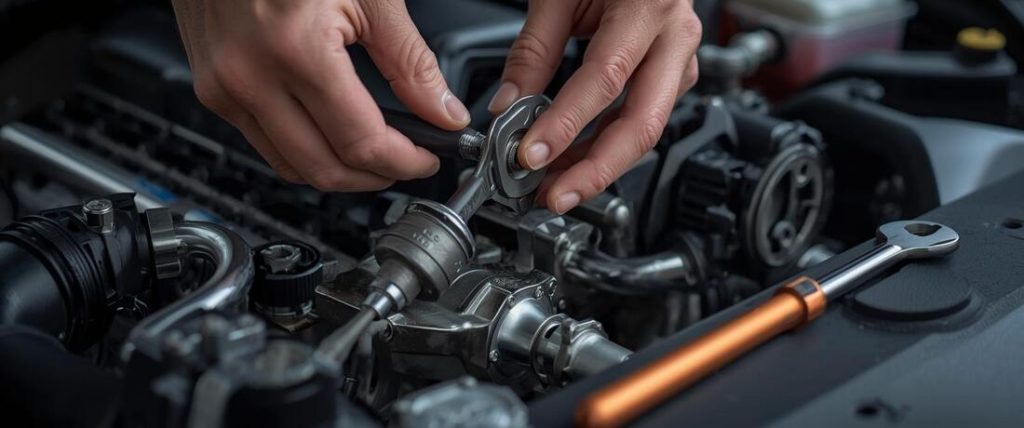
Variable Valve Timing helps performance and economy.
If the VVT solenoid or cam phaser sticks, the timing is wrong. This causes misfires on one side of the engine. It is common on Ford EcoBoost and GM engines. Code: P0011 or P0012. Cost: $100 – $800.
Random vs. Cylinder-Specific Misfire — What the Code Tells You
Use this table to guide your diagnosis.
| Code | What It Means | Where to Start |
|---|---|---|
| P0300 | Random misfire. | Fuel pump, vacuum leak, MAF. |
| P0301 | Cylinder 1 misfire. | Plug, coil, injector on Cyl 1. |
| P0300 + P0171 | Random + Lean. | Vacuum leak or fuel pump. |
| P0300 + P0016 | Random + Timing. | Timing belt or VVT. |
The “Cheapest Fix First” Diagnostic Ladder
Work from the cheapest fix to the most expensive.
- Scan Codes: ($0–$50). Narrow it down.
- Spark Plugs: ($30–$150). Most common fix.
- Swap Coil: ($0 to test). Quick check.
- Fuel Cleaner: ($10–$20). Cheap fix for clogs.
- Fuel Filter: ($30–$150). Easy maintenance.
- Clean MAF: ($8–$12). Quick spray.
- Fix Vacuum Leak: ($20–$100). Look for cracks.
- O2 Sensor: ($150–$400).
- Test Fuel Pressure: ($150–$700).
- Compression Test: ($75–$150). Check engine health.
Is It Safe to Drive With an Engine Misfire?
Do not drive if the check engine light is flashing.
- Steady Light: Drive to a shop.
- Flashing Light: Stop immediately.
- Fuel Smell: Stop. Fire risk.
- White Smoke: Stop. Head gasket risk.
Engine Misfire Repair Costs
Here are the average costs you can expect.
| Repair | Estimated US Cost |
|---|---|
| Spark Plugs | $100 – $350. |
| Ignition Coil | $80 – $300. |
| Fuel Injector | $150 – $500. |
| Vacuum Leak | $20 – $150. |
| O2 Sensor | $150 – $400. |
| Fuel Pump | $300 – $700. |
| Head Gasket | $1,000 – $2,500. |
| Timing Belt | $500 – $1,200. |
RepairPal is a good place to find local estimates.
FAQs About Causes of an Engine Misfire
What does a P0300 code mean?
P0300 means random misfires. It affects multiple cylinders. It usually points to a system-wide issue like low fuel pressure or a vacuum leak. Start with a fuel pressure test.
Can a bad spark plug cause a misfire?
Yes. It is the most common cause. Worn plugs cannot make a strong spark. Replace them every 30,000 to 100,000 miles.
Can a vacuum leak cause an engine misfire?
Yes. A leak lets in extra air. This makes the mix too lean. The engine runs rough and misfires.
What’s the difference between a random misfire and a cylinder-specific misfire?
Random (P0300) affects the whole engine. Specific (P030X) affects one cylinder. Specific codes are easier to fix because you know exactly where to look.
How much does it cost to fix an engine misfire?
It depends on the cause. Plugs are cheap ($100). Head gaskets are expensive ($2,000). Scan the code first to know the cost.
Bottom Line — What to Do Right Now
Fix the small problem before it becomes a big one.
If the light is flashing, pull over. If it is steady, scan the code. Check the spark plugs first. They are the cheapest fix. If you smell gas or see smoke, call a tow truck. A misfire is a warning. Listen to it. Fix it early to save money. If you suspect the fuel system, check our article on symptoms of a bad electronic fuel injection system for more help.
Quick Summary
- A flashing check engine light means stop driving immediately.
- Spark plugs and coils are the most common causes.
- Vacuum leaks cause lean misfires at idle.
- Low fuel pressure starves the engine of gas.
- Mechanical failures like gaskets are expensive to fix.
- Always scan codes before buying parts.
- Start with the cheapest fixes first.