
This article was updated in May 22, 2026 with new products and information by Mark S. Taylor

Your emergency brake is supposed to be a failsafe. When it doesn’t work, most drivers don’t find out until the car rolls in a parking lot — or until they fail a vehicle inspection.
The frustrating part is that an emergency brake can fail in several different ways. It might pull up too high and feel loose. It might not hold on a slope. It might be stuck and won’t release.
This guide covers the eight most common reasons an emergency brake stops working, what each one costs to fix, and what to do before you can get to a shop.
Contents
- 1 Emergency Brake vs Parking Brake — Same Thing?
- 2 How the Emergency Brake Works
- 3 8 Reasons Your Emergency Brake Is Not Working
- 4 Is It Safe to Drive With a Broken Emergency Brake?
- 5 How to Park Safely on a Hill Without a Working Parking Brake
- 6 Emergency Brake Repair Cost Summary
- 7 Can I Fix the Emergency Brake Myself?
- 8 FAQs About Emergency Brake Not Working
Emergency Brake vs Parking Brake — Same Thing?
Yes. Emergency brake, parking brake, handbrake, and e-brake all refer to the same system. The name just depends on who’s talking.
It’s a secondary braking system that works independently of your main hydraulic brakes — applying pressure directly to the rear wheels through a cable or an electric motor, not through brake fluid. If your main brake system fails, this is your backup.
How the Emergency Brake Works
Cable-operated systems (most common)
- 1You pull the handbrake lever or press the foot pedal
- 2A steel cable runs from the lever to the rear wheels
- 3The cable pulls on a mechanism inside the rear brake drums or calipers
- 4This clamps the rear brakes and holds the wheels stationary
Electronic parking brake (EPB) — modern cars
- 1You press a button on the center console
- 2A small electric motor on each rear caliper receives a signal
- 3The motor drives a screw mechanism that clamps the brake pads
- 4Releasing works in reverse — the motor retracts the pads
8 Reasons Your Emergency Brake Is Not Working
Ranked by frequency. Most common causes appear first.
The most common cause on older vehicles. The steel cable stretches gradually over years of use, reducing tension until the brake engages weakly or not at all. What it feels like: The lever or pedal travels further than normal before any resistance.
A cable sitting unused in a wet or salty environment can corrode and seize. Very common in northern states and Canada. What it feels like: The lever either won’t engage at all, or it engages but won’t release.
Vehicles with rear drum brakes have separate small brake shoes for the parking brake. They wear down slowly over time. What it feels like: The brake engages but the car still rolls slowly. The lever goes unusually high before resistance.
Over time, cables stretch and shoes wear, taking the system out of adjustment. This is often the simplest and cheapest fix. What it feels like: The lever pulls up higher than it used to. No other obvious symptoms.
On many vehicles the parking brake works through the main rear brake components. Metal-on-metal rear pads means the parking brake has almost nothing to grip. What it feels like: Weak parking brake and reduced rear braking. Grinding noise when braking.
Water enters the cable housing and freezes overnight — most common after washing the car in freezing temps or driving through slush. Prevention: Apply the parking brake gently a few times after washing in freezing weather to help dry the cable.
EPB systems rely on motors, sensors, and modules. Any failure — a failing motor, faulty sensor, software glitch, or dead battery — can prevent engagement or release. What it feels like: EPB warning light on the dashboard. Brake may not engage or release when pressed.
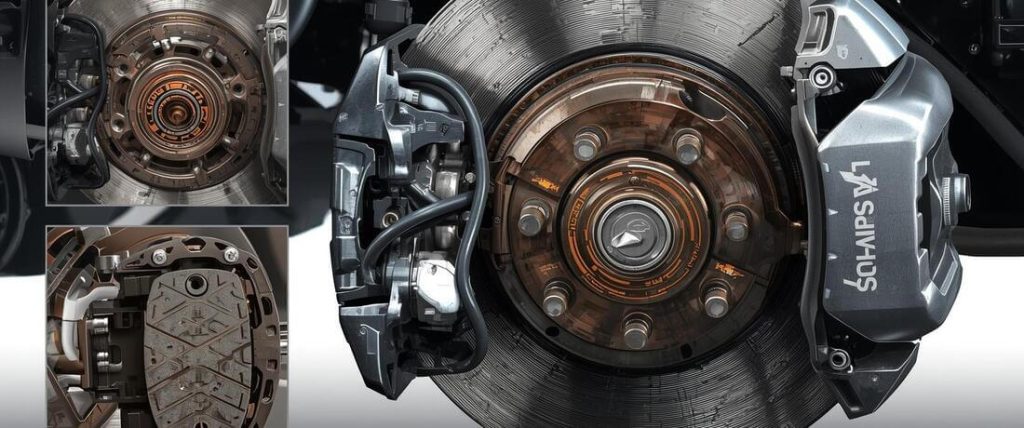
On rear disc brake vehicles, the parking brake is built into the rear calipers. The internal screw-driven mechanism can seize, strip, or wear out — especially on high-mileage vehicles. What it feels like: Only one rear wheel holds. Or the caliper seizes in the applied position, causing the rear brakes to drag.
Is It Safe to Drive With a Broken Emergency Brake?
The short answer: yes, carefully — but fix it soon. Your main hydraulic brakes are unaffected by a parking brake failure. The risk is specific to situations where the parking brake matters most.
| Situation | Risk Level | Action |
|---|---|---|
| Flat parking lots and streets | Low | Can drive temporarily |
| Parking on any incline | High | Do not park on hills |
| Heavy traffic / stop-and-go | Low | Normal braking unaffected |
| Towing a trailer | Very High | Do not tow |
| Vehicle inspection due | High | Will fail inspection |
| Seized caliper (brake drag) | Very High | Stop driving immediately |
How to Park Safely on a Hill Without a Working Parking Brake
If your parking brake fails before you can get it fixed, here’s how to minimize rollaway risk.
- Pull up slowly to the curb and stop
- Turn wheels toward curb (downhill) or away (uphill)
- Shift into Park — let car settle against the pawl
- Release the foot brake gently
- Use wheel chocks under tires if available
- Stop at the curb, turn wheels appropriately
- Leave in 1st gear (uphill) or reverse (downhill)
- Apply foot brake, release clutch slowly until car settles
- Use wheel chocks if available
- Avoid steep hills entirely until repaired
Emergency Brake Repair Cost Summary
| Repair | DIY Friendly? | Average Cost |
|---|---|---|
| Parking brake adjustment | Yes | $50–$100 |
| Cable lubrication | Yes | $20–$50 |
| Parking brake cable replacement | Intermediate | $150–$400 |
| Parking brake shoe replacement | Intermediate | $150–$350 |
| Rear brake pad replacement | Intermediate | $150–$400/axle |
| Rear caliper replacement | Mechanic Only | $300–$700/caliper |
| EPB motor replacement | Mechanic Only | $200–$500/side |
| EPB module / sensor | Mechanic Only | $300–$800 |
Can I Fix the Emergency Brake Myself?
It depends on the cause and your mechanical confidence.
After any parking brake repair, the system needs to be adjusted and tested on an incline. A parking brake that holds on flat ground may still slip on a hill if the adjustment isn’t correct.
FAQs About Emergency Brake Not Working
An emergency brake that doesn’t work isn’t just an inconvenience — it’s a safety gap. Most of the time the fix is straightforward: an adjustment, a cable replacement, or new parking brake shoes. Catch it early and you’re looking at a $50–$300 repair.
- 8 most common causes: stretched cable, seized cable, worn shoes, misadjustment, worn rear brakes, frozen cable, EPB fault, rear caliper failure
- A simple adjustment at $50–$100 is often all that’s needed and is frequently overlooked
- Electronic parking brake faults require diagnostic scanning to identify correctly
- Driving is generally safe short-term — but parking on hills is not
- Seized calipers are the exception — stop driving immediately if rear brakes drag
- Always test the parking brake on an incline after any repair
- Most US states will fail a vehicle inspection with a non-functioning parking brake