
This article was updated in December 22, 2025 with new products and information by Mark S. Taylor
Nothing kills a morning faster than a dead battery or a fuse that keeps blowing. You turn the key, and nothing happens. It is frustrating. But you can fix it.
A short circuit happens when a hot wire touches the ground, bypassing the part it should power.
This drains power fast. It can be scary. But you do not need to be a pro mechanic to find it. In the next 8 minutes, you will learn two dead-simple methods to track it down. You will learn when to use a simple test light and when to grab a meter. We will also tell you exactly when to stop and call for help. Let’s get how to find a short circuit in your car running again.
Contents
What Is a Short Circuit in a Car?
A short circuit is electricity taking a shortcut. It wants to go back to the battery. Usually, it flows through a light bulb or motor first. If the wire rubs through, the power skips the bulb. It goes straight to the metal frame of the car. This is the “short” path.
Short-to-Ground vs. Short-to-Power
There are two main types.
- Short-to-Ground: This is the most common. A hot wire touches the metal body of the car. It blows fuses instantly.
- Short-to-Power: Two wires touch each other. This might make your horn honk when you turn on the wipers. It is weird and annoying.
Dead Short vs. Parasitic Drain – Know the Difference
People mix these up often.
- Dead Short: A fuse blows the second you put it in. You might see a spark.
- Parasitic Drain: The fuse is fine. The car runs fine. But the battery dies if parked overnight. Something is staying on when it should be off.
Why Shorts Are Dangerous
Shorts create heat. A lot of it. If a fuse does not pop, the wire gets hot. It can melt the insulation. It can damage your ECU (the car’s computer). In bad cases, it can start a fire. Always fix shorts fast.
7 Dead-Giveaway Symptoms of an Electrical Short
How do you know if you have a short? Look for these signs.
- Battery dies overnight: You jump it, but it dies again the next day.
- Same fuse keeps blowing: You replace it, and pop—it is gone again.
- Burning plastic smell: This is a big warning sign.
- Flickering lights: Headlights or dash lights dim and brighten.
- Hot spots: A wire or the fuse box feels warm to the touch.
- Random failures: The radio quits, then works again.
- Smoke or sparks: Stop driving immediately.
If you see smoke, pull over. Turn off the car. Do not drive it until it is fixed.
Tools You Actually Need (With 2026 Budget Picks)
You do not need an expensive shop scanner. You can find most shorts with basic tools.
Essential ($0–$35 total)
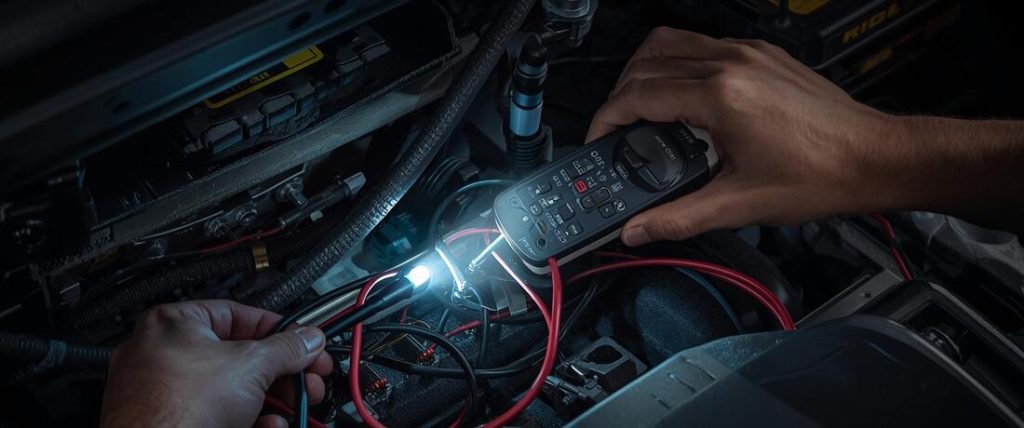
- 12V Test Light ($8–$12): This is the beginner favorite. It is cheap and visual. If it lights up, you found power.
- Digital Multimeter ($18–$30): You need this for numbers. It checks voltage and continuity.
- Fuse Puller & Spare Fuses: Check your glove box. You might already have these.
Nice-to-Have (under $100)
- Power Probe: This tool sends power to wires. It helps test motors.
- Tone Generator: This traces wires inside walls or car panels. It beeps when it is near the wire.
Free Must-Have
You need a map. Get a wiring diagram for your specific car. You can often find these on forums or buy a cheap manual. It shows you which wire goes where.
Safety Rules You Cannot Skip
Electricity demands respect. Even 12-volt car systems can hurt you or the car.
- Disconnect the Battery: Always take the negative (-) cable off before cutting or stripping wires.
- Never Upgrade Fuses: If a 10-amp fuse blows, never put in a 20-amp fuse. The wire will burn before the fuse blows. This causes fires.
- No Jewelry: Take off rings and metal watches. If they touch the battery, they can weld to your skin.
- Watch the Orange Cables: If you have a hybrid or EV, do not touch the bright orange cables. Those are high voltage. They can kill you.
Method 1 – The Test Light Trick (Easiest & Fastest)
This is the best trick in the book. It works for 90% of battery drains. You do not need to know math. You just need to watch a light.
Step 1: Disconnect the Negative Cable Go to your battery. Loosen the nut on the negative (-) terminal. Pull the cable off the post.
Step 2: Connect the Test Light Clip the alligator clip of your test light to the negative battery post. Touch the sharp probe tip to the metal ring of the loose negative cable.
Step 3: Check the Glow Does the test light glow?
- No Light: Your system is safe. No power is leaking.
- Bright Light: You have a short or a drain. Something is pulling power right now.
Step 4: The Fuse Pull Keep the light connected. It should be glowing. Now, go to your fuse box. Pull out fuses one by one.
- Pull a fuse. Look at the light.
- If the light stays on, put the fuse back.
- If the light goes out, you found the bad circuit!
Step 5: Isolate the Component Look at the fuse chart. Did the light die when you pulled the “Radio” fuse? Great. The short is in the radio circuit. Now you know where to look.
Method 2 – Multimeter Continuity Test (Pinpoint Exact Wire)
Method 1 finds the circuit. Method 2 finds the wire. This is great for blown fuses. You do this with the power OFF.
Step 1: Set Your Meter Turn your dial to the Continuity setting. It looks like a sound wave or a WiFi symbol. Touch the probes together. It should beep.
Step 2: Probe the Fuse Holder Remove the blown fuse. Put one probe into the “load” side of the fuse slot. (The side that goes to the light or motor, not the battery side).
Step 3: Connect to Ground Touch the other probe to a clean metal bolt on the car body.
Step 4: Listen for the Beep
- No Beep: The wire is safe (no short to ground).
- Beep: The wire is touching the body of the car somewhere.
Step 5: Divide and Conquer Trace that wire. Find the connectors. Unplug them halfway down the car. Test again.
- Still beeping? The short is closer to the fuse box.
- Beep stopped? The short is further down the line.
Top 6 Places Shorts Hide in Modern Cars
Cars vibrate. Wires rub. Here is where we find shorts most often.
- Door Boots: Open your door. Look at the rubber tube between the door and the car. Wires bend here thousands of times. They break and touch.
- Aftermarket Alarms/Stereos: Did a previous owner install a cool radio? They probably used cheap tape. Check under the dash.
- Under Seats: Power seats move back and forth. They can crush a wire on the seat track.
- Trunk Lid: Just like doors, the trunk harness bends every time you open it.
- Engine Bay: Wires get hot here. Look near the exhaust manifold. If a wire melts on a hot pipe, it shorts out.
- Rodent Damage: Mice love warm engines. They chew wires for fun. Check for nest material under the engine cover.
How to Fix the Short Once You Find It
You found the bare wire. Now what? Do not just wrap it in duct tape. Fix it right.
- Minor Rub: If the copper is okay but the plastic is cut, use high-quality electrical tape. Cover it with plastic loom tubing.
- Melted Wire: You must cut the bad section out. Strip the ends. Use a crimp connector or solder the wires. Use heat shrink tubing to seal it.
- Bad Part: Sometimes the wire is fine, but the part is broken internally. If your alternator has an internal short, you must replace the alternator.
For more on replacing bad parts, check our guide on car battery replacement tips.
How to Test for Parasitic Drain the Right Way
Sometimes the short is small. It takes days to kill the battery. This is a parasitic drain.
Normal Draw is Low Your car clock and alarm need a little power. A normal draw is roughly 50 milliamps (mA) or less. Anything over 50mA is a problem.
How to Measure Amps Safely
- Set your multimeter to Amps (A) or 10A.
- Move the red probe to the 10A port.
- Disconnect the negative battery cable.
- Put one probe on the battery post and one on the cable.
- Read the screen. Is it 0.50 amps? That is 500 milliamps. That is too high!
Start pulling fuses just like Method 1 until the number drops.
When to Stop DIY and Call a Pro (Be Honest)
You can fix a lot. But know your limits.
- Airbag Circuits: Wires wrapped in yellow are for airbags. Do not touch them. One wrong poke can set off the bag and hurt you.
- Main Harness: If the short is deep inside the main dashboard bundle, it is hard to reach. You have to take the whole dash out.
- High Voltage: Hybrids and EVs have orange cables. These carry 300+ volts. Leave these to certified pros.
Cost to Fix: A pro mechanic charges for time. Finding a short can take 1 hour or 5 hours. Expect to pay $150 to $450 at 2025 labor rates. It is cheaper than a burned-down car.
How to Prevent Future Short Circuits
Keep your electrical system healthy.
- Check insulation: Look at wires during oil changes.
- Secure loose wires: Use zip ties to keep wires away from hot or moving parts.
- Seal leaks: Water in the fuse box causes corrosion. Corrosion leads to shorts.
- Use Grommets: If you run a wire through a metal hole, use a rubber grommet. It stops the metal from cutting the wire.
- Keep it Clean: Dirt holds moisture. Keep your engine bay reasonably clean.
FAQs About How to Find a Short Circuit in a Car
How do you trace a short circuit?
The best way is the “Divide and Conquer” method. Split the circuit in half by unplugging a connector. Test which half has the short. Repeat until you find the spot.
What is the easiest way to find a short to ground?
Use a 12V test light. Put it between the negative battery post and the cable. If it lights up, pull fuses until it goes out. The fuse that turns off the light controls the shorted circuit.
How to fix a short circuited car?
Once you find the damaged wire, cut out the bad section. Solder in a new piece of wire. Cover it with heat-shrink tubing to protect it from water.
What are the symptoms of a short circuit in a car?
Common signs are blown fuses, a dead battery, the smell of burning plastic, or lights that flicker or dim.
Can I find a short without a multimeter or test light?
It is very hard. You can look for melted wires visually. You can also listen for the “click” of a relay. But a $10 test light saves you hours of guessing.
The Bottom Line – Your 30-Second Recap
Electrical problems feel huge, but they are just simple physics.
- Start with the test light. It works 9 times out of 10.
- Isolate the circuit. Pull fuses to find the “zone” of the problem.
- Trace the wire. Look for rub marks, cuts, or burns.
- Safety first. Always disconnect the battery before stripping wire.
- Not comfortable? Tow it. It is cheaper than a fire.
If you are stuck, check our maintenance section for more tips. Or, drop your car year, make, and model in the comments below. I’ll tell you the most common places shorts hide in your specific ride.