
This article was updated in May 20, 2026 with new products and information by Mark S. Taylor
Think of your engine’s airflow sensors like a restaurant manager trying to figure out how much food to prep. A MAF sensor counts every single person walking through the front door. A MAP sensor stands in the dining room, feels how compressed the air is, and calculates how many people must be inside.
Both sensors do the same job — help your engine’s computer calculate the right amount of fuel to inject. But they measure completely different things, they fail in different ways, and for performance applications, the choice between them matters more than most guides will tell you.
Here’s everything you need to know about MAF sensor vs MAP sensor, without the jargon.

Contents
Quick Winner
For daily driving on a stock engine: MAF sensor wins. Direct airflow measurement is more accurate across real-world conditions — cold starts, idle, light cruise, hard acceleration.
For performance builds and forced induction: MAP sensor wins. Speed density tuning is more flexible, handles boost pressure naturally, and isn’t restricted by a physical element sitting in the intake path.
For reliability and low maintenance: MAP sensor wins. Sealed design, no exposed element, virtually no maintenance required.
If your car came from the factory with one or the other — you’re not choosing. But if you’re building an engine or diagnosing a fault, that distinction matters.
What Each Sensor Does
MAF Sensor — Mass Airflow Sensor
The MAF sensor sits inside your intake duct, between the air filter and the throttle body. It measures the actual mass of air entering the engine in real time, using a heated wire element. As air flows past the wire, it cools the element. The ECU measures how much electrical current is needed to keep that wire at a constant temperature — more current means more airflow. That number goes directly into the fuel calculation.
Think of it as a scale for air. It weighs every breath your engine takes.
MAP Sensor — Manifold Absolute Pressure Sensor
The MAP sensor mounts on the intake manifold — downstream of the throttle body — and measures the pressure inside the manifold. It doesn’t touch the airflow at all. Instead, it reads vacuum pressure and sends that data to the ECU, which uses the pressure reading combined with engine RPM and a stored volumetric efficiency table to calculate how much air the engine is actually consuming.
Think of it as a barometer for your intake manifold. It infers airflow from pressure, rather than measuring it directly.
That one difference — direct measurement vs. inferred measurement — drives every comparison below.
Key Differences Table
| Feature | MAF Sensor | MAP Sensor |
|---|---|---|
| Measures | Air mass directly | Manifold pressure (infers airflow) |
| Location | Intake duct (in airstream) | Intake manifold (sealed) |
| Accuracy (stock engine) | Higher | Moderate |
| Accuracy (forced induction) | Lower | Higher |
| Failure frequency | More common | Less common |
| Maintenance required | Yes (periodic cleaning) | Virtually none |
| Altitude compensation | Limited | Excellent |
| Replacement cost (parts) | $50–$300 | $20–$100 |
| Performance tuning use | Less preferred | Preferred (speed density) |
| Typical vehicle use | Most modern NA gas engines | Diesel, turbo, older NA engines |
Pros & Cons
MAF Sensor
Pros:
- Directly measures air mass — most accurate for stock, naturally aspirated engines
- Works well across the full RPM and load range without a calibrated VE table
- Compensates automatically for air density changes (somewhat)
- Industry standard on most modern passenger vehicles — parts are widely available
Cons:
- Sits in the airstream — vulnerable to contamination from oil mist, dust, and intake sprays
- Physically restricts intake airflow (a consideration on performance builds)
- Cannot accurately measure air that has already passed through a turbocharger or supercharger
- Hot wire element is fragile — a backfire or debris strike can destroy it instantly
- Requires periodic cleaning to maintain accuracy
MAP Sensor
Pros:
- Sealed from the airstream — virtually immune to contamination
- Excellent altitude and barometric pressure compensation
- Preferred sensor for forced induction applications — reads boost pressure directly
- Lower replacement cost in most applications
- No maintenance required under normal conditions
Cons:
- Infers airflow rather than measuring it directly — less inherently accurate on stock engines without precise VE table calibration
- Requires accurate engine calibration data to work correctly — a poorly calibrated speed density tune is less forgiving than a MAF-based tune
- Vacuum line failure (on older designs) can cause sudden, dramatic sensor errors
- Less plug-and-play for modified engines without a proper retune

Performance Differences
This is where the comparison gets real for enthusiasts — and where most articles go quiet.
MAF-based tuning works by measuring actual airflow and adjusting fuel delivery in real time. It’s forgiving and self-correcting to a degree, because the sensor sees whatever air is actually coming in. But it has a hard limitation: it can’t measure air that’s been compressed by a turbocharger or supercharger. The MAF sits before the turbo on most setups — by the time the air has been compressed and heated, the density has changed completely, and the MAF reading is no longer accurate.
MAP-based (speed density) tuning uses manifold pressure, RPM, and a volumetric efficiency table to calculate airflow mathematically. On a forced induction engine, the MAP sensor reads boost pressure directly — exactly the data a turbocharged engine needs. This is why virtually every serious turbocharged performance build runs a MAP-only or MAP-primary strategy.
Beyond forced induction, speed density tuning also wins when:
- The engine has a large camshaft with aggressive overlap (which confuses MAF readings at idle)
- High-flow intakes or intake manifolds have changed the airflow path significantly
- The builder wants to remove the MAF as an intake restriction on a high-horsepower build
The tradeoff: speed density requires a precise, vehicle-specific VE table. Get the tune wrong and the engine runs poorly. MAF tuning is more forgiving out of the box — it adapts to actual airflow rather than relying on calculated estimates.
Reliability
MAP sensors win on reliability. It’s not particularly close.
The MAP sensor’s design is its advantage — it’s a sealed pressure transducer with no moving parts and no exposure to the airstream. There’s nothing to contaminate, nothing to foul, and no fragile element to damage. On most vehicles, a MAP sensor outlasts the engine with no intervention at all.
The MAF sensor’s weakness is its location. Sitting directly in the intake airflow, the hot wire element is exposed to every contaminant that makes it past the air filter — oil mist from a poorly maintained PCV system, dust from a clogged or low-quality filter, and hydrocarbon deposits over time. Aftermarket intake filter treatments (like some oiled gauze filters) are a notorious MAF killer when over-applied.
The important caveat: most MAF failures are preventable. A clean air filter, a properly functioning PCV system, and a periodic cleaning with MAF-specific spray keeps most sensors running accurately for the life of the vehicle. The reliability gap between MAF and MAP narrows significantly with proper maintenance.
Maintenance & Cost
| Item | MAF Sensor | MAP Sensor |
|---|---|---|
| Routine maintenance | Clean every 15,000–25,000 miles | None required |
| Cleaning product cost | $8–$12 (MAF sensor cleaner spray) | N/A |
| Replacement cost (OEM part) | $100–$300 | $30–$100 |
| Replacement cost (aftermarket) | $50–$150 | $20–$60 |
| Labor cost (shop) | $80–$150 | $60–$120 |
| Total replacement (shop) | $180–$450 | $90–$220 |
MAF sensors cost more to replace — the hot wire sensing element is precision-manufactured and OEM pricing reflects that. MAP sensors are simpler devices and almost always cheaper to source.
That said, a $10 can of MAF sensor cleaner used every 15,000–25,000 miles can prevent the majority of MAF failures entirely. The maintenance cost is minimal. The failure cost is not.
One important note: never use generic electrical contact cleaner on a MAF sensor. The residue destroys the hot wire element. Use only MAF-specific cleaner — the label matters.
Fuel Economy
A failing sensor of either type hurts fuel economy — but the MAF sensor affects MPG more commonly and more severely in real-world use.
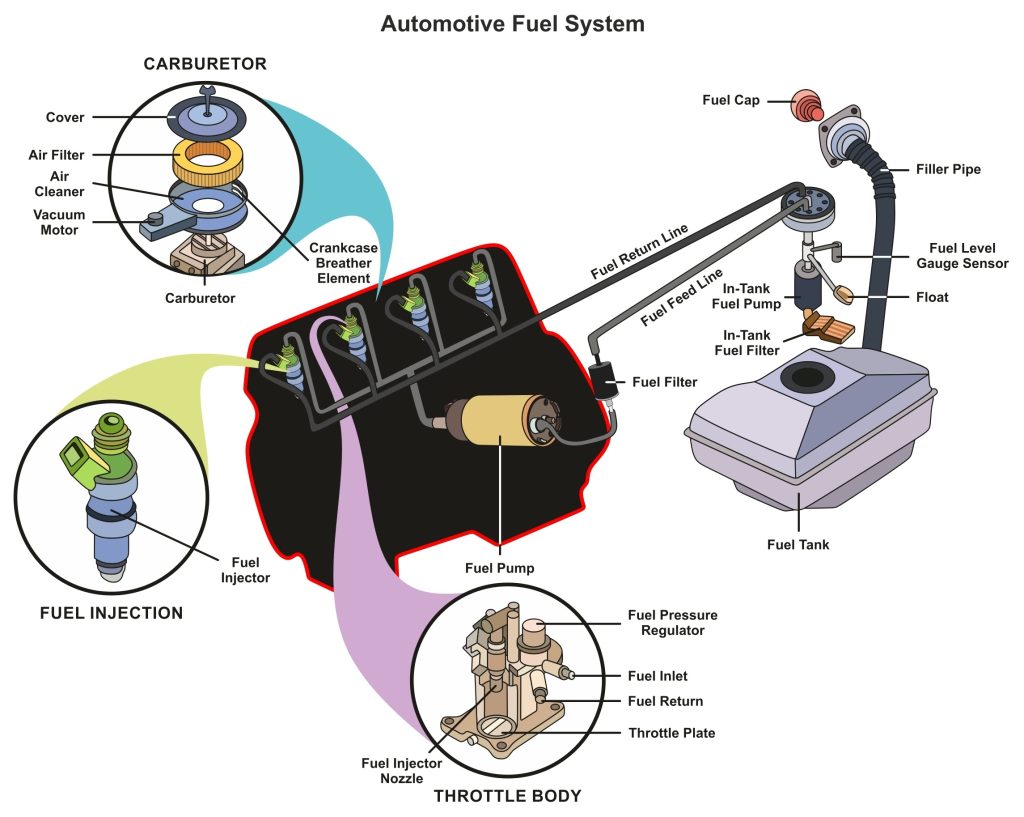
A dirty or failing MAF sensor under-reports the amount of air entering the engine. The ECU, believing less air is present than actually is, injects less fuel — creating a lean condition — or in some failure modes, over-corrects using oxygen sensor feedback and runs rich. Either way, combustion efficiency drops and fuel economy follows.
The impact is gradual and easy to miss. A MAF sensor that’s 15–20% out of calibration from contamination doesn’t trigger a check engine light immediately — it just quietly costs you 1–3 MPG over weeks or months until the long-term fuel trim compensation hits its limit and throws a code.
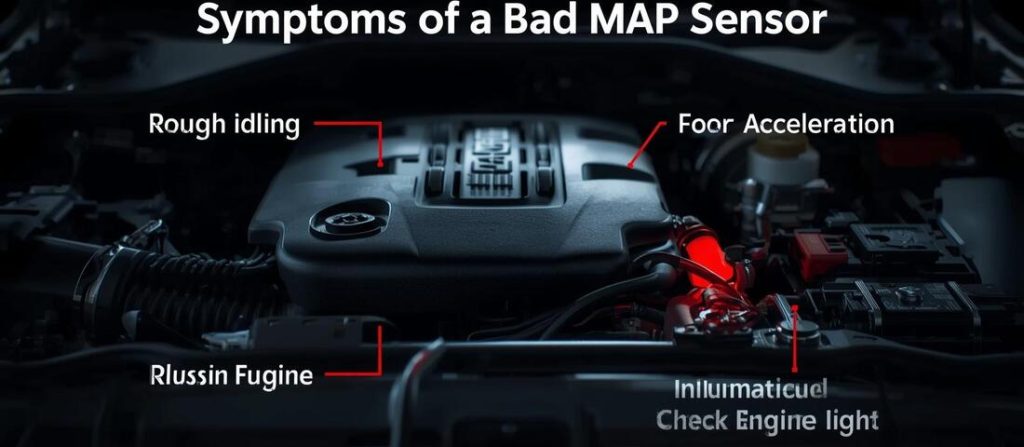
A failing MAP sensor causes similar symptoms — rough idle, poor fuel economy, hesitation — but MAP sensors tend to fail more abruptly (sudden pressure signal loss) rather than gradually drifting out of calibration the way a contaminated MAF does.
Bottom line on fuel economy: Keep your MAF sensor clean. It’s the single most overlooked cause of gradual MPG decline on modern fuel-injected vehicles.
Best for Daily Driving
MAF sensor wins for daily driving on a naturally aspirated stock engine.
The direct airflow measurement handles the variety of conditions a daily driver encounters better than inferred pressure data. Cold starts, variable humidity, altitude changes on a road trip, light city driving, highway cruise — the MAF adapts to all of it in real time without needing a calibrated VE table.
Every major manufacturer chose the MAF sensor for their modern passenger vehicles for exactly this reason. The accuracy advantage in real-world varied conditions outweighs the contamination vulnerability, especially when the sensor is properly maintained.
If your daily driver is a stock or near-stock naturally aspirated gas engine and your MAF fails, replace it with a quality OEM or OEM-equivalent unit. Don’t overthink it.

Best for Performance
MAP sensor wins for performance applications — and it’s not close once forced induction is involved.
On a turbocharged or supercharged engine, the MAF sensor simply cannot do its job accurately. Compressed air behaves differently than ambient air, and a sensor designed to measure ambient airflow mass gives the ECU bad data under boost. Bad data means bad fueling. Bad fueling on a boosted engine means detonation, and detonation means engine damage.
MAP-based speed density tuning reads boost pressure directly, works seamlessly with the ECU’s fueling calculations under all load conditions, and removes the MAF element as a physical intake restriction — a meaningful gain on high-horsepower builds where every CFM counts.
Even on naturally aspirated performance builds with aggressive camshafts, large throttle bodies, or significant intake modifications, speed density tuning often produces better results because the VE table can be calibrated precisely for the specific combination of parts — something a MAF sensor struggles with when the airflow characteristics have changed dramatically from stock.
If you’re building anything beyond a mild bolt-on naturally aspirated engine, the MAP-based tune is the direction professional tuners consistently recommend.
Which Lasts Longer?
MAP sensor — by a meaningful margin under real-world conditions.
A MAP sensor on a well-maintained vehicle routinely lasts 150,000 miles or more with zero intervention. The sealed pressure transducer design has no exposed element and no contact with the airstream. Short of a physical impact or electrical fault, there’s very little that causes a MAP sensor to fail prematurely.
A MAF sensor’s lifespan is more variable and more dependent on maintenance. A well-maintained MAF — clean air filter, healthy PCV system, periodic sensor cleaning — can also last the life of the vehicle. A neglected MAF on a vehicle with an over-oiled aftermarket filter or a failing PCV valve may fail within 50,000–80,000 miles.
If you’re comparing longevity on identical maintenance schedules, MAP wins. If you’re comparing a well-maintained MAF to a neglected MAP, the gap closes considerably.
The real answer: maintain your MAF sensor and the longevity difference becomes largely irrelevant for most drivers.
FAQs About MAF Sensor vs MAP Sensor
Does my car have a MAF or MAP sensor?
Most modern naturally aspirated gasoline passenger vehicles use a MAF sensor. Diesel engines, most turbocharged applications, and many older vehicles (pre-1990s) use a MAP sensor. Some modern vehicles use both — a MAP sensor for barometric pressure reference and a MAF for primary airflow measurement. Check your OBD2 live data: if you see a “MAF” reading in grams per second, you have one. If you only see manifold pressure in kPa, you’re MAP-only.
Can a bad MAF sensor cause the same symptoms as a bad MAP sensor?
Yes — almost completely. Both sensors affect the ECU’s fuel calculation when they fail, so the symptoms overlap heavily: rough idle, poor fuel economy, hesitation under acceleration, black smoke, and stalling. The OBD2 fault codes tell them apart — MAF codes run P0100–P0103; MAP codes run P0105–P0108. Pull codes before replacing anything.
Can I delete my MAF sensor and run MAP only?
Yes, but not without a proper retune. A MAF delete and conversion to speed density tuning requires reprogramming the ECU with a calibrated volumetric efficiency table for your specific engine. Unplugging the MAF without a tune will throw codes and run the engine poorly. This is a modification for engines that already have a professional tune — not a plug-and-play change.
Which sensor is more accurate at high altitude?
MAP sensor. At high altitude, air density drops, and the MAP sensor reads the actual manifold pressure — which reflects that lower density directly. The MAF sensor measures air mass in the intake duct and compensates somewhat, but doesn’t account for barometric pressure changes as completely as a MAP with a dedicated baro sensor reference. Drivers in high-altitude regions (Denver, the Rockies, mountain passes) with performance-tuned vehicles often find MAP-based tunes more consistent across elevation changes.
How often should I clean my MAF sensor?
Every 15,000–25,000 miles as a general guideline, or whenever you replace the air filter. Use only MAF-specific cleaner — never general electrical contact cleaner, brake cleaner, or compressed air directly on the sensing element. Allow the sensor to dry completely before reinstalling. Two minutes of work every oil change interval extends MAF sensor life dramatically.
Verdict
Choose MAF if: Your car is a stock or mildly modified naturally aspirated daily driver. The OEM MAF setup is more accurate, more widely supported, and easier to diagnose with standard OBD2 tools. Keep it clean and it will likely outlast your ownership of the vehicle.
Choose MAP (speed density) if: You’re running forced induction, building a high-horsepower naturally aspirated engine with significant camshaft or intake modifications, or want to remove the MAF as an intake restriction on a serious performance build. The MAP-based speed density tune is what professional tuners use on anything with a turbo — for good reason.
For OEM replacement: If your MAF sensor fails on a stock vehicle, replace it with an OEM or OEM-quality unit. Don’t swap to a MAP-only setup — your ECU isn’t calibrated for it and you’ll need a full retune to make it work properly.
The honest summary: Neither sensor is better in all situations. MAF wins in the showroom; MAP wins at the track. Know which situation you’re in, and the decision makes itself.