
This article was updated in November 27, 2026 with new products and information by Mark S. Taylor
When your rear wiper not working while the front wipers still run, the cause is usually an unlatched liftgate or rear glass interlock, a frozen blade, a blown rear-wiper fuse, a seized pivot shaft, or broken liftgate hinge wiring. Check hatch closure and blade clearance before replacing the motor.


Your front windshield wipers clear the rain cleanly, yet the rear blade sits frozen on the back glass. Because rear wipers usually run on their own fuse, switch circuit, and motor inside the liftgate, working front wipers never prove the rear motor is dead.
Before ordering a replacement motor or pulling interior hatch trim, check a few simple mechanical and control details. Watching how the arm, washer, and liftgate behave narrows down the fault quickly without risking electrical damage.
Contents
- 1 Rear Wiper Symptom Diagnostic Triage Table
- 2 7 Common Causes of a Rear Wiper Not Working
- 2.1 1. An Unlatched Liftgate or Flip-Up Rear Glass Interlock
- 2.2 2. A Frozen Blade or Heavy Snow Obstruction
- 2.3 3. A Salt-Seized Pivot Shaft or Stripped Arm Splines
- 2.4 4. A Blown Rear-Wiper Fuse
- 2.5 5. A Faulty Rear-Wiper Switch or Control Setting
- 2.6 6. Broken Wires in the Liftgate Hinge Harness
- 2.7 7. A Failed Rear Wiper Motor or Park Circuit
- 3 Safe Checks You Can Do Without Removing Trim
- 4 Can You Drive With a Rear Wiper That Does Not Work?
- 5 FAQs About Rear Wiper Not Working?
- 5.1 Why do my front wipers work while the rear wiper does not?
- 5.2 Why does my rear wiper motor hum while the blade refuses to move?
- 5.3 Could a blown fuse stop my rear wiper from working?
- 5.4 Can damaged liftgate wiring stop the rear wiper from working?
- 5.5 Why does my rear wiper turn on by itself when I shift into Reverse?
Rear Wiper Symptom Diagnostic Triage Table
Use what you hear and see when you turn the rear wiper switch on to pinpoint the most likely fault area.
| What the Rear Wiper Is Doing | Most Likely Cause Group | Safe First Check |
| Complete silence and no movement | Unlatched liftgate or rear glass interlock, blown rear fuse, switch, or broken hatch wire | Open and firmly re-close the liftgate and any flip-up rear glass; check the manual’s fuse chart |
| Motor hums or spins, but the blade stays still | Loose arm nut, car-wash stripped arm splines, or stripped internal motor gear | Look closely at the center pivot hub to see if the shaft spins inside a loose arm |
| Blade crawls slowly or stalls halfway across the glass | Frozen blade, salt-corroded pivot shaft, or weak motor under heavy drag | Turn the switch off immediately; let ice thaw before testing again |
| Works only sometimes, or quits alongside rear defroster or hatch lock | Fatigued wiring flexing inside the rubber liftgate hinge boot | Note whether other hatch electrical features also glitch when opening the liftgate |
| Rear washer sprays fluid, but the wiper refuses to sweep | Rear-wiper circuit, blown wiper fuse, seized pivot, or motor fault | Confirm the wiper has its own fuse separate from the washer pump |
7 Common Causes of a Rear Wiper Not Working
Rear wiper systems vary widely between SUVs, crossovers, and hatchbacks, so a technician should verify power and mechanical drag before swapping parts.
1. An Unlatched Liftgate or Flip-Up Rear Glass Interlock
Many SUVs and hatchbacks include a safety interlock switch that automatically disables the rear wiper whenever the liftgate—or an independent flip-up rear window—is not latched completely shut. That interlock keeps the wiper arm from sweeping off the glass and scratching the body.
Even if the liftgate looks closed, a slightly ajar latch or misaligned glass striker can keep the wiper dead. Open and firmly close both the main liftgate and any separate rear glass hatch, and check your dashboard for a liftgate-ajar warning.
2. A Frozen Blade or Heavy Snow Obstruction
Switching on a rear wiper when the rubber blade is frozen solid to the glass puts instant stall load on the tiny rear motor and gear set. Ice buildup or a heavy wet snowpack at the base of the glass can stop the blade completely and pop the circuit fuse.
Turn the rear switch off right away and let the rear defroster or mild ambient warmth free the blade. Never yank upward on a frozen arm or cycle the switch repeatedly while the rubber is stuck to the glass. A fuse that blows after running a frozen blade is usually protecting the circuit from an overload rather than failing on its own.
3. A Salt-Seized Pivot Shaft or Stripped Arm Splines
Flat-backed SUVs and hatchbacks pull salty winter road spray directly onto the rear window. Over several seasons, moisture creeps past the tiny rubber seal around the rear wiper spindle and corrodes the steel shaft inside its aluminum housing until the pivot seizes tight.
Another common mechanical failure happens right after an automatic car wash. Spinning wash brushes can snag the rear wiper arm and strip the soft metal splines inside the arm hub, letting the motor shaft spin freely while the blade sits still. If you hear the motor humming with no arm movement, have a shop inspect the arm nut, splines, and pivot shaft before replacing the motor.
4. A Blown Rear-Wiper Fuse
Most vehicles protect the rear wiper with its own dedicated fuse separate from the front wipers. Check your owner’s manual fuse diagram to locate the exact fuse and amperage rating, and inspect it only with the ignition switched off.
If a fresh fuse of the exact factory rating blows again right away, stop replacing fuses. A repeat blown fuse points to a short circuit in the hatch wiring or a dead-seized pivot shaft overloading the motor. Never install a higher-amperage fuse to keep the wiper running.
5. A Faulty Rear-Wiper Switch or Control Setting
Rear wiper controls can sit on a rotating ring on the steering-column stalk, a dashboard button, or a vehicle settings menu. Worn internal switch contacts can stop the command from ever reaching the body control module or rear motor.
Some vehicles also use model-specific control logic. For example, the 2024 Chevrolet Tahoe and Suburban Owner’s Manual documents an automatic reverse-gear rear-wiping setting that can be turned on or off in the vehicle menu. Confirm your vehicle’s exact control settings in the owner’s manual before assuming a switch failed.
6. Broken Wires in the Liftgate Hinge Harness
Every time you open and close your rear hatch, the electrical wiring bundle inside the flexible rubber boot at the top hinge bends back and forth. Over years of cold winters and daily use, copper strands fatigue and break cleanly inside the insulation.
Watch for companion clues on the liftgate. If your rear wiper fails alongside a glitching rear defroster, backup camera, license-plate light, or power hatch lock, the flexing hinge harness is a prime inspection spot. Avoid pulling on the rubber boot or probing live wires at the roadside without a wiring diagram.
7. A Failed Rear Wiper Motor or Park Circuit
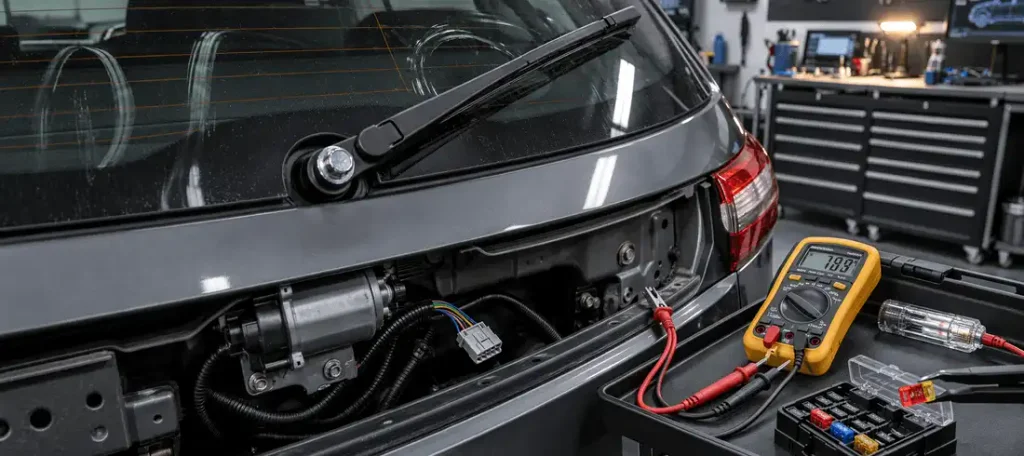
Inside the liftgate sits a compact electric motor paired with an internal plastic gear set and park switch that returns the blade to its resting stop. Water intrusion, stripped internal gears, or a failed park circuit can leave the wiper completely dead or stalled mid-glass.
Because silent motors are often caused by a missing power feed or broken ground wire, a technician should always verify battery voltage, ground, and control signals at the motor connector before condemning the motor. If your wipers are instead stuck running nonstop, read our guide on how wiper park circuits and switches control blade movement.
Safe Checks You Can Do Without Removing Trim
Run through these low-risk checks before scheduling shop time:
- Confirm the rear wiper switch is in an active ON or intermittent position.
- Open and firmly re-close the rear liftgate and any independent flip-up rear glass.
- Check the rear blade for ice, packed snow, or a loose mounting cover.
- Listen briefly for motor humming when switching the wiper on, and shut it off immediately if the blade stalls.
- Test the rear washer spray to see whether the washer circuit still has power.
- Inspect the rear-wiper fuse with the ignition off using your exact owner’s manual diagram.
- Note whether other liftgate electrical items (rear defroster, third brake light, hatch lock, or backup camera) also stopped working.
Can You Drive With a Rear Wiper That Does Not Work?
Whether it is safe to drive depends on weather and how clearly you can see behind you. Federal Motor Vehicle Safety Standard 104 (49 CFR 571.104) sets wiping and washing requirements for the front windshield rather than mandating a rear wiper on every vehicle.
Even so, heavy rain, slush, or muddy highway spray can blind a flat SUV rear window in seconds. If your side mirrors and rear defroster do not give you clear, safe visibility in poor weather, hold off on driving until the rear wiper is repaired.
FAQs About Rear Wiper Not Working?
Why do my front wipers work while the rear wiper does not?
Most vehicles put the rear wiper on its own separate fuse, switch circuit, liftgate wiring harness, and motor. A blown rear fuse, an ajar liftgate interlock, a seized rear pivot shaft, or a broken hatch hinge wire will disable the rear blade while leaving the front wipers untouched.
Why does my rear wiper motor hum while the blade refuses to move?
A humming motor with a stationary blade usually means the wiper arm nut loosened, a car wash stripped the splines inside the arm hub, or internal plastic gears inside the motor gearbox stripped out. Shut the switch off so you do not burn out the motor.
Could a blown fuse stop my rear wiper from working?
Yes. Check your owner’s manual to locate the rear-wiper fuse and inspect it with the ignition off. If a replacement fuse of the exact same amperage blows immediately, stop and have a shop test for a seized pivot shaft or shorted liftgate wire.
Can damaged liftgate wiring stop the rear wiper from working?
Yes. Wires inside the flexible rubber boot at the top of the hatch flex every time you open the liftgate and can break over time. If the rear wiper quits alongside the rear defroster, hatch lock, or backup camera, have a technician inspect that harness first.
Why does my rear wiper turn on by itself when I shift into Reverse?
Many modern SUVs and hatchbacks include an automatic reverse-linked wiping feature that sweeps the rear glass whenever the front wipers are on and you shift into Reverse. Check your vehicle’s infotainment settings or owner’s manual to turn that feature on or off.
Start by checking that the liftgate and any flip-up rear glass are latched tightly, clearing ice from the blade, and checking the rear-wiper fuse against your owner’s manual. Listening for motor noise and noting any other liftgate electrical glitches helps a technician pinpoint a seized pivot, stripped arm, or broken hatch wire without guessing at the motor. For more circuit-testing guides, browse our automotive electrical troubleshooting guides and car problem and symptom troubleshooting guides.