
This article was updated in June 18, 2026 with new products and information by Mark S. Taylor
Your car hesitates when you step on the gas, struggles to start on cold mornings, and completely bogs down on highway on-ramps. While many drivers immediately assume they need expensive new spark plugs or ignition coils, the real culprit is often a heavily restricted fuel filter. This small component stands as your engine’s primary bodyguard, trapping sand, rust, and fuel-tank sediment before it can choke your high-pressure injectors.
When a fuel filter becomes clogged, it starves the combustion chamber of clean gasoline and forces your internal electric fuel pump to work itself to premature death. As an ASE-Certified Master Technician, I have seen simple $20 fixes turn into $800 repair bills because a driver ignored the early warning signs for too long. In this comprehensive guide, we will break down the symptoms of a bad fuel filter by their severity stages so you know exactly when it is safe to drive and when to stop

Contents
- 1 What Does a Fuel Filter Do? (30-Second Explainer)
- 2 The 4-Stage Fuel Filter Symptom Severity Ladder
- 3 5 Definitive Symptoms of a Clogged Fuel Filter
- 4 ⚠️ First — Does Your Car Even Have a Replaceable Fuel Filter?
- 5 The Hidden Danger — Fuel Filter Cascade Damage
- 6 Bad Fuel Filter vs. Bad Fuel Pump — How to Tell the Difference
- 7 Can You Clean a Fuel Filter? (Short Answer: No)
- 8 OBD-II Codes Linked to a Clogged Fuel Filter
- 9 Fuel Filter Replacement Cost
- 10 How Often Should You Replace Your Fuel Filter?
- 11 Is It Safe to Drive With a Bad Fuel Filter?
- 12 How to Prevent Fuel Filter Problems
- 13 FAQs About Symptoms of a Bad Fuel Filter
- 13.1 Q: Can a bad fuel filter cause a car to throw a random misfire code?
- 13.2 Q: Can I wash out or clean a caked fuel filter with carburetor cleaner?
- 13.3 Can you clean a fuel filter instead of replacing it?
- 13.4 What happens if you don’t replace your fuel filter?
- 13.5 What OBD code does a clogged fuel filter cause?
- 14 The Bottom Line from the Shop Garage
What Does a Fuel Filter Do? (30-Second Explainer)
The fuel filter sits between the gas tank and the engine.
It acts like a screen. It catches rust, dirt, and debris before they reach the injectors. Even clean gas has tiny particles in it. Over time, the filter fills up with this grit. The flow gets slower. The engine gets less gas. This happens slowly. You might not notice it at first. But eventually, the engine cannot breathe.

The 4-Stage Fuel Filter Symptom Severity Ladder
A vehicle’s fuel filter rarely clogs instantly. Particulate matter cakes over the internal pleated paper media slowly over a span of months. The driving symptoms degrade progressively through four distinct stages:
Stage 1: The Micro-Restriction (25% to 50% Blocked)
- What You Notice: A highly subtle drop in highway fuel economy (roughly 1 to 2 MPG loss) and an occasional soft hesitation when trying to accelerate rapidly from a dead stop.
- Urgency: Low. The vehicle is completely safe to drive, but you should budget for a replacement within the next month.
Stage 2: The Operational Struggle (50% to 75% Blocked)
- What You Notice: The engine requires extended cranking times (3 to 5 seconds) to start on cold mornings. You will experience a rough, shaking idle at stoplights, and the vehicle will feel lazy or sluggish when climbing steep hills.
- Urgency: Medium. Schedule a replacement within two weeks to prevent stressing your fuel pump.
Stage 3: The Combustion Crisis (75% to 90% Blocked)
- What You Notice: The engine actively sputters, misfires, or stalls completely when returning to an idle speed. The dashboard Check Engine Light triggers constantly, displaying system-lean codes.
- Urgency: High. Fix the filter this week. Continued misfires will dump raw fuel into your exhaust, melting your expensive catalytic converter.
Stage 4: Total System Collapse (90% to 100% Blocked)
- What You Notice: The car cranks indefinitely but refuses to start. If it does catch, it dies within seconds. A loud, high-pitched screaming or whining sound emits continuously from your rear seat area.
- Urgency: Emergency. Stop driving immediately. Your fuel pump is overheating against a solid wall of pressure and is on the verge of burning out completely.
5 Definitive Symptoms of a Clogged Fuel Filter
1. Extended Cranking During Engine Ignition
When a vehicle sits parked overnight, line pressure bleeds down. Upon turn-on, a healthy fuel pump requires roughly two seconds to prime the rail. A choked filter restricts this fluid wave, forcing the starter motor to spin the engine extensively before enough gasoline reaches the cylinders to initiate combustion.
2. Loss of Throttle Response and Power Under Load
This is the classic, un-bypasable mechanical signature of fuel starvation. At a steady 30 mph cruise, the engine demands very little fuel volume, so the car feels completely normal. However, the exact millisecond you floor the pedal to merge onto an interstate highway or carry a heavy load, the car gasps for fuel, bogs down, and refuses to accelerate.
3. Severe Engine Stalling at Low Speeds
When your car drops down to idle at a red light, the alternator spins slower, meaning the fuel pump operates at a slightly lower voltage threshold. If the filter is packed with sediment, this reduced pressure cannot push past the restriction. The engine starves, shudders, and drops to zero RPM.
4. Whining or Buzzing Sounds From the Gas Tank Area
Your vehicle’s electric fuel pump relies on the continuous flow of cool gasoline passing through it to maintain safe operating temperatures. When forced to push fluid against a caked, clogged filter, the electric motor draws excessive current and runs incredibly hot. This physical stress creates a loud, audible buzzing or whining sound beneath the rear passenger seat cushions.
5. Active Lean Dashboard Error Codes
Modern oxygen sensors continuously scan your tailpipe emissions. When a clogged filter restricts fuel delivery while intake air volume remains constant, the system runs lean. The onboard computer detects this unburnt oxygen array and illuminates your check engine light, logging diagnostic trouble codes P0087 (Fuel Rail Pressure Too Low) and P0171 (System Too Lean).
⚠️ First — Does Your Car Even Have a Replaceable Fuel Filter?
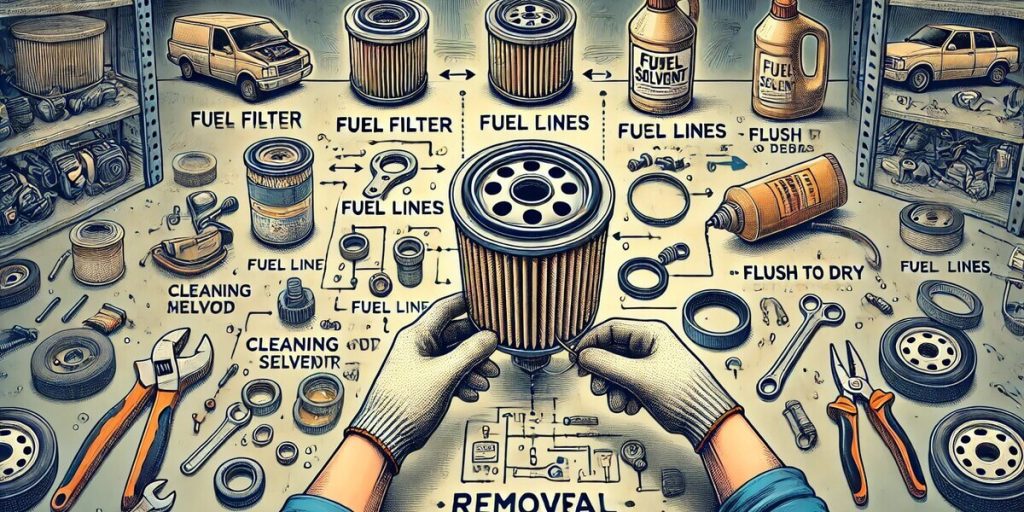
Many modern cars do not have a filter you can change yourself.
| Filter Type | How to Identify | Can You Replace It? |
|---|---|---|
| Inline / External | Metal canister under the car or hood. | ✅ Yes. Easy to reach. |
| In-Tank / Integrated | Inside the fuel tank with the pump. | ⚠️ Only with pump replacement. |
| Lifetime Filter | Mesh screen on the pump. | ❌ No service needed. |
Most cars before 2000 have an inline filter. Many cars after 2010 have a “lifetime” filter or one inside the tank. Look in your owner’s manual. If you have an in-tank filter and have low pressure, the fuel pump is likely the problem.
The Hidden Danger — Fuel Filter Cascade Damage
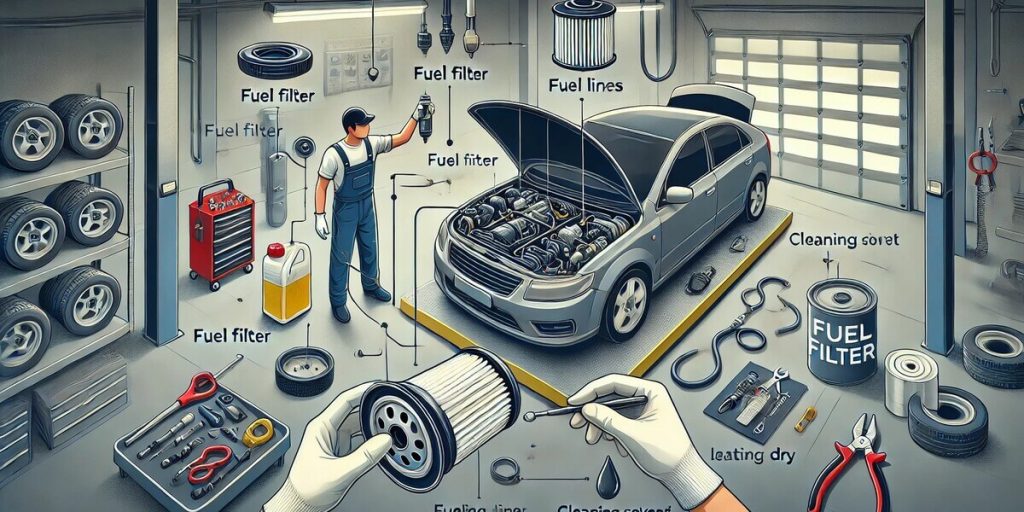
Ignoring the filter destroys other parts.
| What Gets Damaged | How It Happens | Repair Cost |
|---|---|---|
| Fuel Pump | Works too hard. Overheats. | $300 – $700. |
| Injectors | Dirt gets past the filter. | $150 – $500 each. |
| Catalytic Converter | Misfires overheat it. | $1,200 – $2,500. |
A $50 filter can prevent $3,000 in repairs. Do not wait.
Bad Fuel Filter vs. Bad Fuel Pump — How to Tell the Difference
It can be hard to tell them apart.
| Symptom | Clogged Fuel Filter | Bad Fuel Pump |
|---|---|---|
| Power loss under load | ✅ Yes. | ✅ Yes. |
| Stalling at idle | ✅ Yes. | ❌ Rare. |
| Hard start | ✅ Long crank. | ✅ No start. |
| Whining noise | ✅ Pump straining. | ✅ Pump dying. |
| Symptom speed | Gradual (weeks). | Sudden (now). |
Rule: If it happened slowly over weeks, check the filter. If the car died suddenly at highway speed, check the pump.
Can You Clean a Fuel Filter? (Short Answer: No)
You cannot clean a fuel filter.
It is a sealed container. The paper or mesh inside is packed tight. You cannot wash it out. Blowing air through it can damage the media. It will let dirt pass. You must replace it.
OBD-II Codes Linked to a Clogged Fuel Filter
These codes point to low fuel.
| Code | Meaning | Notes |
|---|---|---|
| P0087 | Fuel pressure low. | Most common code. |
| P0171 | System lean (Bank 1). | Not enough fuel. |
| P0174 | System lean (Bank 2). | V-engines. |
| P0300 | Random misfire. | Starving cylinders. |
Tip: P0087 plus P0171 is the strongest sign of a blockage.
Fuel Filter Replacement Cost
The cost is low compared to other repairs.
| Service | Estimated US Cost |
|---|---|
| Inline Filter (Part) | $10 – $40. |
| Inline Filter (Installed) | $50 – $200. |
| In-Tank Filter (w/ Pump) | $300 – $700. |
| Diagnostic Scan | $50 – $150. |
RepairPal is a good site to check fair prices in your area.
How Often Should You Replace Your Fuel Filter?
Check your manual for the exact time.
| Vehicle Type | Recommended Interval |
|---|---|
| Gas (External Filter) | Every 20,000 – 40,000 miles. |
| Diesel (External Filter) | Every 10,000 – 15,000 miles. |
| Modern (Lifetime) | No service needed. |
Never run your tank below ¼ full. The dirt at the bottom mixes with the fuel. This clogs the filter fast.
Is It Safe to Drive With a Bad Fuel Filter?
It is safe only in the early stages.
- Stage 1–2: You can drive. Replace it within two weeks.
- Stage 3: Replace it this week. Misfires hurt the converter.
- Stage 4: Stop driving. The pump is failing. Tow the car.
How to Prevent Fuel Filter Problems
Good habits stop clogs.
- Change it: Follow the schedule.
- Keep it full: Don’t let the tank get low.
- Good gas: Use TOP TIER stations.
- Listen: If the pump gets loud, check the filter.
FAQs About Symptoms of a Bad Fuel Filter
Q: Can a bad fuel filter cause a car to throw a random misfire code?
Yes. Fuel starvation rarely affects all cylinders equally. As line pressure drops, the fuel injectors farthest from the main feed line fail to atomize gasoline, resulting in incomplete combustion. This triggers multiple cylinder misfire codes like P0300.
Q: Can I wash out or clean a caked fuel filter with carburetor cleaner?
Absolutely not. Modern automotive fuel filters utilize microscopic cellulose paper or composite mesh tightly packed inside a sealed aluminum canister. Spraying chemicals or blowing compressed air into it will tear the delicate paper lining, allowing destructive grit to pass straight into your high-pressure injectors.
Can you clean a fuel filter instead of replacing it?
No. You cannot clean it. The filter media is too dense. It traps tiny particles. Flushing it will not remove them. It is cheaper to buy a new one for $15 than to risk your engine.
What happens if you don’t replace your fuel filter?
The pump works harder and burns out. Debris passes the filter and clogs injectors. Misfires ruin the catalytic converter. A small job becomes a huge bill.
What OBD code does a clogged fuel filter cause?
Look for P0087 (low pressure) and P0171 (lean mix). These codes mean the engine is starving for fuel. Check the filter first.
The Bottom Line from the Shop Garage
A restricted fuel filter is a minor \$20 maintenance item that will easily snowball into a catastrophic \$600 fuel pump replacement if ignored for too long. If your engine is stumbling under load or screaming from the rear seat, change the filter immediately.
(Want to ensure your vehicle’s electronic fuel injection systems, oxygen loops, and engine computer networks are functioning flawlessly? Read our master diagnostic guide on How to Read Check Engine Light Codes Without a Scanner or explore The Car Buzz Official Testing and Editorial Integrity Guidelines).