
This article was updated in December 17, 2025 with new products and information by Mark S. Taylor
That high-pitched squeal from your engine isn’t just annoying—it’s your car crying for help. I’ve seen what happens when drivers ignore these sounds. I’ve watched small pulley problems turn into thousand-dollar repairs. Today, I’ll share the 7 warning symptoms of a bad idler pulley. I’ll show you how to spot them early. And I’ll explain what to do next. Don’t wait until you’re stranded on the highway. Let’s fix this before it gets worse.
Contents
What Is an Idler Pulley & What Does It Do?
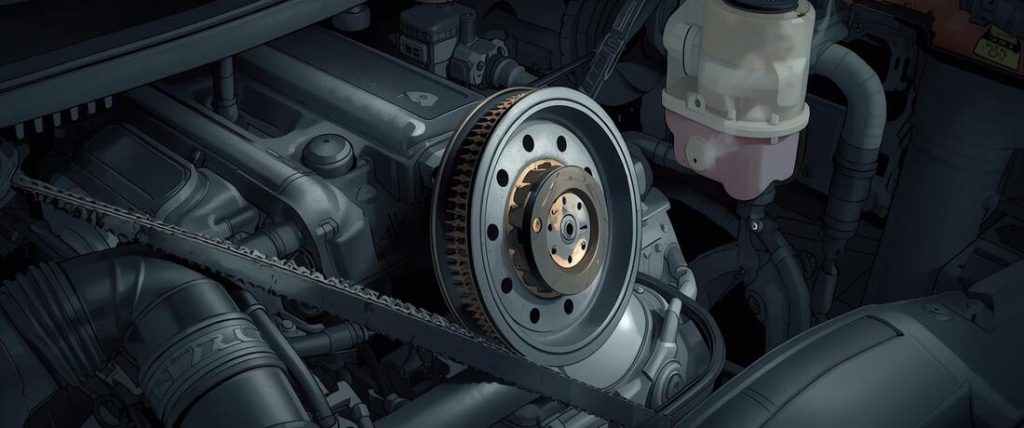
An idler pulley is a guide wheel that helps route the serpentine belt around your engine accessories.
Your engine has a long rubber belt. This belt snakes around the alternator, AC compressor, and power steering pump. The belt needs to turn sharp corners to reach all these parts. The idler pulley sits in those tight spots. It guides the belt on the right path.
It does not power anything. It just spins. It has a bearing inside to keep it moving smoothly. When that bearing dries out, the trouble starts.
The Idler Pulley’s Role in the Drive Belt System
The idler pulley creates the right path for your drive belt.
Without idler pulleys, the belt would rub against other engine parts. It keeps the belt aligned. Most cars have one or two of them. They are simple parts. They are usually made of steel or hard plastic. But they have a very important job. If the pulley seizes, the belt stops moving.

Idler Pulley vs. Tensioner Pulley: What’s the Difference?
The tensioner keeps the belt tight, while the idler pulley just guides the belt.
Many people mix these two up. They look similar. They both have pulleys. But they do different jobs. A tensioner has a spring or hydraulic part attached to it. It pushes hard on the belt to keep it tight. The idler pulley is bolted in one spot. It does not push; it just spins.
Comparison: Idler vs. Tensioner
| Feature | Idler Pulley | Tensioner Pulley |
| Main Job | Guides the belt path | Keeps the belt tight |
| Movement | Spins in place | Spins and pivots (moves) |
| Failure Sign | Squealing, wobbling | Rattling, loose belt |
| Cost | Cheaper ($20–$50) | More Expensive ($50–$150) |
Top 7 Symptoms of a Bad Idler Pulley
The most common symptom is a chirping noise that speeds up when you rev the engine.
You do not need to be a mechanic to spot a bad pulley. Your car will usually give you clear warning signs. Here are the top seven things to look (and listen) for.
1. Squealing or Chirping Noises
A failing bearing often makes a squeal that matches your engine speed.
This is usually the first sign. You might hear a chirp when you start the car in the morning. This happens because the grease inside the pulley bearing dries out. The metal balls inside rub together.
Does the noise get faster when you press the gas? That is a classic sign. It means the noise is coming from something spinning with the engine belt.
2. Grinding or Rattling Sounds
A grinding sound means the bearings have completely fallen apart.
This is worse than a squeal. A grinding noise sounds like metal chewing on metal. It means the smooth balls inside the bearing are broken or gone. If you hear this, you are on borrowed time. The pulley could seize up any minute.
3. Visible Pulley Wobble
A good pulley spins straight; a bad pulley wobbles side to side.
Open your hood while the engine is running. Be careful. Keep your hands away from the moving belt. Look at the round pulley. Is it spinning smoothly? Or does it look like a wobbling coin before it falls?
If it wobbles, the bearing is shot. The inner race of the bearing is loose. This wobbling will tear up your belt very quickly.
4. Surface Wear or Scoring
Scratches or grooves on the pulley face indicate contact issues.
Shut the engine off. Look closely at the surface of the pulley where the belt sits. It should be smooth. If you see deep grooves, pits, or scratch marks, the pulley is worn out.
Sometimes, a seizing pulley will have melted plastic spots if the belt dragged across it.
5. Damaged Serpentine Belt (Fraying or Glazing)
A bad pulley will cause the belt to crack, fray, or look shiny (glazed).
Your belt should look like matte black rubber. If the idler pulley drags or wobbles, it hurts the belt. You might see strings hanging off the side of the belt. Or, the belt might look shiny and hard.
If you are seeing belt damage, check out our guide on serpentine belt replacement to see if you need a new one.
6. Engine Overheating
If the pulley seizes, the belt slips, and the water pump stops cooling the engine.
This is a serious side effect. The serpentine belt often turns the water pump. The water pump cools your engine. If the idler pulley breaks, the belt might fall off or stop turning.
Without the water pump, your engine gets hot fast. You will see the temperature gauge on your dash go up.
7. Accessory Failure (AC, Alternator, Power Steering)
When the pulley fails, other parts like the alternator or AC may stop working.
The belt powers everything. If a bad idler pulley causes the belt to slip, your accessories will fail. You might notice:
- The battery light comes on (Alternator not charging).
- The AC blows warm air.
- The steering feels very heavy.
If your battery light pops on, ensure you have a backup plan, like a jump starter. You can read more about reliable options in our car battery guides.
Interpreting Engine Noises (Diagnostic Guide)
Different sounds point to different problems under the hood.
Engine noises can be tricky. Here is a quick cheat sheet to help you figure out what you are hearing.
| Sound | Likely Problem |
| Light Chirp | Dry bearing grease or belt misalignment. |
| Loud Squeal | Slipping belt (loose tension) or a seized pulley. |
| Grinding/Growling | Collapsed bearing balls (Metal-on-metal). |
| Clicking/Ticking | A chunk is missing from the belt or pulley. |
How to Diagnose a Bad Idler Pulley (Step-by-Step)
The best way to test a pulley is to remove the belt and spin it by hand.
You can do this at home with basic tools. You will need a socket set and a way to release the belt tension.
Step 1: Visual Inspection (Engine Off)
Look for “rust dust” around the center of the pulley.
Make sure the engine is cold and off. Take a flashlight. Look at the center bolt of the idler pulley. Do you see reddish or brown dust? This is a tell-tale sign. It means the seal on the bearing broke. Water got in, and rust is coming out. If you see rust dust, replace the pulley.
Step 2: The “Wiggle” Test
Grab the pulley and try to rock it back and forth.
With the belt still on (or off for better results), grab the pulley with your hand. Try to push it toward the engine and pull it back. There should be no play. It should be rock solid. If it clicks or moves side-to-side, the bearing is worn out.
Step 3: The “Spin” Test (Belt Removed)
A good pulley stops spinning quickly; a bad one spins freely or feels rough.
This is the most accurate test.
- Use a wrench on the tensioner to loosen the belt.
- Slip the belt off the idler pulley.
- Spin the idler pulley hard with your hand.
- Good Pulley: It spins smoothly but feels “thick” due to grease. It stops spinning after a turn or two.
- Bad Pulley (Dry): It spins freely and keeps going for a long time (like a fidget spinner). This means the grease is gone.
- Bad Pulley (Rough): It feels gritty or crunchy when you turn it.
What Causes Idler Pulleys to Fail?
Idler pulleys mostly fail due to age and lack of lubrication.
They are simple parts, but they live in a harsh place.
Normal Wear and Tear (Bearing Fatigue)
Every time your engine runs, that pulley spins thousands of times. Over 50,000 or 100,000 miles, the metal simply wears out. It is a normal maintenance part.
Contaminants (Water, Dirt, Oil Leaks)
If you drive through deep puddles, water can wash the grease out. If your engine has an oil leak, oil can get into the bearing seal. Dirt and grit can also grind down the smooth surfaces.
Improper Belt Tension
If the tensioner is too tight, it pulls too hard on the idler pulley. This extra pressure burns out the bearing faster than normal.
Replacement Cost & Options
Replacing an idler pulley is cheap, costing between $100 and $300 for a pro to do it.
If you catch it early, it is a very affordable repair.
Average Replacement Cost (Parts vs. Labor)
The part itself is inexpensive.
- Part Cost: $20 to $60 depending on your car.
- Labor Cost: $80 to $150 (usually one hour of work).
If you go to a dealer, it might cost a bit more. An independent mechanic is usually cheaper.
DIY Difficulty: Can You Do It Yourself?
Yes, this is a beginner-friendly repair.
If you can change a tire, you can usually change an idler pulley. You need to know how to remove the serpentine belt. Once the belt is off, the pulley is usually held on by just one bolt.
Should You Replace the Tensioner and Belt too?
It is best practice to replace the belt, tensioner, and idler at the same time.
Mechanics call this a “system service.” Since you have to take the belt off anyway, it makes sense to swap old parts for new ones. If the idler is bad, the tensioner is likely old too. You can buy “belt drive kits” that include everything you need.
FAQ: Common Questions About Idler Pulleys
Can a bad idler pulley cause rough idle?
No, usually not directly. A bad pulley makes noise. However, if the pulley seizes and drags the belt down, it can put a heavy load on the engine. This might make the idle feel a little lower or rougher, but noise is the main sign.
Can I drive with a bad idler pulley?
You should not drive for long. If it is just squeaking, you might make it to the shop. But if it is grinding or wobbling, stop driving. If the pulley flies apart, you lose power steering and the car will overheat. It is not worth the risk.
What are the symptoms of a bad tensioner pulley?
A bad tensioner usually causes the belt to flap or squeal. The main difference is that a bad tensioner often makes the belt loose. You might hear a belt slap noise. An idler pulley is more likely to make a constant grinding sound.
Can a bad idler pulley cause a belt to slip?
Yes. If the pulley bearing drags or seizes, the belt will slide over it instead of rolling. This causes a loud screeching noise and burns the belt.
Is it hard to replace an idler pulley yourself?
No, it is generally easy. On most cars, it is right at the front of the engine. The hardest part is often just having enough room for your hands. You can check a repair manual like Haynes or Chilton for your specific car model instructions.
Bottom Line
Do not ignore that squeak. It is a cheap part that protects an expensive engine.
A bad idler pulley is small, but it can cause big problems. If you hear chirping, check it out.
- Listen: Is it squealing or grinding?
- Look: Is the pulley wobbling?
- Test: Does it spin too freely?
Replacing it is quick and cheap. Waiting until it breaks will leave you on the side of the road with a broken belt and an overheated engine.
Quick Summary:
- Idler pulleys guide the belt; they don’t power anything.
- Squealing and grinding are the top signs of failure.
- A “Spin Test” reveals if the bearing is dry.
- Replacement is easy and costs $20-$60 for the part.
- Replace the belt and tensioner at the same time for peace of mind.