
This article was updated in April 10, 2026 with new products and information by Mark S. Taylor
A timing belt that breaks while driving can destroy your engine in a fraction of a second. It often gives very little warning before it does. Unlike most car problems that get worse slowly, timing belt failure is sudden. The worst part is that most drivers do not know their belt is worn until it is gone. This guide covers the symptoms of a bad timing belt, what they mean, and why acting fast matters. Early action can mean the difference between a $500 fix and a $4,000 rebuild.

Contents
⚠️ Critical Safety Note: The Interference Engine Risk
Not all timing belt failures are the same. Your engine type decides how bad the damage is. An interference engine has pistons and valves that share the same space. They rely on precise timing to avoid hitting each other. If the belt breaks, the pistons strike the open valves. This destroys valves, bends rods, or cracks the head. It costs $2,000 to $6,000 to fix. A non-interference engine has separate paths for pistons and valves. If the belt breaks, the engine just stops. It will not run, but it has no catastrophic damage. Most modern engines are interference engines. Check your owner’s manual to be sure. If you have an interference engine, a broken belt can total your car. Do not wait for symptoms.
What Does a Timing Belt Do?
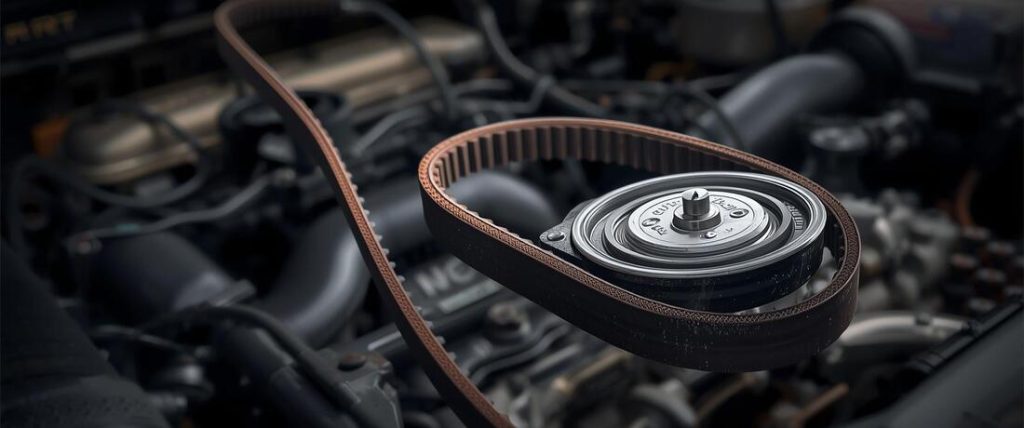
The timing belt synchronizes the crankshaft and camshaft. This makes the valves open and close at the right time. It is located under a plastic cover at the front of the engine. It is made of rubber with nylon reinforcement and teeth on the inside. It also drives the camshafts and often the water pump. Without this belt, the engine stops running immediately. Not every car has a belt. Some use metal timing chains, which last longer.
Timing Belt vs Timing Chain — Do You Have One?
You need to know which one your car has. A timing belt is made of rubber with teeth. It needs scheduled replacement every 60,000 to 105,000 miles. It is quieter. You find it in many cars from Honda, Toyota, and VW. A timing chain is made of metal. It usually lasts the life of the engine. It is found in larger engines and trucks. Chains can stretch and rattle over time. To check yours, look in your owner’s manual. It will say “belt” or “chain.” If you have a chain, watch for rattling noises, not the symptoms below.
7 Symptoms of a Bad Timing Belt
1. Ticking or Clicking Noise from the Engine
A rhythmic ticking sound is the most common early sign. You will hear it from inside the engine bay. Worn belt teeth can cause the belt to skip. A bad tensioner can also make the belt slap against the cover. Ticking can also mean low oil. Check your oil level first. If the oil is fine, the tick might be the belt. This noise is usually louder at idle. It is a fast, high-pitched sound. It does not go away when you rev the engine.
2. Engine Misfires
A worn belt can stretch and slip on the pulleys. When it slips, the timing is off. The valves open and close at the wrong time. Fuel enters the cylinder at the wrong moment. This causes a misfire. Your car will shake or hesitate when you accelerate. You might see a check engine light for codes like P0300. These misfires often affect multiple cylinders. New spark plugs will not fix this problem. If your car misfires after a tune-up, check the timing belt.
3. Oil Leak Near the Front of the Engine
Look at the front of your engine. Do you see wetness or oil? The timing belt cover uses a gasket to seal it. This gasket can fail over time. If oil leaks onto the belt, it is dangerous. Oil destroys rubber quickly. It causes the belt to slip or break. This is a double problem. The leak is a symptom, but it also causes failure. Look for brown residue on the bottom of the cover. You must fix the leak and replace the belt.
4. Engine Won’t Start or Won’t Turn Over Fully
If the belt breaks, the engine will not start. The starter might crank the engine, but it will not fire. The crankshaft spins, but the camshaft does not. Without valve timing, there is no combustion. People often think this is a dead battery. But a battery test will show the battery is good. In severe cases, the engine might not crank at all. This happens if bent valves block the pistons. If your car ran fine yesterday but won’t start today, suspect the belt.
5. Rough Idle and Engine Vibration
A stretched belt creates small timing errors. The camshaft and crankshaft are not perfectly synced. This makes the combustion cycle uneven. Some cylinders fire early or late. The engine will shake at a stop. You might feel the car stumbling or surging. This often happens before the belt breaks completely. Catching this symptom can save your engine. The vibration is usually worse at idle. It might get better when you drive faster.
6. Excessive Exhaust Smoke
When timing is off, fuel does not burn fully. This unburned fuel goes out the exhaust. You will see more smoke than usual. It might be gray or black smoke. You might smell raw fuel. This is bad for your catalytic converter too. Ignoring it can lead to an expensive repair later. White smoke usually means coolant. Blue smoke means oil. Gray or black smoke often points to timing or fuel issues. If you see smoke with a ticking noise, check the belt.
7. Check Engine Light (With Timing-Related Codes)
A slipping belt can trigger many codes at once. You might see misfire codes like P0300. You might also see sensor codes like P0341. The most important codes are correlation codes. These are codes like P0016 or P0017. They mean the camshaft and crankshaft do not match. This is a clear sign of timing problems. A basic code reader might not show everything. A professional scanner is best. If you have multiple codes that will not clear, check the timing belt.

What a Worn Timing Belt Looks Like — Visual Inspection Guide
Sometimes you can see the problem. The belt is under a plastic cover. A mechanic needs to take it off to see it well. But if you look, here is what to find.
- Visible cracks: Look for lines across the rubber. This comes from old age and heat.
- Glazed surface: If the rubber looks shiny or polished, it is hard. It has lost its flexibility. It might snap soon.
- Missing teeth: Check the inside of the belt. If the teeth are worn or chipped, the belt will slip.
- Fraying edges: The edges of the belt might separate. This means the structure is weak.
- Contamination: If the belt looks wet or oily, it is damaged. Oil or coolant ruins the rubber.
If you see any of these signs, replace the belt immediately. Do not wait for the mileage limit.
Timing Belt Tensioner and Idler Pulley Symptoms
The belt is not the only part that fails. The tensioner keeps the belt tight. The idler pulley guides the belt along the path. Both can fail on their own. A bad tensioner makes the belt loose. You will hear a slapping or flapping noise. The belt might skip teeth. A bad idler pulley makes a squealing or grinding noise. It sounds like a bad bearing. This is why you should replace these parts with the belt. If you put a new belt on old parts, the parts will fail soon. Then you have to pay for the labor all over again.
When Should You Replace Your Timing Belt?
Most cars need a new belt every 60,000 to 100,000 miles. You should also change it every 5 to 7 years. Rubber degrades with time, not just mileage. Here is a quick guide for some popular cars. Always check your own manual for the exact number.
| Make / Model | Recommended Interval |
|---|---|
| Most Vehicles | 60,000–100,000 miles or 5–7 years |
| Toyota Camry (4-cyl) | 60,000 miles |
| Honda Accord (V6) | 105,000 miles |
| Subaru Outback (SOHC) | 105,000 miles |
| Subaru Outback (DOHC) | 90,000 miles |
| Volkswagen Jetta (manual) | Up to 120,000 miles |
| Ford Focus (2.0L) | 60,000–90,000 miles |
| Acura TL | 110,000 miles |
Replace it sooner if you drive in extreme heat. If you take many short trips, the engine wears out faster. If you see any symptoms listed above, replace it now.
What Gets Replaced With a Timing Belt (The Full Kit)
When you get this service, you should not just replace the belt. You should replace the whole kit. The labor to access the belt is the most expensive part. It is smart to fix everything while it is open.
Always replace at the same time:
- Timing belt tensioner
- Idler pulley(s)
- Timing belt itself
Strongly recommended at the same time:
- Water pump (most are driven by the timing belt)
- Serpentine belt
- Front seals (crankshaft and camshaft)
Why does this matter? Labor costs about $300 to $500. The parts are cheap. Replacing the extra parts costs only $100 to $200 more. If a tensioner fails next month, you pay that labor fee again. For more info on car maintenance schedules, check our guide.
Timing Belt Replacement Cost
The cost varies by car type. Here is a breakdown of what you might pay.
| Service Type | DIY Cost | Shop Cost | Notes |
|---|---|---|---|
| Belt only (parts) | $25–$75 | — | Not recommended alone |
| Full Timing Belt Kit | $75–$200 | — | Includes tensioner and pulleys |
| Kit + Water Pump | $120–$300 | — | Best value for prevention |
| Professional Labor | — | $300–$700 | Depends on engine access |
| Total Professional Job | — | $500–$1,000 | Average for most cars |
| Engine Damage Repair | — | $1,500–$6,000+ | If belt breaks on interference engine |
V6 engines and complex cars cost more. Some cars require removing the engine to change the belt. This adds to the labor cost.
Can You Drive with a Bad Timing Belt?
You should not drive if you have symptoms. If the belt has not broken yet, you might be able to drive. But it is extremely risky. Every mile is a gamble. The belt could snap at any second. If it breaks, the engine stops instantly. On an interference engine, internal damage happens in milliseconds.
The rule is simple: Do not drive the car once symptoms appear. Have it towed to a shop. There is one exception. If your car is just overdue for a change but runs fine, you can drive carefully to the mechanic. Do not take a long trip. Drive directly to the shop.
FAQs About Symptoms of a Bad Timing Belt
How do I know if my timing belt is bad?
Look for a ticking noise from the engine. Watch for oil leaks near the front cover. Check if the engine misfires or runs rough. If it won’t start but cranks, the belt may be broken.
How much does it cost to replace a timing belt?
The average cost is between $500 and $1,000. This includes parts and labor. The price depends on your vehicle make and model.
Are there any warning signs before a timing belt breaks?
Sometimes there are no warning signs. The belt can snap suddenly. However, ticking noises, rough idle, and oil leaks are common early warnings.
What is the average lifespan of a timing belt?
Most timing belts last between 60,000 and 105,000 miles. You should also replace them every 5 to 7 years, even if you do not drive much.
What is the difference between interference and non-interference engines?
In an interference engine, the valves and pistons occupy the same space. If the belt breaks, they crash and destroy the engine. In a non-interference engine, they do not touch. If the belt breaks, the engine just stops without damage.
Bottom Line — A Bad Timing Belt Is a Ticking Time Bomb
The most common symptoms of a bad timing belt are a ticking noise, misfires, oil leaks, and rough idle. Eventually, the engine will not start at all. But here is the hard truth: many belts give no warning before they snap. Your best defense is knowing your replacement interval. Stick to that schedule. A $500 to $1,000 replacement is a great investment. A broken belt on an interference engine costs $2,000 to $6,000 to fix. If you hear ticking or misfires, do not wait. Get it checked immediately. You can learn more about keeping your engine safe from Car Care Council.
Quick Summary
- The risk: A broken belt can destroy your engine instantly.
- The noise: A rhythmic ticking sound is a key early warning.
- The performance: Misfires and rough idle mean the timing is off.
- The visual: Look for cracks, glazing, or missing teeth on the belt.
- The kit: Always replace the tensioner and water pump with the belt.
- The cost: Expect to pay $500–$1,000 for a professional replacement.
- The rule: Replace it based on mileage, even if it looks fine.