
This article was updated in March 18, 2026 with new products and information by Mark S. Taylor
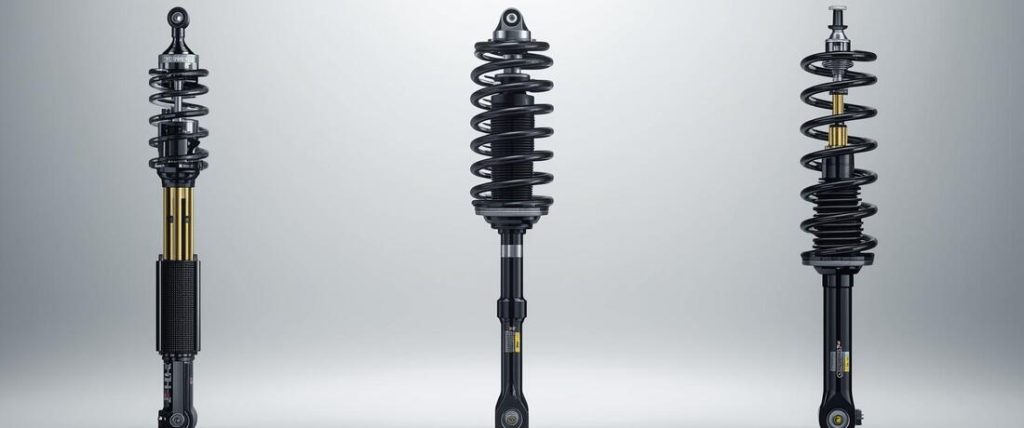
You’re at the mechanic, you need a ‘suspension part,’ and the estimate mentions shocks, struts, or coilovers — and you’re not sure if those are three different things or just three names for the same thing. They ARE different — functionally, structurally, and in terms of what happens if you remove them; the difference is simple once you know the one-sentence test for each. This matters to anyone replacing worn suspension components, considering a performance upgrade, or just wanting to understand what their car uses. We will preview the structural test, the identification guide, the four coilover tiers, and the cost comparison.
Contents
- 1 The One-Sentence Test — The Fastest Way to Understand All Three
- 2 What Is a Shock Absorber?
- 3 What Is a Strut?
- 4 What Is a Coilover?
- 5 Side-by-Side Comparison — Shocks vs. Struts vs. Coilovers
- 6 Do Coilovers Replace Shocks and Struts?
- 7 The Four Coilover Tiers — Not All Coilovers Are Equal
- 8 The Counter-Intuitive Warning — Cheap Coilovers vs. Quality Struts
- 9 Can You Daily Drive on Coilovers?
- 10 Alignment — Which Components Require It?
- 11 Shocks, Struts, and Coilovers — Which Should YOU Get?
- 12 Cost Comparison
- 13 FAQs About What Is the Difference Between Shocks, Struts, and Coilovers?
- 14 Bottom Line — The Decision in Plain English
The One-Sentence Test — The Fastest Way to Understand All Three
The difference between shocks, struts, and coilovers is best explained by what happens if you remove them. This is the clearest way to understand the job each part does.
This explanation comes from technical knowledge bases like Summit Racing, now in plain consumer language.
| Component | What Happens If You Remove It? | What That Tells You |
|---|---|---|
| Shock absorber | Car still drives and steers — just bounces uncontrollably | Non-structural; a damper only |
| Strut | Wheel collapses inward; car cannot drive or steer | Structural; holds the wheel in place AND damps |
| Coilover | Car sits on its bump stops (suspension bottoms out) | Non-structural like a shock; but contains the spring — without it, no ride height |
The simplest summary is this: Shocks damp. Struts damp AND hold the wheel. Coilovers damp AND hold the spring height — but are not structurally load-bearing like a strut.

What Is a Shock Absorber?
A shock absorber is a hydraulic device that controls how fast your suspension spring bounces. It does not support the weight of the car.
The spring absorbs the bump. The shock controls how quickly the spring returns to rest. Without a shock, the spring would keep bouncing for several cycles after a bump. The shock “dampens” that oscillation into one controlled movement.
What shocks do NOT do:
- They don’t support vehicle weight (the spring does that).
- They are not structural suspension components.
- Removing them doesn’t change wheel geometry or alignment.
Where shocks are typically used: You find them on the rear suspension of most vehicles like trucks and SUVs. Some older trucks with front solid axles use shocks at all four corners. If you are seeing uneven wear on your tires, check our guide on what causes tire cupping to see if bad shocks are the culprit.
How a Shock Works (Plain English)
Inside the shock, a hydraulic piston moves through oil-filled chambers. When the wheel hits a bump, the suspension compresses. The piston pushes through the fluid. Fluid resistance slows the compression. When the wheel rebounds, the piston moves the other way. Fluid resistance slows the rebound. The result: The tire stays on the road instead of bouncing freely. The cabin feels smooth instead of jarring.
What Is a Strut?
A strut does everything a shock does, but it also holds the wheel in place. It is a structural part of the suspension.
The strut connects the wheel assembly to the vehicle body. On a MacPherson strut design, which is the most common in the world, there is no upper control arm. The strut IS the upper suspension link.
Critical distinction: If you remove a strut, the wheel can no longer steer. The suspension geometry collapses. That is why strut replacement requires a wheel alignment. The strut’s position directly determines the camber angle.
Most struts also house the coil spring. The spring wraps around the strut body. It is held between a lower spring perch and an upper strut mount. The whole assembly is called a strut assembly.
Strut Components
- Damper body: The shock absorber part inside the strut.
- Coil spring: Wrapped around the body; carries vehicle weight.
- Lower spring perch: Holds the bottom of the spring.
- Upper strut mount: Connects to the strut tower in the body.
- Strut bearing/bearing plate: Allows the spring and strut to rotate with steering input.
How to Tell If Your Car Has Struts or Shocks
Look through the wheel well at the front suspension.
- Do you see a large spring wrapped around the damper cylinder? That is a MacPherson strut.
- Do you see a slim damper cylinder next to a separate spring? That is a shock.
For the rear: Most FWD and AWD cars have rear struts or a torsion beam. Most RWD and truck/body-on-frame vehicles have rear shocks with separate springs.
What Is a Coilover?
A coilover is a single unit that combines a shock absorber and a coil spring. The name is short for “coil spring over shock.”
The spring wraps over the shock body, just like a strut assembly. Unlike a factory strut, the coilover is typically adjustable. You can change ride height by turning a threaded collar. On higher-end units, you can also adjust the damping. This lets you make the shock stiffer or softer.
Key technical distinction from a strut: A coilover is NOT structural. It doesn’t provide the steering pivot function that a MacPherson strut does. When installed on a strut-equipped vehicle, the coilover replaces the spring and damper. The strut housing and mount still provide the structural support.
Think of it this way: A coilover is a performance aftermarket spring-and-shock kit. A strut is a factory structural suspension part. You can install a coilover inside the strut system. You cannot replace the strut system itself with just a coilover.
The Coilover Ride Height Adjustment — Two Methods (Only One Is Good)
- Threaded perch method (budget coilovers): The spring seat moves along the shock body. This compresses the spring preload as you lower. It changes spring behavior and suspension travel. This method is mechanically inferior.
- Threaded body method (quality coilovers): The entire shock body screws up or down. The spring seat moves with it. Preload and spring travel remain constant. This is the correct method. It is used on quality kits like KW, Tein, and Ohlins.

Side-by-Side Comparison — Shocks vs. Struts vs. Coilovers
Here is a direct comparison of how these three components function.
| Feature | Shock Absorber | Strut Assembly | Coilover |
|---|---|---|---|
| Primary function | Damp spring oscillation only | Damp + structural wheel support | Damp + spring support (adjustable) |
| Is it structural? | ❌ No | ✅ Yes | ❌ No (replaces spring/damper, not structure) |
| Does it hold vehicle weight? | ❌ No | ✅ Yes | ✅ Yes (through coil spring) |
| Does it affect wheel alignment? | ❌ Minimal | ✅ Yes — affects camber | ✅ Yes — alignment required after install |
| Is it adjustable? | Usually no | Usually no | ✅ Yes — ride height; damping (on higher tiers) |
| Can you lower/raise ride height? | ❌ No | ❌ No (without different springs) | ✅ Yes — that’s the point |
| Contains a coil spring? | ❌ No (spring is separate) | ✅ Usually | ✅ Yes — always |
| What if you remove it? | Car drives but bounces | Wheel collapses — undriveable | Car sits on bump stops |
| Common application | Rear of many vehicles | Front of most modern vehicles | Performance, track, stance, off-road |
| Factory or aftermarket? | Both | Both | Almost always aftermarket |
| Replacement cost (pair) | $200–$600 | $450–$1,200 | $300–$3,000+ |
| Alignment needed after? | Rarely | Yes — always | Yes — always |
Do Coilovers Replace Shocks and Struts?
Yes, coilovers replace shocks and struts, but in different ways depending on your car.
| Your Vehicle Has | What Coilovers Replace | What They Don’t Replace |
|---|---|---|
| Front struts + rear shocks | Spring and damper on front and rear | The structural strut housing and strut tower mount remain |
| All shocks (no struts) | All four shock absorbers and their adjacent springs | Nothing structural changes |
| All struts | Spring and damper at all four corners | Structural strut housing remains |
The important nuance: A coilover is never a one-part replacement for the entire strut system. On strut-equipped vehicles, you are replacing the spring and the damper portion. You are not replacing the structural arm that connects the wheel to the body. The strut mount, tower, and housing remain.
The Four Coilover Tiers — Not All Coilovers Are Equal
What “coilover” means varies enormously by price and quality tier. This is something many guides miss.
| Tier | Type | Adjustability | Best For | Cost (per set) |
|---|---|---|---|---|
| Tier 1 | Height-adjustable only | Ride height only (no damping adjustment) | Stance, light lowering, budget performance | $300 – $800 |
| Tier 2 | Single-adjustable | Ride height + combined compression/rebound | Street performance, light autocross | $600 – $1,500 |
| Tier 3 | Dual-adjustable | Ride height + compression AND rebound independently | Dual-purpose street/track | $1,500 – $3,000 |
| Tier 4 | Fully adjustable / motorsport | Ride height + compression + rebound + corner weight | Dedicated track, time attack, race | $3,000+ |
Brands by tier (approximate):
- Tier 1: BC Racing (entry), Fortune Auto (entry), Megan Racing, most “Amazon coilovers.”
- Tier 2: Tein Street Basis, BC Racing BR Type, KW Variant 1/2.
- Tier 3: KW Variant 3, BC Racing ER/DS, Fortune Auto 500, Ohlins Road & Track.
- Tier 4: Ohlins TTX, MCS, JRZ.
The Counter-Intuitive Warning — Cheap Coilovers vs. Quality Struts
A high-quality strut is often better than a cheap coilover. This is what performance shops tell you, but consumer articles rarely do.
Suspension engineers state plainly that a well-tuned strut can outperform a poorly valved coilover any day. Budget coilovers in the $300–$800 range (Tier 1) typically use fixed valving. You can only adjust the height. The damping is often softer or poorly matched to the spring rate. The result is a vehicle that bounces more, not less, compared to quality OEM struts.
Grassroots Motorsports, a respected US performance community, repeatedly confirms that a higher-end shock/strut and spring combo is better than budget coilovers.
Budget coilovers have known issues. Many Tier 1 products suffer blown seals or oil leaks within 15,000–20,000 miles. Quality OEM struts typically last 50,000–80,000 miles.
The money-smart decision: If your budget is under $800, do not buy cheap coilovers. Buy quality replacement struts like Bilstein B6, KYB Excel-G, or Monroe OE Spectrum. If you want a lower look, add matched lowering springs. You will get a better result than cheap coilovers for the same price. If you are unsure if your parts are worn, read our guide on the symptoms of bad shocks or struts.
Can You Daily Drive on Coilovers?
You can daily drive on coilovers, but only if you choose the right ones. It is not about coilovers vs. struts; it is about which coilovers.
Cheap, stiff coilovers on a daily driver are harsh, noisy, and uncomfortable. This gives coilovers their bad reputation. Quality street coilovers on a daily driver are often softer than worn OEM struts. Brands like KW, Tein, and BC Racing at street settings are frequently described by users as more comfortable than their tired old suspension.
The harshness many drivers associate with coilovers comes from:
- Running them set too stiff (over-adjusted damping).
- Cheap coilovers with hard spring rates but poor damping control.
- Lowering them too much (reducing suspension travel).
Daily driver coilover rule of thumb: Stay within 1–1.5 inches of lowering. Choose a quality street-oriented coilover with soft or adjustable damping. This ensures a good ride.
Alignment — Which Components Require It?
You must get a wheel alignment after replacing struts or coilovers, but usually not after shocks.
| Service | Alignment Required? | Why |
|---|---|---|
| Replacing rear shocks only | Usually no | Shocks don’t affect geometry. |
| Replacing front shocks | Usually no | Front shocks don’t affect alignment. |
| Replacing front struts | ✅ Always | Strut position directly determines camber. |
| Replacing rear struts | ✅ Recommended | Rear strut changes can affect toe. |
| Installing any coilovers | ✅ Always | Height and damping changes affect all angles. |
| Installing with significant lowering | ✅ Plus possibly camber plates | Lowering moves camber significantly negative. |
Ignoring alignment leads to uneven tire wear. Check our article on inner tire wear cause to understand how alignment angles destroy tires.
Shocks, Struts, and Coilovers — Which Should YOU Get?
Here is a practical decision guide based on your actual situation.
| Your Situation | Best Choice |
|---|---|
| OEM replacement, daily driver, factory ride quality | Quality replacement struts (Bilstein B6, KYB Excel-G) — no coilovers. |
| Slightly sportier ride, 1-inch drop, still comfortable | Quality lowering springs + performance struts OR Tier 2 coilovers. |
| Stance/lowered appearance, occasional spirited driving | Tier 1–2 coilovers with quality damping (not cheap brands). |
| Autocross, occasional track days, dual-purpose | Tier 2–3 coilovers with damping adjustment. |
| Dedicated track use, racing, competitive motorsport | Tier 3–4 coilovers with full adjustability. |
| Off-road truck / Jeep / rock crawler | Off-road-specific long-travel coilovers (King, Fox, Icon). |
| Budget under $600 and want better than worn OEM | Performance strut replacements + stock or mild lowering springs. |
Cost Comparison
Here are the estimated costs for shocks, struts, and coilovers in the US.
| Option | Parts + Labor | Alignment | Total Estimate |
|---|---|---|---|
| OEM replacement struts (per axle) | $450 – $900 | $75 – $150 | $525 – $1,050 |
| Performance struts + springs | $600 – $1,200 | $75 – $150 | $675 – $1,350 |
| Tier 1 coilovers (height-adj only) | $400 – $900 | $100 – $200 | $500 – $1,100 |
| Tier 2 coilovers (single-adjustable) | $700 – $1,600 | $100 – $200 | $800 – $1,800 |
| Tier 3 coilovers (dual-adjustable) | $1,600 – $3,200 | $150 – $300 | $1,750 – $3,500 |
| Tier 4 / race coilovers | $3,000 – $6,000+ | $200 – $400 | $3,200 – $6,400+ |
| Rear shock replacement (pair) | $200 – $600 | Usually $0 | $200 – $600 |
FAQs About What Is the Difference Between Shocks, Struts, and Coilovers?
Do coilovers replace shocks and struts?
Yes, coilovers replace the spring and damper components. On strut-equipped vehicles, the coilover replaces the strut’s spring and shock portion. The structural strut housing and mount remain. On shock-equipped vehicles, coilovers replace both the shocks and adjacent springs. Coilovers do not replace the structural function of the strut tower.
How do I know if my car has shocks or struts?
Look through the wheel well at the front suspension. If you see a large coil spring wrapped directly around a damper cylinder, that is a MacPherson strut. If you see a slim damper cylinder next to a separate, nearby spring, that is a shock. Most modern FWD and AWD cars have front struts. Most trucks and older RWD vehicles have front shocks.
Why does strut replacement require a wheel alignment but shock replacement usually doesn’t?
Struts are structural suspension components directly connected to the steering knuckle. Their position determines the camber angle of the wheel. When you replace a strut, the alignment can shift slightly. Coilovers also require alignment because they change ride height. Shocks are non-structural. They don’t affect wheel geometry.
What are the four types of coilovers?
The four tiers are: (1) height-adjustable only ($300–$800); (2) single-adjustable for ride height and damping ($600–$1,500); (3) dual-adjustable for independent compression and rebound ($1,500–$3,000); and (4) fully adjustable motorsport grade ($3,000+). Budget coilovers are typically Tier 1. They often underperform quality OEM replacement struts.
What is the cheapest way to improve suspension performance?
If your OEM struts are worn, replace them with quality performance shocks or struts like Bilstein B6 or KYB Excel-G. Combine them with matched lowering springs like Eibach Pro-Kit. This typically delivers better performance than budget coilovers at a similar or lower total price. You get matched spring and damper rates and better ride quality.
Bottom Line — The Decision in Plain English
Choose the component that matches your driving needs and budget.
- Your shocks or struts are worn and you want OEM ride quality back: Buy quality replacement struts (Bilstein B6, KYB Excel-G, Monroe OE Spectrum). You don’t need coilovers.
- You want a slightly lower stance and firmer ride without sacrificing comfort: Quality lowering springs + performance struts. This is still better than budget coilovers in this price range.
- You want ride height adjustability and occasionally drive hard: Tier 2 coilovers ($600–$1,500). Look for KW, Tein, or BC Racing BR type. Avoid no-name brands.
- You track your car 10+ times per year: Tier 3 dual-adjustable coilovers. Budget accordingly ($1,500–$3,000). Mandatory alignment + camber plates.
- Someone suggested coilovers and your budget is under $600: Skip the coilovers. Buy Bilstein B6 struts and Eibach springs. You’ll get a better result.
Golden rule: A coilover is not inherently better than a strut. It is a different tool for a different purpose. For most daily drivers, quality replacement struts outperform budget coilovers in ride quality, durability, and cost-effectiveness. Coilovers earn their value at Tier 2 and above — for enthusiasts who need adjustability, not just a replacement.
Quick Summary:
- Shocks are non-structural dampers that control spring bounce.
- Struts are structural components that hold the wheel in place and dampen bounce.
- Coilovers are adjustable spring-and-shock units used for performance or lowering.
- Strut and coilover installation always requires a wheel alignment.
- Quality OEM struts often outperform cheap “Tier 1” coilovers.
- Use the “remove it” test to identify parts: removing a strut collapses the wheel; removing a shock just causes bouncing.
- Choose your parts based on your goal: comfort, performance, or adjustability.