
This article was updated in March 18, 2026 with new products and information by Mark S. Taylor
Your car has been feeling a little bouncy lately — but you’ve gotten used to it. That’s exactly the problem. Shocks and struts wear so slowly that your brain adjusts to the new normal, not realizing the vehicle you’re driving now bounces 30–40% more than it should. Worn shocks don’t just affect ride comfort — they increase stopping distance, compromise ADAS system effectiveness, and cause tire cupping that costs hundreds in new tires. Since shocks and struts cycle up to 1,900 times per mile, by 50,000 miles, they’ve worked 75 million times. We will cover 9 symptoms, the front-vs-rear comparison, the bounce test, and why replacement timing matters.
Contents
- 1 Shocks vs. Struts — Know Which One Your Car Has
- 2 The “Boiling Frog” Problem — Why You Don’t Notice Until It’s Late
- 3 9 Symptoms of Bad Shocks or Struts
- 3.1 1. Excessive Bouncing After Bumps — The Classic Sign
- 3.2 2. Nose Diving When Braking
- 3.3 3. Body Roll or Sway When Cornering
- 3.4 4. Rear Squat When Accelerating
- 3.5 5. Steering Wander, Tramlining, or Poor Tracking
- 3.6 6. Clunking, Knocking, or Popping Noises Over Bumps — Sound Guide
- 3.7 7. Hydraulic Fluid Leak on the Shock or Strut Body
- 3.8 8. Tire Cupping (Scalloped Tread)
- 3.9 9. Increased Stopping Distance and ADAS Interference
- 4 Front Struts vs. Rear Shocks — Symptoms by Location
- 5 The Free Bounce Test — Confirm It Right Now
- 6 Is It Safe to Drive With Bad Shocks or Struts?
- 7 Should You Replace in Pairs? Should You Replace All Four?
- 8 Replacement Cost
- 9 How Long Do Shocks and Struts Last?
- 10 FAQs About Symptoms of Bad Shocks or Struts
- 11 Bottom Line — What to Do Right Now
Shocks vs. Struts — Know Which One Your Car Has
You need to know if you have shocks or struts because replacement costs and alignment needs differ. While they do similar jobs, they are not the same part.
This matters because strut replacement almost always requires a wheel alignment. Shock replacement usually does not.
| Feature | Shock Absorber | Strut Assembly |
|---|---|---|
| What it does | Dampens spring rebound only | Dampens rebound + supports weight + affects alignment |
| Is it structural? | No | Yes |
| Springs attached? | No — separate spring nearby | Yes — coil spring wraps around strut body |
| Affects alignment? | No | Yes — alignment required after replacement |
| Common location | Often rear; some trucks use all 4 | Often front; many vehicles front struts + rear shocks |
| Replacement cost | $200 – $600 per pair (installed) | $450 – $1,200 per pair (installed) |
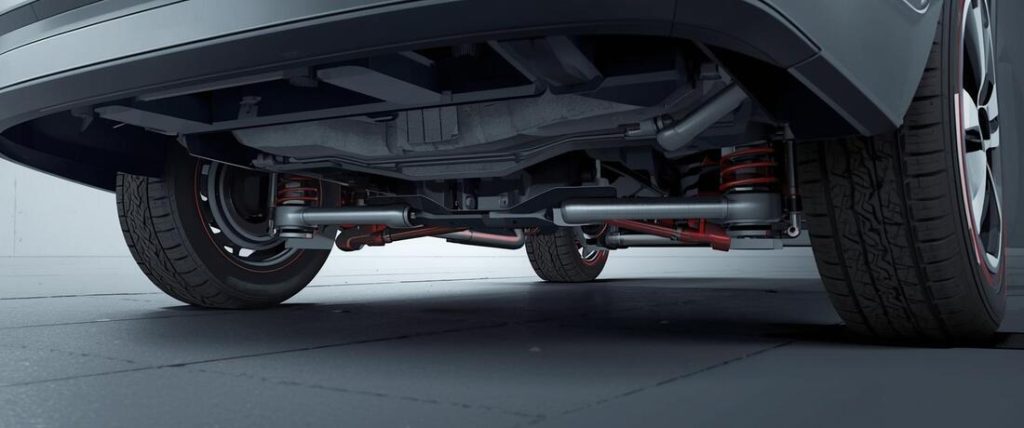
How to tell what you have: Look behind any wheel. If you see a slim cylinder near a separate spring, that is a shock. If you see a large assembly with the spring wrapped around it and a cap at the top, that is a strut. Most modern vehicles have front struts and rear shocks.

The “Boiling Frog” Problem — Why You Don’t Notice Until It’s Late
This is the most important thing to understand before reading any symptom list. Shocks and struts don’t fail suddenly.
They degrade hydraulically, a tiny bit at a time, over thousands of miles. Your brain is excellent at adapting to gradual change. A car that once felt tight and controlled starts feeling “normal” as it gets bouncier. You simply forget what good felt like.
Monroe, the OEM shock manufacturer, explicitly warns that worn shocks and struts wear out so gradually that the negative effects might not be easily recognized in normal driving conditions.
The comparison test is free. Drive a friend’s or rental vehicle of similar size with known-good shocks. The difference in body control and firmness during lane changes is immediately obvious. This comparison is often more diagnostic than any symptom list.
9 Symptoms of Bad Shocks or Struts
1. Excessive Bouncing After Bumps — The Classic Sign
If your car keeps bouncing after a bump, your shocks are likely worn. This is the most common sign.
Press the brake over a pothole or speed bump. A car with good shocks settles in one or two controlled movements. A car with worn shocks continues to bounce, oscillate, or rock for several cycles.
The bounce test takes 60 seconds and is free. Push down firmly on each corner of the car and release. Count the bounces before it settles.
- 1 to 2 bounces then stop: Healthy.
- 3 or more bounces: Shocks are worn.
This test is standard in automotive training. It is referenced by Monroe, StrutMasters, and Les Schwab as the primary consumer diagnostic.
Bouncing is most noticeable on highway entry ramps, railroad crossings, or rough country roads. At highway speed, worn shocks cause the vehicle to feel “floaty” or disconnected from the road.
2. Nose Diving When Braking
Nose diving happens when the front of your car dips sharply downward when you brake. This indicates worn front struts.
Good front struts control weight transfer. Worn struts can’t resist it. The front end plunges dramatically. This shifts more weight to the front tires just when you need them to brake efficiently.
Why it’s dangerous: Nose diving increases stopping distance. It also compresses the front springs toward their limit, which affects steering response during emergency braking.
Research from the Cologne Institute confirms that at just 50% shock efficiency, stopping distance increases by approximately 23%. That is roughly 21 additional feet at 31 mph. If your brake pedal feels different, check our guide on why your brake pedal is spongy to rule out brake system issues.
3. Body Roll or Sway When Cornering
Excessive leaning when you turn suggests your shocks or struts are failing. Body roll is the leaning sensation when you turn.
Some body roll is normal. A car with worn shocks or struts rolls excessively. Passengers feel thrown sideways. The vehicle feels top-heavy. You may need to reduce speed through corners you used to handle easily.
Monroe describes it this way: Shocks lose their ability to control the rate of weight transfer when going around corners. This may result in increased steering input to navigate turns.
On SUVs and crossovers, worn shocks significantly elevate rollover risk in sharp avoidance maneuvers. The taller center of gravity combined with inadequate damping creates unstable body motion.
4. Rear Squat When Accelerating
If the rear of your car drops dramatically when you accelerate, your rear shocks may be worn. This is most noticeable on trucks and RWD cars.
When you press the accelerator hard from a stop, the rear of the vehicle should stay relatively level. Worn rear shocks allow the rear to drop. The front of the vehicle rises as the rear squats.
Passengers in the front may feel thrown back. The front tires temporarily carry less weight, which decreases traction. This is dangerous in rain or snow.
Excessive rear squat also loads the rear springs and bushing mounts disproportionately. This accelerates wear on those components. If you notice other performance issues, read our article on why your car jumps when accelerating.
5. Steering Wander, Tramlining, or Poor Tracking
If your car drifts or requires constant steering corrections, your front struts are likely worn. A car with good front struts tracks a straight line with minimal input.
With worn front struts, the car wanders or drifts. It follows road grooves and expansion joints, called tramlining. Crosswinds affect it more dramatically. Lane changes require deliberate over-correction.
AutoZone explains that worn struts cause dramatically affected steering response. Since most of the weight sits on the front wheels, reduced damping causes the vehicle to flop back and forth during turning maneuvers.
Highway driving with worn struts is noticeably fatiguing. The constant small corrections required over a two-hour drive compound into driver fatigue. This is a key sign of car suspension issues.
6. Clunking, Knocking, or Popping Noises Over Bumps — Sound Guide
Noises from the suspension area indicate worn shock internals or failing mounts. You can often pinpoint the cause by the type of sound.
| Sound | When It Happens | Most Likely Cause |
|---|---|---|
| Deep clunk / knock | Large bump, pothole, or dip | Shock/strut bottoming out; metal-to-metal contact |
| Metallic grinding when turning | Parking lot maneuvers, tight turns | Strut bearing plate failing |
| Creaking or groaning | Turns or slow cornering | Dried or cracked upper strut mount bushing |
| Popping or clicking | Small bumps | Strut mount loose; upper mount hardware loose |
| Banging from the rear | Rough roads | Rear shock bottoming out; shock mount loose |
ZAutoService confirms that strut bearing noise is a distinct metallic grinding or squeaking noise when making turns. This is often misdiagnosed as a wheel bearing or ball joint noise. The key distinction is that strut bearing noise occurs during steering input. Wheel bearing noise occurs at speed regardless of steering.
7. Hydraulic Fluid Leak on the Shock or Strut Body
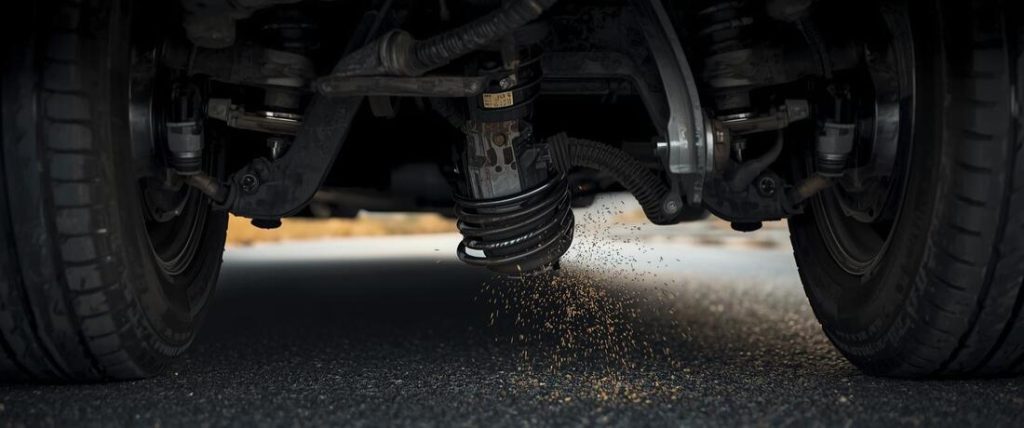
Visible fluid on your shock or strut is a clear sign of failure. Shocks and struts use hydraulic fluid to dampen spring rebound.
When the seal wears or fails, hydraulic fluid seeps or streams down the outside of the body. It looks like a clear to light brown oily film or trail.
What leaking fluid means: The damper can no longer maintain full hydraulic pressure. Damping is reduced proportionally to fluid loss.
How to check: Look at the shock or strut body directly. Check through the wheel well or from under the car. A dry shock should be completely dry. Even minor wetness indicates the seal is failing.
Note: A slightly “sweating” shock with a light, dry film is normal. Active drips or a wet coating indicate replacement is needed now.
8. Tire Cupping (Scalloped Tread)
Tire cupping is one of the most visually obvious symptoms of worn shocks. This looks like a series of scooped-out dips in the tread.
The mechanism is simple. Worn shocks allow the tire to bounce uncontrolled on every road imperfection. Each time the tire slams back onto the road, the hard impact grinds away tread rubber. Repeated over thousands of miles, these impact points create the classic cupped pattern.
Run your hand around the tire circumference. It feels smooth between the spots and bumpy at the cupped areas.
The cost of ignoring it is high. Cupped tires must be replaced because cupping can’t be repaired. New tires on worn shocks will cup the same way. You end up buying tires twice. Fix the shocks first. For a deep dive into this wear pattern, read our guide on what causes tire cupping.
9. Increased Stopping Distance and ADAS Interference
Worn shocks compromise your car’s ability to stop and interfere with safety systems. Most drivers think of brakes for stopping, but the suspension plays a critical role.
During a hard stop, the front of the vehicle loads down. Worn front struts can’t control this weight transfer. The front tires’ contact patch changes dynamically. ABS gets inconsistent wheel speed data from a tire that’s briefly airborne. Stopping distance increases.
The ADAS connection is vital. Modern vehicles rely on stable tire-to-road contact for ABS, electronic stability control, and automatic emergency braking. Worn shocks allow the tire to bounce, which compromises the road contact these systems depend on.
Les Schwab warns that if ride control parts are worn, they might not properly respond when electronic safety systems activate. Your car’s safety technology was calibrated assuming firm, consistent tire contact. Worn shocks partially defeat the safety systems you paid for.
Front Struts vs. Rear Shocks — Symptoms by Location
Where you feel the symptom tells you which end of the car to inspect. Most vehicles have front struts and rear shocks.
| Symptom | Front Struts | Rear Shocks |
|---|---|---|
| Nose dive when braking | ✅ Primary symptom | ❌ Not directly |
| Body roll in corners | ✅ Yes | ✅ Yes (especially rear sway) |
| Rear squat when accelerating | ❌ Not directly | ✅ Primary symptom |
| Rear hop on rough roads | ❌ No | ✅ Primary symptom (trucks) |
| Trailer sway while towing | ❌ Not directly | ✅ Primary symptom |
| Steering wander / tramlining | ✅ Primary symptom | ❌ No |
| Metallic grinding on slow turns | ✅ Strut bearing plate | ❌ No |
| Front tire cupping | ✅ Yes | ❌ Not the front |
| Rear tire cupping | ❌ Not the rear | ✅ Yes |
The Free Bounce Test — Confirm It Right Now
This takes 60 seconds and gives you a real-world data point before calling a shop. It is a reliable way to check your suspension at home.
- Park on a flat, level surface.
- Stand at one corner of the vehicle.
- Push down firmly with both hands. Use your full body weight.
- Release and count bounces before the corner settles.
Results:
- 1–2 bounces, then settles: ✅ Shocks/struts are functioning.
- 3–4 bounces: ⚠️ Shocks are worn. Inspection is due.
- Continues bouncing: ❌ Shocks are significantly worn. Replace soon.
- Corner settles, then continues (slow oscillation): ❌ Worn. May be a failing shock valve.
Repeat at all four corners. A corner that bounces more than others indicates which specific unit is most worn.
Is It Safe to Drive With Bad Shocks or Struts?
It depends on the severity, but worn shocks make every emergency situation more dangerous.
| Symptom Severity | Safe to Drive? | Action |
|---|---|---|
| Slightly bouncier than usual | ⚠️ Short term | Inspect within 2 weeks; don’t delay if over 50K miles. |
| Nose diving on braking | ❌ Not recommended | Stopping distance compromised; book this week. |
| Body roll that affects stability | ❌ Not recommended | Handling compromised; book urgently. |
| Visible fluid leak | ⚠️ Declining quickly | Damping failing; book within 1 week. |
| Tire cupping audible | ⚠️ Caution | Reduced wet traction; fix shocks; assess tires. |
| Bottoming out over speed bumps | ❌ Not recommended | Undercarriage risk; immediate inspection. |
| Metallic grinding when turning | ⚠️ Inspect urgently | Could be strut bearing; get diagnosed. |
The honest safety summary: Les Schwab states plainly that if ride control parts are worn, they might not properly respond when you need to emergency brake or swerve. Your stopping distance is longer. Your lane-change stability is reduced. Your ADAS systems are compromised.
Should You Replace in Pairs? Should You Replace All Four?
Always replace shocks or struts in pairs per axle to maintain stability. This is a common question before booking service.
Always replace in pairs per axle (both fronts or both rears) because:
- Both sides share the same mileage and wear rate.
- Mismatched damping creates instability. One side settles while the other bounces.
- The vehicle pulls or drifts toward the softer side.
AutoZone notes that you must always replace both as a set. Mismatched damping causes dangerous instability.
Consider replacing all four if:
- The vehicle has over 100,000 miles with original parts.
- The rear shocks are worn and the front struts are over 75,000 miles.
- Ride quality is compromised at all four corners.
Loaded strut vs. bare strut — which to buy:
- Loaded strut assembly: Includes new damper, spring, mount, and bearing. Higher parts cost. Lower labor. Best for high-mileage vehicles.
- Bare strut (damper only): New damper only. Reuses old springs and mounts. Lower part cost. Higher labor. Best for low-mileage vehicles.
Replacement Cost
Here are the estimated costs for shock and strut replacement in the US.
| Service | Estimated US Cost |
|---|---|
| Shock absorbers (rear pair, standard) | $200 – $600 installed |
| Struts (front pair, standard damper) | $450 – $900 installed |
| Loaded strut assembly (front pair) | $700 – $1,200 installed |
| Rear shock replacement — trucks/SUV | $250 – $700 installed |
| Wheel alignment (required after struts) | $75 – $150 |
| Total — front struts + alignment | $600 – $1,400 |
| Total — full vehicle (all 4) + alignment | $1,000 – $2,500+ |
Brand tiers:
- Monroe / KYB / Gabriel (standard): Lower cost; solid OEM-equivalent.
- Bilstein / Rancho / Fox (performance): Higher cost; better damping; longer lifespan.
Money-saving tip: Book strut replacement and wheel alignment as a bundle. Most shops reduce the price by $50–$100 compared to booking separately.
How Long Do Shocks and Struts Last?
Most shocks and struts last between 50,000 and 80,000 miles. This varies based on driving conditions.
- Shorter life factors: Rough roads, gravel, potholes, off-road use, heavy towing, aggressive driving.
- Longer life factors: Highway driving on smooth pavement, light loads, gentle driving style.
Inspection schedule:
- Every 12,000 miles or annually (per Les Schwab).
- Inspect at every tire rotation or alignment.
- First inspection at 50,000 miles regardless of how the vehicle feels.
Many vehicles need replacement between 60,000–80,000 miles. Some premium shocks last to 100,000 miles or more.
FAQs About Symptoms of Bad Shocks or Struts
How do I know if my shocks or struts are bad?
The fastest free test is the bounce test. Push down hard on each corner and count the bounces. One to two bounces is healthy. Three or more means they are worn. Also look for fluid leaks on the body, tire cupping, and listen for metallic grinding when turning.
How much does shock and strut replacement cost?
Rear shock replacement costs $200–$600 per pair installed. Front struts cost $450–$900 per pair. Loaded strut assemblies cost $700–$1,200. A wheel alignment adds $75–$150. Replacing all four corners runs $1,000–$2,500+.
Should I replace shocks or struts in pairs?
Yes, always replace in pairs per axle. Mismatched damping creates instability. It causes the vehicle to pull or drift during braking and cornering. Since both sides wear at similar rates, replacing only one is a waste of money.
How long do shocks and struts last?
Most last 50,000–80,000 miles. Heavy towing, off-road driving, and rough roads shorten this range. Have them inspected annually starting at 50,000 miles. Do not rely on feel alone because they degrade slowly.
What is a loaded strut and should I buy one?
A loaded strut is a complete assembly. It comes with a new damper, spring, mount, and bearing. It costs more in parts but saves on labor. It is best for high-mileage vehicles where other parts are also worn. A bare strut is just the damper. It is good for low-mileage cars with good springs.
Bottom Line — What to Do Right Now
Follow this action guide based on your specific situation.
- Car bounces more than 2–3 times: Shocks/struts are worn. Book a suspension inspection.
- Nose diving hard on braking: Front struts are worn. Book this week to restore stopping distance.
- Metallic grinding when turning: Strut bearing plate is likely failing. Get it diagnosed.
- Fluid visible on body: Seals are failing. Book within 1 week.
- Tire cupping visible: Worn shocks are causing it. Replace shocks first, then assess tires. Check our resource on inner tire wear causes for more alignment tips.
- Car feels floaty at speed: Front struts worn. Drive a similar car for comparison to feel the difference.
- Over 75,000 miles with no inspection: Book a proactive inspection. You are in the replacement zone.
Golden rule: Shocks and struts cycle 75 million times by 50,000 miles. They are one of the most-worked components on your vehicle. A $600–$1,200 strut replacement prevents premature tire wear and restores stopping distance. Inspect every 50,000 miles. Don’t wait for noise or drama.
Quick Summary:
- Shocks and struts wear out slowly, often going unnoticed until performance is severely compromised.
- Key symptoms include excessive bouncing, nose diving when braking, and body roll in corners.
- The free bounce test is a reliable way to check for worn shocks at home.
- Always replace shocks or struts in pairs per axle to ensure vehicle stability.
- Worn shocks increase stopping distance and can interfere with modern ADAS safety systems.
- Most shocks and struts last between 50,000 and 80,000 miles.
- Visible fluid leaks and tire cupping are clear signs that replacement is needed immediately.