
This article was updated in October 7, 2026 with new products and information by Mark S. Taylor
If your car running rich, the engine is getting too much fuel for the amount of air it can use efficiently. You may notice black smoke, a strong fuel smell, poor gas mileage, rough running, fouled spark plugs, or a check-engine light.
But do not start by replacing the oxygen sensor. That is one of the most common wrong turns. The sensor may be reporting a real rich condition caused by fuel pressure, a leaking injector, bad temperature data, a faulty MAF sensor, an ignition misfire, or an exhaust problem.
The right fix is to confirm the rich condition, identify why it is happening, then repair the confirmed cause. A code such as P0172 or P0175 narrows the search. It does not name the failed part by itself.
This guide explains what running rich means, what you can safely check, which tests need professional equipment, and when continued driving can damage the engine or catalytic converter.
Contents
- 1 What does “running rich” mean?
- 2 Symptoms of a rich-running engine
- 3 Is it safe to drive a car running rich?
- 4 Common causes and the right way to test them
- 4.1 1. Faulty MAF sensor or incorrect airflow data
- 4.2 2. Incorrect coolant-temperature information
- 4.3 3. Excessive fuel pressure
- 4.4 4. Leaking or stuck fuel injector
- 4.5 5. Incorrect oxygen-sensor or air-fuel-ratio data
- 4.6 6. Ignition misfire that looks like a rich condition
- 4.7 7. EVAP purge valve stuck open
- 4.8 8. Restricted or damaged air intake
- 4.9 9. Exhaust leak or false rich signal
- 4.10 10. Oil contamination from excess fuel
- 4.11 11. Engine-control wiring or software problem
- 5 How to diagnose a rich condition in the right order
- 6 What can you safely check at home?
- 7 What should a professional test?
- 8 How much does it cost to fix a car running rich?
- 9 Questions to ask the repair shop
- 10 FAQs About Car Running Rich How to Fix
- 11 Bottom line
What does “running rich” mean?
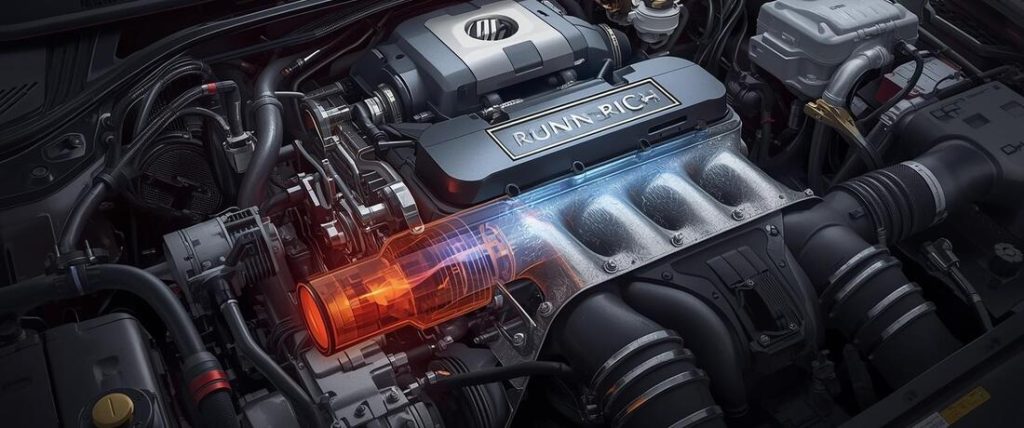
An engine runs rich when the combustion chamber receives more fuel than the available air can burn efficiently. The excess fuel may leave the cylinder unburned or partially burned.
The engine computer controls fuel delivery using information from systems such as:
- Mass airflow or manifold-pressure sensors
- Coolant-temperature sensors
- Throttle-position sensors
- Oxygen or air-fuel-ratio sensors
- Fuel-pressure controls
- Engine-speed and load inputs
A problem in any of those areas can create a real rich mixture or make the computer think the mixture is rich when the underlying issue is elsewhere.
There are two broad possibilities:
- The engine is truly receiving too much fuel. A leaking injector, excessive fuel pressure, or a failed control can cause this.
- The engine computer is receiving bad information. A MAF sensor, coolant-temperature sensor, wiring fault, or exhaust leak can make the computer command the wrong fuel amount or misread the exhaust.
That distinction matters. Fixing the sensor may not fix the mixture if the sensor was only reporting a fuel or mechanical problem.
Symptoms of a rich-running engine
One symptom alone does not prove a rich condition. Several clues together are more useful.
Black smoke from the exhaust
Black smoke usually means the engine is not burning all the fuel efficiently. It is one of the clearest visible signs of an excessively rich mixture.
A brief dark puff on an older vehicle does not identify the cause. Continuous black smoke, especially with a check-engine light or rough running, needs prompt diagnosis.
Strong fuel smell
A raw-fuel smell from the tailpipe, engine bay, or cabin can point to unburned fuel or a fuel leak. A fuel smell inside the cabin is a safety concern, not just a mixture complaint.
Do not keep driving if you see wet fuel, smell a strong fuel odor, or suspect a leaking line or injector. Arrange inspection or towing.
Poor fuel economy
A rich mixture can increase fuel use, but poor mileage is not proof of a rich engine. Low tire pressure, cold weather, short trips, dragging brakes, a transmission problem, and driving conditions can also reduce fuel economy.
Use fuel economy as supporting evidence, not as the diagnosis.
Rough idle, hesitation, or misfire
Too much fuel can make combustion unstable. The engine may shake at idle, hesitate when you accelerate, stumble, or misfire.
A misfire can also create a false rich-looking symptom. If fuel fails to ignite in one cylinder, unburned fuel enters the exhaust. The oxygen sensor may detect that condition even when the injectors are not over-fueling the engine.
Hard starting
An over-fueled engine may be difficult to start, especially after it has been shut off hot. The engine may crank normally but fail to catch, or it may start and immediately run rough.
Hard starting has many other causes, including weak fuel pressure, low battery voltage, ignition failure, and low compression. Do not use it as proof of a rich mixture.
Fouled spark plugs
Excess fuel can leave carbon or wet deposits on spark plugs. Fouled plugs can then create a misfire, which makes the original rich condition harder to interpret.
A plug inspection can provide a clue, but modern engines need the plug condition interpreted alongside scan data and other tests.
Check-engine light and rich-system codes
Common rich-related codes include P0172 and P0175, which refer to a system too rich on a specific engine bank. Other codes can describe a biased or slow oxygen-sensor response or a post-catalyst rich condition.
The exact code meaning and diagnostic procedure depend on the vehicle. Record every code, including pending and manufacturer-specific codes, before clearing anything.
Is it safe to drive a car running rich?
It depends on how severe the condition is and what symptoms are present.
A mild, steady rich condition without smoke, fuel odor, severe misfire, overheating, or warning-light escalation may allow a short trip to a repair shop. That is not a guarantee that the vehicle is safe for extended driving.
Stop driving and arrange an inspection or tow if you notice:
- A flashing check-engine light
- Heavy or continuous black smoke
- A strong fuel smell or visible fuel leak
- Severe shaking or repeated misfires
- A catalytic converter that glows or smells extremely hot
- Oil that smells strongly of fuel
- An oil level that is rising instead of falling
- Stalling or a no-start condition
- Overheating or major power loss
A rich condition can foul spark plugs, build carbon, contaminate engine oil, and overheat or damage the catalytic converter. AutoZone outlines these risks in its P0172 and P0175 rich-system code guide.
Common causes and the right way to test them
1. Faulty MAF sensor or incorrect airflow data
The MAF sensor measures air entering the engine. If it underreports or misreports that airflow, the engine computer may calculate the wrong fuel amount.
Possible clues include rough running, black smoke, hesitation, poor fuel economy, or a rich code. AutoZone explains that MAF problems can contribute to both rich and lean operation and may cause black smoke or rough running. See Symptoms of a Bad Mass Air Flow Sensor.
Before replacing the sensor, inspect:
- The air filter and airbox
- The intake tube for cracks or loose clamps
- The MAF connector and wiring
- Signs of an over-oiled aftermarket air filter
- The sensor for contamination, if the service procedure permits inspection
Do not spray household cleaner or carburetor cleaner on a MAF sensor. Use only a product and method approved for that sensor. Cleaning is not a guaranteed fix if the wiring, intake, or sensor itself is faulty.
2. Incorrect coolant-temperature information
The engine computer enriches the mixture while the engine is cold. If the coolant-temperature sensor or its circuit reports that the engine is colder than it really is, the computer may continue adding fuel after warm-up.
Possible clues include:
- Rich running after the engine is warm
- Poor fuel economy
- Difficult warm starts
- A temperature gauge that behaves oddly
- A coolant-temperature code
- Cooling-fan behavior that does not match engine temperature
Do not assume the sensor is bad because the code mentions temperature. A wiring fault, connector problem, low coolant, or a cooling-system issue can affect the reading.
The technician should compare scan data with the actual engine condition and vehicle-specific specifications.
3. Excessive fuel pressure
Fuel pressure above the vehicle’s specified range can deliver more fuel than intended. Possible causes include a regulator fault, blocked return path on systems that use one, control problems, or a pump issue.
The only reliable way to evaluate this is to compare a measured result with the vehicle’s service information. There is no universal fuel-pressure number for every car.
Fuel-pressure testing can expose gasoline under pressure. AutoZone’s fuel-pressure testing guide says the correct range must come from vehicle-specific repair information. Delphi also warns that releasing fuel under pressure can cause fire and injury in its fuel-pressure and flow testing guide.
Do not open a fuel line or connect a gauge unless you have the correct procedure, adapters, protective equipment, ventilation, and fire precautions. If you are unsure, have a professional perform the test.
4. Leaking or stuck fuel injector
An injector that does not close properly can leak fuel into a cylinder after the engine shuts off or while it runs. A leaking injector can cause a rich cylinder, hard starting, fuel odor, oil dilution, or a misfire.
Possible tests include an injector-balance test, leak-down test, rail-pressure observation, or scan-data comparison. The procedure depends on the fuel system.
Do not remove injectors as a first DIY step. On some systems, fuel pressure is high and components require special handling. A leaking injector can also wash oil from a cylinder wall, so the repair may involve more than replacing the injector.
5. Incorrect oxygen-sensor or air-fuel-ratio data
An oxygen sensor or air-fuel-ratio sensor can fail, but it should not be the automatic first replacement.
The sensor may be correctly reporting a real rich exhaust condition. An exhaust leak can also pull outside air into the exhaust stream and distort what the sensor sees. Wiring damage, poor grounds, contamination, or a problem with the heater circuit can create another false lead.
The technician should check the sensor signal, heater circuit, fuel trims, exhaust leaks, and the other inputs that affect mixture control. A rich code alone does not prove a bad oxygen sensor.
6. Ignition misfire that looks like a rich condition
A failed spark plug, ignition coil, or wiring problem can leave fuel unburned. The exhaust then contains extra fuel, which may create rich-looking symptoms or codes.
Clues include:
- Shaking under load
- A flashing check-engine light
- A cylinder-specific misfire code
- A strong fuel odor
- Poor acceleration
- A rough idle that changes when the engine warms up
If the check-engine light is flashing, stop driving. A severe misfire can overheat the catalytic converter.
A spark-plug or coil inspection can be useful, but do not replace every coil or plug without identifying the affected cylinder or confirming the fault.
7. EVAP purge valve stuck open
The purge valve controls fuel vapor from the charcoal canister into the engine. If it stays open when it should not, vapor can enter at the wrong time and disturb idle or mixture control.
Possible clues include hard starting after refueling, rough idle, stalling at idle, an EVAP code, or a fuel smell. Other fuel-vapor faults can create similar symptoms.
The correct test depends on the vehicle. Do not pinch or disconnect EVAP lines at random. A smoke test or valve-control test may be needed.
8. Restricted or damaged air intake
A severely restricted air filter or collapsed intake duct can limit air entering the engine. Depending on the sensor strategy, this may contribute to a rich mixture or poor performance.
Inspect the airbox, filter, intake duct, clamps, and resonators. Replace a filter only when it is actually restricted or due under the maintenance schedule. An air filter replacement will not fix a leaking injector or excessive fuel pressure.
9. Exhaust leak or false rich signal
An exhaust leak near an oxygen sensor can allow outside air to enter the exhaust stream. That can distort the sensor signal and cause incorrect fuel corrections or confusing codes.
Look for soot near a manifold, flange, gasket, or cracked pipe only when the exhaust is cool. Do not touch hot exhaust components or use an unsafe spray test around the engine.
A professional may use a smoke machine, pressure method, or other vehicle-appropriate test to confirm the leak.
10. Oil contamination from excess fuel
If fuel enters the crankcase, the oil level may rise and the oil may smell strongly of gasoline. Fuel-diluted oil can reduce lubrication and increase engine wear.
Check the oil level using the owner’s manual procedure. If the level is rising or the oil smells strongly of fuel, stop driving and arrange service. Changing the oil without finding the source of the fuel contamination only resets the clock.
11. Engine-control wiring or software problem
A rich mixture can come from a damaged wire, poor ground, corroded connector, failed driver circuit, or control-module issue. These problems can imitate a bad sensor or injector.
A technician may need a wiring diagram, voltage-drop testing, live data, and circuit checks. Do not probe unknown terminals or replace the control module because a code mentions it.
How to diagnose a rich condition in the right order
Step 1: Record the symptoms and codes
Write down when the issue occurs, whether the engine is hot or cold, fuel level, fuel economy, smoke, odor, roughness, and recent repairs.
Scan for stored, pending, and manufacturer-specific codes. Save freeze-frame data if your scanner provides it. Do not clear the codes before recording them.
Step 2: Confirm that the condition is truly rich
Do not rely on one symptom or one code. Compare the symptoms with scan data, fuel trims, oxygen-sensor or air-fuel-ratio behavior, engine temperature, and the engine’s actual running condition.
A rich-looking code with a severe misfire may require ignition testing before fuel-system replacement. A rich code with high fuel pressure points in another direction.
Other codes can change the diagnostic path. Look for codes involving:
- MAF or MAP sensors
- Coolant temperature
- Misfires
- Fuel pressure
- Injectors
- EVAP purge
- Oxygen-sensor heaters or circuits
- Throttle position
- Low system voltage
- Communication faults
CarParts recommends retrieving other trouble codes and checking the MAF when diagnosing P0172. See its P0172 system-too-rich guide.
Step 4: Inspect the simple physical causes
Check the intake, airbox, MAF connector, vacuum hoses, fuel odor, visible leaks, oil level, oil smell, and recent repair work.
A new rich condition after an air-filter replacement may point to an improperly seated airbox, an over-oiled filter, or a disturbed connector. A new symptom after a fuel-system repair may point toward a pinched line, connector, or installation problem.
Step 5: Test inputs before replacing parts
Depending on the vehicle, the next tests may include:
- MAF or MAP plausibility
- Coolant-temperature plausibility
- Fuel pressure
- Injector leakage or balance
- Purge-valve operation
- Oxygen-sensor signal and heater circuit
- Exhaust leaks
- Ignition performance
- Fuel-trim behavior under different conditions
The test should be selected because it can distinguish between likely causes. Do not test everything at random.
Step 6: Repair the confirmed cause and verify it
After the repair, clear codes only according to the service procedure, verify that the rich symptom is gone, check fuel trims or relevant data, and confirm that no misfire or warning returns.
If fuel has diluted the oil, the service may also require an oil and filter change after the root cause is repaired. If the catalytic converter has overheated, it may need separate inspection.

What can you safely check at home?
A beginner can usually start with non-invasive checks:
- Read the owner’s manual
- Record the codes before clearing them
- Check for black smoke and fuel smell
- Inspect the air filter and airbox
- Look for loose intake hoses or connectors
- Check the oil level and smell, with the engine off and safe to inspect
- Look for visible fuel or fluid leaks without touching unknown liquids
- Review recent repairs and maintenance
Stop before opening fuel lines, removing injectors, testing hot exhaust parts, or probing unknown wiring.
Do not clean the MAF sensor with a random solvent. Do not add fuel additives as a substitute for diagnosis. Do not replace the oxygen sensor because it appears in a code. Do not keep driving with a flashing check-engine light or strong fuel odor.
What should a professional test?
A shop may need to test:
- Fuel pressure and pressure retention
- Injector leak or balance
- MAF and MAP signals
- Coolant-temperature input
- Fuel trims and oxygen-sensor behavior
- EVAP purge operation
- Ignition and misfire performance
- Exhaust leaks
- Compression or mechanical condition
- Wiring, grounds, and control circuits
The exact sequence depends on the vehicle and the evidence. A competent technician should be able to explain what each test is intended to prove.
How much does it cost to fix a car running rich?
There is no responsible universal repair price for a rich-running vehicle. The repair may involve a cleaning, sensor, wiring repair, injector, fuel-pressure component, ignition part, oil service, catalytic converter, or engine repair.
Ask the shop to separate:
- Diagnostic labor
- Confirmed failed component
- Parts and labor
- Oil and filter service, if fuel dilution occurred
- Catalytic-converter or spark-plug damage
- Programming or relearn work
- Taxes and shop fees
- Warranty coverage
A cheap sensor replacement is not a good repair if the real problem is excessive fuel pressure or a leaking injector.
Questions to ask the repair shop
Ask:
- What confirms that the engine is actually running rich?
- Which codes and freeze-frame data were recorded?
- Are the fuel trims rich on one bank or both?
- Could a misfire or exhaust leak be creating a false rich signal?
- Was fuel pressure compared with the vehicle’s specification?
- Were injectors checked for leakage or imbalance?
- Was the MAF or temperature input tested instead of simply replaced?
- Is the oil contaminated with fuel?
- Has the catalytic converter overheated or been damaged?
- What test confirms the proposed repair?
- Is the diagnostic charge separate from the repair estimate?
- What will be checked if the rich code returns?
The best answer is not “we replaced the sensor and will see.” It is a test result tied to a repair decision.
FAQs About Car Running Rich How to Fix
How do I fix a car that is running rich?
First confirm the rich condition with codes, symptoms, and appropriate data. Then inspect air measurement, coolant-temperature input, fuel pressure, injectors, purge control, ignition, exhaust leaks, and wiring as the evidence requires. Replace the confirmed failed component rather than guessing at the O2 or MAF sensor.
What are the signs of a rich-running engine?
Common signs include black exhaust smoke, strong fuel smell, poor fuel economy, rough idle, hard starting, misfires, fouled spark plugs, poor acceleration, and rich-system codes. These clues overlap with other faults, so they do not prove over-fueling by themselves.
Is P0172 always a bad oxygen sensor?
No. P0172 means the fuel system is too rich on one engine bank, but the oxygen sensor may be correctly reporting the condition. Possible causes include MAF data, fuel pressure, injector leakage, temperature information, ignition misfire, exhaust leaks, wiring, or control faults.
Can cleaning the MAF sensor fix a rich condition?
It can help if the MAF sensing element is contaminated and the vehicle’s service procedure allows cleaning. It will not fix damaged wiring, an internal sensor fault, excessive fuel pressure, a leaking injector, or an unrelated misfire. Use only a product approved for MAF sensors.
Can a bad coolant-temperature sensor make a car run rich?
Yes. If the engine computer receives a temperature signal that says the engine is colder than it really is, it may continue adding fuel. The sensor, connector, wiring, cooling system, and scan data need to be tested before replacement.
Bottom line
A car running rich does not need a parts lottery. It needs a confirmed diagnosis.
Start with the symptoms and codes. Check the MAF and intake path, temperature information, fuel pressure, injector condition, purge control, ignition, exhaust leaks, and wiring in the order the evidence suggests. Use vehicle-specific service information for every measurement.
Do not replace the O2 sensor just because a rich code appears. Confirm the mixture, identify the cause, repair it, and check for oil or catalytic-converter damage before putting the car back into regular service.