
This article was updated in March 22, 2026 with new products and information by Mark S. Taylor
Your horn stopped working. Or your airbag light is on. Or the steering wheel buttons only work when the wheel is pointing in one specific direction. These are classic symptoms of a bad clock spring — and at least one of them is a genuine safety emergency. The clock spring (also called a spiral cable or cable reel) is a flat ribbon of wires coiled inside your steering column. It keeps the steering wheel electrically connected to the car as it turns. When it fails, multiple systems go down at once — including your driver-side airbag. This guide covers 8 symptoms, a free position test you can do right now, why the SRS light is urgent, and a clear cost breakdown.
Contents
- 1 What Is a Clock Spring and Why Does It Fail?
- 2 ⚠️ Safety Warning First — This Is Why the SRS Light Is Urgent
- 3 The Free 60-Second Position Test — Do This Before Calling a Shop
- 4 8 Symptoms of a Bad Clock Spring
- 4.1 1. Airbag Warning Light (SRS Light) — The Most Critical Symptom
- 4.2 2. Horn Doesn’t Work — Or Only Works in One Position
- 4.3 3. Steering Wheel Buttons Not Working
- 4.4 4. Cruise Control Failure
- 4.5 5. Traction Control or Electronic Throttle Warning Lights
- 4.6 6. Grinding or Scraping Noise When Turning
- 4.7 7. Blown Fuses Related to Steering Wheel Circuits
- 4.8 8. Airbag Doesn’t Deploy in a Collision
- 5 The “Horn Going Off by Itself” Scenario — A Distinct Clock Spring Pattern
- 6 The Over-Rotation Warning — Why Airbag Lights Appear After Steering Work
- 7 Is It Safe to Drive With a Bad Clock Spring?
- 8 Used Clock Spring Safety Warning
- 9 Steering Angle Sensor Reset After Clock Spring Replacement
- 10 Clock Spring Replacement Cost
- 11 FAQ About Symptoms of a Bad Clock Spring
- 11.1 Can a bad clock spring cause the airbag light to turn on?
- 11.2 Can a bad clock spring cause the horn to stop working?
- 11.3 Can a bad clock spring cause traction control or stability control lights?
- 11.4 How much does clock spring replacement cost?
- 11.5 Can I use a used clock spring from a salvage yard?
- 12 Bottom Line — What to Do Right Now
What Is a Clock Spring and Why Does It Fail?
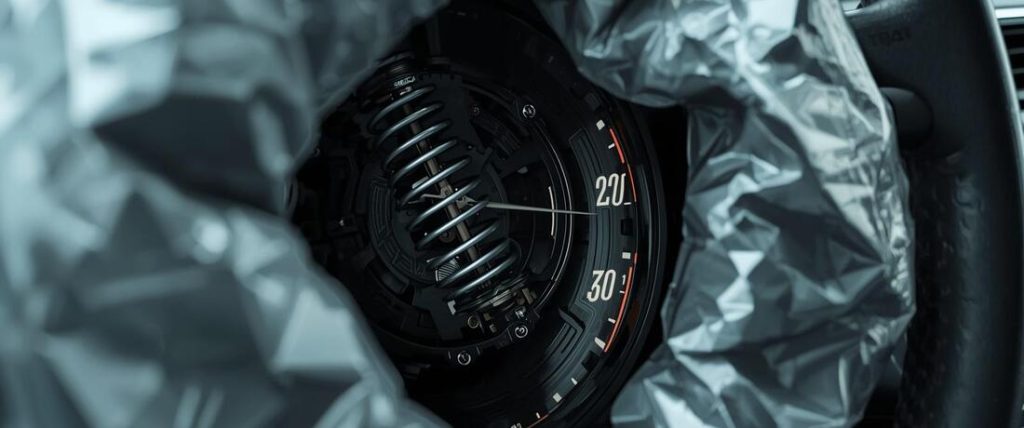
A clock spring is a coiled ribbon of wires that allows the steering wheel to turn without breaking electrical connections. It lives inside the steering column.
According to BobIsTheOilGuy, the clock spring consists of a ribbon multi-wire cable encased in housing. It has two connectors. One plugs into the stationary steering column harness. The other connects to the steering wheel. When you turn the wheel, the cable winds or unwinds inside the case.
Why does it fail? The failure is generally attributed to normal wear and tear. The ribbon moves with every revolution of the steering wheel. Over time, this movement weakens the wires.
MOPARNuts lists other causes:
- Over-rotation damage: If steering parts are disconnected during a repair, the wheel can turn too far. This snaps the ribbon.
- Age: Older vehicles face more wear.
- Moisture: Water in the steering column causes corrosion.

⚠️ Safety Warning First — This Is Why the SRS Light Is Urgent
If the airbag light is on, your driver-side airbag will not deploy in a crash. This is a critical safety fact.
FRAM warns that in the worst case, if you ignore the airbag light, your airbags might not deploy. This is not a maybe. As long as the light is on, the airbag control module disables deployment. It does this to prevent accidental firing.
But it also means you lose a key safety system. Do not ignore the SRS light. Even if the car drives fine, get it scanned.
The Free 60-Second Position Test — Do This Before Calling a Shop
You can confirm a bad clock spring by testing if the horn or buttons work only in one steering position. This test costs nothing.
The Horn Position Test
- Park safely. Start the engine.
- Press the horn button.
- Slowly turn the steering wheel from full left to full right.
Interpret results:
- Horn works in only one position: The ribbon is broken. It only makes contact at that one spot. Clock spring confirmed.
- Horn doesn’t work at all: Could be the clock spring or a blown fuse/relay.
- Horn works at all positions: Clock spring is likely fine. Check the horn relay.
BobIsTheOilGuy notes that the horn not working or working intermittently while turning points to the clock spring.
The Steering Wheel Button Test
Press a non-working button. Turn the wheel through its full range. If it works in one spot but not others, the clock spring is bad.
Clock Spring vs. Horn Relay — The Disambiguation Test
Readers often confuse a dead horn from a relay with a bad clock spring.
| Test | Clock Spring | Horn Relay / Fuse |
|---|---|---|
| Horn works in one steering position | ✅ Confirms clock spring | ❌ Relay affects all positions |
| Other steering buttons not working | ✅ Suggests clock spring | ❌ Relay only affects horn |
| Airbag / SRS light on | ✅ Clock spring very likely | ❌ Relay doesn’t trigger SRS |
| Fuse is intact, relay tests good | ✅ Points to clock spring | N/A |
8 Symptoms of a Bad Clock Spring
1. Airbag Warning Light (SRS Light) — The Most Critical Symptom
The airbag warning light is the most common sign of a faulty clock spring. Even a slight fault will light up the dash.
FRAM explains that the airbag is a susceptible system. If the light turns on specifically when you turn the wheel, that points directly to the clock spring. A steady light could be other components.
VW Vortex confirms that clock springs frequently fail and cause the SRS light. You will likely need an SRS-capable scanner to read these codes.
2. Horn Doesn’t Work — Or Only Works in One Position
A horn that works intermittently or not at all is a primary symptom. The horn gets power through the clock spring.
BobIsTheOilGuy states that over time, wires in the clock spring can break. This stops the horn from working. If the horn works in exactly one steering position, the ribbon is broken.
A unique variant is the horn going off by itself while turning. This means a short circuit in the ribbon.
3. Steering Wheel Buttons Not Working
Non-working buttons on the steering wheel often indicate a bad clock spring. This includes audio, phone, and cruise controls.
MOPARNuts notes that this lack of operation stems from a separation of the wires. If the buttons work in a particular position, there is a problem with the clock spring.
4. Cruise Control Failure
Cruise control may fail to set or disengage randomly if the clock spring is bad. The buttons need the connection through the spiral cable.
MOPARNuts explains that the clock spring maintains the connection between the cruise buttons and the car’s system. If it malfunctions, you cannot set speed.
5. Traction Control or Electronic Throttle Warning Lights
You might see traction control or throttle warning lights alongside cruise control failure. This surprises many drivers.
The Truck Stop explains that cruise control works with traction and throttle systems. If the connection breaks, it can trigger these lights. If you see these lights with a dead cruise button, check the clock spring before checking sensors. You can read more about related systems in our article on symptoms of a bad electronic stability control module.
6. Grinding or Scraping Noise When Turning
A grinding noise from inside the steering wheel suggests a damaged clock spring casing. It is not a suspension noise.
Car Mods Australia notes this noise happens when the clock spring is damaged. Metal or plastic parts rub together. A broken ribbon cable can get stuck in the casing. This might make the wheel harder to turn.
7. Blown Fuses Related to Steering Wheel Circuits
Rapidly blowing fuses for the horn or airbag can signal a shorted clock spring. This happens when wires arc against grounded surfaces.
MOPARNuts confirms that a damaged clock spring can result in rapid fuse failure. If you replace a fuse and it blows again, inspect the clock spring.
8. Airbag Doesn’t Deploy in a Collision
The driver-side airbag will not fire during a crash if the clock spring is broken. This is the most dangerous symptom.
Westwood Honda reminds us that this is only obvious after an accident. It is why you must not ignore the other seven symptoms.
The “Horn Going Off by Itself” Scenario — A Distinct Clock Spring Pattern
If your horn honks spontaneously when you turn the wheel, you have a shorted clock spring. This is different from a broken wire that causes silence.
The damaged ribbon makes momentary contact with another wire. This completes the horn circuit briefly. BobIsTheOilGuy confirms the horn going off by itself while turning is a direct symptom.
This is easier to diagnose. It clearly links the honking to the steering movement.
The Over-Rotation Warning — Why Airbag Lights Appear After Steering Work
Mechanics can break the clock spring by turning the steering wheel too far during repairs. This happens when steering linkage is disconnected.
MOPARNuts explains that the steering wheel is usually limited by the wheels. But when linkage is disconnected, the wheel can turn indefinitely. Turning it one too many times snaps the ribbon.
If your airbag light appears right after steering work, return to the shop. They should fix it.
Is It Safe to Drive With a Bad Clock Spring?
Driving with a broken clock spring is not advisable because critical safety systems are offline. You lose the horn and airbag.
| Symptom | Safe to Drive? | Action |
|---|---|---|
| Steering buttons not working | ⚠️ Short term | Book inspection within 1 week |
| Horn not working | ❌ Not recommended | Horn is a safety device; book soon |
| SRS / airbag light on | ❌ Not safe | Airbag disabled; book immediately |
| Grinding noise | ⚠️ Caution | Risk of jamming; book this week |
| Traction control light + cruise dead | ⚠️ Caution | Systems degraded; scan codes |
| Horn going off by itself | ❌ Not recommended | Electrical short; potential fire risk |
Used Clock Spring Safety Warning
Do not use a clock spring from a vehicle that was in a crash or deployed airbags. It is likely useless.
TruckersReport warns that the clock spring is rendered useless once airbags deploy. Also, used parts have unknown rotation history. If it was not centered when pulled, it may fail immediately.
Always use a new OEM or quality aftermarket part. Do not save $40 on a part that saves your life. If you see warnings on your dash like FCW System Failed, do not ignore them.
Steering Angle Sensor Reset After Clock Spring Replacement
You must reset the steering angle sensor after installing a new clock spring. This restores traction control function.
GCG Turbos explains that the sensor is often integrated with the clock spring. Without a reset, traction control may not work properly.
This reset typically costs $85–$150 at a dealer or alignment shop. Factor this into your budget. For vehicles like Hondas, this might be related to a Check VSA System Light.
Clock Spring Replacement Cost
Replacing a clock spring typically costs between $200 and $700 installed. The part is not extremely expensive, but labor adds up.
TurboPACS notes the part costs between $60 and $450. Labor takes 1.5–2 hours.
| Service | Estimated US Cost |
|---|---|
| Clock spring (parts only, aftermarket) | $60 – $150 |
| Clock spring (parts only, OEM) | $150 – $450 |
| Labor (1.5–2 hours) | $150 – $300 |
| Total installed (aftermarket) | $200 – $400 |
| Total installed (OEM) | $350 – $700 |
| Steering angle sensor reset | $85 – $150 |
DIY is possible but risky. You must follow safety procedures to avoid accidental airbag detonation.
FAQ About Symptoms of a Bad Clock Spring
Can a bad clock spring cause the airbag light to turn on?
Yes, it is the most common reason. FRAM states that the airbag is a susceptible system. The slightest fault lights the warning. If the light flickers when you turn the wheel, it points directly to the clock spring.
Can a bad clock spring cause the horn to stop working?
Yes. BobIsTheOilGuy confirms that broken wires in the clock spring stop the horn from working. If the horn only works in one steering position, the ribbon is broken.
Can a bad clock spring cause traction control or stability control lights?
Yes. Carwood notes that a faulty clock spring can cause traction control lights. It cannot relay information between the wheel and the modules. The cruise control wiring often triggers this cascade.
How much does clock spring replacement cost?
Total replacement typically runs $200–$400 for aftermarket parts. OEM parts push the total to $350–$700. You must add $85–$150 for a steering angle sensor reset.
Can I use a used clock spring from a salvage yard?
It is not recommended. TruckersReport warns that units from crashed cars are useless. The risk of failure is high. Buy a new unit for safety.
Bottom Line — What to Do Right Now
Follow this action guide based on your specific situation.
- SRS/airbag light is on: Get an SRS scan immediately. Book repair as a priority. Your airbag is disabled.
- Horn is dead or works in one position: Do the position test. If confirmed, book replacement.
- Steering wheel buttons not working: Test them while turning. Position-specific failure means clock spring.
- Traction control light + cruise control dead: Suspect the clock spring. Scan for airbag codes first.
- Airbag light appeared after steering work: Return to the shop. They likely over-rotated the wheel.
- Grinding sound from inside the wheel: Book inspection within 1 week.
Golden rule: If your SRS light is on, act immediately. Your driver-side airbag is offline. A $200–$400 repair is not optional when your life is at risk.
Quick Summary:
- The SRS light is the most critical symptom; it means the airbag will not deploy.
- A horn that works in only one steering position confirms a bad clock spring.
- Steering wheel buttons failing is a common sign of a broken ribbon wire.
- Do not use a used clock spring from a salvage yard; buy new for safety.
- Over-rotation during steering repairs is a common cause of sudden failure.
- You must reset the steering angle sensor after replacing the clock spring.
- Expect to pay $200–$700 for total replacement costs.