
This article was updated in May 31, 2026 with new products and information by Mark S. Taylor
When your engine misfires in the rain, moisture is creating a shortcut for high-voltage electricity. Your ignition system generates 20,000 to 40,000 volts to fire each spark plug. When water seeps into a cracked coil boot, worn plug wire, or distributor cap, it gives that voltage an easier path to ground than jumping the spark plug gap. The cylinder doesn’t fire. You feel a stumble, a shake, or a loss of power. The good news: this is one of the most diagnosable problems in automotive repair, and most fixes cost under $200.
I’ve been turning wrenches for 20 years, and rain misfires are like a fingerprint — they always point to the same handful of culprits. The trick is knowing which one is guilty on your specific car, and I’m going to show you how to find it with a $2 spray bottle.
Contents
- 1 What Is a Rain-Related Engine Misfire?
- 2 Symptoms and Warning Signs
- 3 Common Causes (By Ignition System Type)
- 4 How to Diagnose It (The Spray Bottle Test)
- 5 Can You Drive With It?
- 6 Repair Cost Breakdown
- 7 DIY vs. Mechanic: Should You Fix It Yourself?
- 8 Prevention Tips
- 9 FAQs About Engine Misfire When Raining
- 9.1 Q: Can rain actually cause an engine misfire?
- 9.2 Q: Why does my car misfire only when it rains and run fine when it’s dry?
- 9.3 Q: Will driving with a misfire damage my engine?
- 9.4 Q: How do I know if it’s the spark plugs, wires, or coil causing the rain misfire?
- 9.5 Q: Can I use WD-40 or silicone spray to fix a rain misfire temporarily?
- 10 The Bottom Line
What Is a Rain-Related Engine Misfire?
Inside your engine, the ignition system’s job is simple: create a lightning bolt at exactly the right moment to ignite the air-fuel mixture in each cylinder. That lightning bolt needs to jump a gap of about 0.040 inches — roughly the thickness of a credit card — inside the combustion chamber. To do that, the ignition coil steps up your car’s 12 volts to 20,000–40,000 volts.
Here’s the problem: electricity is lazy. It always takes the easiest path to ground. A healthy ignition system forces that voltage to jump the spark plug gap because there’s nowhere else to go. But when moisture gets inside a cracked coil boot, a frayed plug wire, or a distributor cap with carbon tracking, water creates a conductive bridge. The voltage says “thanks, I’ll take the easy way” and arcs to ground through the moisture instead of the spark plug. That cylinder misfires.
Think of it like a garden hose with a pinhole leak. Most of the water still comes out the nozzle, but enough sprays sideways to kill your pressure. In your engine, that “sideways spray” is electricity escaping where it shouldn’t.
The critical distinction: A misfire only in wet weather means your ignition components are degraded but not dead. They’re failing the “moisture test.” Fix them now, before they fail completely and strand you on a dry day too.
Symptoms and Warning Signs
Rain misfires don’t all feel the same. Your symptoms tell me which part is failing.
- Flashing check engine light during rain: This is the big one. A flashing CEL means the engine is misfiring badly enough that raw, unburned fuel is entering your exhaust system. Every second you drive is damaging your catalytic converter. Pull over as soon as it’s safe.
- Steady check engine light with rough idle in rain: The misfire is present but intermittent. You can probably drive carefully to a shop, but don’t ignore it. The steady light will become a flashing light as the part degrades further.
- Misfire at idle but smooth at highway speed: This usually points to a specific plug wire or coil boot. At idle, cylinder pressure is low and the spark doesn’t need much voltage to fire. Moisture steals just enough to cause a miss. At higher RPM, the coil generates more voltage and overcomes the leak.
- Misfire under acceleration in rain: This points to a more serious ignition leak. Under acceleration, cylinder pressure skyrockets and the spark needs maximum voltage. If moisture is stealing voltage at high load, the leak is significant. Suspect a cracked coil pack or severely degraded plug wires.
- Engine stalls in heavy rain but restarts when dry: This is often a distributor cap full of water (on older cars) or a coil pack with severe moisture ingress. The ignition system is so compromised that multiple cylinders misfire simultaneously.
- No codes but rough running in humidity: Some cars won’t set a misfire code until the miss is severe. If you feel a stumble on damp mornings with no check engine light, your ignition components are borderline. The rain is just pushing them over the edge.

Common Causes (By Ignition System Type)
Rain misfires depend heavily on what kind of ignition system your car has. Here’s how to think about it based on your vehicle’s age and design.
If Your Car Has a Distributor (Typically Pre-2000)
This is the classic rain misfire setup. The distributor cap and rotor sit at the center of the engine, and spark plug wires run from the cap to each plug.
- Distributor cap with carbon tracking or cracks: Moisture gets inside the cap and creates a conductive film on the inside surface. The spark arcs between terminals instead of going to the correct cylinder. I see this constantly on older Hondas, Toyotas, and Fords. The fix is a new cap and rotor — usually under $40.
- Old spark plug wires: Rubber insulation degrades over time. Microscopic cracks let moisture in. The voltage leaks through the wire’s outer jacket to the engine block instead of reaching the plug. A new wire set runs $50–$150 depending on the car.
- Moisture inside the distributor from a missing seal: The distributor has an O-ring or gasket where it mounts to the engine. When that seal fails, engine heat draws moisture into the distributor housing. This is an easy miss — mechanics focus on the cap and forget the seal underneath.
If Your Car Has a Coil Pack (Typically 1995–2010)
Coil packs replaced distributors on most cars in the mid-90s. One or two coils serve multiple cylinders through short plug wires.
- Cracked coil pack housing: This is the #1 cause of rain misfires I diagnose in my shop. The coil pack’s plastic case develops hairline cracks from heat cycling. Moisture seeps in, and the high voltage arcs inside the coil or across the case to ground. VW, Audi, GM, and Ford coil packs are notorious for this. A new coil pack is $75–$200.
- Bad plug wire boots: Even with coil packs, short plug wires connect the coil to the plugs. The rubber boots at each end crack and let moisture in. These are cheap — $10–$30 for a set — but often overlooked.
- Oil-soaked coil pack: On some engines (especially GM V6s), a leaking valve cover gasket drips oil onto the coil pack. Oil attracts and holds moisture. The coil works fine when dry but misfires in damp weather. Clean the oil, fix the gasket, replace the coil.
If Your Car Has Coil-on-Plug (COP) (Typically 2000+)
Modern engines have one coil per cylinder, mounted directly on top of each spark plug. No plug wires.
- Cracked coil boot: The rubber boot that insulates the coil from the plug is the weak point. It sits in a hot, oily environment and degrades over time. A crack lets moisture into the spark plug well, and the voltage arcs to the metal tube surrounding the plug. New boots are $5–$15 each. A whole COP unit is $40–$100 per cylinder.
- Leaking spark plug tube seal: The valve cover has a seal around each spark plug tube. When that seal fails, oil fills the tube and pools around the plug. Oil + moisture = conductive sludge that causes misfires. This requires a valve cover gasket replacement ($150–$400) plus new plugs and boots.
- Missing hood weatherstrip: Here’s the angle nobody talks about. A damaged or missing hood seal channels rainwater directly onto the ignition coils. I had a customer with a 2015 Holden Commodore whose engine misfired only in rain. The windshield installer had left out the hood weatherstrip. Water sprayed onto the coil leads and shorted them. A $20 eBay weatherstrip fixed it permanently.
How to Diagnose It (The Spray Bottle Test)
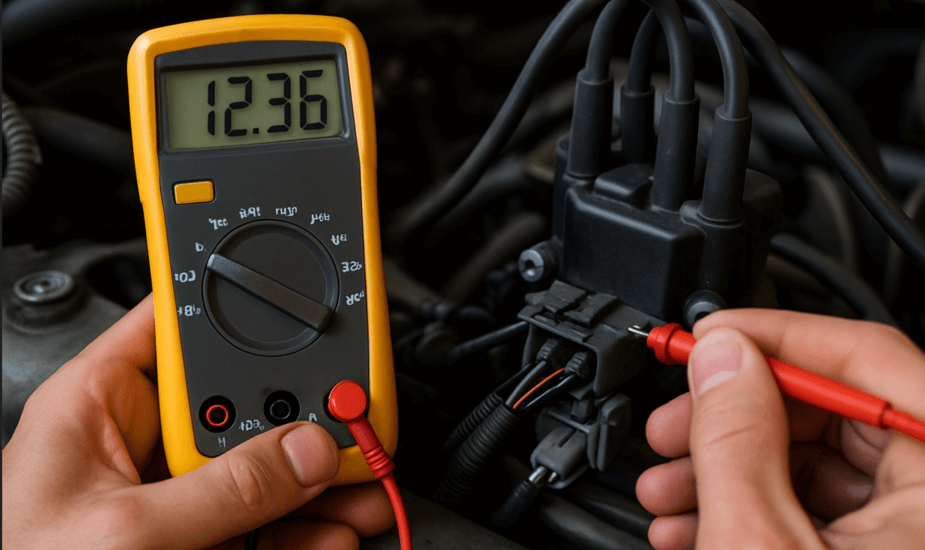
You don’t need to wait for the next thunderstorm. Here’s how to reproduce the problem in your driveway and pinpoint the exact failing part.
Step 1: Scan for Codes (2 minutes) Plug in an OBD2 scanner. Look for P0300 (random/multiple misfire) or P0301–P0308 (specific cylinder misfire). A specific code tells you exactly which cylinder to focus on. Write it down.
Step 2: The Spray Bottle Test (10 minutes) Start the engine and let it reach normal operating temperature. Fill a spray bottle with water. With the engine running, mist water over each ignition component one at a time:
- Distributor cap: Spray around the base and across the top. Listen for RPM drop or rough running.
- Plug wires: Mist each wire from end to end. A bad wire will cause an immediate stumble.
- Coil pack: Spray across the top and sides. Look for arcing — you may see a faint blue spark jumping from the case.
- Coil-on-plug boots: Mist each boot where it meets the valve cover. A cracked boot will often cause a miss within seconds.
Pro tip: Do this at dusk or with the garage lights off. A failing ignition component will often show visible arcing — a tiny blue spark jumping to ground — that you can’t see in daylight.
Step 3: The AM Radio Trick (5 minutes) This is an old mechanic’s trick that costs nothing. Tune an AM radio to a frequency between stations — you should hear static. Hold the radio near the engine while it runs. A failing plug wire or coil will create distinct “pops” or clicks in the static at engine speed. The louder the popping, the worse the leak. Move the radio around to find the loudest spot — that’s your culprit.
Step 4: The Stethoscope Test (Optional) If you have a mechanic’s stethoscope, touch the probe to each coil or plug wire boot while the engine idles. A failing component will sometimes make an audible ticking or snapping sound as voltage escapes. No stethoscope? A long screwdriver pressed to your ear works almost as well.
Step 5: Visual Inspection Remove the suspect component and look for:
- White or gray carbon tracks on the inside of a distributor cap
- Black burn marks on a coil pack housing
- Cracked or brittle rubber on plug wire boots
- Oil pooling in spark plug wells (COP systems)
Can You Drive With It?
This is the question that matters when you’re caught in a downpour. Here’s my traffic-light system:
Table
| Condition | Drive or Tow? | Action |
|---|---|---|
| Light stumble, steady CEL, no loss of power | GREEN — Cautious Drive | Drive to a shop at moderate speed. Avoid hard acceleration. |
| Rough idle, steady CEL, noticeable power loss | YELLOW — Drive to Shop Only | Drive directly to a repair facility. No highway speeds. |
| Flashing CEL at any time | RED — Stop Immediately | Pull over safely. A flashing CEL means catalytic converter damage is happening now. Tow to shop. |
| Engine stalls in rain and won’t restart | RED — Tow | Do not attempt to restart repeatedly. Call a tow truck. |
| Misfire + strong fuel smell from exhaust | RED — Stop | Raw fuel is entering the exhaust. Tow immediately. |
If you’re driving in the rain and the engine starts misfiring, don’t panic. Ease off the accelerator, move to the right lane, and find a safe place to pull over. If the check engine light is flashing, shut the engine off. If it’s steady and the car still runs, you can likely limp to a shop. But every mile with a flashing CEL is a mile closer to a $1,500 catalytic converter bill.
Repair Cost Breakdown
Here’s what you’re actually looking at, based on 2026 national averages:
Table
| Repair | Cost Range | When It’s Needed |
|---|---|---|
| Spark plug replacement (set of 4) | $40–$150 DIY; $100–$300 shop | Worn or fouled plugs contributing to misfire |
| Spark plug wire set | $50–$150 DIY; $150–$300 shop | Degraded insulation leaking voltage in moisture |
| Distributor cap + rotor | $30–$80 DIY; $100–$200 shop | Carbon tracking or moisture inside cap |
| Ignition coil pack | $75–$200 DIY; $200–$400 shop | Cracked housing with moisture ingress |
| Coil-on-plug unit (per cylinder) | $40–$100 DIY; $150–$300 shop | Failed COP with cracked boot |
| Valve cover gasket + tube seals | $50–$100 DIY; $150–$400 shop | Oil leaking into spark plug wells |
| Catalytic converter (if damaged) | $1,000–$2,500 | Unburned fuel from prolonged misfire |
| Hood weatherstrip replacement | $15–$50 DIY | Missing or damaged seal channeling water |
The reality: 80% of rain misfires are fixed for under $200. The danger isn’t the repair cost — it’s ignoring the misfire and frying your catalytic converter. That’s a 10x multiplier on your bill.

DIY vs. Mechanic: Should You Fix It Yourself?
Table
| Task | DIY? | Skill Level | Tools Needed |
|---|---|---|---|
| Spray bottle diagnostic test | Yes | Beginner | Spray bottle, OBD2 scanner |
| Replace spark plugs | Yes | Beginner | Spark plug socket, ratchet, torque wrench |
| Replace spark plug wires | Yes | Beginner | None — pull and push |
| Replace distributor cap and rotor | Yes | Beginner | Screwdriver, basic sockets |
| Replace coil pack | Yes | Intermediate | Socket set, dielectric grease |
| Replace coil-on-plug unit | Yes | Intermediate | Socket set, torque wrench |
| Replace valve cover gasket | Maybe | Intermediate | Full socket set, torque wrench, patience |
| Catalytic converter replacement | No | Advanced | Welding equipment, lift, extensive tools |
If you can change your own oil, you can handle 90% of rain misfire repairs. The spray bottle test requires zero mechanical skill and will tell you exactly which part to buy. The only jobs that need a shop are valve cover gaskets (if you’re not comfortable with torque specs) and catalytic converter replacement.
Prevention Tips
The best rain misfire is the one that never happens. Here’s how to keep moisture out of your ignition system:
- Replace ignition components before they fail. Spark plug wires last about 60,000 miles. Coil packs last 100,000–150,000 miles. Don’t wait for the rain to tell you they’re worn.
- Use dielectric grease on every spark plug boot. A $5 tube of dielectric grease, applied inside each boot during installation, creates a moisture barrier. I do this on every plug and wire job that comes through my bay. It prevents 90% of moisture-related misfires.
- Check your hood weatherstrip. Look at the rubber seal along the front edge of your hood. Is it cracked, missing, or sagging? A $20 replacement can prevent water from channeling directly onto your ignition components.
- Keep spark plug wells clean and dry. On COP engines, pull the coils every 30,000 miles and inspect the wells. If you see oil, the tube seals are leaking. Fix them before the oil attracts moisture.
- Clear your cowl drain holes. The area at the base of your windshield has drain holes that channel water away from the engine bay. If they’re clogged with leaves, water overflows into the engine compartment. Clean them with a wire coat hanger twice a year.
- Avoid pressure-washing your engine bay. High-pressure water forces moisture into every crack and connector. If you must clean the engine, use a gentle spray and avoid the ignition components entirely.
FAQs About Engine Misfire When Raining
Q: Can rain actually cause an engine misfire?
A: Yes — rain and high humidity are common triggers for misfires in cars with degraded ignition components. Moisture creates a conductive path that lets high-voltage electricity escape before it reaches the spark plug. The misfire usually stops once the engine warms up and dries out the components, but the underlying problem remains and will get worse.
Q: Why does my car misfire only when it rains and run fine when it’s dry?
A: Because your ignition components — spark plug wires, coil boots, or distributor cap — are borderline worn. They’re good enough to work in dry conditions but fail the “moisture test.” Think of it like a roof with a small leak: it stays dry on sunny days but drips in the rain. The leak was always there — the rain just revealed it.
Q: Will driving with a misfire damage my engine?
A: The misfire itself won’t hurt the engine’s pistons or cylinders. The real danger is unburned fuel entering your exhaust system and overheating the catalytic converter. A flashing check engine light means converter damage is happening in real time. Even a steady misfire, driven for weeks, can eventually clog the cat and turn a $200 ignition repair into a $2,000 exhaust job.
Q: How do I know if it’s the spark plugs, wires, or coil causing the rain misfire?
A: Use the spray bottle test. Mist each component while the engine runs. The part that causes a stumble when sprayed is your culprit. If you have a specific misfire code (like P0302 for cylinder 2), focus on that cylinder’s plug, wire, and coil first. No scanner? Do the AM radio trick — the pops will be loudest near the failing component.
Q: Can I use WD-40 or silicone spray to fix a rain misfire temporarily?
A: WD-40 can displace moisture and get you out of a jam, but it’s not a fix. It evaporates and leaves a film that can attract dirt. Silicone spray is better — it creates a moisture-repellent coating on distributor caps and plug wires. But both are band-aids. The cracked or worn component still needs replacement. I keep a can of silicone spray in my toolbox for emergency roadside fixes, but I never let a customer leave my shop without replacing the real problem.
The Bottom Line
A rain misfire is your ignition system’s way of waving a white flag. Moisture has found a crack, gap, or leak in your high-voltage circuit, and it’s stealing the spark before it can fire your engine. The fix is almost always cheap — new plugs, wires, a coil pack, or a distributor cap. The danger is waiting too long and letting unburned fuel destroy your catalytic converter.
The first thing I do when a customer rolls in with a rain misfire? I grab my spray bottle and head to the parking lot. In 10 minutes, I can tell them exactly which part is failing and write them a repair estimate before they even pull into a bay. You can do the same thing in your driveway. Find the leak, fix the part, and the next thunderstorm will be background noise — not a reason to panic.