
This article was updated in July 20, 2026 with new products and information by Mark S. Taylor
Your car feels a little slower than it used to, your gas mileage slipped, and someone at the counter says you need a new air filter. Maybe. But before you say yes to a $150 quote, let’s find out if the filter is actually the problem — because on most cars this is a $20 part you can check yourself in the time it takes to read this section.
A dirty engine air filter chokes the airflow your engine needs to burn fuel properly. The most common dirty engine air filter symptoms are weak acceleration, worse fuel economy, rough idling, and a check engine light — but here’s what the parts-store blogs won’t tell you: on a modern fuel-injected car, the computer quietly compensates for a dirty filter, so your symptoms are usually milder than the scare articles claim. That’s exactly why so many drivers pay for repairs they didn’t need.
Here’s how to read the signs, confirm it’s really the filter, and know what the fix should cost.
Contents
What Is an Engine Air Filter?
Think of the engine air filter as your engine’s lungs. Every time the engine runs, it pulls in a huge amount of outside air to mix with fuel and burn inside the cylinders. The filter sits in that path and traps dirt, dust, pollen, and debris before they reach the engine.
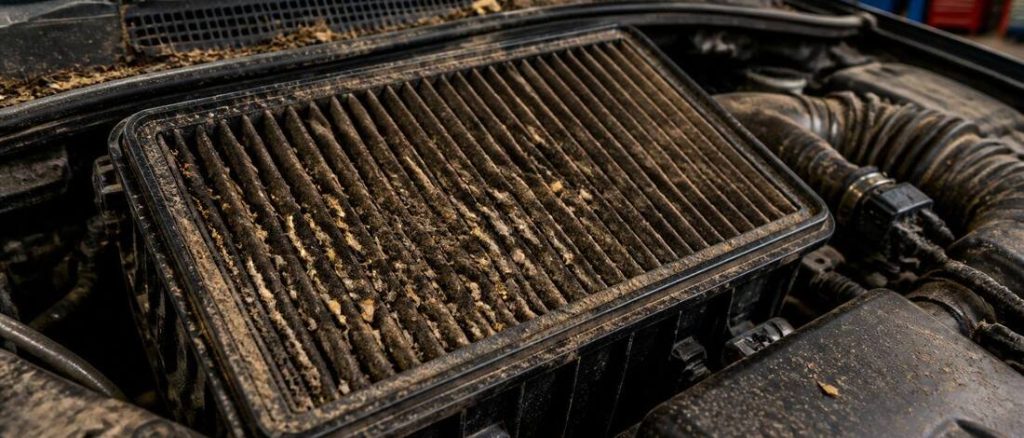
It’s a pleated panel — usually paper or cotton media folded into an accordion shape to grab more junk without blocking too much air. It lives in a plastic air box under the hood, and on most cars it pops out in seconds.
One thing to be clear on: this is not the same as your cabin air filter. The cabin filter cleans the air you breathe inside the car. The engine air filter protects the engine itself. People mix these up constantly, and shops sometimes charge for both when you only needed one.
6 Symptoms of a Dirty Engine Air Filter
Some of these signs point straight at the filter. Others can be faked by different parts, so treat the list as a starting point, not a verdict.
It looks dirty. This is the fastest and most reliable check. Pull the filter and hold it up to sunlight. If light passes through the pleats, it’s fine. If you see packed dirt and can’t see light, it’s done. A clean filter is nearly white; a spent one is gray, brown, or black.
Sluggish acceleration. Starve the engine of air and it makes less power. If your car feels lazy pulling onto the highway or hesitates when you press the pedal, restricted airflow is one possible cause.
Worse gas mileage. When airflow drops, the engine can end up burning fuel less efficiently to keep running. If you’re filling up more often with the same driving, the filter is worth a look — though on newer cars this effect is smaller than most articles suggest.
Rough idle or a hard start. A badly clogged filter can throw off the air-fuel mix, leaving the engine shaky at a stop or slow to fire up. Long term, a too-rich mix can foul spark plugs.
Check engine light. A severely restricted filter can skew the mass airflow (MAF) sensor readings enough to trip the light. The light alone doesn’t confirm the filter — but paired with a dirty filter and other symptoms, it fits.
Unusual pinging or knocking. Poor airflow can cause combustion to run off, producing a light pinging under load. This one has many other causes, so don’t hang your diagnosis on it alone.
If you only do one thing from this list, do the visual check. It settles the question faster than any other symptom.
Common Causes
A filter doesn’t go bad on a schedule — it goes bad based on what your car breathes.
Skipped maintenance. The most common cause. The filter quietly loads up over tens of thousands of miles until airflow suffers.
Dusty or unpaved driving. Gravel roads, construction zones, and dry climates clog a filter far faster than clean highway miles. This is “severe service,” and it can cut filter life in half.
Heavy stop-and-go traffic in hot weather. More running time, more airborne grit.
Rodent nests. Mice love a warm air box. Nesting material and chewed debris can clog a filter (and wreck it) in a single season.
Mileage is a guideline. Environment is the real driver.

How to Diagnose It (Is It Actually the Filter?)
This is the step most articles skip, and it’s the one that saves you money. A dirty filter shares symptoms with several other parts, so confirm before you spend.
Start with the visual test. Pop the air box, pull the filter, and hold it to the light. A dirty, light-blocking filter that lines up with your symptoms is your answer — replace it and reassess.
Here’s the part that matters: if the filter looks clean, the filter is not your problem. Move on. When acceleration, idle, or a check engine light stick around after a fresh filter, the usual suspects are:
MAF sensor — a dirty or failing mass airflow sensor causes very similar power and idle complaints and often sets its own codes.
Spark plugs — worn or fouled plugs cause misfires and rough idle.
Throttle body — carbon buildup restricts airflow the same way a clogged filter does.
Vacuum leak — an unmetered air leak throws off idle and fuel trims.
If you have a code reader, pull the codes before buying anything. A P0171 (system too lean) or a MAF-related code points you away from a simple filter swap. The first thing I check when a customer swears it’s the filter is whether the filter is even dirty — half the time it isn’t, and we’d have wasted their money chasing the wrong part.
Can You Drive With a Dirty Air Filter?
Yes, you can keep driving — this isn’t a tow-it-home emergency. A clogged air filter won’t leave you stranded or cause sudden failure. What it does is nickel-and-dime you: slightly worse mileage, a bit less power, and, over a long stretch of neglect, extra wear if the filter gets so damaged that unfiltered air reaches the engine.
The real risk shows up when a filter is so far gone that the media breaks down or gets pulled into the intake. That’s rare, but it’s how a $20 part turns into a much bigger bill. If your filter is visibly packed with dirt, replace it soon — not because your car will die tomorrow, but because there’s no upside to driving on a filter you already know is shot.
Repair Cost Breakdown
Here’s where drivers get burned. The part itself is cheap. What varies wildly is who installs it and how much they mark up the labor.
| Where you get it | Part cost | Labor | Total |
|---|---|---|---|
| DIY (parts store filter) | $15–$40 | $0 | $15–$40 |
| Independent shop | $15–$40 | $20–$55 | $40–$95 |
| Quick-lube (add-on) | $20–$45 | included/upsold | $40–$90 |
| Dealership | $30–$60 | $60–$130+ | $130–$300+ |
For context, RepairPal pegs the national average engine air filter replacement at roughly $77–$97, with labor around $38–$55. That’s fair for a shop doing it. What isn’t fair is the $200–$336 dealer quotes drivers report for bundling it with a “vehicle inspection.” If a dealer quotes you over $150 to swap a standard engine air filter, decline and do it yourself or take it to an independent.
The math is simple: the same filter costs the same $20 no matter who installs it. You’re paying for minutes of labor on a job that’s often tool-free.

DIY vs. Mechanic
On the majority of cars, this is one of the easiest jobs you can do. The air box is usually held by a few metal clips or Phillips screws, the old filter lifts straight out, and the new one drops in the same orientation. No tools on many models, five minutes start to finish.
When it’s worth paying a pro:
| Do it yourself if… | Let a mechanic do it if… |
|---|---|
| The air box has simple clips or screws | The intake is buried under engine covers |
| You can match the filter to your car | Your car uses an awkward or sealed housing |
| You’re already under the hood | You’re getting other service done anyway |
Buy the right filter by entering your year, make, and model at the parts counter or online — fitment is exact, and the wrong size won’t seal. One caution: if your car has a reusable performance filter (like a K&N), it needs cleaning and re-oiling with a specific kit, not a straight swap. Standard paper filters just get replaced.
Prevention Tips
Inspect it yearly or at every oil change. A 10-second look beats guessing.
Follow the severe-service interval if it fits you. Dusty roads, gravel, or heavy traffic in heat mean checking more often — sometimes twice as often as the normal schedule.
Check your owner’s manual for the baseline interval. Most makers list somewhere around 15,000 to 45,000 miles, but your driving decides the real number.
Watch the air box after any rodent activity. If you park outdoors or seasonally, a quick peek can catch a nest early.
FAQs About Dirty Engine Air Filter Symptoms
How often should I change my engine air filter?
Most manufacturers list somewhere between 15,000 and 45,000 miles, but it depends on where you drive. Dusty and stop-and-go conditions shorten that. Inspect it yearly and replace it when the pleats are visibly dirty rather than trusting mileage alone.
Can I clean a dirty engine air filter instead of replacing it?
Only if it’s a reusable performance filter designed for it, using the proper cleaning-and-oiling kit. A standard paper filter should not be repeatedly cleaned — blowing it out damages the media and lets dirt slip through. For paper filters, replace, don’t clean.
Can a dirty air filter cause a check engine light?
It can. A severely clogged filter can skew mass airflow sensor readings enough to trip the light. But the light has many causes, so scan for codes before assuming it’s the filter.
Is the engine air filter the same as the cabin air filter?
No. The engine air filter protects the engine; the cabin air filter cleans the air inside your car. They’re separate parts in separate locations, and you can need one without the other.
Will a new air filter improve gas mileage or horsepower?
If your old filter was genuinely clogged, a new one restores lost performance and efficiency. If the filter was already fairly clean, don’t expect a noticeable gain — the “free horsepower” claims are overstated on modern cars.
Bottom Line
A dirty engine air filter is one of the cheapest, easiest problems your car will ever hand you. Confirm it with the light test, and if the pleats are packed with dirt, replace it — usually for under $40 doing it yourself. The only real mistake here is paying dealer prices for a five-minute job, or replacing a clean filter and ignoring the MAF sensor, spark plugs, or throttle body that were the actual cause. Check first, then fix.