
This article was updated in July 29, 2026 with new products and information by Mark S. Taylor
The earliest sign of a dying hybrid battery usually isn’t a warning light. It’s your fuel economy quietly slipping and the gas engine kicking on more than it used to. By the time the “Check Hybrid System” message or the red triangle lights up, the pack has often been fading for weeks.
Here’s the reassuring part: hybrid batteries almost always warn you before they quit. Catch the signs early and you can plan a replacement on your schedule instead of paying for a tow on top of the repair. This guide walks you through the warning signs in the order they tend to appear, shows you how to tell the expensive pack apart from the cheap 12-volt battery, explains how to test the battery yourself, and lays out what a fix actually costs.

Contents
- 1 7 Signs Your Hybrid Battery Is Dying
- 2 Wait — Is It the Hybrid Battery or the 12V Battery?
- 3 How to Check Your Hybrid Battery’s Health
- 4 Can You Keep Driving With a Dying Hybrid Battery?
- 5 Safety and Maintenance Tips
- 6 Hybrid Battery Replacement Cost
- 7 FAQs About Signs of a Hybrid Battery Dying
- 8 Bottom Line
7 Signs Your Hybrid Battery Is Dying
These are listed roughly in the order they show up — the quiet clues first, the alarming ones last. You rarely get all seven at once. Two or three together is your signal to act.
1. Your fuel economy drops
This is almost always the first clue, and it’s the one most people ignore. Your hybrid saves fuel by letting the electric motor do part of the work. When the battery can’t hold or deliver a solid charge, the gas engine picks up the slack and burns more fuel to do it.
One Prius owner watched their average slide from roughly 50 mpg to 40 mpg as the car crossed 160,000 miles. That’s a 20% hit with no change in how they drove. If your MPG has fallen off over a few tanks and nothing else explains it — no winter cold, no new roof rack, no tire pressure problem — put the battery at the top of your suspect list.
2. The gas engine runs more often
A healthy hybrid glides silently on electric power at low speeds, at stoplights, and in slow traffic. A weak battery forces the engine to start up and stay running when it normally wouldn’t.
You can hear this one. On a quiet street, turn off the radio and just listen. If the engine almost never shuts off anymore — even coasting or sitting at a light — the battery is struggling to carry its share.
3. The charge gauge bounces around
Find your battery’s state-of-charge display (most hybrids show it on the energy screen or dash). In a healthy car it moves gradually. In a failing one, it swings — full to nearly empty and back again within a single short drive.
That erratic jumping usually means the battery’s internal modules have fallen out of balance. Some cells are weak, so the reading can’t settle. It’s one of the clearest signs the pack itself is the problem.
4. Acceleration feels weaker
Less electric assist means slower, softer pickup. You’ll notice it most when merging onto a highway or climbing a hill — the car feels like it lost a step, or hesitates before it gathers speed. Some drivers describe it as the car feeling “heavier” than it used to.
5. The “Check Hybrid System” light or red triangle appears
This is the dashboard telling you directly. On many Toyotas and Lexus models it’s the “red triangle of death,” often paired with a “Check Hybrid System” message. Other makes use a hybrid-system warning symbol.
Once this is lit, don’t sit on it. Get the car scanned promptly, because this warning can come right before the car drops into reduced-power limp mode.
6. The cooling fan runs loud or constantly
Your hybrid pack has its own cooling fan, usually tucked behind the rear seat or in the trunk area. As a battery weakens and runs hotter, that fan works harder and longer, and you may hear it whirring more than usual.
This sign cuts both ways, which is good news. Sometimes the fan is loud because the pack is failing — but sometimes the pack is overheating because the fan’s intake is clogged with dust and pet hair. Cleaning that vent is cheap, so it’s always worth checking before you assume the worst.
7. Harder starting or electrical gremlins
A pack that can’t hold a stable charge can make the car slow to power up, cause displays to flicker, or throw seemingly random electrical faults. On its own this often points to the 12-volt battery (more on that next), but combined with signs 1 through 3, it rounds out the picture of a dying high-voltage pack.
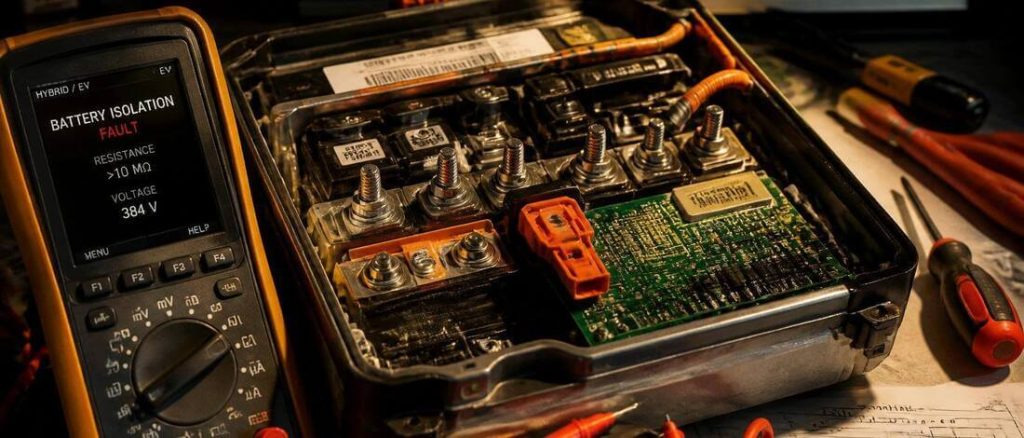
Wait — Is It the Hybrid Battery or the 12V Battery?
Before you brace for a four-figure repair, learn this one distinction — it saves people from unnecessary bills constantly.
Your hybrid has two batteries. The big high-voltage pack powers the electric motor. But there’s also a small 12-volt battery, just like the one in any gas car, and it handles waking the car up and running the electronics. A weak 12-volt battery can trigger the same warning lights, no-start problems, and flickering displays as a dying pack.
The difference in your wallet is enormous. A 12-volt battery costs about $150 to $300. The high-voltage pack costs thousands.
So triage before you panic:
Suspect the 12V battery if: the car is slow to power on, the dash flickers, you get random unrelated warning lights, or it won’t wake up after sitting. These are classic signs of a tired 12V — cheap to test, cheap to replace.
Suspect the hybrid pack if: your MPG has dropped, the gas engine runs constantly, the charge gauge swings wildly, and acceleration feels weak. These point at the expensive part.
The move: have the 12-volt battery load-tested first. Any shop can do it in minutes, and it’s the single best way to avoid paying for a pack you didn’t need.
How to Check Your Hybrid Battery’s Health
You don’t have to walk into a shop blind. You can gather real evidence yourself, safely, before anyone gives you a quote.
Step 1 — Scan for trouble codes. Plug a basic OBD-II scanner into the port under the dash and read the stored codes. This tells you whether the fault points at the battery or at something else entirely, so you’re not guessing.
Step 2 — Read the module voltages. App-and-dongle tools (there are popular ones made specifically for Prius and other hybrids) connect to your phone and show the voltage of each battery module, plus an overall health estimate. Expect to pay about $30 to $60 for the tool — a bargain next to a needless pack replacement.
Step 3 — Look at the balance. In that app data, compare the modules to each other. If one or two read noticeably lower than the rest, that imbalance is a failing pack showing its hand. Healthy packs stay tightly grouped.
Step 4 — Track your fuel economy for a week. Write down your MPG each tank. A documented, steady drop is strong evidence — and it helps you time the replacement so you’re never caught off guard.
One hard rule: everything above is safe because it doesn’t touch the high-voltage system. Never open, unbolt, or probe anything connected to the thick orange cables — that system carries enough voltage to kill you. Leave any hands-on pack work to a trained hybrid technician.

Can You Keep Driving With a Dying Hybrid Battery?
Usually yes, for a while — but understand you’re borrowing time. Most hybrids will keep running on the gas engine even with a badly weakened pack. You’ll just live with worse fuel economy and softer power until you fix it.
The risk is how it ends. If the battery fails hard, the car can drop into limp mode or refuse to start, often at the worst possible moment — a merge ramp, a busy intersection, a road trip far from home.
Here’s the part most articles skip: heat speeds up the decline. A struggling battery runs hotter, and heat kills more modules, which makes it run hotter still. That feedback loop can turn a slow fade into a fast failure, especially in summer or hot climates. A battery that seemed “fine, just thirsty” in spring can quit in July.
Practical rule: if the car suddenly loses power or the red triangle appears while you’re driving, get off at the next exit and have it scanned. And don’t plan a long trip on a pack you already know is fading.
Safety and Maintenance Tips
You can’t stop a battery from aging, but you can avoid an early death — and stay safe around a system that deserves respect. Follow these and many owners get well past 150,000 miles.
Keep the battery cooling fan and vents clean. This is the single most valuable habit. The pack’s cooling fan pulls cabin air through a vent, usually near the rear seat or in the trunk. Dust, crumbs, and pet hair clog it, the pack overheats, and heat is what kills modules. Vacuum the intake grille every few months and check that nothing (car seats, luggage, cargo covers) is blocking it.
Park in the shade or a garage in extreme heat. Heat is the number-one enemy of battery life. When summer parking gives you the choice, pick shade. A garage in a hot climate pays for itself in battery years.
Drive the car regularly. Hybrids don’t like sitting for weeks. Long storage lets both batteries drift to a poor charge state, which stresses the pack and can flatten the 12-volt. If you’re storing it, a maintenance charger on the 12-volt battery helps.
Stay current on regular maintenance. Fresh oil, healthy tires, and a well-running engine mean the hybrid system isn’t straining to compensate for other problems. A tired battery paired with a neglected engine ages faster.
Address warning lights early. A small imbalance caught now is far cheaper than a total failure later — sometimes a shop can rebalance or replace a single bad module instead of the whole pack.
Respect the orange cables. For your own safety: never cut, pierce, or disconnect the high-voltage wiring or connectors. If you’re doing any work near the pack, or after a collision, treat that system as live and let a hybrid-trained tech handle it.
Buy smart if you’re shopping used. Considering a used hybrid? Ask for the battery’s history, check the build date, and if possible run a health scan before you buy. A pack near the end of its life is a negotiating point, not a deal-breaker — as long as you know going in.

Hybrid Battery Replacement Cost
Dealers aren’t your only option, and knowing the tiers keeps you from overpaying.
| Option | Typical cost (parts + labor) |
|---|---|
| Reconditioned/refurbished pack | $1,000–$2,500 |
| New aftermarket pack | $1,500–$3,500 |
| Dealer (mainstream Toyota/Honda) | $2,500–$4,500 |
| Dealer (Lexus/luxury/PHEV) | $4,000–$8,000+ |
Ranges reflect US-market shop and dealer pricing; your model and battery chemistry drive the final number.
Independent hybrid specialists often replace a pack for well under dealer pricing, many with strong warranties and same-day or mobile installation. If the rest of your car is solid, a reconditioned or quality aftermarket pack can add years of driving without a dealer-sized bill. Weigh the repair against the car’s value, but for most well-kept hybrids, a new pack is far cheaper than a new car.
FAQs About Signs of a Hybrid Battery Dying
Is it the hybrid battery or the 12V battery?
Both can cause warning lights and starting trouble. A weak 12V battery ($150 to $300) usually shows up as flickering dash lights, random faults, and a slow or failed startup. A dying hybrid pack shows up as falling MPG, the gas engine running constantly, and a bouncing charge gauge. Have the 12V load-tested first — it’s the cheapest way to rule out the expensive fix.
How long can you drive with a dying hybrid battery?
Often weeks or even months on the gas engine, but with worse fuel economy and the real risk of limp mode or a no-start. Heat accelerates the damage, so don’t treat that window as guaranteed — plan the repair rather than pushing your luck.
How much does a hybrid battery replacement cost?
Roughly $1,000 to $2,500 for a reconditioned pack, $1,500 to $3,500 for aftermarket, and $2,500 to $8,000 or more at a dealer. Lexus, luxury, and plug-in hybrid packs sit at the top of the range.
How do I check my hybrid battery’s health?
Use an OBD-II scanner to pull trouble codes and a hybrid battery health app to read individual module voltages. A large imbalance between modules is a clear sign the pack is failing. Keep your hands off the orange high-voltage cables — that’s technician-only territory.
How long do hybrid batteries last before they die?
Typically 100,000 to 150,000 miles, or about 8 to 15 years. Some fail closer to 70,000 miles; well-maintained packs can pass 200,000. Federal law requires at least an 8-year/100,000-mile warranty, and Toyota now backs its hybrid batteries for 10 years or 150,000 miles.
Bottom Line
Don’t wait for the red triangle. Your real early warnings are a steady drop in fuel economy and a gas engine that never seems to shut off — both usually show up long before any dashboard light. When the signs stack up, work the problem in order: rule out the cheap 12-volt battery first, confirm the pack’s health with a scanner or app, and keep the cooling vents clean so heat doesn’t finish the job early. If it truly is the hybrid battery, price reconditioned and aftermarket options alongside the dealer before you spend — the gap can be thousands. Catch it early and a dying hybrid battery is a planned expense, not a roadside emergency.