
This article was updated in August 19, 2026 with new products and information by Mark S. Taylor
Your vehicle floats like a boat over highway dips, clunks over speed bumps, or squats toward the pavement every time you accelerate. You take it to a repair shop for an oil change, and the service advisor hands you a suspension repair estimate that makes your jaw drop: $1,400 for front struts, or $2,200 for all four corners.
Before you hand over your credit card, you need to understand what you are actually paying for. In my 20 years running shop bays, suspension quotes are where vehicle owners get overcharged more than almost anywhere else.
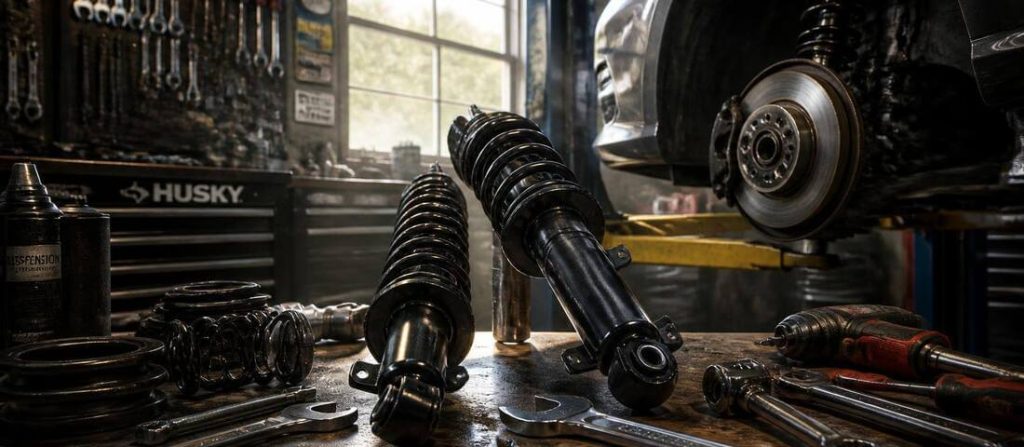
Quick Answer (Replacing Shocks and Struts Cost):
On average, replacing shocks and struts costs between $900 and $1,800 for all four corners on a standard passenger vehicle at an independent repair shop. Replacing a pair of front struts costs $650 to $1,200 (including parts, labor, and a mandatory $100–$150 wheel alignment). Replacing a pair of rear shocks costs $250 to $500 total. Doing the job yourself with pre-assembled loaded struts drops your total cost to $350 to $700 for all four corners.
NATIONAL REPLACEMENT COST SUMMARY
| Service Scope | DIY Cost | Pro Shop Cost |
| Rear Shocks (Pair) | $80 – $180 | $250 – $500 |
| Front Struts + Alignment | $250 – $480 | $650 – $1,200 |
| All 4 Corners (Standard Car) | $350 – $700 | $900 – $1,800 |
| All 4 Corners (Truck / SUV) | $450 – $950 | $1,200 – $2,400 |
| Electronic / Air Ride (All 4) | $1,200 – $2,800 | $2,500 – $4,500 |
Contents
- 1 Can You Drive With Blown Shocks or Struts?
- 2 Shocks vs. Struts: Why Front Struts Cost Twice as Much as Rear Shocks
- 3 Symptoms of Failing Shocks and Struts: How to Confirm Failure
- 4 The “Quick-Strut” Secret: How Loaded Assemblies Save You $150+ in Labor
- 5 Comprehensive Shocks and Struts Replacement Cost Breakdown
- 6 Step-by-Step Replacement Overview: What the Mechanic Does
- 7 DIY vs. Professional Shop Decision Guide
- 8 The Quote Auditor Checklist: How to Avoid Getting Ripped Off
- 9 FAQs About Replacing Shocks and Struts Cost
- 9.1 Do I have to replace all 4 shocks and struts at the same time?
- 9.2 Do I really need an alignment after replacing shocks and struts?
- 9.3 How long do shocks and struts typically last?
- 9.4 What is the difference between OEM and aftermarket shocks?
- 9.5 Can bad shocks cause shaking or vibration at highway speeds?
- 10 Mark’s Final Verdict
Can You Drive With Blown Shocks or Struts?
⚠️ Mechanic Safety Assessment: Fix Within 500 to 1,000 Miles
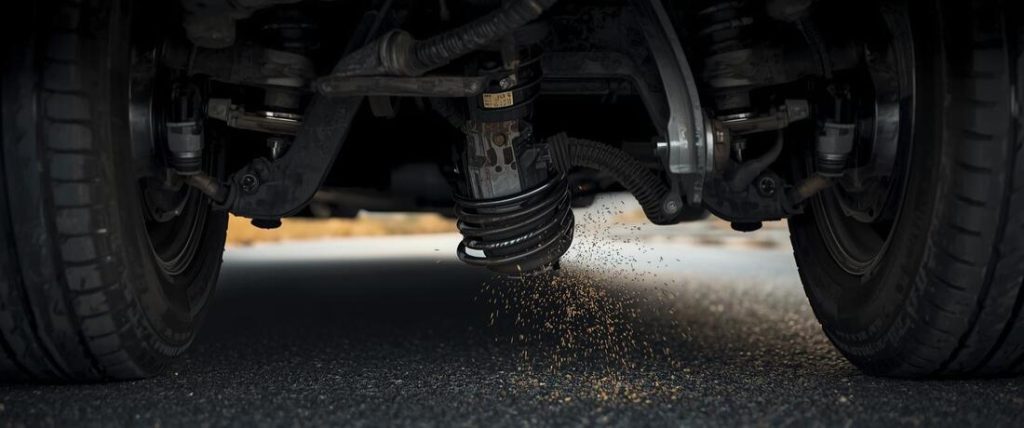
Driving on worn or leaking shocks and struts is possible, but it compromises vehicle stability, increases emergency stopping distances, and causes severe collateral damage. When suspension dampers lose their internal hydraulic fluid or nitrogen gas charge, the tires lose continuous contact with the road over bumps. This increases panic braking distances by 10 to 20 feet on uneven pavement, triggers premature anti-lock braking system (ABS) intervention, and ruins an $800 set of radial tires through severe tread cupping within 8,000 to 12,000 miles.
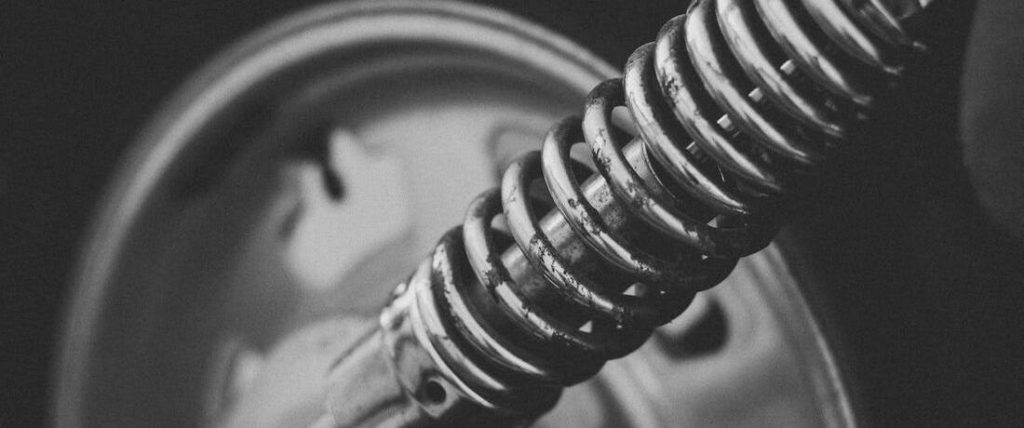
When a shock absorber fails, the heavy steel coil spring continues to bounce uncontrolled after every bump. The damper’s job is to absorb and dissipate that energy in a single oscillation.
Without functioning dampers, your tire literally bounces down the highway like a basketball. Every time the tire leaves the pavement or unloads its weight, your vehicle loses braking friction and steering control.
If your car bounces more than twice after pushing down hard on a bumper, or dives violently forward during routine stops, budget for replacement promptly to avoid wrecking your tires and suspension bushings.
Shocks vs. Struts: Why Front Struts Cost Twice as Much as Rear Shocks
Many drivers and even some generic auto parts websites use the words “shock” and “strut” interchangeably. Mechanically, they are completely different components that require entirely different labor procedures.
| Standalone Shock | MacPherson Strut |
| • Dampens bounce only | • Holds up vehicle weight |
| • Not a structural part | • Structural suspension link |
| • No spring attached | • Integrated coil spring |
| • Replaced in 30–45 minutes | • Acts as steering pivot |
| • NO alignment needed | • MANDATORY alignment needed |
| • Typical Cost: $250–$500/pr | • Typical Cost: $650–$1,200 |
The Standalone Shock Absorber (Rear Axles & Trucks)
A standalone shock absorber is a simple hydraulic cylinder with two mounting eyes. It bolts between the vehicle frame and the suspension control arm or solid rear axle.
Its only job is to dampen up-and-down spring oscillation. A shock absorber does not support vehicle weight, does not hold a coil spring, and does not determine wheel alignment angles.
Replacing a pair of rear shocks takes an experienced technician 30 to 45 minutes on a lift. You unbolt the top nut, unbolt the bottom bolt, slide in the new unit, and torque the fasteners. No alignment is needed afterward.
The MacPherson Strut Assembly (Front Suspension & Unibody Cars)
A MacPherson strut is a major structural backbone of your vehicle’s chassis. It combines the hydraulic damper, heavy coil spring, upper mounting plate, bump stop, and steering pivot bearing into one massive assembly.
The strut bolts directly to the steering knuckle at the bottom and the vehicle body tower at the top. It supports the entire physical weight of that corner of the car.
When you turn the steering wheel, the entire front strut assembly rotates on its upper bearing. Because unbolting the strut changes your steering geometry (camber and toe angles), a professional four-wheel computerized alignment ($100–$150) is non-negotiable after installation.
Symptoms of Failing Shocks and Struts: How to Confirm Failure
Do not let a repair shop sell you $1,500 in suspension work based on a vague verbal recommendation. Look for these five undeniable physical symptoms:
5 SIGNS YOUR DAMPERS ARE DEAD
- The Bounce Test: Vehicle oscillates > 1.5 times.
- Nose-Dive & Squat: Front dives hard under braking.
- Cupped Tire Tread: High/low scalloped bald spots on tire.
- Active Wet Fluid Leak: Oil running down damper body.
- Front-End Clunking: Knocking noise over expansion joints.
- The Physical Bounce Test: Walk to each corner of your vehicle and push down with all your body weight on the bumper, then release immediately. A healthy damper stops the car instantly—it rebounds up, settles back to ride height, and stops. If the body bounces up and down two, three, or four times, the internal valving is completely shot.
- Front-End Nose-Dive Under Braking: When you apply firm brake pressure, does the front hood plunge toward the ground while the rear bumper rises? Blown front struts cannot resist dynamic forward weight transfer, overloading your front brakes and extending stopping distance.
- Cupped or Scalloped Tire Wear: Run your bare palm along the perimeter of your tire tread. If you feel high and low hills (scallops or dips every few inches), your shock absorber has been allowing the tire to bounce off the asphalt at 60 mph.
- Active Wet Fluid Leakage: Look through your wheel spokes at the damper cylinder. A light, dry, dusty oil film around the top seal (oil misting) is normal sweating over years of use. However, if you see wet, shiny, dripping hydraulic fluid pooling around the spring seat or running down the shock body, the shaft seal has ruptured and the damper must be replaced.
- Clunking or Rattling Over Sharp Bumps: When the internal piston rod develops play or the upper rubber strut mount bearing cracks, the metal shaft bangs inside the housing over road seams, expansion joints, and potholes.
The “Quick-Strut” Secret: How Loaded Assemblies Save You $150+ in Labor
If you are replacing front struts, the single most important financial decision you will make is choosing between bare strut cartridges and pre-assembled loaded struts (often branded as Monroe Quick-Struts or KYB Strut-Plus).
| Bare Strut Cartridge | Loaded Quick-Strut Assembly |
| • Parts Price: $120–$220/pair | • Parts Price: $250–$450/pair |
| • Labor Time: 3.0–4.0 hours | • Labor Time: 1.5–2.2 hours |
| • Shop Labor: $360–$600 | • Shop Labor: $180–$330 |
| • Alignment: $100–$150 | • Alignment: $100–$150 |
| • Reuses 100k-mile spring/mt | • 100% NEW spring, mount, brg |
| TOTAL COST: $580 – $970 (Plus old worn mounts!) | TOTAL COST: $530 – $930 (All new parts + cheaper!) |
The Bare Strut Rebuild Trap
If a shop installs bare struts, the technician must unbolt the old strut, mount it in a wall spring compressor, compress the dangerous coil spring, unbolt the top nut, swap the bare damper cartridge, and reassemble everything.
This process adds 1.0 to 1.5 hours of billable labor per axle. Worse, you are reusing your old, sagging coil springs and 100,000-mile rubber mount bearings, which frequently begin squeaking or binding shortly after the repair.
Why Loaded Assemblies Win Every Time
A loaded quick-strut comes straight out of the box with a brand-new damper, fresh factory-height coil spring, new upper strut mount, new bearing plate, new bump stop, and protective dust boot.
The technician unbolts the old unit and bolts the new assembly straight in—zero spring compression required. The higher parts cost ($100 more per pair) is completely canceled out by saving $150 to $250 in billable shop labor. You get 100% brand-new components for less total money out of pocket.
Comprehensive Shocks and Struts Replacement Cost Breakdown
To help you audit a repair estimate or plan your DIY budget, here is a detailed breakdown of 2026 pricing across vehicle segments, axle positions, and suspension types.
SUSPENSION REPLACEMENT COST MATRIX
[Compact / Midsize Sedan] ──> $850 – $1,600 (All 4)
[Crossover / Midsize SUV] ──> $950 – $1,850 (All 4)
[Full-Size Truck / 4×4] ──> $1,200 – $2,400 (All 4)
[Luxury / Adaptive Ride] ──> $2,200 – $4,500+ (All 4)
1. Cost by Axle Location (Standard Passenger Vehicle)
| Component / Service | DIY Parts Cost | Professional Labor (at $140/hr) | Wheel Alignment Fee | Total Professional Cost |
| Rear Shocks (Pair) | $80 – $180 | $140 – $240 (1.0–1.5 hrs) | $0 (Not Required) | $220 – $420 |
| Front Loaded Struts (Pair) | $240 – $480 | $240 – $380 (1.8–2.5 hrs) | $100 – $150 (Mandatory) | $580 – $1,010 |
| Complete Set (All 4 Corners) | $320 – $660 | $380 – $620 (2.8–4.0 hrs) | $100 – $150 (Mandatory) | $800 – $1,430 |
| Sway Bar End Links (Front Pair) | $35 – $75 | $40 – $70 (Overlap Labor) | $0 (Included in Struts) | $75 – $145 |
2. Cost by Vehicle Segment (All 4 Corners Installed)
- Economy & Compact Cars (e.g., Honda Civic, Toyota Corolla, Hyundai Elantra):
- Parts: $280–$500 | Labor & Alignment: $450–$750 | Total: $730–$1,250
- Midsize Sedans & Crossovers (e.g., Toyota RAV4, Honda CR-V, Subaru Outback):
- Parts: $340–$620 | Labor & Alignment: $500–$850 | Total: $840–$1,470
- Full-Size Trucks & Body-on-Frame SUVs (e.g., Ford F-150, Chevy Silverado, Ram 1500):
- Parts: $450–$900 | Labor & Alignment: $600–$1,100 | Total: $1,050–$2,000
- Luxury & Electronic Damping Vehicles (e.g., Cadillac Magnetic Ride, BMW EDC, Mercedes Airmatic):
- Parts: $1,400–$3,200 | Labor & Calibration: $800–$1,500 | Total: $2,200–$4,700+
💡 Shop Tip (Electronic Damping Conversion): If you drive an older luxury SUV (like a GMC Yukon Denali or Lincoln Navigator) with failed factory magnetic or air suspension, you do not have to pay $3,500 for OEM electronic dampers. You can buy an aftermarket passive conversion kit (such as Monroe or Arnott) for $600 to $900 in parts, converting the vehicle to conventional steel springs and hydraulic shocks for under $1,500 total installed.
Step-by-Step Replacement Overview: What the Mechanic Does
Understanding what happens during a suspension replacement helps you see where your labor dollars go and why front strut work requires precision equipment.
- Lifting and Pre-Inspection: The vehicle is hoisted on a two-post shop lift, and the technician inspects ball joints, tie rod ends, and control arm bushings for secondary wear.
- Disconnecting Linkages: The front wheels are removed. The technician unbolts the sway bar end links and detaches the ABS wheel speed sensor wire and brake line brackets from the strut body.
- Unbolting the Steering Knuckle: Two large clevis bolts holding the bottom of the strut to the steering knuckle are broken loose using a high-torque pneumatic or cordless impact wrench.
- Dropping the Strut Assembly: The three upper strut mount nuts inside the engine bay tower are removed while supporting the lower knuckle. The old heavy strut assembly is guided out of the wheel well.
- Installing the Loaded Quick-Strut: The new pre-assembled unit is lifted into place. The upper tower nuts are threaded by hand, and the lower clevis bolts are slid through the steering knuckle.
- Torquing to Factory Specification: Fasteners are torqued under vehicle load—typically 50 to 75 ft-lbs (68 to 102 Nm) for lower clevis bolts and 25 to 40 ft-lbs (34 to 54 Nm) for upper tower nuts.
- Computerized 4-Wheel Alignment: The vehicle rolls directly onto the alignment rack. Lasers measure camber, caster, and toe angles. The technician adjusts the front tie rods and strut clevis bolts to return steering geometry to factory specification.
DIY vs. Professional Shop Decision Guide
Can you replace shocks and struts in your home driveway, or should you leave this job to a certified automotive shop? Use this checklist to decide:
DO IT YOURSELF IF:
✔ You are replacing standalone rear shocks (extremely easy, 2 bolts per side).
✔ You are installing pre-assembled loaded Quick-Struts on the front.
✔ You have a hydraulic floor jack, 2 heavy jack stands, and a 1/2-inch breaker bar.
✔ You live outside the heavy rust belt where lower clevis bolts are not seized solid.
✔ You budget an extra $100–$150 to drive immediately to an alignment shop afterward.
HIRE A PROFESSIONAL REPAIR SHOP IF:
✘ You bought bare strut cartridges that require using a manual coil spring compressor.
✘ You live in the rust belt and your lower strut mounting bolts are seized into the knuckle.
✘ Your vehicle features electronic adaptive dampers or air-ride suspension requiring scan-tool height calibration.
✘ You do not own a calibrated torque wrench or heavy-duty lifting equipment.
⚠️ Mechanic Safety Warning (Coil Spring Compression): Never attempt to compress a front automotive coil spring using cheap threaded hook clamp tools from the internet. A compressed automotive spring stores thousands of foot-pounds of potential energy. If a cheap clamp slips, that spring will release with explosive force, causing catastrophic physical injury. Always buy pre-assembled loaded Quick-Struts for DIY jobs.
The Quote Auditor Checklist: How to Avoid Getting Ripped Off
When a repair shop hands you an estimate for shocks and struts, run it through this 4-point audit to ensure you are paying a fair price:
QUOTE AUDIT CHECKLIST
- Verify Part Type: Are they billing for Loaded Struts or Bare Struts? If loaded, labor should be under 2.5 hrs
- Check Alignment Line-Item: Is a $100–$150 alignment included, or will it be added as a surprise at pickup?
- Check Sway Bar Link Overlap: If replacing sway links, labor should be near $0 because links are already off!
- Confirm Brand Quality: Are they installing reputable brands (Monroe, KYB, Bilstein) or cheap white-box parts?
- “Are you installing complete loaded struts or bare cartridges?” If the shop is installing loaded Quick-Struts, their billable labor should be between 1.8 and 2.2 hours for the front pair. If they are charging 3.5 to 4.0 hours of labor for loaded struts, they are double-dipping on labor time.
- “Does this estimate include the mandatory four-wheel alignment?” Some shops leave the alignment off the initial quote to make the price look lower, then hit you with an extra $120 to $180 charge when you pick up the keys. Ensure alignment is written into the quote.
- “How much extra labor are you charging for sway bar links?” Sway bar end links must be unbolted during strut replacement anyway. If a shop quotes an additional $100 in labor to replace worn end links, challenge them. The overlapping labor should add no more than $20 to $40 total.
- “What brand of dampers are you quoting?” Ensure the shop is installing established Tier-1 suspension brands like KYB, Monroe, Bilstein, Gabriel, or OEM parts. Avoid unbranded “white-box” internet suspension kits, which often fail and leak within 15,000 miles.
FAQs About Replacing Shocks and Struts Cost
Do I have to replace all 4 shocks and struts at the same time?
No. You do not need to replace all four corners simultaneously if only one axle is worn. However, you must always replace dampers in pairs across the same axle (both front struts together, or both rear shocks together). Replacing only one side creates an uneven rebound rate, causing the vehicle to pull, lean, and handle unpredictably during emergency maneuvers.
Do I really need an alignment after replacing shocks and struts?
You always need an alignment after replacing front struts, because unbolting the strut assembly from the steering knuckle alters front camber and toe angles. Driving without an alignment will scrub the inside or outside edges of your front tires down to the steel belts within 2,000 to 3,000 miles. However, you do not need an alignment after replacing rear shocks on vehicles with solid rear axles or independent setups where the shock does not locate the hub.
How long do shocks and struts typically last?
Quality shocks and struts have a functional lifespan of 50,000 to 100,000 miles, depending on road conditions, payload, and driving style. Vehicles driven primarily on smooth highways can see dampers last beyond 90,000 miles, while cars driven on pothole-ridden city streets or gravel roads often require replacement around 50,000 to 60,000 miles.
What is the difference between OEM and aftermarket shocks?
Original Equipment Manufacturer (OEM) shocks are engineered to match the exact factory ride stiffness and handling balance of your vehicle when it was brand new, but they carry a 30% to 60% price premium at dealerships. Quality aftermarket brands (such as KYB Strut-Plus, Monroe Quick-Strut, and Bilstein B4) meet or exceed OEM specifications, offer identical or superior longevity, and cost significantly less.
Can bad shocks cause shaking or vibration at highway speeds?
Yes. While high-speed vibration is usually triggered by an out-of-balance wheel or warped brake rotor, worn shocks aggravate the condition dramatically. A worn damper cannot hold the spinning tire firmly against the road, allowing small tire balance imperfections to amplify into violent vertical chassis vibrations at speeds above 55 mph.
Mark’s Final Verdict
Replacing worn shocks and struts is not just about getting rid of annoying squeaks and bumpy rides. Your suspension dampers are essential primary safety components that dictate how quickly your car stops in an emergency and how well it grips the pavement in sudden avoidance maneuvers.
For a standard passenger car, crossover, or truck, a fair independent repair quote should fall between $900 and $1,800 for all four corners, inclusive of quality loaded assemblies and a professional four-wheel alignment.
If you are a capable DIYer, stick to complete pre-assembled Quick-Struts, steer clear of dangerous spring compressors, budget $120 for an immediate alignment, and you will save over $700 in shop labor while restoring your car’s factory ride.