
This article was updated in September 13, 2026 with new products and information by Mark S. Taylor
If your check engine light is on and your scanner shows P0101, don’t automatically buy a new mass air flow (MAF) sensor.
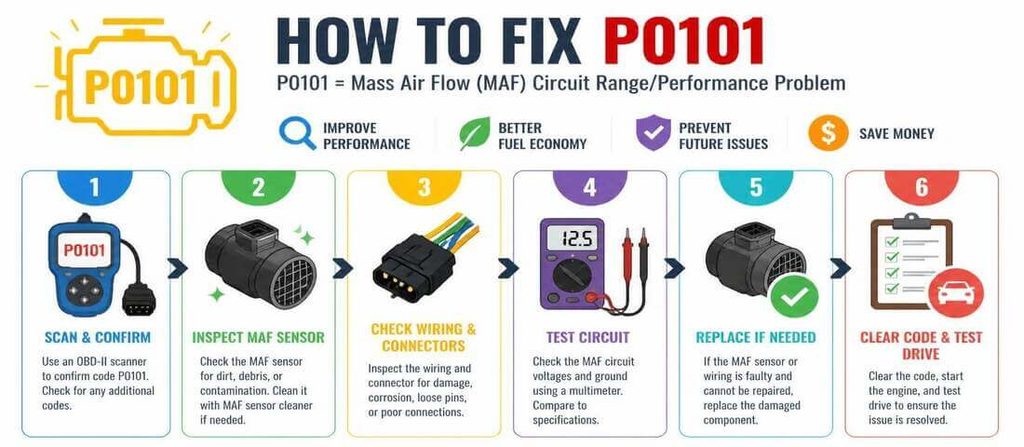
P0101 means the engine computer is seeing a mass-airflow reading that doesn’t match the airflow it expects. A dirty MAF sensor can cause it, but so can an intake leak, damaged wiring, a restricted air filter, a loose airbox, a boost leak on a turbocharged engine, or another problem that changes the engine’s calculated airflow.
The best way to fix P0101 is to diagnose the entire air-intake and airflow system before replacing parts.
Contents
- 1 What Does P0101 Mean?
- 2 P0101 Symptoms
- 3 What Causes P0101?
- 3.1 1. Dirty or contaminated MAF sensor
- 3.2 2. Intake air leak
- 3.3 3. MAF wiring or connector problem
- 3.4 4. Dirty or restricted air filter
- 3.5 5. Airbox or intake assembly problem
- 3.6 6. Turbo or charge-air leak
- 3.7 7. Faulty MAF sensor
- 3.8 8. Related sensor or engine problem
- 3.9 9. Exhaust restriction
- 3.10 10. PCM software or vehicle-specific issue
- 4 How to Diagnose P0101 Step by Step
- 4.1 Step 1: Scan for all codes
- 4.2 Step 2: Inspect the entire intake system
- 4.3 Step 3: Check the air filter
- 4.4 Step 4: Inspect the MAF sensor
- 4.5 Step 5: Inspect the MAF connector and wiring
- 4.6 Step 6: Check for intake leaks
- 4.7 Step 7: Check turbocharged engines for boost leaks
- 4.8 Step 8: Check live MAF data
- 4.9 Step 9: Check related sensors and data
- 4.10 Step 10: Check for technical service bulletins
- 5 How to Fix P0101
- 6 Does P0101 Always Mean You Need a New MAF Sensor?
- 7 P0101 Repair Cost
- 8 Can You Drive With P0101?
- 9 Common P0101 Diagnostic Mistakes
- 10 FAQs About How Do I Fix Code P0101
- 11 Final Verdict
Quick Answer: How Do I Fix Code P0101?
To fix P0101, start by:
- Checking for other trouble codes.
- Inspecting the air filter and airbox.
- Checking the intake tube for cracks or loose connections.
- Inspecting the MAF sensor connector and wiring.
- Checking for air leaks downstream of the MAF sensor.
- Inspecting turbo/charge-air hoses on turbocharged engines.
- Checking MAF readings with a capable scan tool.
- Testing related MAP/BARO sensors when indicated.
- Checking for vehicle-specific technical service bulletins or software updates.
- Replacing the MAF sensor only after testing shows that it is actually faulty.
Don’t treat P0101 as a guaranteed MAF sensor failure. The code tells you where the airflow problem is being detected, not necessarily which component failed.
What Does P0101 Mean?
P0101 is a generic OBD-II powertrain trouble code that means:
Mass or Volume Air Flow “A” Circuit Range/Performance
The MAF sensor measures the amount of air entering the engine. The PCM uses that information to help calculate how much fuel the engine needs.
But the PCM doesn’t rely on the MAF reading alone. It compares airflow with other operating information such as engine speed, load, throttle position and other sensor inputs.
If the measured airflow doesn’t agree with the expected airflow closely enough, the PCM can store P0101.
That is why a P0101 diagnosis requires more than simply looking at the MAF sensor.
P0101 Symptoms
Depending on the vehicle and the underlying problem, P0101 may cause:
- Check engine light
- Rough idle
- Hesitation during acceleration
- Poor throttle response
- Reduced engine power
- Engine stalling
- Hard starting
- Poor fuel economy
- Black smoke on some vehicles
- Limp mode on some vehicles
Some vehicles may store P0101 while still appearing to drive normally.
That’s possible because the PCM can detect an airflow plausibility problem before the driver notices a major drivability issue.

What Causes P0101?
The most common causes include:
1. Dirty or contaminated MAF sensor
Dirt, oil or other contamination can affect the sensor’s airflow measurement.
This is especially worth investigating when the vehicle has a reusable oiled air filter or when the air-intake system has recently been serviced.
2. Intake air leak
A cracked intake boot or loose hose can allow air into the engine without the airflow being measured correctly.
Pay particular attention to the intake duct between the MAF and throttle body.
Small cracks can sometimes open wider when the engine moves or when the intake system is under load.
3. MAF wiring or connector problem
The MAF sensor can be perfectly good while its electrical circuit is not.
Look for:
- Loose connector
- Bent terminals
- Corrosion
- Broken wires
- Chafed harness
- Water intrusion
- Poor electrical contact
HELLA’s diagnostic procedure specifically includes checking the MAF connector, sensor condition, power supply and connecting cables.
4. Dirty or restricted air filter
A severely restricted filter can change the amount of air entering the engine and affect airflow calculations.
Check the filter before replacing expensive components.
5. Airbox or intake assembly problem
A poorly sealed airbox, incorrectly installed filter or damaged intake duct can disturb airflow through the MAF.
6. Turbo or charge-air leak
On turbocharged engines, a leaking charge-air hose or connection can cause P0101.
For example, Volkswagen published a technical tip directing technicians diagnosing P0101 to pressure-test the charge-air system and check for loose or popped boost hoses.
7. Faulty MAF sensor
The MAF itself can fail because of electrical problems, damaged sensing elements or contamination.
But it should be confirmed before replacement.
8. Related sensor or engine problem
Depending on the vehicle, MAP, BARO, throttle-position or other engine-management problems can affect the airflow calculation.
9. Exhaust restriction
A restricted catalytic converter or exhaust system can sometimes create airflow-related problems and should be considered when the normal checks don’t find the cause.
10. PCM software or vehicle-specific issue
Don’t overlook manufacturer-specific technical information.
For example, Honda issued a bulletin for certain 2012–2013 Civic models where P0101 could be caused by how the PCM interpreted MAF inputs during certain driving conditions, with software updating included in the corrective procedure.

How to Diagnose P0101 Step by Step
The following sequence helps prevent unnecessary parts replacement.
Step 1: Scan for all codes
Don’t look at P0101 in isolation.
Record every stored and pending code before clearing anything.
For example, P0101 combined with lean codes, misfire codes or other airflow-related codes may point toward a larger intake or engine problem.
Step 2: Inspect the entire intake system
With the engine off, inspect:
- Air filter
- Airbox
- MAF housing
- Intake boot
- Clamps
- Vacuum hoses
- PCV hoses
- Turbo inlet
- Intercooler piping
- Charge-air connections
Look for cracks, loose clamps, disconnected hoses and damaged plastic.
Step 3: Check the air filter
Remove the filter and inspect it.
If it is heavily contaminated or restricted, replace it with the correct filter.
Also make sure the filter is installed correctly and that the airbox closes and seals properly.
Step 4: Inspect the MAF sensor
Remove the sensor only according to the manufacturer’s procedure.
Look for obvious contamination or physical damage.
Do not touch the delicate sensing element.
Some aftermarket guidance recommends cleaning a contaminated MAF with an appropriate MAF-specific cleaner. However, cleaning isn’t a guaranteed repair, and HELLA currently recommends replacement rather than cleaning for reliable long-term results when the sensor itself is contaminated or faulty.
The important point is to follow the procedure recommended for your specific MAF and vehicle.
Step 5: Inspect the MAF connector and wiring
Check the connector for:
- Corrosion
- Loose terminals
- Bent pins
- Broken locking mechanism
- Water intrusion
Then inspect the harness for chafing or broken wires.
Don’t assume a new MAF will fix a wiring problem.
Step 6: Check for intake leaks
This is one of the most important P0101 checks.
The MAF measures air entering the intake system. If air gets into the engine through a leak after the MAF, the computer may see a mismatch between measured and expected airflow.
A smoke test is often more effective than simply looking at the hoses.
Step 7: Check turbocharged engines for boost leaks
If the vehicle has a turbocharger, inspect the charge-air system.
Look for:
- Split hoses
- Loose clamps
- Popped connections
- Damaged intercooler piping
- Leaking couplers
A pressure test may be required.
Step 8: Check live MAF data
A scan tool that displays live data is much more useful than simply reading and clearing the code.
Monitor the MAF reading while comparing it with engine RPM, throttle position, calculated load and other relevant parameters.
There is no universal MAF reading that is correct for every vehicle.
Don’t diagnose a sensor as bad simply because its reading doesn’t match a generic internet specification.
Use the manufacturer’s data for the specific engine.
If the intake and MAF circuit appear normal, investigate other inputs used by the PCM to calculate airflow.
Depending on the vehicle, this can include:
- MAP sensor
- BARO data
- Throttle position
- Engine RPM
- Intake air temperature
- Fuel trims
A professional-level scan tool can make this comparison much easier.
Step 10: Check for technical service bulletins
Search for P0101 plus the vehicle’s:
- Year
- Make
- Model
- Engine
Some vehicles have known software, wiring, intake or sensor issues that can save considerable diagnostic time.
How to Fix P0101
Once the actual cause has been identified, the repair may be relatively simple.
If the intake hose is cracked
Replace the damaged hose or intake boot and properly tighten the clamps.
If the air filter is restricted
Replace it with the correct filter and make sure the airbox is properly sealed.
If the MAF connector is damaged
Repair the connector or terminals according to the manufacturer’s wiring procedure.
If MAF wiring is damaged
Repair the harness using the correct wiring repair method.
If there is an intake leak
Repair the leaking hose, gasket or connection and verify that the leak is gone.
If there is a boost leak
Repair the damaged charge-air hose, coupler, intercooler connection or related component.
If the MAF sensor has actually failed
Replace it with a sensor appropriate for the vehicle.
A quality OE/OEM-equivalent sensor is generally a better choice than an extremely cheap unknown-brand replacement.
If a software update is required
Have the PCM updated according to the manufacturer’s procedure when the vehicle’s service information identifies software as the cause.
Does P0101 Always Mean You Need a New MAF Sensor?
No.
This is probably the most important thing to understand about the code.
A P0101 diagnosis can lead to a MAF replacement, but the code itself does not prove that the MAF is defective.
RepairPal makes the same distinction in its current MAF replacement guidance: a code referring to the MAF does not necessarily mean the sensor has failed.
Replacing the sensor before checking for an intake leak, wiring problem or other airflow issue can leave you with the same P0101 and a lighter wallet.
P0101 Repair Cost
Repair costs vary dramatically because P0101 can be caused by anything from a loose intake connection to a failed sensor or a more complicated airflow problem.
For planning purposes:
| Repair | Typical cost situation |
|---|---|
| Air filter | Low |
| Intake hose/clamp repair | Low to moderate |
| MAF cleaning/service | Low |
| Wiring/connector repair | Moderate |
| Smoke/air-leak diagnosis | Moderate |
| MAF sensor replacement | Moderate |
| Charge-air leak repair | Moderate to high |
| Exhaust restriction diagnosis/repair | Vehicle-dependent |
| PCM/software repair | Vehicle-dependent |
As a current reference point, RepairPal’s September 2026 estimate puts average MAF sensor replacement at $274–$381, including roughly $51–$75 labor and $223–$306 for parts. Actual cost varies by vehicle, location and parts choice.
Treat those numbers as planning ranges, not a quote for your vehicle.
Can You Drive With P0101?
Sometimes, but it depends on how the engine is running.
If the car has only a check engine light and drives normally, you may be able to drive it a short distance for diagnosis.
However, don’t continue driving normally if P0101 is accompanied by:
- Severe loss of power
- Engine stalling
- Heavy black smoke
- Severe hesitation
- Misfires
- Flashing check engine light
- Dangerous or unpredictable throttle response
A flashing check engine light can indicate an active misfire that may damage the catalytic converter.
If the vehicle is stalling or losing power in traffic, have it diagnosed rather than continuing to drive it.
Common P0101 Diagnostic Mistakes
Replacing the MAF immediately
This is the biggest mistake.
Code ≠ failed part.
Ignoring the intake duct
A five-minute visual inspection can sometimes find the problem.
Checking only the sensor
The connector and wiring are part of the MAF circuit too.
Using generic voltage or airflow specifications
MAF readings vary by sensor design, engine size, operating condition and manufacturer.
Use vehicle-specific specifications.
Clearing the code without fixing the cause
Clearing P0101 doesn’t repair anything.
If the underlying problem remains, the code will return.
Installing a cheap replacement sensor
Poor-quality MAF sensors can produce inaccurate airflow readings and create new diagnostic headaches.
P0101 may be part of a larger engine-management problem.
Always look at the complete code set.
FAQs About How Do I Fix Code P0101
What is the most common fix for P0101?
There isn’t one universal fix. Common solutions include repairing an intake leak, correcting an airbox or filter problem, repairing MAF wiring, addressing a boost leak, or replacing a verified faulty MAF sensor.
Can a dirty MAF cause P0101?
Yes. Contamination can affect the airflow measurement and cause the PCM to detect a mismatch between measured and expected airflow.
Can a vacuum leak cause P0101?
Yes. An intake leak downstream of the MAF can allow unmetered air into the engine and contribute to an airflow plausibility problem.
Can a bad air filter cause P0101?
A severely restricted or incorrectly installed air filter can contribute to airflow problems. It should be inspected before replacing the MAF.
Should I replace the MAF sensor when P0101 appears?
Not automatically. Test the intake system, sensor wiring and airflow data first.
Can cleaning the MAF fix P0101?
It can help when contamination is the actual cause, but cleaning isn’t guaranteed to solve the problem. Follow the vehicle and sensor manufacturer’s recommendations.
Final Verdict
The correct way to fix P0101 is to find out why the PCM’s expected airflow doesn’t agree with the measured airflow.
Start with the simple stuff: inspect the air filter, airbox, intake duct, hoses and MAF connector. Then check for intake or boost leaks and use live scan data to evaluate the MAF reading.
Only replace the MAF sensor after testing supports that diagnosis.
P0101 is an airflow plausibility code—not a guaranteed MAF sensor failure. That’s the distinction that prevents unnecessary parts replacement and leads to a proper repair.