
This article was updated in October 27, 2026 with new products and information by Mark S. Taylor
Your car is lurching at a steady speed, and it feels electrical, not mechanical, but you’re not sure. Here’s the answer: yes, a dying alternator can cause jerking, especially the kind that shows up at a steady RPM with your dash lights pulsing along with it. Scroll down for the exact pattern that points to the alternator, and the patterns that point somewhere else entirely.
Now, you might be wondering why an electrical part would make the whole car lurch instead of just draining your battery. Here’s the mechanism, and the giveaway that separates this from a transmission problem.
Contents
- 1 The Jerking Pattern That Points to the Alternator
- 2 Why This Happens
- 3 When It’s Probably NOT the Alternator
- 4 How to Confirm It: The Voltage Test
- 5 Is It Safe to Keep Driving?
- 6 What It Costs
- 7 Common Mistakes
- 8 FAQs About Will a Bad Alternator Cause Jerking?
- 8.1 Will a bad alternator cause my car to jerk?
- 8.2 How is alternator-related jerking different from a transmission problem?
- 8.3 Can a bad alternator make the steering wheel jerk too?
- 8.4 Is it safe to drive with jerking caused by a bad alternator?
- 8.5 How much does it cost to fix jerking caused by a bad alternator?
- 9 Bottom Line
The Jerking Pattern That Points to the Alternator
Jerking caused by a dying alternator has a recognizable signature, and it’s different from the transmission-related or fuel-related jerking most articles cover. Based on real owner reports and repair-content sources, here’s what it tends to look like:
- Jerking at a steady cruise RPM, often somewhere in the 1,750 to 2,200 RPM range, regardless of whether you’re accelerating, cruising, or coasting downhill
- Dash lights and headlights pulsing or strobing in sync with the jerk, sometimes described as looking like a police car’s lights
- The power steering feeling like it’s straining or jerking when you turn the wheel, especially at idle, as the electric or electro-hydraulic pump fights inconsistent voltage
- An idle that surges, climbing or dropping on its own without you touching the pedal
- Everything getting worse the more electrical load you add, headlights, AC, defroster, and blinkers all stacking the strain on a charging system that’s already struggling
That cluster, especially the lights pulsing in time with the jerk, is the real giveaway. A transmission or fuel problem doesn’t make your headlights strobe.
Why This Happens
Your alternator doesn’t just charge the battery. It’s the live power source for the ignition coils, fuel injectors, the throttle body on modern drive-by-wire cars, and in many vehicles, the power steering system too, while the engine runs.
That brings us to the biggest mistake people make: assuming a dying alternator just means “weak charging.” In reality, a failing voltage regulator or worn brushes inside the alternator often causes output to fluctuate rapidly rather than just drop steadily, swinging between roughly 12.4 and 13.9 volts in real cases, sometimes several times a second. Every system reading that unstable voltage reacts to it. The ECU adjusts timing and fuel delivery on the fly to compensate, the power steering pump strains, and the result feels like the whole car is hiccupping.
Picture a dimmer switch somebody’s jiggling instead of turning smoothly. Every light wired to it flickers, not just one. A fluctuating alternator does the same thing to every electrical system in your car at once, which is exactly why the jerking shows up alongside pulsing lights rather than on its own.
When It’s Probably NOT the Alternator
The truth is, most jerking has nothing to do with the alternator. Here’s how the more common causes tend to show up, so you can rule them out fast:
| When it happens | More likely cause |
|---|---|
| Under hard acceleration or climbing a hill | Failing ignition coil or worn spark plugs |
| Steady cruise at light throttle, like driving over rumble strips | Torque converter clutch shudder |
| During gear changes, or getting back on the gas at a rolling stop | Transmission software or worn fluid |
| The instant you get on or off the gas pedal | Worn engine or transmission mounts |
| Only under sustained heavy load, like towing or long hills | Weak fuel pump or a clogged filter |
| Steady RPM, any throttle position, with lights pulsing in sync | Alternator or charging system |
The best part? That last row is specific enough that you usually know within a few minutes of driving which category you’re in.
How to Confirm It: The Voltage Test
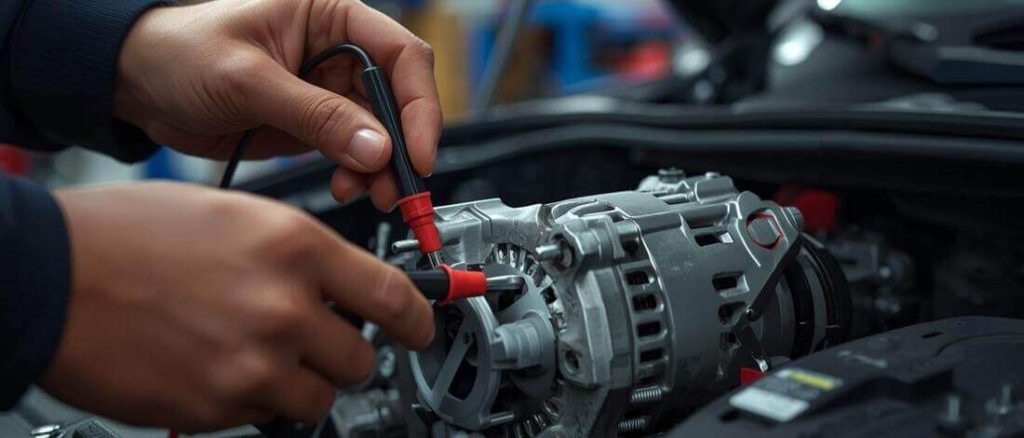
- Battery baseline, engine off. Multimeter on DC volts, red to positive, black to negative. Healthy reading: roughly 12.4 to 12.7 volts.
- Start the engine, watch the reading, not just a single number. A healthy system holds steady, roughly 13.5 to 14.8 volts. A fluctuating alternator won’t sit still, you’ll see the number climb and drop on its own, sometimes bouncing within a one- or two-volt range.
- Turn the steering wheel with the engine idling. If the lights dim hard and the reading drops sharply, that’s the power steering pump pulling load the charging system can’t support cleanly.
- Stack the electrical load: headlights, blower, defroster, blinkers all on. If the jerking or surging gets noticeably worse, that confirms the charging system is the common thread.
Big mistake: disconnecting the battery while the engine runs to “test” the alternator. Without the battery there to absorb the output, voltage can spike past 30 volts in an instant and destroy the alternator’s internal diodes and regulator. Keep the battery connected through every step above.
On the flip side, if your voltage holds rock steady through all of this and the jerking still happens only under hard acceleration or during gear changes, you’ve ruled out the alternator, go back to the table above instead.
Is It Safe to Keep Driving?
Here’s the catch: jerking by itself is uncomfortable, not usually dangerous in the moment. But a charging system bad enough to cause it tends to get worse, often ending in a stall or a car that won’t restart, and that’s a different kind of dangerous if it happens in traffic.
Get it looked at soon, don’t keep driving on it long-term, if:
- Jerking shows up alongside pulsing lights, a battery warning light, or a whining noise
- The car has nearly stalled or has stalled at a stop
Fine to drive carefully to a shop if:
- The jerking is mild and consistent, and the car hasn’t shown any sign of actually dying yet
Treat a confirmed charging-system fault as something to fix promptly. A car that stalls because the alternator finally gave out can do it anywhere, including an intersection.
What It Costs
These are U.S. ranges from repair-cost sources as of late 2026, not quotes.
| Repair | Typical U.S. range | Notes |
|---|---|---|
| Alternator replacement, total | Commonly $350 to $1,100 | More on performance models or hard-to-reach engines |
| Battery replacement, if damaged by a fluctuating charge | About $45 to $250 | Check it if it’s been running on a flaky alternator for a while |
| Diagnostic fee | Often $50 to $150 | Ask if it’s credited toward the repair |
| If testing rules out the alternator | Varies widely by actual cause | See the differentiation table above; ignition, transmission, and mount repairs each price very differently |
One real-world warning worth knowing: a handful of owner reports describe the jerking and pulsing persisting even after an alternator replacement, traced back to a second bad part, a worn belt slipping under load, corroded grounds, or in rarer cases a second failed alternator. Confirm the fix with the same voltage test after the repair rather than assuming a new part automatically solved it.
Common Mistakes
- Assuming jerking is always a transmission problem. A fluctuating alternator causes a specific, recognizable version of it that gets missed because nobody thinks to check the lights for a pattern.
- Testing with the battery disconnected. That destroys a good alternator instead of testing it.
- Replacing the alternator and declaring victory without retesting. If the jerking returns, check belts, grounds, and the new part itself before assuming you got a bad replacement.
- Ignoring the power steering clue. A wheel that jerks or strains specifically when you turn it at idle, synced with dimming lights, is a strong, often-overlooked tell.
FAQs About Will a Bad Alternator Cause Jerking?
Will a bad alternator cause my car to jerk?
Yes. A failing alternator, especially one with a worn voltage regulator or brushes, can cause output to fluctuate rapidly instead of just dropping steadily. That instability reaches the ignition, fuel, and sometimes power steering systems at once, producing a jerking or surging feeling, often at a steady cruise RPM with the lights pulsing along with it.
Alternator jerking tends to happen at a steady RPM regardless of throttle position, and comes with dash or headlight pulsing in sync with the jerk. Transmission-related jerking usually shows up specifically during gear changes or when getting back on the gas, without any lighting symptoms.
Can a bad alternator make the steering wheel jerk too?
Yes, on vehicles where the power steering pump draws from the same electrical system. A wheel that feels like it’s straining or jerking when you turn it at idle, especially alongside dimming lights, points toward the charging system rather than the steering components themselves.
Is it safe to drive with jerking caused by a bad alternator?
For a short trip to get it diagnosed, usually yes, but don’t treat it as a long-term condition. A charging system bad enough to cause jerking tends to get worse and can eventually stall the engine without warning, which is more dangerous in traffic than at a diagnostic bay.
How much does it cost to fix jerking caused by a bad alternator?
Alternator replacement commonly runs $350 to $1,100 total. If the battery was damaged by running on inconsistent voltage, add $45 to $250 for a replacement. If testing shows the alternator is fine, cost depends entirely on the actual cause, ignition, transmission, mounts, or fuel delivery each price differently.
Bottom Line
- Yes, a bad alternator can cause jerking, and it has a specific signature: steady-RPM lurching with pulsing lights, not just hard-acceleration hesitation.
- Rule it out or confirm it with a five-minute voltage test, watching for fluctuation, not just a low number.
- Never disconnect the battery to test the alternator while it’s running.
- If jerking only happens during gear changes or hard acceleration, look at the transmission or ignition system instead.
- After a repair, retest. A second bad part can mimic the same symptoms a fresh alternator was supposed to fix.