
This article was updated in September 27, 2026 with new products and information by Mark S. Taylor
If your car cranks but will not start, the starter is turning the engine, but the engine is not running on its own. The problem is usually related to fuel, spark, air, compression, engine timing, or an electronic system that prevents the engine from starting.
Before replacing a fuel pump, ignition coil, crankshaft sensor, or other expensive part, you can perform several basic DIY tests.
The key is to test the system instead of guessing.
A crank-no-start symptom tells you that the engine is not running. It does not tell you which part failed.
Contents
- 1 What Does an Engine Need to Start?
- 2 9 DIY Tests for a Car That Cranks But Will Not Start
- 3 DIY Test #2: Check the Battery and Cranking Voltage
- 4 DIY Test #3: Scan for Trouble Codes
- 5 DIY Test #4: Check for a Security or Immobilizer Problem
- 6 DIY Test #5: Check for Spark
- 7 DIY Test #6: Check Fuel Delivery
- 8 DIY Test #7: Check Injector Pulse
- 9 DIY Test #8: Check Compression
- 10 DIY Test #9: Check Engine Timing
- 11 DIY Crank-No-Start Diagnostic Flowchart
- 12 What If the Car Starts With Starting Fluid?
- 13 What If the Car Starts Then Dies?
- 14 What If the Engine Cranks Faster Than Normal?
- 15 What Tools Do You Need?
- 16 DIY Test Results Cheat Sheet
- 17 When Should You Stop the DIY Diagnosis?
- 18 The Biggest DIY Diagnostic Mistake
- 19 FAQs About Car Cranks But Will Not Start DIY Test
- 19.1 What should I test first when my car cranks but won’t start?
- 19.2 How do I test for spark when my car won’t start?
- 19.3 How do I test fuel pressure at home?
- 19.4 Can an OBD2 scanner diagnose a crank-no-start?
- 19.5 Can a bad crankshaft sensor cause a crank-no-start?
- 19.6 How do I know if my car has a fuel problem or spark problem?
- 20 The Bottom Line
First: Make Sure It Really Is a Crank-No-Start
There are two very different problems:
No-crank
You turn the key or press the start button and:
- Nothing happens
- You hear a click
- You hear repeated clicking
- The engine turns very slowly
This points toward the battery, cables, starter, starter circuit, or related systems.
Crank-no-start
The engine turns over at a fairly normal speed, but it never catches and runs.
That is the problem this article covers.
Separating these two conditions is the first diagnostic step because they require completely different testing paths.
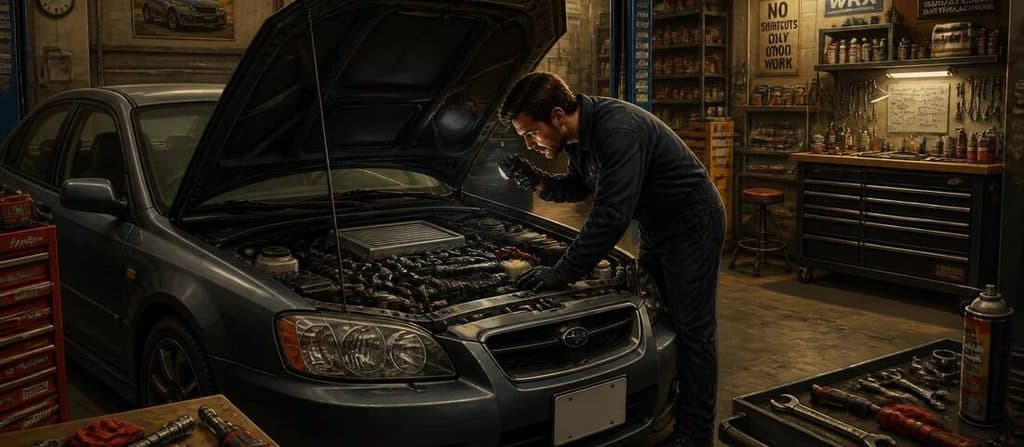
What Does an Engine Need to Start?
For a typical gasoline engine, think of the problem as several basic requirements:
- Adequate cranking speed
- Fuel
- Spark at the correct time
- Adequate compression
- Correct engine timing
- Proper air flow
- Electronic authorization and control
You do not need to test every component individually.
Instead, test the major systems.
If you discover that spark is missing, you can stop investigating the fuel system temporarily and concentrate on the ignition/control side.
That is what makes diagnostic testing more efficient.
9 DIY Tests for a Car That Cranks But Will Not Start
DIY Test #1: Listen to How the Engine Cranks
Start with your ears.
Turn the engine over and listen carefully.
A healthy engine normally produces a relatively consistent cranking rhythm.
Normal cranking
You hear something like:
rrr-rrr-rrr-rrr
Possible problem
If the engine suddenly sounds much faster:
rrrrrrrrrrrr
that can indicate a loss of compression.
A timing belt or timing-chain problem is one possibility, depending on the engine.
A significantly different cranking sound should be treated as a clue rather than ignored. Current diagnostic guidance specifically identifies unusually fast cranking as a reason to investigate mechanical timing or compression.
DIY result
Normal cranking → continue.
Abnormally fast cranking → investigate compression and mechanical timing before repeatedly cranking the engine.
DIY Test #2: Check the Battery and Cranking Voltage
A car can appear to crank normally while system voltage drops too low during starting.
If you have a digital multimeter, measure battery voltage with the engine off and then observe voltage while cranking.
The exact acceptable voltage depends on the vehicle, temperature, battery condition, and testing method, so don’t use a universal number to condemn the battery.
Also inspect:
- Battery terminals
- Negative cable
- Engine ground
- Main power connections
Why this matters
A voltage problem can affect electronic control modules even when the starter still manages to turn the engine.
If the battery voltage collapses during cranking, correct that problem before chasing fuel or ignition faults.
DIY result
Normal cranking and stable electrical supply → continue.
Weak/abnormal cranking or major voltage drop → solve the power/starting issue first.
DIY Test #3: Scan for Trouble Codes
If you have an OBD-II scanner, plug it in before replacing parts.
Look for:
- Stored codes
- Pending codes
- Crankshaft-position sensor codes
- Camshaft-position sensor codes
- Fuel-pressure codes
- Ignition-related codes
- Immobilizer/security-related information when supported
Some crank-no-start conditions can produce useful diagnostic codes.
But there is an important warning:
No trouble code does not prove that the engine has no fault.
A no-start condition can exist without a stored code.
DIY result
Relevant code → investigate that system.
No code → continue testing.
Do not replace a sensor simply because its code appears. Verify the circuit and sensor operation according to the vehicle’s service information.
DIY Test #4: Check for a Security or Immobilizer Problem
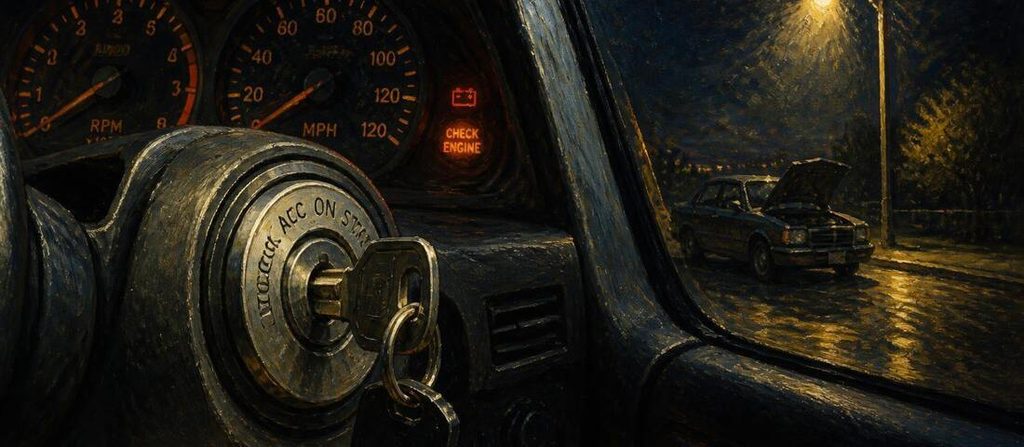
Look at the instrument cluster while attempting to start the engine.
Is a:
- Key symbol
- Padlock symbol
- Security light
- Anti-theft warning
flashing or behaving differently from normal?
A vehicle’s immobilizer can prevent the engine from starting even though the starter still cranks.
This is particularly worth checking if:
- The problem began after using another key
- The key was recently replaced
- The vehicle has recently had electrical work
- The security indicator is behaving abnormally
DIY result
Security system appears normal → continue.
Security warning behaves abnormally → consult the owner’s manual and diagnose the immobilizer system before replacing engine parts.
DIY Test #5: Check for Spark
For a gasoline engine, determine whether the ignition system is producing spark.
The preferred DIY method is an inline ignition spark tester designed for this purpose.
Connect the tester according to its instructions and crank the engine.
A consistent ignition spark indicates that at least part of the ignition system is functioning.
No spark on one cylinder is different from no spark on every cylinder.
If one cylinder has no spark
Investigate:
- Spark plug
- Ignition coil
- Coil wiring
- Coil power
- Cylinder-specific components
If multiple cylinders have no spark
Think further upstream:
- Ignition power supply
- Engine-control system
- Crankshaft-position signal
- Camshaft-position signal
- Immobilizer
- Wiring
- Ground
- ECU/PCM control
Current diagnostic references emphasize that widespread no-spark conditions should lead you toward shared power, control, sensor, or security causes rather than assuming that several ignition coils failed simultaneously.
Important safety warning
Do not hold a spark plug or ignition lead in your hand while the engine is cranking.
High-voltage ignition systems can cause injury.
Keep sparks away from fuel vapors, leaking fuel, and open fuel-system components. Gasoline is highly flammable.
DIY Test #6: Check Fuel Delivery
Next determine whether the engine is receiving fuel.
There are several levels of DIY testing.
Basic check
Make sure there is actually fuel in the tank.
Don’t rely entirely on the fuel gauge if the vehicle recently developed a problem.
Listen for the fuel pump
Turn the ignition on without starting the engine.
On many vehicles, the fuel pump runs briefly to build pressure.
You may hear a short humming sound.
But:
Hearing the fuel pump does not prove that fuel pressure is correct.
A pump can run and still fail to produce adequate pressure.
Better test: Fuel-pressure gauge
If the vehicle provides a safe test connection and you have the correct equipment, measure fuel pressure.
Compare the reading with the manufacturer’s specification for the exact vehicle and engine.
Possible low-pressure causes include:
- Weak fuel pump
- Failed pump
- Restricted filter where applicable
- Fuel-pressure regulator problem
- Electrical supply problem
- Wiring problem
- Fuel-pressure control problem
Current diagnostic sources specifically recommend measuring fuel pressure rather than assuming that a pump is good simply because it runs.
DIY result
Correct fuel pressure → move on.
Low/no fuel pressure → diagnose the fuel-delivery system.
DIY Test #7: Check Injector Pulse
If you have confirmed ignition spark but suspect fuel delivery, you can check whether the injectors are receiving a control signal.
A noid light can be used on applicable injector connectors.
During cranking, the light should show injector-control activity according to the vehicle’s system design.
No injector pulse can point toward:
- Missing crankshaft signal
- Camshaft signal problem
- Immobilizer intervention
- ECU/PCM power problem
- Wiring fault
- Ground problem
- Control-system fault
This is more useful than simply replacing the injectors.
Important
Injector systems differ by vehicle.
Do not assume that every injector connector or control strategy can be tested the same way.
DIY Test #8: Check Compression
If you have:
- Adequate cranking speed
- Spark
- Fuel delivery
but the engine still refuses to start, investigate compression and mechanical timing.
A compression tester can provide useful information.
Remove the spark plugs and follow the tester manufacturer’s procedure and the vehicle-specific service procedure.
Record the result for each cylinder.
What matters?
Don’t focus only on one universal PSI number.
The manufacturer’s specification is more important.
Also compare cylinders with each other.
A large difference between cylinders can indicate a mechanical problem.
Possible causes include:
- Valve problem
- Piston problem
- Worn rings
- Head-gasket problem
- Incorrect valve timing
- Timing-chain or timing-belt problem
Important diagnostic clue
If compression is extremely low across all cylinders and the engine suddenly began cranking faster than normal, mechanical timing becomes a major area of investigation.
DIY Test #9: Check Engine Timing
Timing is the final major branch of the diagnostic tree.
The engine may have:
- Fuel
- Spark
- Compression
and still fail to start if those events are occurring at the wrong time.
Possible causes include:
- Jumped timing chain
- Broken timing belt
- Incorrectly installed timing components
- Cam/crank synchronization problem
Modern vehicles can also detect crank/cam synchronization problems electronically.
A scan tool with live data may show whether the ECU is seeing engine RPM while cranking. Some diagnostic systems can use this information to distinguish a missing crankshaft signal from other no-start causes.
Important
Do not assume a specific sensor is bad simply because a synchronization code exists.
The sensor, wiring, connector, reluctor/tone wheel, mechanical timing, and control module may all need to be checked.
DIY Crank-No-Start Diagnostic Flowchart
Use this simple sequence:
Does the engine crank?
↓ YES
Does it crank at normal speed?
↓ YES
Check OBD-II codes
↓
Check security/immobilizer indicator
↓
Do you have spark?
NO
Check:
- Crank sensor
- Cam sensor
- Ignition power
- Coil control
- Wiring
- Grounds
- Immobilizer
- ECU/PCM control
YES
Continue.
↓
Is fuel pressure correct?
NO
Check:
- Fuel pump
- Pump power
- Fuse
- Relay
- Fuel-pressure control
- Wiring
YES
Continue.
↓
Is injector pulse present?
NO
Investigate engine-control, sensor, wiring, or security authorization.
YES
Continue.
↓
Is compression adequate?
NO
Investigate:
- Mechanical timing
- Valves
- Pistons
- Rings
- Head gasket
YES
Investigate:
- Engine timing
- Airflow
- Mixture
- Sensor inputs
- Control-system faults
This is much more useful than replacing parts based on symptoms.
What If the Car Starts With Starting Fluid?
Some DIY guides recommend spraying starting fluid into the intake as a quick fuel-vs-spark test. That can provide diagnostic information, but I would not make it the primary recommendation for a general-audience The Car Buzz article.
Starting fluid is highly flammable, and incorrect use around an intake system can create a fire or engine-damage risk.
For most readers, a proper fuel-pressure test is the better diagnostic path.
If a trained DIYer uses a manufacturer-appropriate diagnostic procedure, it should be done with extreme caution and away from fuel leaks, ignition sources, and hot components.
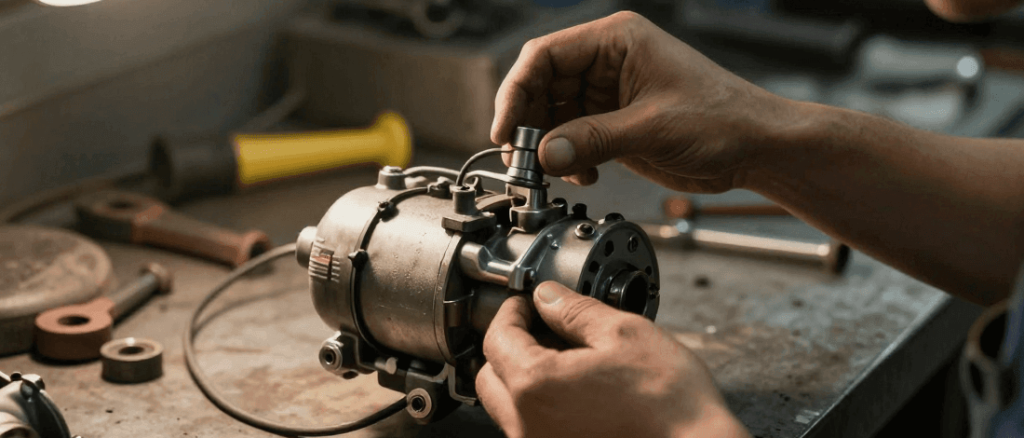
What If the Car Starts Then Dies?
That’s a slightly different pattern.
If the engine:
Starts → runs briefly → dies
consider:
- Fuel delivery
- Immobilizer/security
- Loss of crank/cam signal
- Air/fuel control
- Electrical power
- ECU/PCM control
The timing of the stall matters.
For example:
Starts for 1–2 seconds and then shuts off can make an immobilizer problem more relevant.
Runs until hot, then dies can point toward an intermittent heat-related electrical or sensor fault.
The pattern is evidence—but it is not a diagnosis.
What If the Engine Cranks Faster Than Normal?
Stop and investigate.
An unusually fast cranking sound can indicate that the engine has lost compression.
Possible causes include:
- Broken timing belt
- Timing-chain failure
- Valve-train problem
- Other mechanical failure
Don’t keep cranking repeatedly hoping it will suddenly start.
If a timing failure is suspected, the correct inspection procedure depends on the engine design.
What Tools Do You Need?
You don’t need a professional shop to perform the first level of diagnosis.
Basic DIY toolkit
- OBD-II scanner
- Digital multimeter
- Spark tester
- Basic hand tools
- Flashlight
Intermediate toolkit
- Fuel-pressure gauge
- Noid light
- Compression tester
- Test light
Advanced diagnostic equipment
- Oscilloscope
- Current clamp
- Professional scan tool
- Manufacturer-specific service information
You don’t need every tool.
The goal is to choose the least invasive test that can eliminate the largest number of possible causes.
DIY Test Results Cheat Sheet
| Test result | What it suggests |
|---|---|
| Engine does not crank | Starting-system diagnosis |
| Engine cranks slowly | Battery, cables, starter, or mechanical resistance |
| Engine cranks unusually fast | Possible compression/timing problem |
| No spark on multiple cylinders | Shared ignition/control problem |
| Spark is good but fuel pressure is low | Fuel-delivery problem |
| Fuel pressure is good but no injector pulse | Control/sensor/security issue |
| Spark + fuel but no start | Timing/compression/air-control investigation |
| Very low compression on all cylinders | Possible timing/mechanical problem |
| Security light abnormal | Immobilizer/security investigation |
| No codes | Does not rule out a no-start fault |
When Should You Stop the DIY Diagnosis?
Stop and get professional help if you encounter:
- Fuel leakage
- Strong fuel odor with visible leakage
- Smoke
- Fire risk
- Severe electrical arcing
- Unusual mechanical noise
- Suspected internal engine damage
- Suspected timing failure
- High-voltage ignition testing you cannot safely perform
- A vehicle-specific procedure you cannot verify
Also stop if the engine has a major change in cranking speed or sound.
Repeatedly cranking a vehicle that has a mechanical failure can waste battery power and potentially create additional problems.
The Biggest DIY Diagnostic Mistake
The biggest mistake is parts cannon diagnosis.
Someone hears:
“My car cranks but won’t start.”
Then they buy:
- Fuel pump
- Spark plugs
- Ignition coil
- Crankshaft sensor
- Battery
And the car still doesn’t start.
Why?
Because the symptom never identified the failed component.
A better approach is:
Test → Get a result → Eliminate a system → Test the next system.
That turns a long list of possibilities into a much smaller diagnostic path.
FAQs About Car Cranks But Will Not Start DIY Test
What should I test first when my car cranks but won’t start?
First confirm that the engine is cranking at a normal speed. Then scan for diagnostic codes, check the security system, and test the major starting requirements: spark, fuel delivery, compression, and timing.
How do I test for spark when my car won’t start?
Use an appropriate inline spark tester according to its instructions. Test safely and keep ignition sparks away from fuel vapors or leaking fuel. Do not hold an ignition component or spark plug by hand while the engine is cranking.
How do I test fuel pressure at home?
Use a fuel-pressure gauge designed for the vehicle’s fuel system and compare the measurement with the manufacturer’s specification. Do not assume the fuel pump is working correctly simply because you hear it run.
Can an OBD2 scanner diagnose a crank-no-start?
An OBD-II scanner can provide useful diagnostic codes and, on supported vehicles, live data such as engine RPM while cranking. However, a scan tool does not automatically identify the failed part, and a crank-no-start can occur without a stored trouble code.
Can a bad crankshaft sensor cause a crank-no-start?
Yes. A missing or invalid crankshaft-position signal can prevent proper ignition and fuel control. However, the sensor, wiring, connector, reluctor, and ECU input should be tested before replacing the sensor.
How do I know if my car has a fuel problem or spark problem?
Test them separately. If spark is present but fuel pressure or injector operation is missing, investigate the fuel system. If fuel delivery is confirmed but spark is absent, investigate the ignition and engine-control system.
The Bottom Line
If your car cranks but will not start, begin by confirming that the engine is actually cranking at a normal speed.
Then use DIY tests to determine what is missing:
- Check cranking speed.
- Scan for trouble codes.
- Check the security/immobilizer indicator.
- Test for spark.
- Check fuel delivery and pressure.
- Check injector pulse when appropriate.
- Test compression.
- Investigate mechanical timing if necessary.
- Verify air and engine-control inputs.
The goal isn’t to guess whether the fuel pump, crankshaft sensor, ignition coil, or another part is bad.
The goal is to prove which requirement the engine is missing.
That is the fastest way to avoid unnecessary parts replacement.