
This article was updated in September 30, 2026 with new products and information by Mark S. Taylor
Contents
- 1 Is your engine overheating?
- 2 Engine overheating symptoms
- 3 What to do when your car overheats
- 4 Common causes of engine overheating
- 5 How to diagnose an overheating engine
- 6 Can you drive with an overheating engine?
- 7 What can you safely check yourself?
- 8 Repair cost: why there is no honest one-size-fits-all number
- 9 Prevention tips
- 10 FAQs About engine overheating symptoms and causes
- 10.1 What is the most common cause of engine overheating?
- 10.2 Can low oil cause an engine to overheat?
- 10.3 Why does my car overheat in traffic but not on the highway?
- 10.4 Why is my car overheating when the coolant is full?
- 10.5 Can I add coolant and keep driving?
- 10.6 How long does it take for an overheated engine to cool down?
- 10.7 Does an overheating warning always mean the engine is ruined?
- 11 Bottom line
Is your engine overheating?
If the temperature gauge climbs into the hot zone, a temperature warning light comes on, or steam comes from under the hood, pull over and shut the engine off as soon as it is safe. Do not keep driving to “see if it clears up.” More heat can turn a cooling-system problem into a damaged head gasket, warped cylinder head, or ruined engine.
The most common causes include low coolant, a coolant leak, a failed thermostat, a bad water pump, a radiator fan problem, poor airflow, or a blocked radiator. A faulty temperature sensor can also send a false warning. You need testing to tell these problems apart.
This guide covers the warning signs, the common causes, what you can check safely, and when the car needs a tow. It applies to most gasoline and diesel vehicles. Electric and hybrid vehicles may use different cooling systems, so do not apply every step to them.
Engine overheating symptoms
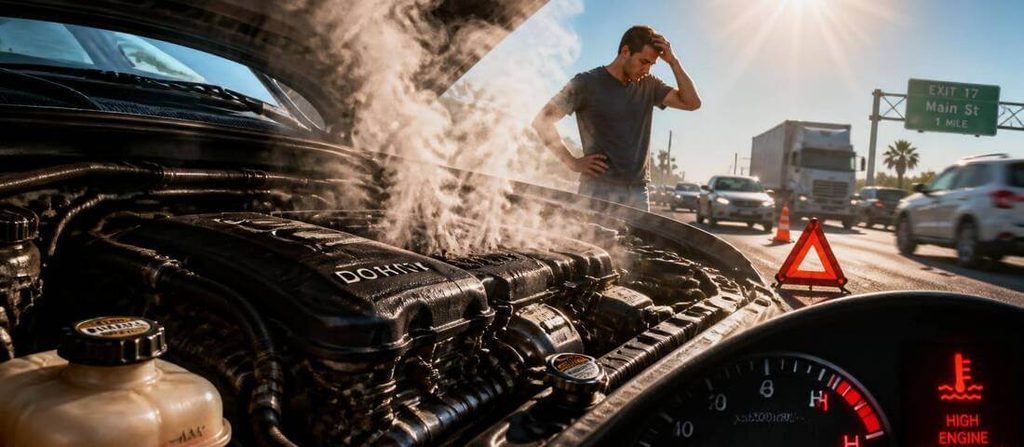
The temperature gauge is often the first warning. It may rise above its normal position or move toward the red zone. Some vehicles do not use a traditional gauge. Instead, they show a red temperature warning light or a message on the dashboard.
Watch for these signs:
- A temperature gauge that keeps rising
- A red temperature warning light
- Steam or vapor from under the hood
- A sweet smell from coolant
- Coolant dripping or pooling under the vehicle
- Reduced engine power
- Rough running or stalling
- Ticking, knocking, or other new engine noises
- A heater that suddenly blows cold air while the engine is hot
- A cooling fan that runs loudly or never turns on
A sweet smell usually points toward coolant. The smell may come from a leak, a spill, or coolant escaping onto a hot engine part. Do not assume the smell tells you which part failed.
Steam can also be confused with smoke. Steam is often white and disappears quickly. Smoke may point to oil, wiring, or another problem. Either one deserves caution. Keep your hands away from the engine bay until the vehicle has cooled.
What to do when your car overheats
Treat an overheating warning as a safety problem first. Diagnosis comes later.
1. Get out of traffic
Turn off the air conditioner and move to a safe place if the vehicle is still moving normally and you can do so without pushing the engine harder. If the gauge is already in the red, steam is pouring out, or the engine is losing power, stop as soon as it is safe.
Do not race to the next exit or repair shop. A few extra miles can change the repair from a cooling-system part to major engine work.
2. Shut the engine off
Turn the engine off once you are safely stopped. Keep people away from steam, hot coolant, belts, and fans. Some electric cooling fans can start without warning, even after the engine is turned off.
3. Do not open the radiator cap while hot
The cooling system can stay pressurized after the engine stops. Opening the radiator cap or coolant reservoir too soon can release boiling coolant and cause severe burns.
Wait until the engine is fully cool. That can take much longer than a few minutes. If you are not sure, do not open anything.
4. Call for help when needed
Arrange a tow if the engine is actively overheating, coolant is leaking, steam is present, the warning returns, or you cannot tell whether the temperature reading is real. A tow is cheaper than gambling on engine damage.
Common causes of engine overheating
Low coolant or a coolant leak
The cooling system needs the correct amount of coolant to carry heat away from the engine. If the level drops, the engine may run hot or develop hot spots.
Low coolant is not the full diagnosis. Coolant does not normally disappear from a sealed system. A low reservoir may point to a leaking hose, radiator, water pump, thermostat housing, radiator cap, heater core, or another component.
You may notice:
- A low coolant reservoir
- A sweet smell
- Wet spots under the car
- Dried white, green, pink, or yellow residue, depending on the coolant
- A warning that returns after topping off the reservoir
Only check the level when the engine is cold. Use the coolant type listed in the owner’s manual. Do not mix products unless the vehicle manufacturer says they are compatible.
Failed radiator fan or fan control
The radiator needs airflow to release heat. At low speeds, the cooling fan creates much of that airflow. If the fan, fuse, relay, wiring, or control module fails, the engine may overheat in traffic or while idling.
A vehicle that runs cooler at highway speed but overheats in stop-and-go traffic may have an airflow problem. That pattern is a clue, not proof. Low coolant, a restricted radiator, or another fault can create similar symptoms.
Do not reach near a fan to test it. The fan may start without warning. Let a professional check the circuit and fan operation.
Stuck thermostat
The thermostat controls when coolant flows through the radiator. If it sticks closed, coolant flow may be restricted and the engine can overheat. If it sticks open, the engine may run too cool or take too long to reach normal temperature.
A thermostat is not automatically the cause just because the gauge is high. Replacing parts based on one symptom is how drivers pay twice for the same problem. A shop should confirm coolant flow, temperature readings, and related faults before replacing it.
Failing water pump
The water pump moves coolant through the engine and radiator. A worn pump may leak, make noise, or move too little coolant. Some pumps are driven by a belt, while others use an electric motor.
Possible clues include overheating, coolant loss, a grinding or whining noise, or a temperature that rises under load. These signs overlap with other cooling-system failures, so they do not identify the pump by themselves.
A water-pump repair may involve belts, pulleys, covers, or tight access. That makes it a poor beginner repair unless the vehicle-specific service information and required tools are available.
Blocked radiator or poor airflow
A radiator may lose cooling ability because of internal blockage, external debris, corrosion, or damage. Leaves, dirt, plastic, or bent fins can reduce airflow through the radiator.
Do not assume that flushing the radiator will fix the problem. A flush may not repair a damaged radiator, remove every internal restriction, or address the cause of contamination. Diagnosis should determine whether the problem is flow, airflow, a leak, or internal engine pressure.
Faulty coolant-temperature sensor or gauge
A sensor or wiring fault can report the wrong temperature. That can create a warning when the engine is not actually overheating. The opposite is also possible: a bad sensor can fail to warn you about a real problem.
A diagnostic code does not always identify the failed part. For example, KBB describes P0217 as a broad engine-overtemperature code with several possible causes, including low coolant, leaks, fan failure, thermostat problems, water-pump problems, radiator restrictions, sensor faults, and internal engine issues. See KBB’s P0217 explanation.
The first step is to compare the dashboard reading with live temperature data and a physical inspection. Do not replace the sensor just because it is the easiest part to reach.
Head-gasket or internal engine damage
An engine that keeps overheating can damage the head gasket or cylinder head. In some cases, an internal gasket failure is the original cause of overheating.
Possible clues include repeated coolant loss with no visible external leak, white exhaust after the engine is warm, bubbles or abnormal pressure in the cooling system, milky oil, misfires, or exhaust gases entering the coolant. These clues are not proof. A pressure test, combustion-gas test, compression test, leak-down test, or other vehicle-specific checks may be needed.
Do not jump straight to “blown head gasket.” It is an expensive conclusion, and other cooling-system failures can create similar symptoms.
Heavy load, towing, or extreme conditions
A vehicle working hard on a steep grade, while towing, or in very hot weather produces more heat. That extra load can expose a weak cooling fan, low coolant level, restricted radiator, or failing pump.
Hot weather alone should not make a healthy cooling system overheat. If the gauge climbs only during heavy work, the condition still needs attention.
How to diagnose an overheating engine
Start with the conditions, not the parts list. Ask when the overheating occurs:
- At idle or in traffic
- At highway speed
- During acceleration or uphill driving
- With the air conditioner running
- After a recent repair
- Only after the engine reaches operating temperature
- Immediately after starting
The pattern helps a technician choose the right tests. It does not confirm the cause.
A professional diagnosis may include:
- Checking the stored diagnostic codes and live temperature data
- Inspecting coolant level, leaks, hoses, belts, wiring, and the radiator
- Testing the cooling fan and its controls
- Checking thermostat operation and coolant flow
- Pressure-testing the cooling system when the engine is cold and the procedure is safe
- Testing for combustion gases if an internal leak is suspected
- Comparing the dashboard reading with an independent temperature reading
The important point is sequence. Do not replace the thermostat, water pump, fan, and sensor one at a time until something works. That approach is expensive and can still miss the root cause.
Can you drive with an overheating engine?
If the engine is truly overheating, do not drive it to a repair shop. Have it towed.
Stop driving when you see a red temperature warning, the gauge enters the hot zone, steam appears, coolant is leaking, the engine loses power, or the warning returns after the vehicle cools.
If the warning appears to be a sensor fault, you still cannot safely assume that from the dashboard alone. Until the actual temperature is checked, treat the warning as real.
A short drive can cause major damage when coolant is low or circulation has stopped. The damage may include a warped cylinder head, failed head gasket, damaged pistons, or an engine that no longer runs.
What can you safely check yourself?
Only inspect the vehicle after the engine is fully cold and the car is parked on a stable surface.
You may be able to:
- Check the coolant reservoir level
- Look for obvious puddles or wet areas
- Look for dried coolant residue around hoses and connections
- Read the owner’s manual for the correct coolant specification
- Do not restart the engine just to see whether the warning returns
- Photograph the warning light, leak, or gauge position for the repair shop
Do not:
- Remove a hot radiator cap
- Pour cold water into a hot engine
- Reach near a running cooling fan
- Crawl under a car held up only by a jack
- Replace a part based on one symptom
- Drive repeatedly after the engine overheats
- Open or service a hybrid or EV high-voltage cooling system without proper training
Repair cost: why there is no honest one-size-fits-all number
A repair estimate depends on the vehicle and the confirmed cause. A leak from a hose is not priced like a water pump. A water pump is not priced like a radiator. Internal engine damage can be a different financial decision altogether.
| Possible repair | What changes the cost | What to ask the shop |
|---|---|---|
| Leak diagnosis or repair | Leak location, access, parts, coolant, and testing | Is the leak confirmed? Is diagnosis included? |
| Thermostat repair | Vehicle design, access, housing, coolant, and bleeding procedure | What test showed the thermostat is the cause? |
| Cooling-fan repair | Fan motor, relay, fuse, wiring, module, and programming | Was the full circuit tested? |
| Water-pump repair | Pump design, belt access, labor time, and related parts | Is the pump leaking, noisy, or failing a flow test? |
| Radiator repair or replacement | Damage, blockage, access, coolant, and related hoses | Is the restriction internal or external? |
| Internal engine repair | Head-gasket damage, cylinder-head condition, machining, and labor | What test confirms internal damage? |
Ask for the diagnosis separately from the repair estimate. A shop should be able to explain what failed, what test found it, what parts are needed, and what damage may already have occurred.
Avoid any quote that lists several major parts with no explanation of the test results. “Replace everything in the cooling system” is not a diagnosis.
Prevention tips
Cooling-system maintenance is cheaper than repeated overheating.
- Check the coolant level when the engine is cold.
- Follow the owner’s manual for coolant service.
- Fix small leaks before the reservoir runs low.
- Pay attention to new smells, stains, noises, or temperature changes.
- Keep the radiator area clear of heavy debris.
- Have the cooling system checked before a long trip if the vehicle has a history of overheating.
- Do not ignore a temperature warning because the vehicle still seems to run normally.
AAA recommends scheduled maintenance to find cooling-system problems before they cause a breakdown. See AAA’s summer vehicle-care guidance.
FAQs About engine overheating symptoms and causes
What is the most common cause of engine overheating?
Low coolant is a common cause, but low coolant usually points to a leak or another cooling-system problem. Other common causes include a failed fan, stuck thermostat, weak water pump, blocked radiator, poor airflow, or a faulty sensor.
Can low oil cause an engine to overheat?
Low oil can increase friction and engine heat, but a high temperature warning still requires a cooling-system check. Check the oil level only as part of a broader inspection. Do not use an oil refill as a reason to keep driving an overheating vehicle.
Why does my car overheat in traffic but not on the highway?
That pattern can point toward a cooling fan or airflow problem because the car gets less natural airflow at low speed. Low coolant, radiator restrictions, and other faults can create the same pattern. Testing is still needed.
Why is my car overheating when the coolant is full?
A full reservoir does not prove that coolant is circulating correctly. The problem may involve a thermostat, water pump, radiator, fan, trapped air, sensor, or internal engine leak. The reservoir level alone cannot identify the cause.
Can I add coolant and keep driving?
Only add the correct coolant when the engine is fully cold and the owner’s manual supports that product. Topping off the reservoir may help prevent immediate coolant loss, but it does not repair the leak or prove the engine is safe to drive. If the car overheated, arrange a professional inspection or tow.
How long does it take for an overheated engine to cool down?
There is no safe universal wait time. Cooling depends on outside temperature, coolant level, engine load, airflow, and the vehicle. Do not open the cooling system until it is fully cold. If you are unsure, leave it closed and call for help.
Does an overheating warning always mean the engine is ruined?
No. A warning can come from a repairable cooling-system problem or a faulty sensor. But continued driving can create severe damage. Stop first, then diagnose the cause.
Bottom line
An overheating engine is not a warning to ignore. Pull over, shut it off, keep away from hot coolant and moving fans, and do not open the radiator cap while the system is hot.
Low coolant, leaks, fans, thermostats, water pumps, radiators, sensors, and internal engine problems can all create similar symptoms. The safest answer is not to guess the part. Stop the heat, tow the vehicle when needed, and have the cause tested before replacing anything.