
This article was updated in October 14, 2026 with new products and information by Mark S. Taylor
The big three symptoms of low oil pressure are the oil pressure warning light, ticking or knocking noises from the engine, and a gauge reading that drops — especially at idle. The most common cause is simply low oil level, followed by wrong oil viscosity, a failing pump, sludge-clogged passages, or worn bearings. If the oil light comes on while driving, shut the engine off immediately — driving on without pressure can seize an engine in minutes. A professional diagnosis (mechanical gauge test) typically runs $50–$150 and tells you whether it’s actually low pressure or just a bad sensor lying to you.
Contents
- 1 What oil pressure actually does
- 2 The symptoms, in the order drivers usually notice them
- 3 How Is Low Oil Pressure Diagnosed?
- 4 The trap: it’s often the sensor, not the pump
- 5 Low Oil Pressure vs. Low Oil Level
- 6 What a professional checks, in order
- 7 The usual causes, ranked
- 8 What about HIGH oil pressure?
- 9 When Low Oil Pressure Becomes an Emergency
- 10 Engine Oil Pressure Symptoms: Quick Reference
- 11 What it costs
- 12 The Most Important Mistake to Avoid
- 13 Safety box
What oil pressure actually does
Think of it like blood pressure. Your oil pump pushes oil through narrow passages to every bearing, piston, camshaft, and lifter in the engine. Pressure is what keeps a film of oil between metal parts that would otherwise grind themselves to dust. When pressure drops, that film collapses — and metal-on-metal wear starts immediately. That’s why this warning light is different from all the others. It’s not a suggestion.
The symptoms, in the order drivers usually notice them
1. The oil pressure warning light. Usually a little oil can icon, sometimes red. This is the one that matters most. It means pressure has dropped below the minimum the manufacturer considers safe — not “getting low,” but already too low.
2. Ticking or knocking noises. Lifters tick first — a rapid tapping from the top of the engine, often at startup or idle. Deeper knocking from the bottom end means rod or crank bearings are starving. Knocking is worse. Much worse.
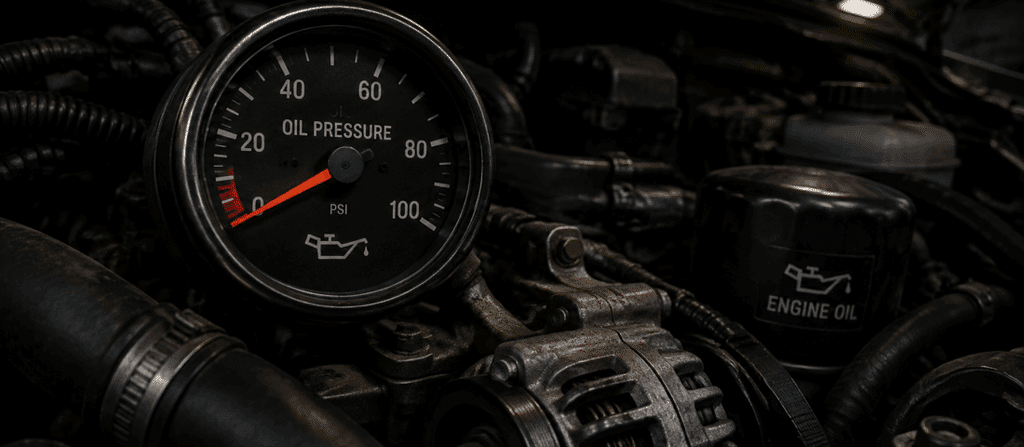
3. The gauge drops. If you have an actual pressure gauge (not just a light), watch it at idle when the engine is fully warm. Pressure naturally reads lower at idle than at speed, but a gauge sitting near zero at a hot idle is a red flag.
4. Performance loss and overheating. Oil cools as well as lubricates. Low pressure can push temperatures up and rob power. If the temperature gauge is climbing alongside the oil light, stop.
5. Burning oil smell. Often means oil is leaking or burning off somewhere — which leads to low level, which leads to low pressure. The smell is the early warning; the light is the late one.
6. Check engine light with running symptoms. On some vehicles, oil pressure control faults set codes like P06DD, which brings the check engine light plus the oil light, unusual noises, sluggish performance, and sometimes limp mode.
How Is Low Oil Pressure Diagnosed?
A proper diagnosis starts with the symptom and then confirms whether the pressure is actually low.
Step 1: Stop the engine
If the oil-pressure warning appears while the engine is running, safely pull over and shut the engine off.
Honda and Ford owner information both direct drivers to stop the vehicle and shut the engine down when the oil-pressure warning remains illuminated.
Step 2: Check the oil level
Park on level ground and follow the procedure in the owner’s manual.
If the level is low, determine why.
Don’t simply add oil and forget about it.
Step 3: Look for obvious leaks
Check for signs of fresh oil around:
- The oil pan
- Drain plug
- Oil filter
- Engine
- Ground beneath the vehicle
Step 4: Verify actual oil pressure
If the warning remains or the pressure is suspected to be low, a technician can measure actual oil pressure using the appropriate equipment and compare the result with the manufacturer’s specification.
This is critical.
A warning light tells you that the vehicle detected a pressure condition.
A mechanical pressure test can help determine whether the pressure itself is actually outside specification.
Step 5: Diagnose the cause
Once low pressure is confirmed, the next step depends on the engine.
Potential areas include:
- Oil pump
- Pickup
- Filter
- Internal engine wear
- Oil passages
- Oil viscosity
- Other vehicle-specific lubrication components

The trap: it’s often the sensor, not the pump
Here’s the misdiagnosis that costs people real money. The oil pressure sending unit — the little sensor that reports pressure to your gauge and light — fails fairly often. When it does, it triggers the exact same warning light as genuinely low pressure.
The rule, from every experienced tech: never assume it’s the sensor, and never assume it isn’t. A mechanic threads in a mechanical gauge and reads actual pressure directly. That one test — cheap, fast, definitive — separates a $150 sensor job from a $1,200 pump job. Anyone quoting you a pump replacement without a gauge reading is guessing with your money.
Low Oil Pressure vs. Low Oil Level
These terms are often confused.
| Problem | What it means |
|---|---|
| Low oil level | There isn’t enough oil in the sump |
| Low oil pressure | The lubrication system isn’t maintaining the required pressure |
| Oil-pressure sensor fault | The warning system may report low pressure even when actual pressure is normal |
| Oil-change reminder | Scheduled maintenance is due |
The distinction matters because adding oil only addresses low oil level.
It doesn’t automatically repair a failing pump, worn bearings, restricted pickup, or faulty sensor.
What a professional checks, in order
- Oil level and condition on the dipstick. Low level is the most common cause, full stop. Also checks: is the oil black and gritty, or does it smell like fuel? Both kill pressure.
- Leaks. Under the car, around the filter, at the drain plug, valve covers. A visible puddle means the level problem will return.
- Mechanical gauge test. The sending unit comes out, a calibrated gauge goes in. Pressure is read cold and hot, at idle and at RPM. This is the moment of truth.
- Sending unit test. If the gauge reads fine but the dash light is on, the sensor is the liar. Replace it.
- Filter and pickup inspection. A clogged filter or sludge-choked pickup strainer starves the pump — pressure drops hardest at high RPM when demand peaks.
- Bearing wear assessment. On high-mileage engines with verified low pressure and knocking, worn crankshaft and rod bearings are the likely culprit — the clearances have grown too large to hold pressure.
The usual causes, ranked
- Low oil level — leaks, burning oil, or just neglected checks. Check it monthly; it takes 60 seconds.
- Wrong viscosity — oil too thin for the engine or the climate won’t hold pressure. Always use the grade on your oil cap or manual.
- Failed oil pressure sending unit — false alarm, but verify before celebrating.
- Clogged filter, strainer, or passages — sludge from skipped oil changes. The slow killer.
- Worn oil pump — gears and relief valves wear; output fades. Listen for whining from the timing cover area.
- Worn engine bearings — high-mileage engines; pressure drops because the gaps got bigger.
What about HIGH oil pressure?
Less common, worth one paragraph. A gauge pinned high usually means a stuck pressure relief valve in the pump — it can’t bleed off excess pressure. Symptoms: gauge reading maxed out, sometimes oil filter or seal failures from the excess force. It still needs a pro; overpressure blows seals and gaskets.

When Low Oil Pressure Becomes an Emergency
Treat the situation as urgent when you have:
- Oil-pressure warning while the engine is running
- Oil-pressure warning plus knocking
- Oil-pressure warning plus severe ticking
- Oil-pressure warning plus overheating
- Oil-pressure warning plus loss of power
- Very low oil level
- Significant oil leak
- Repeated warning-light activation
The safest response is:
Stop safely. Shut the engine off. Check the oil according to the owner’s manual. Do not continue driving if the warning remains or the cause is unknown.
The exact restart procedure can vary by manufacturer. Honda, for example, specifies checking the oil after stopping and then checking whether the warning disappears after restarting; if it remains beyond its specified period, Honda says to stop the engine and seek service.
Engine Oil Pressure Symptoms: Quick Reference
| Symptom | What it may indicate | What to do |
|---|---|---|
| Red oil-pressure warning | Low pressure or warning-system fault | Stop and investigate |
| Warning + knocking | Potential serious lubrication problem | Shut engine off |
| Warning + low oil level | Oil shortage may be affecting pressure | Add correct oil per manual and find the cause |
| Warning + full oil level | Sensor or mechanical pressure problem possible | Verify actual pressure |
| Warning at hot idle | Pressure may be marginal under those conditions | Diagnose promptly |
| Ticking + warning | Possible lubrication problem | Stop and inspect |
| Burning oil smell | Oil leak or oil contacting hot components possible | Inspect for leaks |
| Oil leak + warning | Oil loss may be reducing available oil | Stop and address the leak |
| Overheating + oil warning | Potentially serious engine problem | Stop driving |
| No warning but engine noise | Many possible causes | Diagnose; don’t assume low pressure |

What it costs
| Service | Typical US range | Notes |
|---|---|---|
| Professional diagnostic (mechanical gauge test) | $50–$150 | Confirms real pressure vs. sensor fault — always first |
| Oil + filter change (correct viscosity) | $50–$120 | Fixes it outright if the oil was old or wrong |
| Oil pressure sending unit replacement | $100–$450 | Wide range — some engines bury the sensor; documented dealer jobs have hit $450 on labor access alone |
| Oil pump replacement | $900–$1,400 | Verified averages run $883–$1,316 across common models; labor-heavy job |
| Engine bearing repair / rebuild | $2,000–$5,000+ | Estimate — if it was driven with the light on; often exceeds the car’s value |
US market, 2026. Pump cost swings hard with accessibility — the part is often cheap, the labor is the bill.
The Most Important Mistake to Avoid
The biggest mistake is treating the oil-pressure warning as an ordinary maintenance reminder.
It isn’t.
The second biggest mistake is going in the opposite direction and assuming the engine is definitely destroyed.
It might be:
- Low on oil
- Reporting a false signal
- Suffering from a pump problem
- Experiencing internal wear
- Dealing with another lubrication-system fault
The correct response is neither panic nor dismissal.
It’s verification.
Safety box
- Oil light on while driving = shut the engine off now. Not at the next exit. Now. Every minute without pressure is bearing damage.
- Don’t confuse the oil pressure light with the maintenance reminder. The wrench or “oil change due” message is a schedule nudge. The red oil can is an emergency.
- Flashing oil light at idle that goes out with RPM still needs prompt diagnosis — it’s often early bearing wear or a weak pump, and it gets worse, never better.
- Never open the oil fill cap on a hot running engine to “check” — hot oil spatter burns. Check the dipstick with the engine off.