
This article was updated in October 19, 2026 with new products and information by Mark S. Taylor
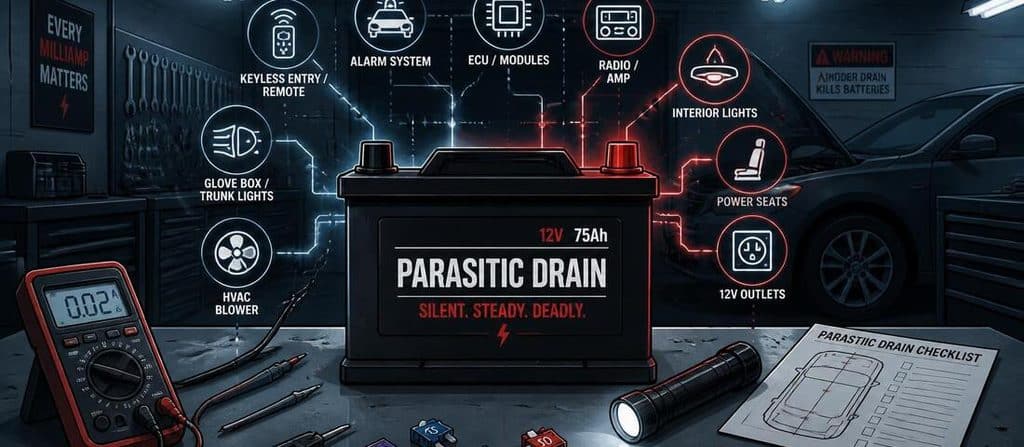
Parasitic drain is power your battery loses after you’ve shut the car off and walked away. A small amount, commonly cited as 20 to 50 milliamps, is normal and won’t hurt a healthy battery over a few weeks of parking. The usual culprits above that range are a light that didn’t shut off, a relay stuck closed, an aftermarket accessory wired straight to the battery, or a module that won’t go to sleep. You confirm it with a multimeter and find it by pulling fuses one at a time.
Here’s the mental model. Your car’s electronics are supposed to clock out when you turn the key off, the same way employees leave an office and the lights go dark. Parasitic drain is one circuit that never clocked out. It’s still on the clock, still pulling a paycheck from your battery, all night long.
This guide covers what causes it and how much draw is normal. If your car is already dead and you’ve jumped it, see our guide on car only starts with a jump for the full diagnosis, since a weak battery can look exactly like a drain.
Contents
- 1 What Counts as Normal vs. a Problem
- 2 The 6 Usual Causes
- 3 Is It the Drain, or Just a Tired Battery?
- 4 How to Test for Parasitic Drain at Home
- 5 Is It Safe to Keep Driving on a Car With a Drain?
- 6 What It Costs to Fix
- 7 Common Mistakes
- 8 Pro Tips
- 9 FAQs About What Causes Parasitic Drain on Your Car Battery?
- 10 Bottom Line
What Counts as Normal vs. a Problem
Every car draws a small amount of power with the key off. The clock, the alarm system, and your radio presets all need a trickle of electricity to remember their settings. Several independent repair sources converge on the same rough range:
| Draw | What it usually means | Rough time to a dead battery (typical 60 Ah battery) |
|---|---|---|
| 20 to 50 milliamps | Normal standby draw | Weeks, not a problem |
| 75 to 100 milliamps | Slightly elevated, worth a look | Roughly 3 to 5 weeks |
| 150 to 250 milliamps | Abnormal | Roughly 10 to 17 days |
| 500 milliamps or more | A real fault | 5 days or less |
These are consistent figures across the sources checked for this article, not a single lab-verified standard, so treat them as a reasonable guideline rather than an exact spec for your vehicle.
The 6 Usual Causes
1. A light that didn’t fully shut off
Trunk, glovebox, and under-hood lights run on small switches that can stick, corrode, or sit slightly out of alignment. When one doesn’t close all the way, the light that’s supposed to come on for ten seconds stays lit for ten hours. This is one of the simplest causes to find and fix, since you can often see or feel the light is warm, and one of the most common according to repair-guide sources.
2. A relay stuck closed
A relay is a small electrical switch. When it sticks in the closed position, instead of opening and cutting power when you shut the car off, it keeps feeding power to whatever it controls, a cooling fan, a fuel pump, an accessory. One source notes a stuck fuel pump relay specifically can pull several amps continuously, which is enough to kill a battery in hours, not days. A relay that’s bad often clicks when you tap the fuse box, which is one quick way shops narrow in on it.
3. Aftermarket accessories wired incorrectly
Stereos, amplifiers, LED light bars, remote starters, alarm systems, and dash cams are frequently named as the single biggest cause of excessive drain across the sources checked for this piece. The problem isn’t the accessory itself, it’s how it’s wired. Done right, an accessory connects to a switched circuit that only has power when the ignition is on. Done wrong, it’s spliced straight to the battery’s positive terminal, so it stays “awake” all the time. A dash cam left in parking mode without a proper low-voltage cutoff is a commonly cited example, with reports of it draining a battery flat in under a day.
4. Damaged or poorly spliced wiring
A chafed wire that touches bare metal, a pinched harness, or a sloppy aftermarket splice can create a path for current to leak out where it shouldn’t. This cause is harder to spot visually than a stuck light and often shows up during the fuse-pulling test below rather than on a walkaround.
5. A module that won’t go to sleep
Modern cars run on a web of small computers, the body control module, infotainment, telematics, and more, each supposed to power down after a set time. A software glitch, a bad sensor input, or a communication fault on the vehicle’s internal network can leave one of these modules running when it should be idle. This is the trickiest cause on this list to chase down at home, since pulling and reinserting a fuse can accidentally wake a sleeping module back up and reset your test.
6. Failing alternator diodes
The alternator uses diodes to let current flow one way, into the battery, while the engine runs. When a diode fails, it can let current flow backward out of the battery even with the engine off. This is a less common cause than the five above, but worth knowing, since the fix is an alternator repair, not an electrical hunt through the fuse box.
Is It the Drain, or Just a Tired Battery?
Before you spend an evening pulling fuses, rule out the simpler explanation. Fully charge the battery first. A weak, aging battery can mimic a drain, since it loses voltage faster than a healthy one even under a perfectly normal load. If the battery is more than 3 to 4 years old or has been jump-started more than once recently, have it load-tested before you assume the problem is electrical. See our guide on car battery replacement cost and lifespan.
How to Test for Parasitic Drain at Home
You’ll need a digital multimeter with a DC amp setting (ideally one with a milliamp range), a fuse puller, basic hand tools, and your vehicle’s fuse box diagram.
- Start from a full charge. Confirm or charge the battery first so a weak battery doesn’t throw off your reading.
- Close everything up and let the car fall asleep. Shut all doors, remove the key, and wait 15 to 30 minutes. Many cars have a sleep timer before every module powers down fully.
- Set the multimeter to its highest DC amp range and connect it in series between the negative battery terminal and the disconnected negative cable. Never connect an amp meter in parallel, that blows the meter’s internal fuse instantly.
- Read the draw. A reading at or below roughly 50 milliamps is in the normal range. Higher than that, you’ve confirmed a drain.
- Pull fuses one at a time, starting with the interior fuse box, then the underhood box, watching the meter after each pull. Reinstall each fuse before moving to the next unless you see a sharp drop.
- When the draw falls to a normal level, note which fuse caused it and check your fuse diagram for what’s on that circuit.
- Narrow it further by unplugging individual components on that circuit until the draw returns to normal. That component, or its wiring, is your culprit.
A safety note: never start the engine while the multimeter is connected in series. That sends far more current through the meter than it’s rated for.
A newer-car caveat: on vehicles with a lot of computer modules, pulling and reinserting fuses can wake a sleeping module and throw off your reading, since every car on the market behaves a little differently here. If your draw won’t stabilize, or the fuse-pulling method keeps giving inconsistent numbers, that’s a sign to hand it to a shop with the right equipment rather than keep guessing.
Is It Safe to Keep Driving on a Car With a Drain?
Generally yes, a parasitic drain by itself doesn’t affect how the car runs or stops. The real risk is getting stranded by a dead battery at an inconvenient time, and repeatedly deep-discharging a battery shortens its life. Treat a confirmed drain as something to fix soon, not an emergency, unless your battery is also old enough that it’s at real risk of leaving you stuck.
Stop and have the battery checked right away if:
- The battery case is swollen, cracked, or leaking
- You smell a strong sulfur odor near the battery
Fine to keep driving while you investigate if:
- The car starts and runs normally, and the issue is only that it’s dead after sitting
What It Costs to Fix
Costs vary widely because the fix depends entirely on what’s causing the drain. These are U.S. ranges from shop pricing guides and independent repair sources as of late 2026, not quotes.
| Item | Typical U.S. range | Notes |
|---|---|---|
| Shop diagnostic test | About $50 to $250. Commonly priced as roughly one hour of labor | Some shops credit this toward the repair if you have them do the work; ask upfront |
| DIY test tool (inline parasitic drain tester) | About $14 to $40 | Makes a multimeter test easier without disconnecting the battery cable each time |
| Minor wiring repair | About $100 and up | Climbs significantly for extensive or hard-to-reach damage |
| Full repair, typical straightforward case | Often cited as up to roughly $200 for a simple fix like a stuck light or accessory rewire | A severe or unusual case (one owner reported about $700 to $1,000 total for a specific door-handle sensor fault, including diagnostics) can run well past that |
DIY or shop? The multimeter test and fuse-pulling method are doable at home with basic tools and patience. A straightforward drain from a stuck light, a relay, or an obvious aftermarket accessory is commonly found in well under an hour once you know the method. A module-related or intermittent drain is a different story and often genuinely needs a shop’s equipment and vehicle-specific data to chase down without spending a weekend on it.
Common Mistakes
- Assuming it’s a drain before ruling out a weak battery. A tired battery can look exactly like a parasitic draw.
- Pulling multiple fuses at once. You lose track of which one caused the change, and you risk a system-wide reset that hides an intermittent fault.
- Starting the engine with the meter still in series. That’s how you blow a multimeter’s internal fuse.
- Blaming the alternator first. A bad alternator diode is a real but less common cause; test it, don’t assume it.
- Wiring an aftermarket accessory to a constant power source instead of a switched circuit, the single most frequently cited cause of excessive drain in the sources for this guide.
Pro Tips
- If you added a dash cam, amplifier, remote starter, or alarm recently and the drain started around the same time, start your search there.
- A relay that’s stuck closed will sometimes click when you tap the fuse box near it. Worth a listen before you start pulling fuses.
- Write down your stabilized key-off reading before you touch a single fuse. It’s your baseline for comparison as you go.
- If the draw won’t stabilize or keeps changing on its own, that pattern itself is a clue: it points toward a module or an intermittent fault rather than a simple stuck light.
FAQs About What Causes Parasitic Drain on Your Car Battery?
What is considered a normal parasitic drain on a car battery?
Most sources put normal standby draw at roughly 20 to 50 milliamps. That’s enough to run the clock, alarm, and a few memory functions without meaningfully affecting a healthy battery over several weeks of parking. A reading consistently above about 50 to 75 milliamps is worth investigating.
What’s the most common cause of parasitic battery drain?
Interior or trunk lights that don’t fully shut off, stuck relays, and improperly wired aftermarket accessories are the three causes that show up most often across repair sources. Aftermarket accessories wired directly to the battery instead of through a switched circuit are frequently named as the single biggest contributor on modern vehicles.
How do I test for parasitic drain myself?
Fully charge the battery first, let the car sit for 15 to 30 minutes to fall asleep, then connect a multimeter in series between the negative terminal and the disconnected cable, set to its highest DC amp range. A reading above roughly 50 milliamps confirms a drain. Pull fuses one at a time, watching the meter, until the reading drops to find the circuit responsible.
Can a bad alternator cause parasitic drain?
Yes, though it’s less common than the other causes. A failing diode inside the alternator can let current leak backward out of the battery even when the engine isn’t running. If your fuse-pulling test doesn’t turn up an obvious circuit, a charging-system check is worth adding to the list.
How much does it cost to fix parasitic battery drain?
It depends entirely on the cause. A shop diagnostic commonly runs $50 to $250, sometimes credited toward the repair. A simple fix, like a stuck light or rewiring an accessory, is often cited as running up to roughly $200. A harder-to-find or unusual fault can cost significantly more once diagnostics and parts are added together.
Bottom Line
- Some drain is normal. Roughly 20 to 50 milliamps won’t meaningfully hurt a healthy battery over a few weeks parked.
- Lights, stuck relays, and badly wired aftermarket accessories cause the large majority of real problems.
- Rule out a simply tired battery before you assume it’s a drain.
- The multimeter-and-fuse-pulling method is a real DIY option for straightforward cases; an intermittent or module-related drain is better handed to a shop.