
This article was updated in October 17, 2026 with new products and information by Mark S. Taylor
Your Car Battery Is Dead in the Morning. Now What?
You park the car at night. Everything seems normal.
The next morning, you turn the key or press the start button.
Nothing.
Maybe you hear a few clicks. Maybe the dash lights are barely visible. Or maybe the car is completely dead.
If this keeps happening, don’t automatically buy another battery.
A battery that dies overnight can have several causes. The battery itself may be weak. An electrical component may be staying awake after you shut the car off. A light may be left on. An aftermarket accessory may be pulling power. Or the charging system may not be putting enough energy back into the battery.
The important part is finding out where the power is going.
Contents
- 1 The Battery Itself Is Weak
- 2 A Parasitic Draw Is Draining the Battery
- 3 A Light Is Staying On
- 4 An Aftermarket Accessory Is Draining the Battery
- 5 Your Key Fob May Be Keeping the Car Awake
- 6 The Alternator May Not Be Charging the Battery Properly
- 7 Corroded or Loose Battery Connections
- 8 The Car Doesn’t Get Driven Enough
- 9 Extreme Temperatures Can Expose a Weak Battery
- 10 How to Tell If It’s a Bad Battery or a Parasitic Drain
- 11 How a Mechanic Finds an Overnight Battery Drain
- 12 Can an Alternator Drain a Battery Overnight?
- 13 Why Does My Car Battery Die Overnight but Not During the Day?
- 14 Why Does My Battery Die After One Night?
- 15 Why Does My Car Battery Keep Dying Even After I Replace It?
- 16 Is It Safe to Keep Driving With a Battery That Keeps Dying?
- 17 What Should You Do When Your Battery Is Dead in the Morning?
- 18 Don’t Make This Common Mistake
- 19 Quick Reference: Car Battery Drains Overnight Causes
- 20 Bottom Line
Quick answer
The most common causes of a car battery draining overnight are:
- A weak or failing battery
- A parasitic electrical draw
- Interior, trunk, glove-box, or exterior lights staying on
- An aftermarket dash cam, stereo, alarm, or other accessory
- A key fob staying close to the vehicle
- An alternator or charging-system problem
- Corroded or loose battery connections
- The car sitting for long periods or making mostly short trips
- Extreme temperatures exposing a weak battery
- An electronic module that fails to go to sleep
Modern cars still use a small amount of electricity after the engine is off. That’s normal. The problem starts when something uses too much power for too long. AAA describes this as a parasitic drain.
The Battery Itself Is Weak
This is the first thing to consider.
A car battery doesn’t last forever. AAA says a typical automotive battery lasts about three to five years, although climate, driving habits, and maintenance can shorten or extend that life.
A weak battery may still start the car during the day.
Then you park it overnight.
The small amount of power normally used while the vehicle is parked is enough to push the battery over the edge.
This can make it look like something is draining the battery when the real problem is simply that the battery can no longer hold a charge.
Signs the battery may be failing
Look for:
- Slow cranking
- Clicking when you try to start the engine
- Dim interior or dashboard lights
- The battery repeatedly going dead
- A battery that is several years old
- Corrosion or physical damage
- A battery that tests poorly even after being fully charged
A proper battery test is more useful than guessing from its age alone.

A Parasitic Draw Is Draining the Battery
This is the classic answer when someone says, “My car battery dies overnight.”
A parasitic draw happens when an electrical component continues using more power than it should after the vehicle is shut off.
Some electrical use is normal.
Your car may keep systems such as security equipment, memory functions, clocks, and other electronics alive while parked.
The problem is when a component refuses to shut down or wakes up when it shouldn’t.
That extra current can slowly drain the battery while the car sits.
Modern vehicles have more computers and electronics than older cars, so there are more possible sources of unwanted electrical consumption.
A Light Is Staying On
This sounds obvious, but it’s one of the first things I check.
A light doesn’t have to be visibly glowing when you walk away.
A trunk light, glove-box light, vanity-mirror light, or interior light can stay on because a switch or latch isn’t working correctly.
AAA specifically lists headlights and interior lights among common sources of battery drain.
Check these areas
- Glove box
- Trunk
- Cargo area
- Vanity mirrors
- Door lights
- Interior dome lights
- Reading lights
- Headlights
- Parking lights
A door that isn’t fully closed can also keep interior electronics awake.
If the battery dies after one particular door, trunk, or hatch has been used, pay attention to that clue.
An Aftermarket Accessory Is Draining the Battery
This is a big one, especially on modified vehicles.
Common suspects include:
- Dash cams
- Remote starters
- Aftermarket alarms
- Stereo systems
- GPS trackers
- Radar detectors
- USB chargers
- Bluetooth accessories
- Auxiliary lighting
- Other electronics connected directly to the battery
Some accessories are designed to remain powered when the vehicle is off.
That’s not automatically a problem.
The problem is poor wiring, incorrect installation, a failed accessory, or an accessory that draws more current than it should.
AAA notes that improperly installed aftermarket stereos and alarms can create significant battery drain.
A simple clue
If the battery problem started shortly after you installed an accessory, don’t ignore that timing.
It may be the best clue you have.
Your Key Fob May Be Keeping the Car Awake
Some modern vehicles monitor nearby key fobs so they can provide features such as keyless entry and passive unlocking.
In certain vehicles, keeping the key fob very close to the car for long periods can prevent parts of the system from fully going to sleep.
AAA has identified keeping a key fob close to the vehicle as a potential source of battery drain on some vehicles.
This doesn’t mean every key fob will drain every car.
Vehicle design matters.
If your battery keeps dying and you normally leave the keys on a table or hook right next to the garage, try moving the fob farther away and see whether the problem changes.
The Alternator May Not Be Charging the Battery Properly
Here’s where diagnosis gets important.
The alternator normally recharges the battery while the engine is running.
If the charging system isn’t working correctly, the battery may never become fully charged.
You shut the car off at night with a battery that is already low.
By morning, there’s not enough energy left to start the engine.
That can look like an overnight battery drain.
Possible charging-system problems include:
- Weak alternator output
- Voltage regulator problems
- Damaged wiring
- Poor battery connections
- Ground problems
- A worn or damaged drive belt
AAA notes that wiring problems, voltage-regulator faults, alternator problems, and parasitic drains can all be associated with charging-system symptoms.
One important point
A new battery won’t fix an alternator that isn’t charging properly.
It may only delay the next dead-battery morning.
Corroded or Loose Battery Connections
Sometimes the battery isn’t the problem.
The connection is.
Corrosion around the battery terminals can interfere with electrical flow. A loose connection can do the same thing.
AAA also notes that corrosion can contribute to battery problems and shorten battery life.
Look at both battery terminals.
You want clean, secure connections.
Also inspect the main positive cable and ground connections if you are comfortable doing so.
A poor ground can cause charging problems that are easy to mistake for a bad battery.
The Car Doesn’t Get Driven Enough
A car that sits for days can eventually have a low battery.
That’s because the vehicle still uses some electrical power while parked.
The battery also loses charge naturally over time.
If you mostly take short trips, the alternator may not have enough time to replace the energy used during starting and driving. AAA says repeated short trips and long periods of inactivity can leave a battery at a lower state of charge.
This is especially important if the battery is already older.
A car that sits for weeks needs a different strategy than a daily commuter.
For a vehicle that is stored for long periods, a properly selected battery maintainer can help keep the battery charged.
Extreme Temperatures Can Expose a Weak Battery
Temperature doesn’t always cause the original problem.
Sometimes it reveals it.
Very hot weather can accelerate battery deterioration. Very cold weather makes it harder for a battery to deliver the power needed to start the engine.
That means a battery that seemed fine last month may suddenly struggle after a major temperature change. AAA identifies both extreme heat and cold as factors that can shorten battery life or reduce battery performance.
If the battery is already weak, one cold night may be enough to expose it.
How to Tell If It’s a Bad Battery or a Parasitic Drain
This is the question that saves you money.
If you replace the battery without finding the cause, the replacement may eventually go dead too.
A basic diagnostic approach looks like this:
| What you find | What it may point to |
|---|---|
| Battery fails a proper test | Weak or damaged battery |
| Battery is good but repeatedly goes dead | Possible parasitic draw |
| Battery is low after short trips | Charging or driving-pattern issue |
| Battery light comes on while driving | Charging-system problem |
| Problem started after accessory installation | Aftermarket accessory or wiring |
| Interior light stays on | Light, latch, or switch problem |
| Battery terminals are heavily corroded | Connection or battery problem |
| Battery dies after sitting for weeks | Normal discharge, weak battery, or excessive draw |
| Battery repeatedly dies despite replacement | Look for charging or electrical problems |
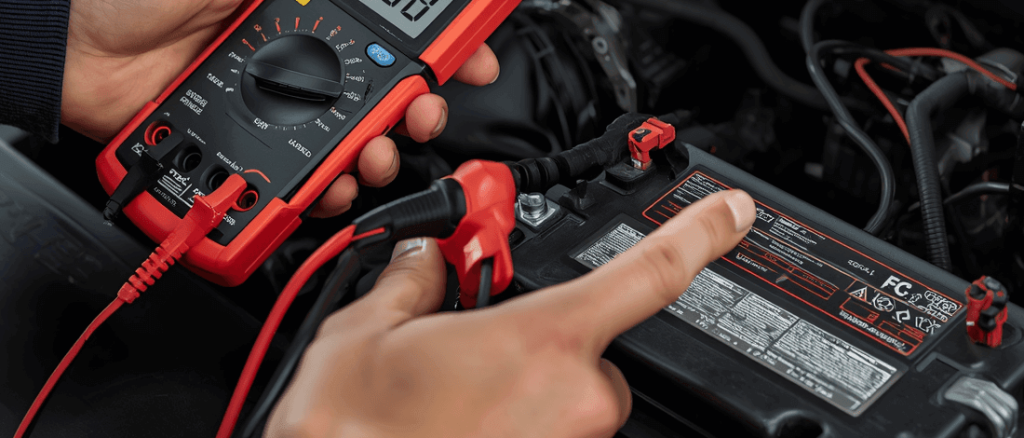
The key is to test instead of guessing.
How a Mechanic Finds an Overnight Battery Drain
A technician normally starts by making sure the battery is charged and capable of holding that charge.
Then the charging system is checked.
If the battery and charging system pass, the next step is looking for unwanted electrical draw with the vehicle turned off.
This is often called a parasitic draw test.
The vehicle needs time to shut down its modules before the technician decides whether the current draw is excessive. Modern vehicles can take time to enter their normal sleep state.
A technician can then measure the electrical current and isolate circuits until the problem is found.
Depending on the vehicle, this may involve checking fuses, modules, relays, accessories, wiring, and aftermarket equipment.
Why this matters
Pulling random fuses and guessing can waste hours.
A good diagnostic process works from evidence.
Battery condition → charging system → key-off current draw → affected circuit → faulty component.
That’s much more reliable than simply installing another battery.
Can an Alternator Drain a Battery Overnight?
Yes, but don’t jump straight to that conclusion.
An alternator can contribute to a battery-drain problem in different ways.
A charging-system fault may leave the battery undercharged.
An electrical fault involving the alternator can also create unwanted current flow when the engine is off.
That’s why the alternator should be tested as part of the complete diagnosis rather than replaced based only on the symptom.
If the battery warning light comes on while you’re driving, take it seriously. AAA advises pulling over safely and having the vehicle checked because a charging-system failure can eventually leave the vehicle unable to run.
Why Does My Car Battery Die Overnight but Not During the Day?
Because the problem may only appear when the car is parked.
During the day, the engine is running and the alternator is supplying electrical power.
At night, the engine is off.
Now the battery is supplying the vehicle’s remaining electrical needs.
If a module stays awake, a light stays on, or an accessory continues drawing power, the battery can slowly lose its charge.
A weak battery makes the situation worse.
That’s why an overnight failure doesn’t automatically mean the battery suddenly “went bad” overnight.
The problem may have been building for weeks.
Why Does My Battery Die After One Night?
If a healthy, fully charged battery goes completely dead after one night, that’s worth investigating.
A large electrical load may have been left on.
Examples include:
- Headlights
- Interior lights
- A trunk or cargo light
- An aftermarket stereo
- An alarm system
- A dash cam
- Another accessory
- A failed electrical component
AAA notes that some lights can drain a battery very quickly when left on.
If nothing obvious was left on, a proper parasitic-draw test is the next logical step.
Why Does My Car Battery Keep Dying Even After I Replace It?
This is a major red flag.
If a replacement battery also goes dead, stop assuming you simply got a bad battery.
Look for an underlying problem.
The likely areas include:
- Parasitic draw
- Charging-system fault
- Poor battery connection
- Aftermarket accessory
- Repeated short trips
- Vehicle sitting unused for long periods
- A battery that was never fully charged after installation
Repeatedly discharging a battery can also shorten its life. AAA notes that a deeply discharged battery may not return to its original capacity even after recharging.
Is It Safe to Keep Driving With a Battery That Keeps Dying?
Not if you haven’t found the reason.
If the battery keeps going dead, the vehicle could eventually leave you stranded.
More importantly, a charging-system problem can cause the engine to stop running while you’re driving.
If the battery warning light comes on while driving, don’t treat it like a routine maintenance reminder. Pull over somewhere safe and have the charging system checked.
What Should You Do When Your Battery Is Dead in the Morning?
Start with the basics.
Step 1: Look for something obvious
Check the headlights, interior lights, trunk, glove box, and accessories.
Step 2: Check the battery
Look for corrosion, damage, swelling, or loose connections.
Don’t handle a damaged or leaking battery yourself.
Step 3: Get the battery tested
A voltage reading alone doesn’t tell the whole story. Have the battery properly tested for its condition and ability to start the vehicle.
Step 4: Test the charging system
Make sure the alternator and its wiring are doing their job.
Step 5: Look for a parasitic draw
If the battery and charging system are good but the battery keeps dying while parked, this becomes a major suspect.
Step 6: Trace the circuit
Once excessive key-off current is confirmed, the next job is finding which circuit or component is responsible.
That’s where professional electrical diagnosis can save a lot of time.
Don’t Make This Common Mistake
Don’t keep replacing the battery without testing the car.
A new battery can temporarily hide the problem.
Then a few weeks or months later, you’re right back where you started.
If the battery repeatedly dies overnight, think of the battery as the victim until testing proves otherwise.
The real problem may be somewhere else.
Quick Reference: Car Battery Drains Overnight Causes
| Cause | How likely? | What to check |
|---|---|---|
| Weak battery | Very common | Battery age and battery test |
| Lights left on | Common | Interior, trunk, glove box, headlights |
| Parasitic draw | Common | Key-off current test |
| Aftermarket accessory | Common | Dash cam, stereo, alarm, tracker |
| Charging problem | Common | Alternator and charging voltage |
| Corroded terminals | Possible | Battery posts and cables |
| Key fob nearby | Vehicle-dependent | Move fob farther from vehicle |
| Long periods without driving | Common | Driving pattern and battery condition |
| Extreme temperatures | Common contributor | Battery condition and climate |
| Failed electronic module | Possible | Scan and electrical diagnosis |
Bottom Line
When a car battery drains overnight, don’t assume the battery itself is bad.
A weak battery is certainly possible. But so are lights, accessories, poor connections, charging problems, and parasitic electrical draws.
The fastest path to the answer is simple:
Test the battery. Check the charging system. Then check for unwanted electrical draw with the car off.
That’s how you separate a bad battery from a car that is quietly stealing power while it sits in the driveway.
And if you’ve already replaced the battery more than once, don’t buy another one yet.
Find out where the power is going first.