
This article was updated in November 7, 2026 with new products and information by Mark S. Taylor
If your car is hard to start, stalls unexpectedly, or loses power during acceleration, a fuel pump problem may be responsible. How to test a fuel pump can help determine whether it is delivering enough fuel and receiving the electrical power it needs.
The most useful fuel pump tests check three things: fuel pressure, fuel delivery volume, and electrical performance. A pressure test shows whether the system can build the required pressure. A volume test checks whether it can deliver enough fuel. Electrical tests help identify problems with the pump’s power supply, ground, wiring, or control circuit.

However, no single test confirms every fuel pump failure. A weak electrical connection can make a good pump perform poorly, while an intermittent pump may pass a pressure test when it happens to be working.
The correct testing procedure depends on your vehicle’s year, make, model, engine, and fuel-system design. Always use the manufacturer’s specifications and service instructions before testing or replacing a component.
Contents
- 1 What You Need to Know Before Testing a Fuel Pump
- 2 What Tools Are Used to Test a Fuel Pump?
- 3 How to Check for Fuel-Pump Operation
- 4 How to Test Fuel Pressure
- 5 How to Test Fuel Volume or Delivery
- 6 How to Check Fuel-Pump Power and Ground
- 7 How to Interpret Fuel-Pump Current Draw or Scope Patterns
- 8 What to Check When Fuel Pressure Is Low
- 9 Common Fuel-Pump Testing Mistakes
- 9.1 1. Replacing the Pump Because You Cannot Hear It
- 9.2 2. Assuming a Running Pump Is a Good Pump
- 9.3 3. Using a Generic Fuel-Pressure Specification
- 9.4 4. Testing Pressure Without Checking Electrical Supply
- 9.5 5. Treating a Normal Pressure Reading as Proof That the Pump Is Good
- 9.6 6. Ignoring Fuel Volume
- 9.7 7. Using the Wrong Test Equipment
- 9.8 8. Applying a Low-Pressure Test to a High-Pressure System
- 10 When Professional Fuel-Pump Testing Is Necessary
- 11 FAQs About How to Test a Fuel Pump
- 11.1 How do you test a fuel pump at home?
- 11.2 Can you test a fuel pump with a multimeter?
- 11.3 How do you know if a fuel pump is working without a pressure gauge?
- 11.4 What fuel pressure should a fuel pump have?
- 11.5 Can a fuel pump pass a pressure test and still be bad?
- 11.6 What is the difference between a fuel-pressure test and a fuel-volume test?
- 11.7 Can a bad fuel pump cause low fuel pressure?
- 11.8 Do I need to remove the fuel tank to test a fuel pump?
- 11.9 Can you test a fuel pump without starting the engine?
- 11.10 Is it safe to test a fuel pump by disconnecting a fuel line?
- 11.11 How do you test a high-pressure fuel pump?
- 12 Final Thoughts
What You Need to Know Before Testing a Fuel Pump
Before testing a fuel pump, identify the type of fuel system in your vehicle, find the correct specifications, and understand the safety requirements.
A fuel pump test designed for an older port-injected engine may not apply to a modern gasoline direct-injection or diesel engine.
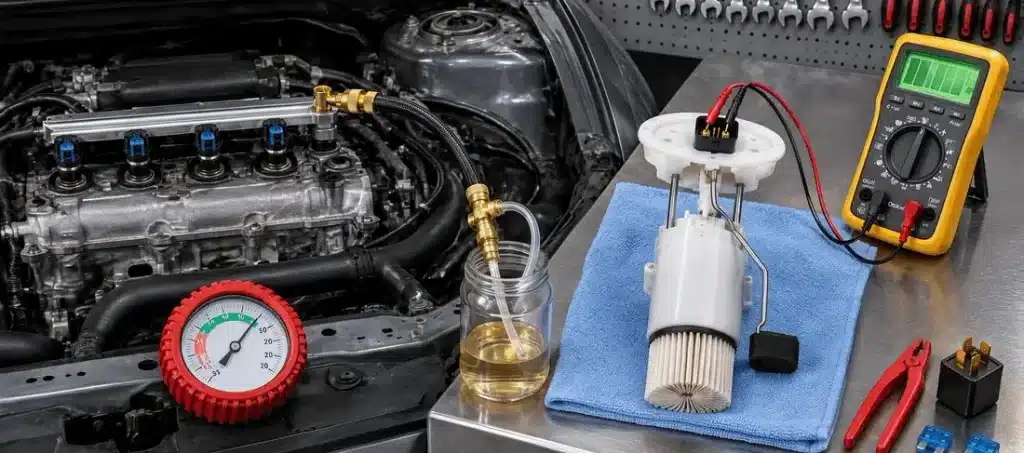
Identify the Fuel-System Type
Most modern gasoline vehicles use an electric fuel pump inside the fuel tank. However, fuel-system designs differ.
Common arrangements include:
- Port fuel injection: Fuel is supplied to a fuel rail and delivered through injectors located in the intake ports.
- Gasoline direct injection (GDI): A low-pressure pump supplies fuel to a mechanically driven high-pressure pump. The high-pressure pump supplies the fuel rail and injectors.
- Diesel common rail: A low-pressure supply system feeds a high-pressure pump that supplies the common rail and injectors.
- Older mechanical fuel-pump systems: Some older gasoline engines use an engine-driven mechanical pump instead of an electric in-tank pump.
Some vehicles also use multiple pumps, variable-speed pump control, or a dedicated fuel-pump control module.
These differences affect where pressure is measured, how the pump is commanded, and which testing equipment is appropriate.
Important: Do not apply a conventional gasoline fuel-pressure gauge procedure to a gasoline direct-injection or diesel high-pressure circuit. High-pressure fuel systems require specialized equipment and trained service procedures.


Find the Manufacturer’s Fuel-Pressure and Delivery Specifications
Before testing, obtain the service information for the exact vehicle and engine.
You may need specifications for:
- Key-on, engine-off fuel pressure, where applicable.
- Fuel pressure while cranking.
- Fuel pressure at idle.
- Fuel pressure under specified operating conditions.
- Residual or holding pressure after shutdown.
- Fuel delivery volume or flow rate.
- Pump electrical supply and ground.
- Voltage drop.
- Pump current draw.
- Fuel-pump control commands.
There is no universal fuel-pressure, flow-rate, or amperage specification for every vehicle.
Even two vehicles from the same manufacturer may use different fuel-system designs.
Use the manufacturer’s service information or a reliable vehicle-specific repair database. Do not decide that a pump is defective because its pressure differs from a generic number found online.
Understand Fuel-System Safety
Gasoline is highly flammable. Fuel systems may also retain pressure after the engine has been switched off.
Incorrect testing can release pressurized fuel, create a fire hazard, damage electrical connectors, or cause injury.
Before performing any fuel-system inspection:
- Work in a properly ventilated area approved for fuel-system service.
- Keep cigarettes, flames, sparks, and other ignition sources away.
- Wear suitable eye protection and fuel-resistant protective equipment.
- Keep an appropriate fire extinguisher available.
- Follow the manufacturer’s fuel-pressure relief procedure before opening a fuel connection.
- Use only approved pressure-testing equipment and vehicle-specific adapters.
- Keep fuel away from hot engine components and electrical equipment.
Never loosen a fuel line to see whether fuel comes out. Never direct fuel into an open container as an improvised volume test.
Stop and seek professional service if you find a fuel leak, smell a strong fuel odor, or cannot identify a safe testing connection.
High-pressure gasoline direct-injection and diesel common-rail systems require additional precautions. Do not loosen high-pressure lines or attempt mechanical pressure testing on these systems without the required training and equipment.
What Tools Are Used to Test a Fuel Pump?
The tools depend on the fuel-system design and the type of test required.
| Tool | What it checks |
|---|---|
| OBD-II scan tool | Diagnostic codes, available fuel-pressure data, pump commands, and related sensor information |
| Fuel-pressure gauge | Fuel pressure in systems with an approved mechanical test connection |
| Approved fuel-pressure test adapters | Safe connection to the specified test point |
| Fuel-volume or flow-testing equipment | Fuel delivery rate using an approved procedure |
| Digital multimeter (DMM) | Electrical voltage and voltage-drop measurements |
| Proper electrical back-probes | Electrical testing without damaging connector terminals |
| Current clamp | Fuel-pump electrical current draw |
| Automotive lab oscilloscope | Pump current waveform and intermittent electrical or motor problems |
| Manufacturer service information | Correct procedures, wiring diagrams, and specifications |
You do not need every tool for every diagnosis.
A basic scan tool may help identify a fuel-system fault, but it cannot independently confirm that a fuel pump is defective. A pressure gauge can show a pressure problem, but it cannot always identify the cause.
Professional diagnosis may require a scan tool, pressure and flow equipment, a current clamp, and an oscilloscope.
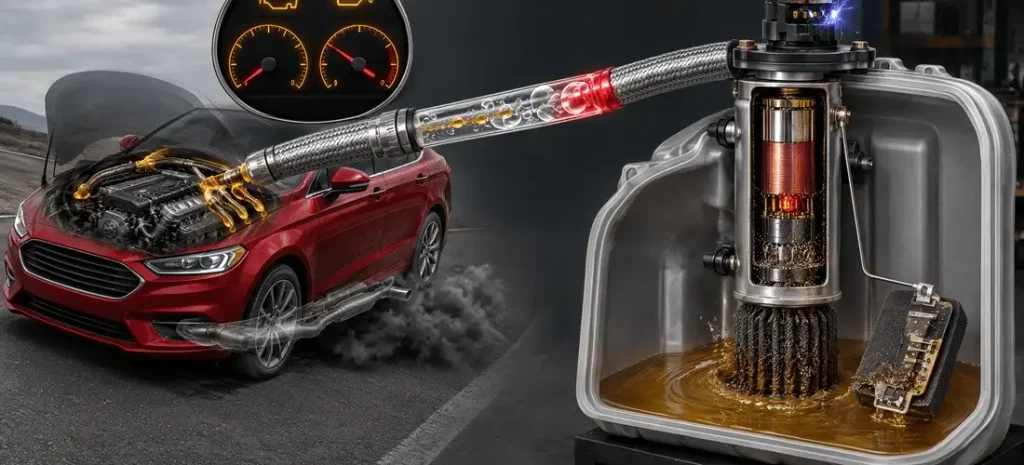
How to Check for Fuel-Pump Operation
A basic preliminary check is to determine whether the electric fuel pump appears to operate when the vehicle is switched on or commanded to run.
On some vehicles, the pump runs briefly when the ignition is switched on to build initial fuel pressure. On others, the pump may operate only under specific conditions or when the engine is cranking.
Listen for the Fuel Pump
On a vehicle that uses an audible key-on pump-priming cycle:
- Park the vehicle in a safe, ventilated location.
- Apply the parking brake and switch off the engine.
- Follow the vehicle’s starting and ignition instructions.
- Listen near the fuel tank for a brief humming sound when the pump is commanded to operate.
A short humming sound may indicate that the electric pump is operating.
However, hearing the pump does not prove that it produces the required pressure or fuel volume.
A pump can make noise and still be weak, restricted, or unable to supply enough fuel.
Likewise, not hearing the pump does not automatically prove that it has failed. The vehicle may not command the pump during that particular ignition cycle.
Check Pump Operation With a Scan Tool
Some vehicles allow a technician to command the fuel pump through a bidirectional scan tool.
Depending on the vehicle, the scan tool may display:
- Fuel-pump command or duty cycle.
- Fuel-pump control-module information.
- Desired fuel pressure.
- Actual fuel pressure.
- Low-pressure fuel-system data.
- High-pressure fuel-rail data.
Not every vehicle provides these parameters.
A commanded pump that does not operate requires electrical and control-circuit diagnosis. A pump that operates but produces incorrect pressure needs further fuel-delivery testing.
How to Test Fuel Pressure
A fuel-pressure test measures whether the fuel system can produce the pressure required by the manufacturer.
It is one of the main tests used when diagnosing hard starting, stalling, hesitation, and other suspected fuel-delivery problems.
The correct test method depends on the vehicle. Some systems have a dedicated pressure-test port. Others require approved adapters or scan-tool data.
Static and Key-On, Engine-Off Pressure Checks
A key-on, engine-off pressure check evaluates the fuel system during its initial operating or priming cycle, where the vehicle uses one.
The general diagnostic process is:
- Identify the manufacturer’s approved pressure-test point.
- Obtain the correct pressure gauge and adapter, if a mechanical test is specified.
- Follow the manufacturer’s fuel-pressure relief and connection procedure.
- Connect the equipment as instructed.
- Command the pump to operate using the specified method.
- Record the pressure reading.
- Compare the result with the vehicle’s specification.
Some vehicles run the pump briefly during the initial key-on cycle. Others use a different control strategy.
If the system does not build the specified pressure, investigate the pump, electrical supply, filter or strainer, fuel lines, and pressure-control components.
A low reading does not automatically mean the pump is bad.
Running Fuel-Pressure Checks
A running pressure test checks fuel pressure while the engine is operating.
The procedure may require checking pressure at idle or under other manufacturer-specified conditions.
The technician compares the measured pressure with the correct service specification.
Possible results include:
- Pressure below specification: A weak pump, restricted filter, low electrical supply, or pressure-control fault may be responsible.
- Pressure above specification: A regulator or pressure-control problem, restricted return path on applicable systems, or another fault may be involved.
- Pressure within specification: The system meets the pressure requirement under the conditions tested, but this does not prove that fuel volume or intermittent operation is correct.
Some systems do not use a conventional vacuum-operated fuel-pressure regulator. Follow the correct diagnostic procedure for the system design.
Fuel Pressure Under Load
A pump may maintain adequate pressure at idle but fail when the engine needs more fuel.
For that reason, some diagnostic procedures require checking fuel pressure under specified load or operating conditions.
This can help identify a fuel-delivery problem that does not appear during a basic idle test.
The test must follow the manufacturer’s procedure. Depending on the vehicle, it may require scan-tool data, approved test equipment, or a controlled workshop test.
Do not disconnect a fuel line, improvise a pressure restriction, or perform an unsafe road test to create engine load.
If the vehicle may stall or lose power, do not drive it on public roads for testing.
What Does a Fuel-Pressure Test Prove?
A pressure reading shows whether the system produces the required pressure at the time and under the conditions of the test.
It does not always identify the failed component.
For example, low pressure may result from:
- A weak or failed fuel pump.
- A restricted fuel filter.
- A clogged pump strainer.
- Low voltage at the pump.
- A poor ground or electrical connection.
- A faulty pressure regulator.
- A restricted fuel line.
- A fuel-pump control problem.
- A leaking injector or another system fault.
The next diagnostic step should be based on the test result and the manufacturer’s troubleshooting procedure.
How to Test Fuel Volume or Delivery
Fuel pressure and fuel volume are related, but they measure different things.
Pressure measures the force of the fuel against the system. Volume measures how much fuel the system can deliver over a specified period.
A pump may produce acceptable pressure during one test but fail to deliver enough fuel when demand increases.
A fuel-volume test helps determine whether the system can supply the required amount of fuel.
How a Fuel-Volume Test Works
The exact method depends on the vehicle and the approved testing equipment.
A technician may use a dedicated fuel-flow tester connected through the specified adapter or test point.
The general diagnostic process is:
- Identify the manufacturer’s fuel-delivery test procedure.
- Confirm the correct test connection and equipment.
- Follow the required fuel-pressure relief and safety instructions.
- Configure the approved flow-testing equipment.
- Command the pump to operate under the specified conditions.
- Measure the delivered fuel volume over the required time.
- Compare the result with the manufacturer’s specification.
Some systems require the pump to operate at a particular speed or command level. A vehicle with a variable-speed pump may need a scan tool to command the correct operating condition.
Never use an open bucket, bottle, or improvised container to collect pressurized gasoline. Fuel-volume testing should use approved equipment designed for the procedure.
What Does Low Fuel Volume Mean?
Low fuel volume may indicate:
- A weak fuel pump.
- A restricted filter.
- A clogged pump strainer.
- A restricted fuel line.
- Low electrical supply.
- A poor pump ground.
- A pressure-control problem.
- A tank-venting or fuel-supply issue.
If pressure and volume are both below specification, the pump may be underperforming. The electrical circuit and possible restrictions still need to be checked before replacement.
If pressure is acceptable but volume is low, the system may be unable to maintain delivery under greater demand.
The test result must be interpreted according to the system design.

How to Check Fuel-Pump Power and Ground
An electric fuel pump needs the correct electrical supply to operate properly.
A pump may receive power but still perform poorly if the circuit has excessive resistance, a damaged connector, or a poor ground.
This is why electrical testing is important before replacing a pump.
Check the Fuel-Pump Fuse and Relay
Begin with the vehicle’s wiring diagram and fuse information.
Inspect the relevant fuse, relay, connectors, and accessible wiring for:
- A blown fuse.
- Corroded terminals.
- Loose connections.
- Heat damage.
- Broken wires.
- Damaged insulation.
A relay that clicks is not necessarily supplying power to the pump. Its contacts and the rest of the circuit may still need testing.
If a fuse repeatedly blows, investigate the underlying electrical fault. Replacing the fuse repeatedly does not fix the cause.
Check Voltage at the Fuel Pump
A digital multimeter can help determine whether the pump receives the required electrical supply.
The test must be performed under the conditions specified by the manufacturer.
A reading taken with the pump disconnected may not reveal a high-resistance connection that fails under load.
Where the procedure requires a connected circuit, use the correct back-probe or breakout equipment. Do not force meter probes into connector terminals or pierce wire insulation.
Some modern fuel-pump systems use pulse-width modulation or variable-speed control. A conventional multimeter may display an average voltage that does not represent the actual control signal. These systems may require an oscilloscope or manufacturer-approved diagnostic equipment.
Perform a Voltage-Drop Test
A voltage-drop test checks for unwanted resistance in the power or ground circuit while current is flowing.
A technician may test:
- The power-side circuit between the battery supply and pump.
- The ground-side circuit between the pump ground and battery ground.
Excessive voltage drop can indicate corrosion, a damaged wire, a loose terminal, a poor ground, or another high-resistance connection.
Delphi’s published voltage-drop procedure explains that poor power or ground connections can cause low pressure and flow that resemble a failing pump. It also warns against probing connector terminals with unsuitable meter leads because damaged terminals can overheat.
Use the applicable manufacturer’s limits. A voltage-drop value published for one procedure should not be treated as a universal specification for every vehicle.

How to Interpret Fuel-Pump Current Draw or Scope Patterns
Fuel-pump current testing can provide additional information about the pump motor and the electrical load.
A current clamp or suitable current-measuring equipment can measure how much electrical current the pump draws during operation.
An oscilloscope can display changes in current over time. This can help identify internal pump-motor problems that pressure and volume tests may miss.
What Does Fuel-Pump Current Draw Tell You?
The current draw must be compared with the manufacturer’s specification for the exact pump and operating conditions.
General diagnostic possibilities include:
| Current-test finding | Possible explanation |
|---|---|
| Higher-than-specified current | Pump overload, restriction, or mechanical drag |
| Lower-than-specified current | Electrical supply problem, poor connection, worn motor components, or another fault |
| Unstable current | Intermittent electrical or motor operation |
| Current present but pump does not deliver correctly | Pump, restriction, or fuel-system problem requiring further diagnosis |
Current draw alone does not identify the failed component.
For example, excessive current may result from a restricted filter or strainer that increases pump load. Low current may result from a poor ground or high-resistance connection.
What Does a Fuel-Pump Oscilloscope Test Show?
A lab oscilloscope can display the fuel pump’s current waveform.
In a conventional electric pump motor, the waveform may show repeating patterns related to the motor’s commutator and armature operation.
Delphi explains that an irregular waveform can reveal brush or commutator problems. These problems may cause intermittent starting even when conventional pressure and volume tests appear normal.
A scope test can help identify:
- Irregular current patterns.
- Possible brush or commutator wear.
- Intermittent pump-motor operation.
- Electrical supply or ground problems.
- Unusual current draw that may indicate excessive pump load.
This is an advanced diagnostic test. It requires the correct current probe, scope setup, vehicle information, and experience interpreting the waveform.
What to Check When Fuel Pressure Is Low
Low fuel pressure is a finding, not a final diagnosis.
Before replacing the pump, check the other components that can reduce fuel delivery.
| Possible cause | What to investigate |
|---|---|
| Weak fuel pump | Pump performance, current draw, and manufacturer test results |
| Restricted fuel filter | Filter condition and service requirements |
| Clogged pump strainer | Inlet restriction and tank contamination |
| Low electrical supply | Power-side voltage drop and charging-system condition |
| Poor ground | Ground-side voltage drop and terminal condition |
| Faulty relay or fuse | Fuse condition, relay contacts, and circuit operation |
| Damaged fuel line | Kinks, restrictions, leaks, or damaged fittings |
| Pressure regulator or control fault | Actual versus specified pressure and control-system operation |
| Fuel-pump control module | Power, ground, command, and output checks |
| Fuel tank venting issue | Tank ventilation and related service information |
A Practical Diagnostic Sequence
If fuel pressure is below specification, use this general diagnostic order:
- Confirm the complaint and verify the fuel level.
- Check for visible fuel leaks or damaged components.
- Scan for relevant trouble codes and review available fuel-system data.
- Check the fuse, relay, wiring, connectors, and ground.
- Perform the required electrical tests under the correct operating conditions.
- Inspect for restrictions in the filter, strainer, and fuel lines.
- Check the pressure regulator or electronic pressure-control system.
- Repeat the required pressure and delivery tests.
- Replace the pump only if the test results identify it as the failed component.
This is a general diagnostic framework. The actual test order may differ according to the manufacturer’s service procedure.

Common Fuel-Pump Testing Mistakes
A fuel-pump test can produce misleading results if the test conditions, equipment, or system design are misunderstood.
1. Replacing the Pump Because You Cannot Hear It
Not every vehicle runs the pump during the same ignition cycle. Some systems require cranking or a scan-tool command.
Confirm the pump’s operating strategy before deciding it has failed.
2. Assuming a Running Pump Is a Good Pump
A pump can make noise and still fail to produce the required pressure or volume.
Verify its output using the correct test.
3. Using a Generic Fuel-Pressure Specification
Fuel pressure varies by vehicle and fuel-system design.
Use the manufacturer’s specification for the exact year, make, model, engine, and test condition.
4. Testing Pressure Without Checking Electrical Supply
Low voltage or a poor ground can reduce pump performance.
Check the electrical circuit before condemning the pump.
5. Treating a Normal Pressure Reading as Proof That the Pump Is Good
A pump may pass a pressure test and still have an intermittent motor problem.
If the complaint is intermittent, consider current-waveform testing and the manufacturer’s diagnostic procedure.
6. Ignoring Fuel Volume
A pressure reading does not always prove that the system can deliver enough fuel under demand.
Perform a volume or flow test when the manufacturer requires it.
7. Using the Wrong Test Equipment
An unsuitable gauge, adapter, current-measuring method, or scan tool can produce misleading results or damage the vehicle.
Use equipment designed for the system being tested.
8. Applying a Low-Pressure Test to a High-Pressure System
Gasoline direct-injection and diesel common-rail systems have high-pressure circuits.
Do not loosen high-pressure lines or connect a conventional pressure gauge to those circuits. Use the manufacturer’s approved diagnostic method and equipment.

When Professional Fuel-Pump Testing Is Necessary
Some fuel-pump checks are suitable for preliminary inspection, but many diagnostic procedures require specialized tools and training.
Seek professional service when:
- The vehicle has gasoline direct injection or a diesel common-rail system.
- Fuel lines must be opened or disconnected.
- The pump is inside a fuel tank that must be removed.
- The system has a fuel-pump control module or variable-speed operation you cannot test.
- Pressure and volume readings are inconsistent.
- The vehicle has an intermittent no-start problem.
- An oscilloscope or advanced scan-tool diagnosis is required.
- You find fuel leakage or smell a strong fuel odor.
- You cannot locate the manufacturer’s test procedure.
If the vehicle stalls, loses power, or may stop running unexpectedly, avoid driving it until the problem is diagnosed.
FAQs About How to Test a Fuel Pump
How do you test a fuel pump at home?
You can begin with basic checks such as confirming the fuel level, checking for visible damage, scanning for trouble codes, and listening for pump operation where the vehicle uses a key-on priming cycle. These checks cannot confirm that the pump produces the required pressure or volume. More complete testing requires suitable equipment and vehicle-specific service information.
Can you test a fuel pump with a multimeter?
Yes. A digital multimeter can be used for specified electrical checks, including power supply and voltage drop. However, a multimeter reading alone cannot confirm that a pump produces enough fuel pressure or delivery volume. Some variable-speed systems also require an oscilloscope or manufacturer-approved diagnostic equipment.
How do you know if a fuel pump is working without a pressure gauge?
Listening for a brief pump sound may indicate that an electric pump is being activated. A scan tool may also show a pump command or related fuel-system data on supported vehicles. Neither method proves that the pump delivers the required pressure or volume.
What fuel pressure should a fuel pump have?
There is no single correct pressure for every vehicle. The specification depends on the year, make, model, engine, injection system, and test condition. Always compare the reading with the manufacturer’s service information.
Can a fuel pump pass a pressure test and still be bad?
Yes. An intermittent electrical or internal pump-motor fault may not appear during a short pressure test. Delphi describes pump problems involving worn commutator components that can cause intermittent starting even when pressure and volume tests pass. Current-waveform testing may help identify these faults.
What is the difference between a fuel-pressure test and a fuel-volume test?
A pressure test measures the pressure produced by the fuel system. A volume test measures the amount of fuel delivered over a specified period. Both may be needed because acceptable pressure during one test does not always prove adequate fuel delivery under demand.
Can a bad fuel pump cause low fuel pressure?
Yes. A weak or failing pump can cause low fuel pressure. However, a restricted filter, clogged strainer, damaged fuel line, low electrical supply, poor ground, or pressure-control fault can cause the same result.
Do I need to remove the fuel tank to test a fuel pump?
Usually, a complete pump removal is not the first diagnostic step. Many vehicles allow relevant pressure, electrical, and scan-tool checks without removing the tank. Access and test procedures vary by vehicle. Pump removal should follow the manufacturer’s service instructions.
Can you test a fuel pump without starting the engine?
On some vehicles, the pump can be activated during a key-on priming cycle or with a suitable scan tool. Other vehicles require cranking or a different command. The correct method depends on the manufacturer’s pump-control strategy.
Is it safe to test a fuel pump by disconnecting a fuel line?
No. Do not disconnect a pressurized fuel line to see whether fuel comes out. This can release flammable fuel and create a fire or injury hazard. Use the approved test connection, pressure-relief procedure, and equipment specified for the vehicle.
How do you test a high-pressure fuel pump?
Gasoline direct-injection and diesel high-pressure pumps require specialized diagnostic procedures. Technicians typically use vehicle-specific scan data, pressure-sensor readings, control-system checks, and approved equipment. Do not loosen high-pressure fuel lines or attempt a conventional mechanical gauge test unless the manufacturer specifically provides a safe procedure and the correct equipment.
Final Thoughts
Testing a fuel pump involves more than listening for a humming sound or checking one pressure reading.
A reliable diagnosis considers fuel pressure, delivery volume, electrical supply, ground, current draw, and the vehicle’s fuel-pump control strategy.
If pressure or volume is low, investigate the filter, strainer, fuel lines, electrical circuit, and pressure-control system before replacing the pump. If the problem is intermittent, current-waveform testing may reveal a fault that conventional pressure and volume tests miss.
Always use the correct vehicle-specific specifications and safety procedures.
Test the complete fuel-delivery system before deciding that the pump has failed.