
This article was updated in November 4, 2026 with new products and information by Mark S. Taylor
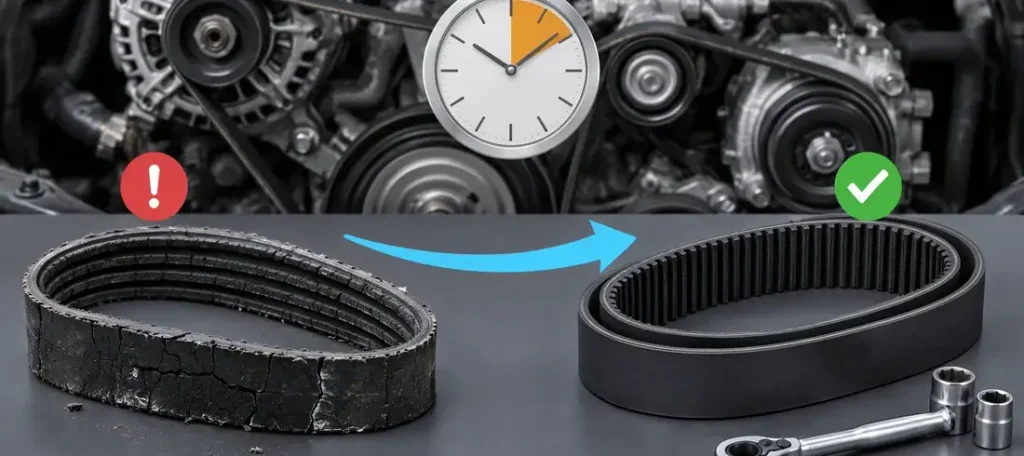
How often should you replace a serpentine belt? There is no single mileage interval that applies to every car.
As a general aftermarket guideline, serpentine belts may last roughly 60,000 to 100,000 miles, but the correct replacement interval depends on the vehicle manufacturer’s maintenance schedule, belt material, driving conditions, and actual belt condition. NAPA gives a 60,000–100,000-mile general range, while Gates recommends inspecting the accessory belt drive system at about 60,000 miles and replacing worn components by 90,000 miles or as advised by the vehicle manufacturer.
That does not mean your vehicle needs a new serpentine belt at exactly 60,000 or 90,000 miles.
The best rule is simple:
Check your owner’s manual first. If the belt shows damage, excessive wear, contamination, misalignment, or other failure signs, replace it sooner.
Contents
- 1 What Is the Serpentine Belt Replacement Interval?
- 2 Is There a Standard Serpentine Belt Replacement Interval?
- 3 How Long Does a Serpentine Belt Last?
- 4 When Should You Replace a Serpentine Belt?
- 5 Why You Can’t Rely on Cracks Alone
- 6 Should You Replace a Serpentine Belt at 60,000 Miles?
- 7 Should You Replace a Serpentine Belt at 90,000 Miles?
- 8 What Are the Signs a Serpentine Belt Needs Replacing?
- 9 1. Squealing or squeaking
- 10 2. Visible rib wear
- 11 3. Frayed edges
- 12 4. Missing chunks of rib material
- 13 5. Belt contamination
- 14 6. The belt keeps coming off
- 15 Does a Serpentine Belt Need to Be Replaced by Age?
- 16 Do EPDM Serpentine Belts Last Longer?
- 17 Should You Replace the Tensioner With the Serpentine Belt?
- 18 What Happens if a Serpentine Belt Breaks?
- 19 Can You Drive With a Cracked Serpentine Belt?
- 20 What Causes a Serpentine Belt to Wear Out Early?
- 21 How Often Should You Inspect a Serpentine Belt?
- 22 Serpentine Belt Replacement Interval by Mileage
- 23 Serpentine Belt vs Timing Belt: Don’t Confuse Them
- 24 How to Find Your Vehicle’s Correct Serpentine Belt Replacement Interval
- 25 Should You Replace the Serpentine Belt Before a Long Road Trip?
- 26 What Should You Replace With a Serpentine Belt?
- 27 FAQs About Serpentine Belt Replacement Interval
- 27.1 How often should a serpentine belt be replaced?
- 27.2 What is the 60,000-mile rule for serpentine belts?
- 27.3 Should I replace my serpentine belt at 90,000 miles?
- 27.4 How do I know when my serpentine belt needs replacing?
- 27.5 Can a serpentine belt last 100,000 miles?
- 27.6 Should I replace the tensioner when replacing the serpentine belt?
- 27.7 Can I drive with a cracked serpentine belt?
- 27.8 What happens if a serpentine belt breaks?
- 28 Bottom Line: Serpentine Belt Replacement Interval
- 29 Reliable Sources for Serpentine Belt Information
What Is the Serpentine Belt Replacement Interval?
For many vehicles, a serpentine belt can last 60,000 to 100,000 miles or more, but there is no universal replacement mileage.
Modern EPDM belts can wear without developing obvious cracks. Gates notes that EPDM belts can run 100,000 miles or beyond without visible cracking, making material loss and belt-profile wear more useful indicators than simply counting cracks.
A practical maintenance approach is:
- Check the manufacturer’s maintenance schedule.
- Inspect the belt regularly.
- Pay attention to mileage and vehicle age.
- Replace the belt when wear or damage is present.
- Inspect the tensioner and idler pulleys at the same time.
- Investigate oil or coolant contamination rather than installing a new belt and ignoring the leak.
If your belt is already damaged, don’t wait for the mileage interval.
Is There a Standard Serpentine Belt Replacement Interval?
No.
That’s one of the most important points to understand.
Serpentine belts are exposed to heat, friction, contaminants, pulley movement, and changing engine loads. Different vehicles use different belt materials, belt-drive layouts, tensioners, pulley designs, and accessory configurations.
Toyota, for example, explains that belt functions and configurations vary between vehicle models and engine designs and recommends checking the owner’s manual for the appropriate inspection interval.
Ford’s maintenance information also includes accessory drive belts in its scheduled multi-point inspection process rather than applying one universal replacement mileage to every vehicle.
So if someone tells you:
“Every car needs a serpentine belt every 60,000 miles.”
That’s too broad.
How Long Does a Serpentine Belt Last?
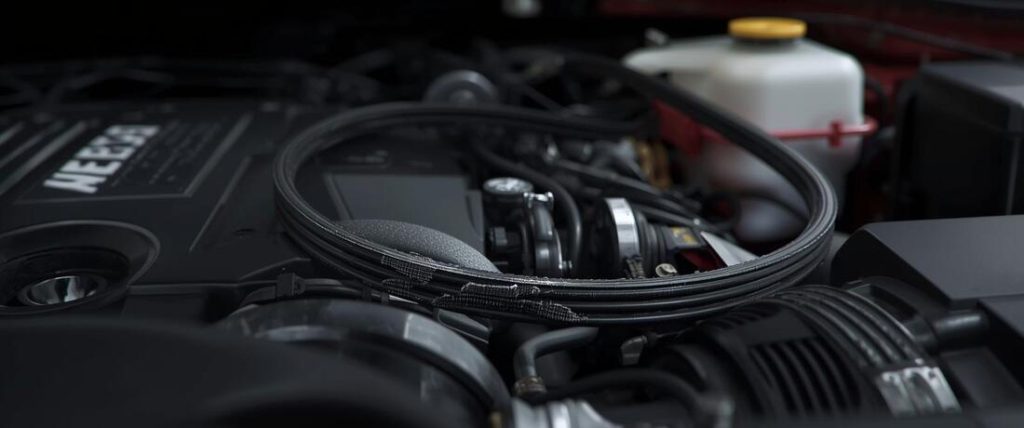
A typical serpentine belt may last 60,000 to 100,000 miles, but some belts can last longer when conditions are favorable.
NAPA gives 60,000–100,000 miles as a general replacement range and emphasizes checking the owner’s manual for vehicle-specific guidance.
Gates recommends replacing its Micro-V serpentine belts at 90,000 miles to help prevent breakdowns, or as advised by the vehicle manufacturer. Gates also recommends checking the accessory belt drive system at 60,000 miles.
Those figures are useful reference points, not a universal prescription.
Why can two belts last different amounts of time?
Because belt life depends on more than mileage.
Factors include:
- Engine temperature
- Belt material
- Oil or coolant contamination
- Pulley alignment
- Tensioner condition
- Idler pulley condition
- Accessory bearing condition
- Dust, dirt, salt, and road debris
- Stop-and-go driving
- Long periods of idling
- Extreme temperatures
- Heavy vehicle use
- Towing or high accessory loads
A belt that runs on a healthy, correctly aligned pulley system can have a very different service life from one exposed to contamination or a failing tensioner.
When Should You Replace a Serpentine Belt?
You should replace the belt when the manufacturer calls for replacement or when inspection shows that the belt is no longer in good condition.
Look for:
- Excessive rib wear
- Missing pieces of rib material
- Fraying
- Longitudinal cracking
- Severe glazing
- Edge damage
- Contamination with oil or coolant
- Belt misalignment
- Slipping
- Repeated belt noise
- A belt that repeatedly jumps off the pulley
Chrysler’s owner-manual guidance, for example, identifies rib chunking, excessive wear, longitudinal cracking, slipping, groove jumping, and objectionable noise as conditions that can require belt replacement.
The important distinction is that not every visible crack means the belt has reached the end of its life.
Modern EPDM belts are a good example.
Why You Can’t Rely on Cracks Alone
Older serpentine belts were often made from materials where cracking was a useful visual warning.
Modern EPDM belts behave differently.
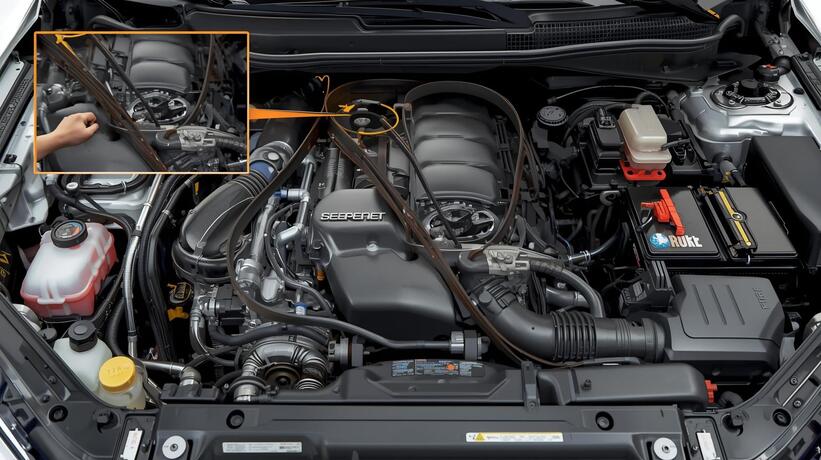
Gates explains that EPDM belts naturally resist cracking and can reach 100,000 miles or more without obvious visible cracks. Instead, wear can show up as material loss and changes in the belt’s rib profile.
That means this inspection method is outdated:
“I don’t see cracks, so the belt must be good.”
A better inspection asks:
- Are the ribs worn?
- Is belt material missing?
- Is the belt riding correctly in the pulley grooves?
- Is the belt contaminated?
- Is there edge wear?
- Is the tensioner operating correctly?
- Are the pulleys aligned?
- Is the belt slipping?
The belt is part of a system, not an isolated component.
Should You Replace a Serpentine Belt at 60,000 Miles?
Not automatically.
Sixty thousand miles is a useful inspection milestone, not a universal replacement command.
Gates recommends inspecting the accessory belt drive system at 60,000 miles and replacing worn components by 90,000 miles or according to the vehicle manufacturer’s recommendation.
Your vehicle may specify something different.
At 60,000 miles, the smart move is to determine:
- What does the owner’s manual say?
- What condition is the belt in?
- Are the tensioner and idler pulleys healthy?
- Is there any oil or coolant contamination?
- Is the belt tracking correctly?
- Has the belt already been replaced?
If everything checks out, mileage alone may not justify replacing the belt.
Should You Replace a Serpentine Belt at 90,000 Miles?
It may be a sensible preventive-maintenance point, but it still depends on the vehicle.
Gates recommends replacement at 90,000 miles for its Micro-V belts or according to the vehicle manufacturer’s recommendation.
That does not override your vehicle’s maintenance schedule.
If the manufacturer specifies a different interval, use the manufacturer specification.
And if the belt is visibly damaged at 50,000 miles, don’t wait until 90,000 miles.
Condition can override mileage.
What Are the Signs a Serpentine Belt Needs Replacing?
A worn or damaged belt can produce several warning signs.
1. Squealing or squeaking
A squealing belt can indicate slipping, insufficient tension, contamination, misalignment, or another problem in the accessory drive system.
Don’t automatically assume the belt itself is the only problem.
Gates notes that improper tension can cause belt slip, noise, increased bearing heat, and reduced accessory performance.
2. Visible rib wear
Look closely at the ribs.
Excessive material loss, damaged ribs, or an altered rib profile can indicate significant wear.
This is particularly important with modern EPDM belts because visible cracking may be minimal even when the belt has lost material.
3. Frayed edges
A belt with damaged or frayed edges needs attention.
Edge wear can point to:
- Pulley misalignment
- A damaged pulley
- Incorrect belt routing
- A worn tensioner
- A belt that is not correctly matched to the application
Replacing the belt without finding the cause can lead to another failure.
4. Missing chunks of rib material
If pieces of the rib material are missing, the belt should not be treated as normal.
Rib chunking can affect how the belt grips the pulleys and may lead to belt failure.
5. Belt contamination
Oil, coolant, or other contaminants can degrade belt performance.
If you find contamination, don’t simply install a new belt and stop there.
Find and repair the leak first.
Gates specifically identifies contamination and other system problems as factors that can contribute to belt failure.
6. The belt keeps coming off
A serpentine belt that repeatedly comes off is a diagnostic problem.
Possible causes include:
- Misaligned pulley
- Failed tensioner
- Damaged idler pulley
- Incorrect belt
- Damaged accessory pulley
- Incorrect routing
- Accessory bearing problems
Gates warns that replacing a component a second time for the same reason can indicate another problem in the system.
Does a Serpentine Belt Need to Be Replaced by Age?
Sometimes age matters even when mileage is low.
A vehicle that has accumulated only 40,000 miles over many years has not necessarily escaped belt aging.
Heat cycles, environmental exposure, contamination, and long-term material degradation can affect belt condition.
However, there is no single age limit that applies to every serpentine belt.
If your vehicle has low mileage but is older, inspect the belt and follow the manufacturer’s maintenance guidance rather than relying on a mileage number alone.
Do EPDM Serpentine Belts Last Longer?
EPDM belts can have excellent durability, but “longer-lasting” does not mean “maintenance-free.”
Gates explains that EPDM belts resist cracking and can operate beyond 100,000 miles without obvious visible cracks. The wear pattern is often better identified through material loss and changes in the rib profile.
That creates a common trap.
A belt can look clean and relatively intact while having significant wear.
So with an EPDM belt:
Inspect the belt profile, not just the surface cracks.
Should You Replace the Tensioner With the Serpentine Belt?
Not every vehicle requires automatic tensioner replacement whenever the belt is replaced.
But the tensioner and idler pulleys should be inspected.
The belt depends on the entire accessory drive system to maintain proper tension and alignment.
A worn tensioner can cause:
- Belt slip
- Noise
- Poor belt tracking
- Premature belt wear
- Repeated belt failure
Gates recommends looking at the complete accessory belt drive system and notes that belts, pulleys, and tensioners can wear together.
Replace the tensioner when inspection shows a problem
Examples include:
- Excessive movement
- Weak or inconsistent tension
- Damaged pulley bearing
- Rough pulley rotation
- Visible damage
- Belt misalignment caused by the tensioner
Replacing a perfectly healthy tensioner simply because the belt is being replaced is not a universal requirement.
What Happens if a Serpentine Belt Breaks?
The consequences depend on which accessories are driven by that belt.
A serpentine belt can drive some combination of:
- Alternator
- Air-conditioning compressor
- Power-steering pump
- Water pump
- Other accessory components
Not every vehicle uses the belt to drive all of these components. Toyota notes that accessory configurations vary by vehicle and engine design.
If the belt breaks, the alternator may stop charging the battery. If the belt drives the water pump on that vehicle, engine cooling can also be affected.
That’s why a broken serpentine belt can quickly turn a routine maintenance issue into a roadside breakdown.
Can You Drive With a Cracked Serpentine Belt?
You should not treat a visibly damaged serpentine belt as something to ignore until the next service.
A damaged belt can deteriorate further and fail without much warning.
The correct response depends on the severity and the vehicle, but if the belt is significantly damaged, arrange an inspection and replacement rather than continuing to drive normally.
If the belt is already making severe noise, visibly coming apart, or has missing sections, continued driving can create additional risk.
What Causes a Serpentine Belt to Wear Out Early?
A belt can fail earlier than expected even when its mileage is relatively low.
Common causes include:
Oil or coolant contamination
Fluid contamination can affect the belt material and should be corrected before installing a replacement belt.
Pulley misalignment
A misaligned pulley can create edge wear and abnormal belt tracking.
Bad tensioner
A weak or damaged tensioner can allow slip or poor belt tracking.
Worn idler pulley
A rough or damaged idler pulley can damage a new belt.
Seized accessory
An accessory bearing or pulley that begins to lock up can put excessive load on the belt.
Incorrect belt
The replacement belt must match the vehicle application.
Ford, for example, specifies Motorcraft belts for its applicable vehicles and emphasizes correct fit and belt length.
Incorrect installation
Even the correct belt can fail prematurely if it is routed incorrectly or installed without addressing an underlying system problem.
How Often Should You Inspect a Serpentine Belt?
Follow the inspection interval in your owner’s manual.
As a general aftermarket reference, Gates recommends checking the accessory belt drive system at about 60,000 miles, while Ford includes accessory drive belts in its scheduled multi-point inspection process.
A belt should also be inspected sooner if you notice:
- Squealing
- Squeaking
- Belt dust
- Visible damage
- Fraying
- Fluid contamination
- Belt misalignment
- Accessory-drive noise
- Charging problems
- Cooling problems
A new symptom is a reason to inspect the system even if the mileage interval has not arrived.
Serpentine Belt Replacement Interval by Mileage
| Mileage | What to Do |
|---|---|
| Under 60,000 miles | Follow the manufacturer’s inspection schedule; replace sooner if damaged |
| Around 60,000 miles | Inspect the complete accessory belt drive system |
| 60,000–90,000 miles | Pay close attention to belt wear, tensioner condition, pulley alignment, and contamination |
| Around 90,000 miles | Consider replacement if recommended by the manufacturer or belt manufacturer and condition warrants it |
| Over 100,000 miles | Don’t rely on mileage alone; inspect belt material, ribs, pulleys, and tensioner carefully |
Important: This table is a general maintenance framework, not a universal replacement schedule. Your vehicle’s manufacturer documentation takes priority.
Serpentine Belt vs Timing Belt: Don’t Confuse Them
A serpentine belt and a timing belt do different jobs.
The serpentine belt transfers engine power to accessory components.
The timing belt, where equipped, synchronizes engine components such as the camshaft and crankshaft.
They are not interchangeable maintenance items.
A timing belt can have a manufacturer-specified replacement interval that is very different from the service approach for a serpentine belt.
If you’re searching for a timing-belt replacement interval, don’t use the mileage guidance from this article.
How to Find Your Vehicle’s Correct Serpentine Belt Replacement Interval
The most reliable process is straightforward.
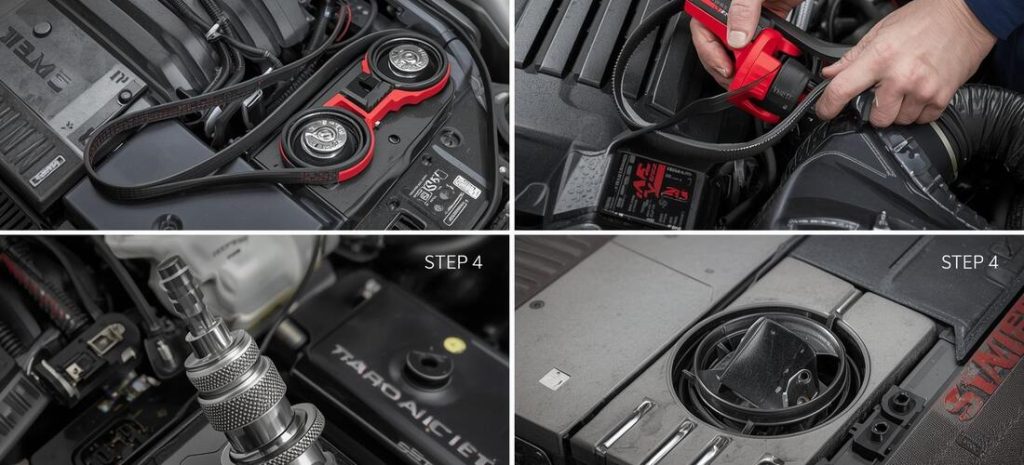
Step 1: Identify the exact vehicle
Use:
- Model year
- Make
- Model
- Engine
- Drivetrain when relevant
Step 2: Check the owner’s manual
Look under:
- Maintenance schedule
- Scheduled maintenance
- Drive belt
- Accessory belt
- Serpentine belt
- Inspection
Some manufacturers call it an accessory drive belt rather than a serpentine belt.
Step 3: Check the actual belt
Look for:
- Rib wear
- Cracks or splits
- Missing material
- Fraying
- Glazing
- Contamination
- Edge wear
Step 4: Inspect the system
Check the:
- Tensioner
- Idler pulleys
- Accessory pulleys
- Belt alignment
- Belt routing
Step 5: Replace the underlying problem
If the belt is contaminated, repair the leak.
If the belt is misaligned, identify why.
If the tensioner is damaged, repair the tensioner problem.
Don’t make the new belt responsible for an old system problem.
Should You Replace the Serpentine Belt Before a Long Road Trip?
If the belt is near the end of its manufacturer-recommended service interval, has unknown history, or shows signs of wear, inspecting it before a long trip is sensible.
A belt inspection is particularly worthwhile before:
- Long highway trips
- Extreme temperatures
- Heavy towing
- Extended idling
- Remote travel
Ford, for example, identifies extreme temperatures, dusty conditions, extended idling, short trips, and heavy loads or towing among conditions that can fall under severe driving conditions for maintenance purposes.
Don’t replace a perfectly good belt solely because you’re taking a trip, but don’t ignore an overdue or questionable belt either.
What Should You Replace With a Serpentine Belt?
The answer depends on what inspection finds.
A complete accessory-drive service may involve:
- Serpentine belt
- Belt tensioner
- Idler pulley
- Damaged accessory pulley
But replacing every component automatically is not always necessary.
Gates recommends looking at the accessory belt drive as a complete system because related components can contribute to premature belt failure.
The better approach is:
Inspect → identify the failed component → replace what is actually worn or damaged.
FAQs About Serpentine Belt Replacement Interval
How often should a serpentine belt be replaced?
Many serpentine belts last approximately 60,000–100,000 miles, but there is no universal replacement interval. Check the owner’s manual and inspect the belt for actual wear or damage.
What is the 60,000-mile rule for serpentine belts?
Sixty thousand miles is better treated as an inspection milestone than a universal replacement requirement. Gates recommends inspecting the accessory belt drive system at 60,000 miles, while the actual replacement interval should follow the vehicle manufacturer’s recommendation.
Should I replace my serpentine belt at 90,000 miles?
Not automatically. Gates recommends replacing its Micro-V belts at 90,000 miles or as advised by the vehicle manufacturer. Your vehicle’s maintenance schedule and belt condition should determine the decision.
How do I know when my serpentine belt needs replacing?
Look for excessive rib wear, missing material, fraying, longitudinal cracking, severe glazing, contamination, misalignment, slipping, or abnormal belt noise. Some modern EPDM belts may show little visible cracking even when worn.
Can a serpentine belt last 100,000 miles?
Yes, some can. Gates notes that EPDM belts can operate 100,000 miles or beyond without obvious visible cracks. However, mileage alone does not prove that a belt is still healthy.
Should I replace the tensioner when replacing the serpentine belt?
Not automatically. The tensioner and idler pulleys should be inspected, and they should be replaced if worn, damaged, noisy, or unable to maintain proper belt tension.
Can I drive with a cracked serpentine belt?
You should not ignore a significantly damaged belt. A damaged belt can fail and stop accessories driven by it. Have the belt and the complete accessory-drive system inspected promptly.
What happens if a serpentine belt breaks?
Depending on the vehicle, a broken serpentine belt can stop the alternator, air-conditioning compressor, power-steering pump, water pump, or other accessories from operating. Accessory layouts vary by vehicle.
Bottom Line: Serpentine Belt Replacement Interval
There is no magic number for every vehicle.
A reasonable general expectation is that many serpentine belts fall somewhere around the 60,000–100,000-mile range, but that range should be treated as a guideline, not a universal service rule. NAPA gives this general range, while Gates recommends inspecting the system around 60,000 miles and replacing worn components by 90,000 miles or according to the vehicle manufacturer.
The most reliable strategy is:
- Follow your vehicle manufacturer’s maintenance schedule.
- Inspect the belt rather than relying on mileage alone.
- Remember that EPDM belts may wear without obvious cracks.
- Inspect the tensioner and pulleys.
- Repair oil or coolant leaks that contaminate the belt.
- Replace a damaged belt immediately rather than waiting for an interval.
In other words, the correct serpentine belt replacement interval is the manufacturer’s schedule plus the actual condition of the belt-drive system.
Reliable Sources for Serpentine Belt Information
For a vehicle-specific answer, the owner’s manual and manufacturer maintenance information should take priority.