
This article was updated in November 9, 2026 with new products and information by Mark S. Taylor
If you drive through regular snow, packed snow, or long periods of freezing weather, dedicated winter tires are usually the better choice. If your winters are mild and snow is rare, a suitable all-season tire may be enough.
There is also a middle option: all-weather tires. Some are designed for year-round use and carry the Three-Peak Mountain Snowflake symbol for severe-snow traction.


Your drivetrain does not settle the decision. All-wheel drive can help a vehicle accelerate on slippery roads, but it does not give the tires extra grip when braking or turning.
Contents
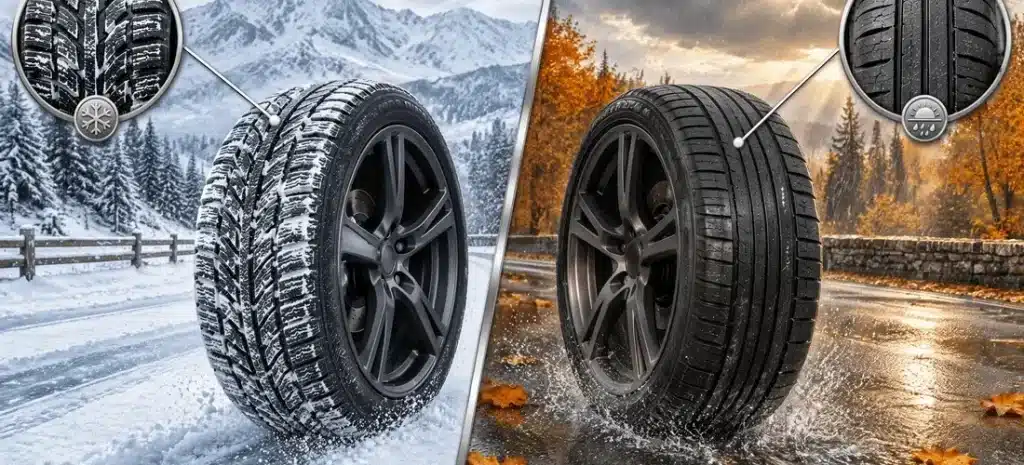
Winter Tires vs. All-Season Tires: What Is the Difference?
The biggest differences are the rubber compound, tread design, and conditions each tire is built to handle.
| Tire type | Best use | Main limitation |
| All-season | Everyday driving in mild climates, including occasional light snow | Usually not as capable as a dedicated winter tire in deep or packed snow |
| All-weather | Year-round use where drivers also face meaningful winter conditions | Performance varies by tire; check the sidewall and independent testing |
| Winter/snow | Frequent snow, packed snow, freezing temperatures, and winter roads | Can wear faster in warm weather and may feel less suitable in summer |
| Summer | Warm-weather driving and performance-focused use | Not designed for snow/ice or below-freezing conditions |
According to the National Highway Traffic Safety Administration (NHTSA), all-season tires can handle a variety of road conditions and have some mud-and-snow capability, while winter tires are more effective in deep snow. Summer tires are explicitly not designed for below-freezing temperatures, snow, or ice.
All-season tires
All-season tires are built for a broad range of conditions. They can be a sensible choice if your area has mild winters, roads are cleared quickly, and heavy snow is uncommon.
However, the name can create false confidence. “All-season” does not mean the tire performs like a dedicated winter tire in every season or on every surface.
Some all-season tires carry the 3PMSF symbol. If winter performance matters, check the sidewall instead of relying solely on the product name.
All-weather tires
All-weather tires are marketed as year-round options with stronger cold-weather capability than conventional all-season designs. Many carry the Three-Peak Mountain Snowflake symbol. Still, the label “all-weather” is not a substitute for checking the tire’s actual markings, specifications, and independent test results.
An all-weather tire may suit a driver who sees regular cold weather and occasional snow but does not want to switch tire sets twice a year. It is not automatically the best choice for frequent mountain driving or severe winter conditions.
Dedicated winter tires
Winter tires are designed specifically for cold-weather use. Their compounds and tread patterns are developed to maintain grip in sub-freezing temperatures and on packed snow.
While they provide a distinct advantage on winter surfaces, their performance still depends heavily on tread depth, tire condition, vehicle setup, speed, and road conditions. Winter tires do not make it safe to drive at normal dry-road speeds on ice. You still need to slow down and leave extra stopping distance.
What Do M+S and 3PMSF Mean?
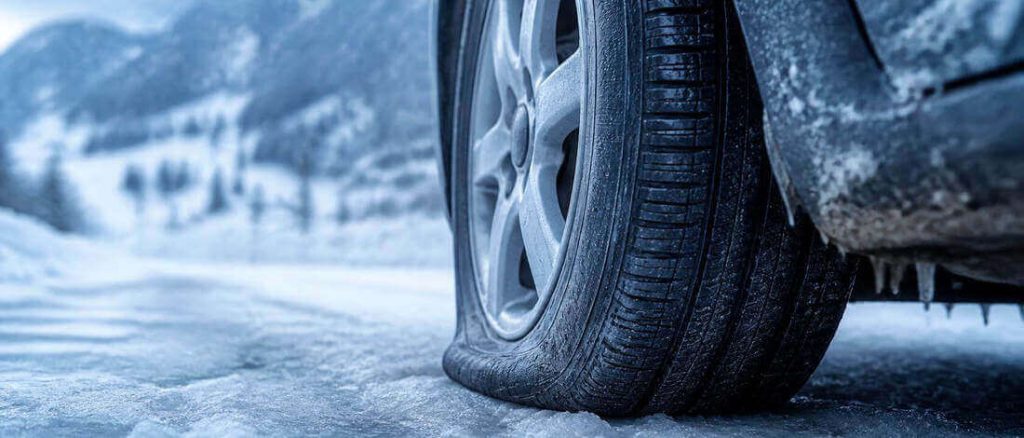
Look closely at the tire sidewall before you buy. Two markings are especially important: M+S and the Three-Peak Mountain Snowflake (3PMSF) symbol.
M+S means Mud and Snow
M+S may also appear as M&S, M/S, or M-S. The U.S. Tire Manufacturers Association (USTMA) outlines a tread-design definition for this marking, which includes specific tread slots and a minimum open area in a new tread.
While useful, this designation is not the same as a severe-snow traction test. An M+S marking alone does not prove that the tire passed a standardized snow-performance threshold.
3PMSF means the tire met a severe-snow traction threshold
The Three-Peak Mountain Snowflake symbol shows that the tire meets the USTMA severe-snow performance definition. This industry standard utilizes the ASTM F1805 snow traction test on a medium-packed snow surface, requiring the tire to reach a specified snow-grip index against a standard reference tire.
This provides stronger evidence of snow traction than an M+S marking alone. However, the symbol has limitations. It does not guarantee the tire will stop well on every type of ice, slush, wet pavement, or packed snow, nor is it an absolute promise against skidding.
Furthermore, do not confuse winter markings with a tire’s UTQG traction grade. NHTSA’s UTQG traction grades relate exclusively to wet-pavement stopping performance, not snow or ice behavior.
Do AWD and 4WD Vehicles Need Winter Tires?
Yes, they may.
AWD and 4WD systems distribute engine power to more wheels, which helps a vehicle get moving on a slippery surface. But acceleration is only one component of vehicle control.
When you brake or turn, your tires must generate friction against the road surface. AWD does not create extra friction. An AWD vehicle equipped with all-season tires can still slide, understeer, or take an dangerously long distance to stop on snow or ice. This is why tire choice remains critical regardless of your vehicle’s drivetrain.
Why you should use four matching winter tires
Never install winter tires on only the front or rear axle. A vehicle requires balanced grip at all four corners. If one axle possesses significantly more traction than the other, the vehicle can react unpredictably during braking or cornering.
A tire-manufacturer safety manual hosted in NHTSA’s technical-bulletin repository states that winter tires should be fitted to all wheel positions. It explicitly warns that if winter tires are fitted to the front axle, they must also be fitted to the rear. This applies to front-wheel-drive, 4×4, and AWD passenger vehicles and light trucks.
Additionally, AWD and some 4WD systems maintain strict mechanical tolerances regarding tire circumference and tread depth. Consult your owner’s manual before replacing individual tires. (For broader maintenance insights, consult our guide on tire maintenance tips.)

When Should You Switch to Winter Tires?
Many tire manufacturers use 45°F as a general rule of thumb for considering winter tires. Treat this as a planning guide rather than a strict legal cutoff or magic temperature. Local climate, road conditions, and the specific tire model ultimately dictate the right timing.
If your region stays cold for months, installing winter tires before the first major snowstorm prevents you from scrambling for an appointment when local service shops are fully booked. Conversely, winter tires wear more rapidly in warm weather because their compounds are optimized for sub-freezing temperatures. If your area experiences hot summers and mild winters, a separate winter set may not justify the storage and seasonal swap costs, making a high-quality all-season tire a more practical fit.
Which Tire Type Should You Choose?
Base your decision on your normal driving conditions rather than the worst-case weather scenario you might encounter once every few years.
| Your typical conditions | A reasonable starting point |
| Warm climate; snow is extremely rare | All-season tire that meets the vehicle’s requirements |
| Mild winter; occasional light snow; roads cleared quickly | Suitable all-season tire; consider 3PMSF if snow performance matters |
| Cold winter; recurring snow and slush | 3PMSF all-weather or dedicated winter tires, depending on severity |
| Frequent packed snow, mountain roads, or long freezing periods | Dedicated winter tires are usually the stronger choice |
| Severe ice exposure | Dedicated winter tire with strong ice performance in independent tests; still drive cautiously |
This table serves as a general starting point rather than a vehicle-specific tire approval. Your final selection must account for your vehicle type, exact tire size, load requirements, and speed rating.
Check Fitment Before Buying
Never select a replacement tire based on sidewall symbols alone. Before purchasing, verify:
- The approved tire size for your vehicle
- The required load index
- The required speed rating
- Wheel and brake clearance
- Whether your vehicle requires staggered (different front and rear) tire sizes
- Any special drivetrain requirements in your owner’s manual
- Local state regulations regarding studded tires
The driver’s door-jamb tire label and owner’s manual are your primary references. If you are comparing alternative dimensions, you can reference TheCarBuzz Tire Size Calculator, keeping in mind that it estimates physical dimensions rather than official vehicle fitment approvals. Always have a qualified tire professional confirm non-original sizes. Furthermore, if you install winter tires with a lower speed rating than your original equipment, never exceed the tire’s rated speed.
FAQs About
Are winter tires worth it if I have AWD?
Yes. While AWD helps a vehicle accelerate on slippery roads, braking and cornering depend entirely on tire grip. AWD does not create extra friction, meaning an AWD vehicle on all-season tires can still slide, understeer, or take significantly longer to stop on snow and ice.
What is the difference between M+S and the 3PMSF symbol?
M+S (Mud and Snow) indicates a tread-design definition set by the USTMA with specific slot ratios, but it does not require a severe-snow traction test. The Three-Peak Mountain Snowflake (3PMSF) symbol proves the tire passed a standardized ASTM F1805 snow-grip test.
Are all-weather tires the same as dedicated winter tires?
No. All-weather tires are engineered for year-round use with added cold-weather capability and often carry the 3PMSF symbol. Dedicated winter tires feature specialized rubber compounds and aggressive tread layouts optimized exclusively for freezing temperatures, packed snow, and severe winter driving.
Do I need to install four matching winter tires?
Yes. You must use a matching set of four winter tires unless the vehicle manufacturer explicitly specifies otherwise. Installing winter tires on only one axle creates a dangerous grip imbalance, leading to unpredictable handling and loss of control during braking or cornering.
When should I switch from all-season to winter tires?
A common industry guideline is to switch when daily temperatures drop consistently below about 45°F. Rather than waiting for the first major snowstorm, installing them proactively avoids emergency rush appointments and ensures your vehicle has proper rubber elasticity before freezing roads arrive.
Bottom Line
The best tire depends entirely on where and how you drive. A quality all-season tire handles mild winters effortlessly, while all-weather tires offer a balanced year-round compromise. If you face regular snow, packed snow, or extended freezing periods, dedicated winter tires remain the superior choice.
Do not let AWD dictate your decision—your tires handle the critical tasks of braking and cornering. Verify the 3PMSF symbol, install a matching set of four tires, and confirm sizing against your vehicle requirements.