
This article was updated in November 20, 2026 with new products and information by Mark S. Taylor
A turn signal blinking faster than normal often means the vehicle has detected a lamp failure or an electrical problem in the signal circuit. Check every front, rear, side, and mirror-mounted signal on the affected side. If all lamps appear to work, investigate bulb compatibility, sockets, wiring, trailer equipment, and vehicle-specific lighting controls.


Contents
- 1 What Does a Fast-Blinking Turn Signal Mean?
- 2 Common Reasons a Turn Signal Blinks Fast
- 2.1 1. A Turn-Signal Bulb or LED Lamp Has Failed
- 2.2 2. The Wrong Replacement Bulb Was Installed
- 2.3 3. An LED Conversion Is Not Compatible
- 2.4 4. The Bulb Socket Is Loose or Corroded
- 2.5 5. A Ground or Wiring Problem Affects the Signal Circuit
- 2.6 6. Trailer Wiring or an Upfitter Modification Changed the Circuit
- 2.7 7. A Flasher, Lighting Module, or Body Control Module Has a Fault
- 3 How to Check a Fast-Blinking Turn Signal Safely
- 4 What Should a Repair Shop Test?
- 5 Can You Drive With a Fast-Blinking Turn Signal?
- 6 FAQs About Turn Signal Blinking Fast?
- 6.1 Does a fast-blinking turn signal always mean a bulb is burned out?
- 6.2 Why does my turn signal blink fast after I install LED bulbs?
- 6.3 Why is my turn signal blinking fast even though all the bulbs work?
- 6.4 Can a bad body control module cause a fast turn signal?
- 6.5 Why does my turn-signal indicator blink normally when a bulb is out?
- 6.6 Should I add a load resistor to stop hyperflash?
- 7 The Bottom Line
What Does a Fast-Blinking Turn Signal Mean?
A fast-blinking turn signal is often called hyperflash. On many vehicles, it warns the driver that an exterior turn-signal lamp may have failed.
A burned-out bulb is a common cause. However, the problem can also involve a loose socket, poor ground, damaged wiring, an incompatible LED bulb, trailer wiring, or an integrated LED lamp assembly.
The exact warning strategy depends on the vehicle.
Some vehicles use a faster dashboard indicator when a lamp fails. Others may use a steady indicator or another warning method.
What does the federal lighting standard say?
Federal Motor Vehicle Safety Standard 108 addresses turn-signal lamp-failure indication.
Under section S9.3.6, when a turn-signal lamp failure reduces performance below the required level, the pilot indicator must show the failure through an allowed behavior. This includes a steady-on condition, steady-off condition, or a significant change in flashing rate.
The standard also includes exceptions for certain variable-load flasher systems, including some larger vehicles and vehicles equipped to tow trailers.
This does not mean every vehicle must use a fast flash when a lamp fails. Your owner’s manual is the best starting point for understanding your vehicle’s warning behavior.
Common Reasons a Turn Signal Blinks Fast
1. A Turn-Signal Bulb or LED Lamp Has Failed
A burned-out bulb is one of the first things to check.
If a front or rear turn signal on one side stops working, the vehicle may change the dashboard indicator’s flash rate to warn you.
Modern vehicles use different lighting designs. Your vehicle may have:
- A replaceable incandescent bulb
- A replaceable LED bulb
- An integrated LED module
- A sealed headlamp or tail-lamp assembly
A failed LED strip may require a different repair from a simple bulb replacement.
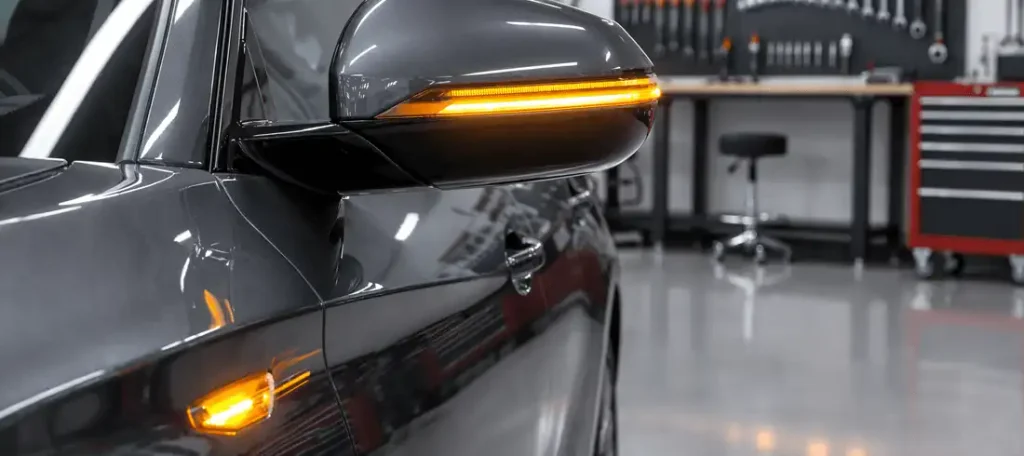
Check the front and rear signals on the affected side. Also inspect side-marker and mirror-mounted indicators if your vehicle has them.
Do not assume the problem is limited to the lamp that is easiest to see.
2. The Wrong Replacement Bulb Was Installed
A replacement bulb must match the vehicle’s specified type and electrical requirements.
A bulb that physically fits the socket may still be incorrect. Some lamps combine turn-signal and parking-light functions in one bulb, while others use separate bulbs or integrated LED assemblies.
Check the owner’s manual or manufacturer’s parts information before buying a replacement.
Pay attention to:
- The specified bulb type
- Single-function or dual-function operation
- Socket design
- Electrical compatibility
- The correct application for the vehicle’s year, trim, and lighting package
Do not assume a bulb number from another trim or model year will work in your vehicle.
If the fast blinking started immediately after a bulb replacement, verify the replacement part before investigating more complicated electrical faults.
3. An LED Conversion Is Not Compatible
A fast blink that starts after an LED conversion may involve the vehicle’s lighting-monitoring system.
Some vehicles designed around incandescent bulbs monitor electrical load. An LED replacement may draw less current, and the vehicle may interpret the difference as a failed lamp.
Other vehicles use LED-compatible controls or different monitoring strategies.
The correct solution depends on the vehicle’s wiring, lamp design, and control system.
Do not install a generic load resistor or splice wiring based on a universal online instruction. Resistor selection, installation location, and heat management depend on the actual circuit.
Use an approved replacement or ask a qualified technician to verify LED compatibility.
4. The Bulb Socket Is Loose or Corroded
A working bulb may still fail to make reliable electrical contact.
Moisture, corrosion, a loose terminal, or heat damage can interrupt the signal circuit. This may cause a fast flash, intermittent operation, or a dim lamp.
Possible clues include:
- The signal works sometimes but not every time.
- The lamp looks dim or flickers.
- The fast blink changes after driving over a bump.
- The socket or connector shows moisture or corrosion.
- The connector has discolored or melted plastic.
If the socket is damaged, do not keep bending the contacts or forcing the bulb into place.
A melted connector or damaged pigtail may need proper replacement. Simply installing another bulb may not solve the problem.
5. A Ground or Wiring Problem Affects the Signal Circuit
A damaged wire, poor ground, corroded connector, or loose terminal can interrupt current to a lamp.
The result may be a fast flash, dim lamp, intermittent signal, or multiple lighting problems.
Wiring and ground checks deserve attention if:
- The turn signal changes when the vehicle hits a bump.
- Other lamps on the same corner behave strangely.
- The signal works intermittently.
- A connector shows moisture or damage.
- The problem started after bodywork or electrical repairs.
Do not assume the alternator is bad because one turn signal flashes fast. A charging-system fault needs support from other symptoms and test results.
A technician can use the correct wiring diagram and voltage-drop testing to locate a circuit problem.
6. Trailer Wiring or an Upfitter Modification Changed the Circuit
Added trailer wiring, a lighting converter, auxiliary lamps, or commercial upfitter equipment can affect the vehicle’s lighting system.
The added equipment may change the electrical load or require a vehicle-specific configuration.
Ford SSM 53201 documents fast turn-signal flashing on certain 2023–2024 F-Super Duty trucks after exterior-lighting changes during upfitting.
Ford directs technicians to the applicable Body Builder Layout Book and diagnostic software to configure the exterior lighting.
This example applies to the listed trucks and conditions. It does not mean every vehicle with a fast signal needs software programming.
If the problem started after a trailer harness, tow package, work-body, or auxiliary-light installation, tell the repair shop exactly what was added.
7. A Flasher, Lighting Module, or Body Control Module Has a Fault
Older vehicles may use a separate flasher unit to control turn-signal operation.
Many newer vehicles control the lights through a body control module or another lighting controller.
A flasher or module can fail, but it should not be the first part replaced.
Check the lamps, bulb type, sockets, grounds, wiring, and recent modifications first. A technician should then follow the vehicle-specific diagnostic procedure.
Modern LED assemblies can also cause a fast-flash condition without a conventional replaceable bulb.
For example, GM bulletin PIT6374C covers specified 2025–2026 Cadillac Escalade and Escalade ESV vehicles with front turn-signal faults. The reported conditions may include fast flashing or a signal that flashes once and stops.
The bulletin identifies a possible failure within the daytime-running-light LED strip. It also notes that related diagnostic trouble codes may not be present.
This is a model-specific example. It does not establish that every Cadillac or every vehicle with a fast turn signal has the same problem.
A basic code scan alone may not find every lighting fault. The exact OEM diagnostic procedure matters.

How to Check a Fast-Blinking Turn Signal Safely
You can make a useful first inspection without probing live wiring.
Step 1: Park in a Safe Place
Park on level ground, apply the parking brake, and keep the vehicle out of traffic.
If possible, ask another person to operate the turn signals while you inspect the exterior lamps.
Step 2: Turn on the Hazard Lights
Walk around the vehicle and check each exterior signal.
Look at the front, rear, side-marker, and mirror-mounted lamps where fitted.
Check for lamps that are:
- Completely dark
- Dimmer than the opposite side
- Flickering
- Intermittent
- Showing visible moisture or damage
Step 3: Test Left and Right Separately
Turn on the left signal, then the right signal.
Note which side flashes fast and whether any exterior lamp on that side is dark, dim, or intermittent.
If both sides behave differently, record that too.
Step 4: Check the Owner’s Manual
Confirm the correct bulb type and the vehicle’s warning-indicator behavior.
Do not buy a replacement based only on a bulb that looks similar.
Step 5: Think About Recent Changes
Consider whether the problem started after:
- A bulb replacement
- An LED conversion
- Trailer wiring installation
- A tow-package repair
- An auxiliary-light installation
- Collision or bodywork repairs
Recent changes can help narrow the diagnostic path.
Step 6: Look for Visible Damage
With the lamps switched off and cool, look for moisture, corrosion, melted plastic, or a loose lamp housing.
Do not probe live connectors unless you have the correct wiring diagram, equipment, and training.
If your vehicle uses a sealed LED headlamp or tail-lamp assembly, do not open it unless the manufacturer provides an approved service procedure.
What Should a Repair Shop Test?
If all exterior lamps appear to work but the dashboard indicator still flashes fast, ask for a vehicle-specific lighting diagnosis.
Depending on the system, a technician may need to:
- Confirm the correct lamp and bulb specification.
- Inspect the bulb socket and connector terminals.
- Check ground connections and wiring condition.
- Measure voltage drop under the correct operating conditions.
- Inspect trailer connectors and added lighting harnesses.
- Scan the body or lighting module, not just the engine computer.
- Check live lamp commands and fault data.
- Verify configuration after an upfitter or lighting modification.
- Follow any applicable manufacturer service bulletin for the exact model year and VIN.
A fast blink is a symptom. It does not prove that the flasher relay or body control module has failed.
A proper repair recommendation should identify the failed component and explain which test confirmed the fault.
Can You Drive With a Fast-Blinking Turn Signal?
Do not ignore a fast-blinking turn signal.
If an exterior signal lamp is out, other drivers may not see your intended turn or lane change. This creates a safety risk, especially in traffic or at night.
If a required signal lamp is not working, repair it before normal driving. If you cannot signal safely, avoid driving in traffic and arrange repair or recovery.
Also check the brake lamps if your vehicle uses a shared bulb or lamp assembly.
Even when every lamp appears to work, have a persistent fast-flash condition checked. The vehicle may be warning about an intermittent or internal lamp fault.
FAQs About Turn Signal Blinking Fast?
Does a fast-blinking turn signal always mean a bulb is burned out?
No. A burned-out bulb is a common cause, but a socket, ground, wiring fault, incompatible LED, trailer modification, lighting module, or integrated LED lamp can also be involved.
Why does my turn signal blink fast after I install LED bulbs?
The LED may not be compatible with the vehicle’s lamp-monitoring system. Some vehicles detect changes in electrical load and use that change as a lamp-failure warning. Check the exact vehicle and bulb requirements before adding a resistor or changing wiring.
Why is my turn signal blinking fast even though all the bulbs work?
A lamp may be intermittent, dim, or failing internally. The vehicle may also use an integrated LED assembly or detect a circuit or configuration issue. Check every signal lamp and use the manufacturer’s diagnostic procedure before replacing a module.
Can a bad body control module cause a fast turn signal?
It can on some vehicles, but fast flashing alone does not prove a BCM fault. Confirm the bulbs, lamp assemblies, sockets, grounds, wiring, and configuration first. A module should be replaced only after the required tests support that diagnosis.
Why does my turn-signal indicator blink normally when a bulb is out?
Some vehicles use variable-load flashers or trailer-tow configurations that do not show the same fast-flash warning. The 2007 Chevrolet Uplander owner’s manual specifically warns that its trailer-wiring option can allow a normal indicator rate even when a turn-signal bulb is burned out. Check the exterior lamps directly.
Should I add a load resistor to stop hyperflash?
Not without confirming the correct solution for your vehicle. A resistor is not a universal repair. The correct bulb, LED-compatible component, configuration, or wiring repair depends on the vehicle’s design. Have the circuit checked before modifying it.
The Bottom Line
A fast-blinking turn signal often points to a lamp or circuit problem, but the cause is not always a burned-out bulb.
Check every exterior signal first. Then consider the correct bulb, socket condition, LED compatibility, trailer wiring, and vehicle-specific lighting controls.
Do not replace a relay or body control module based on the flash rate alone. Confirm the failed part with the right test and the manufacturer’s service information.