
This article was updated in November 23, 2026 with new products and information by Mark S. Taylor
When windshield wipers will not turn off, the cause is usually an active AUTO rain-sensor setting, a stuck wiper relay, a faulty motor park switch, or a bad multifunction stalk. Pull over safely if continuous wiping distracts you, note whether they stop with the ignition off, and test the circuit before buying parts.


You flip the wiper stalk to OFF, yet the blades keep sweeping across the glass. Sometimes they run nonstop at a single speed, or they stall halfway up the windshield instead of tucking down at the bottom.
Running wipers across dry glass drags fine road grit under the rubber, which can leave permanent wiper-blade scratches on your windshield, shred the blades, and overheat the wiper motor. Pull over in a safe spot if the constant motion distracts you, and never reach into the moving linkage or try to force the arms down by hand.
Contents
First, Rule Out Normal Behavior and AUTO Mode
Before assuming an electrical failure, make sure the system is actually ignoring you. Many modern vehicles run one to three extra sweeps after you spray windshield washer fluid, and some pause for a few seconds before making a final “drip wipe.”
Check whether your stalk or rotary dial is still clicked into AUTO. Vehicles with automatic rain-sensing wipers use an optical sensor bonded to the inside of the windshield with a clear gel pad.
If your wipers suddenly started wiping dry glass right after a windshield replacement, the glass shop may have reused an old gel pad or trapped an air bubble behind the sensor. That optical distortion tricks the module into reading dry glass as heavy rain.
Behavior-to-Circuit Diagnostic Triage Table
Watch how the wipers react when you switch the ignition off and cycle the stalk. That pattern narrows down which part of the circuit is holding power.
| What the Wipers Are Doing | Most Likely Circuit Area | Safe Next Step |
| Keep running even with the ignition OFF and key removed | Stuck wiper relay, constant battery-power short, or wet BCM/fuse box | Check for water near the fuse box; have a shop isolate the live feed so the battery does not drain |
| Run nonstop with ignition ON, stop immediately when ignition is turned OFF | Failed motor park switch, bad wiper stalk, or switched-power short | Confirm the stalk is out of AUTO/INT, then schedule a park-circuit and switch test |
| Sweep normally, then stop halfway up the glass when switched OFF | Internal wiper motor park switch or broken park-circuit ground | Do not force the arms down by hand; test the park circuit before replacing the motor |
| Wipe dry glass randomly only in AUTO mode (especially after windshield work) | Misaligned optical rain sensor or air bubble in the sensor gel pad | Switch the stalk fully to OFF; have the rain-sensor mount and gel pad inspected |
4 Common Causes When Windshield Wipers Won’t Turn Off
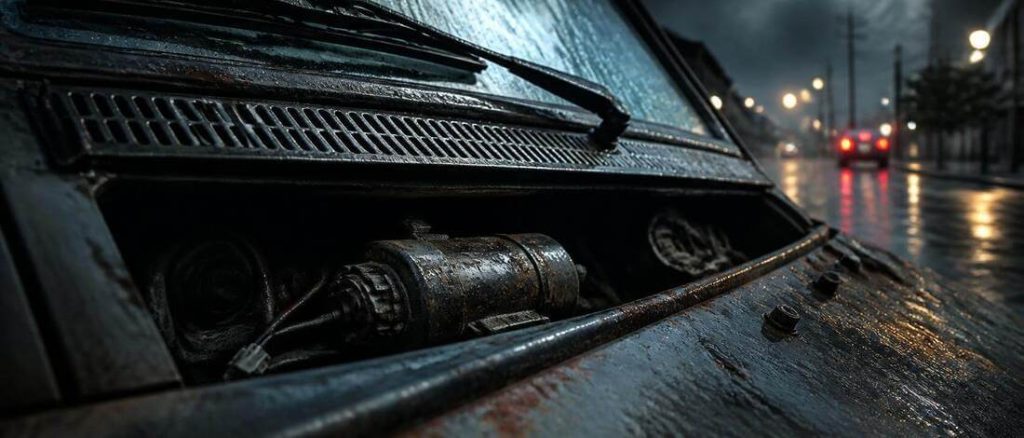
These four fault areas cover most stuck-on wiper complaints. Because wiper wiring varies widely across makes and model years, a technician should test the circuit before ordering parts.
1. Faulty Wiper Stalk or Multifunction Switch
Your wiper stalk tells a relay or control module which speed you want. Internal contacts inside the stalk wear down over years of use, or dust and spilled drinks can bridge the contacts so the module keeps reading an ON command.
Watch for supporting clues like intermittent speeds acting erratically, washer spray triggering on its own, or wiggling the stalk changing the wipe speed. Even with those clues, test the switch output on a scan tool or wiring diagram before replacing the steering-column assembly.
2. Stuck Wiper Relay Contacts
Many vehicles use a replaceable electromagnetic relay to carry heavy current to the wiper motor. When high current arcs across aging relay points, the internal contacts can weld shut and feed power to the motor continuously.
Not every modern vehicle has a standalone wiper relay, as some route power directly through an integrated power distribution module or body control module. On vehicles that do use a removable relay, testing an automotive relay with a multimeter confirms whether the load contacts are stuck closed.
3. Failed Wiper Motor Park Switch
When you turn your wipers off mid-sweep, the blades do not freeze in front of your face. A dedicated park circuit keeps feeding power to the motor just long enough for the arms to reach the bottom of the glass, then opens a small internal switch to stop them.
As illustrated in a factory wiper park-switch circuit description for a 1999 Land Rover Discovery II, that park circuit relies on clean internal contacts and proper grounding. When the park switch sticks closed or loses its ground path, the motor either loops nonstop or halts in the middle of the windshield.
Because park switches are often built inside the wiper motor housing, a confirmed park-circuit failure frequently requires replacing the motor assembly. Always test the park wire at the motor connector first so you do not buy a motor for a broken wire.
4. Wiring Shorts, Water Intrusion, or Control Module Faults
Chafed wiring harnesses, corroded firewall connectors, or water leaking into a cabin fuse box can feed stray voltage into the wiper circuit. On newer vehicles, a Body Control Module (BCM) or Steering Column Control Module (SCCM) interprets the stalk signal and commands the motor over a data network.
Factory service records show why testing must come before parts swapping. For example, Chrysler TSB 08-31-98A documented self-activating and stuck-on wipers on specific 1996–1997 minivans, while a June 2025 manufacturer communication (NHTSA ID 11020098) directs technicians to rule out low battery voltage and communication faults before condemning an SCCM. If your wiper issue appeared alongside glitching interior lights, door locks, or battery trouble, look into other electrical problems that need circuit testing.
What You Can Safely Check Yourself
You can collect helpful diagnostic notes in five minutes without pulling trim or touching live wires.
- Confirm the stalk is clicked fully to OFF and any AUTO rain-sensing ring is disabled.
- Turn the ignition completely off, remove the key or press the stop button, and open the driver’s door to see whether the wipers shut down.
- Check the cabin floor near the fuse panel for dampness if the issue started right after heavy rain or a car wash.
- Write down any recent work, such as a windshield replacement, battery jump-start, or steering-column repair.
- Enter your VIN in the NHTSA recall lookup tool to see whether an open safety recall covers your wiper motor or control module.
Do not pull fuses randomly while the car is running, because a single fuse can share power with brake lights, shift interlocks, or safety modules. If the wipers keep running with the ignition completely off and threaten to kill your battery while you wait for help, check your owner’s manual fuse diagram to see if the wiper motor has a dedicated fuse before touching anything—and if the fuse is shared or the blades are still sweeping, call roadside assistance instead.
How a Technician Diagnoses Stuck-On Wipers
A qualified shop isolates the fault in order instead of guessing at expensive components.
First, the technician checks live scan data on the BCM or SCCM to see whether the computer actually receives an OFF signal when the stalk moves. If the module sees OFF while the blades keep running, the fault lies downstream in the relay, wiring, or motor park circuit.
Next, the shop checks battery voltage, grounds, and connector pins at the wiper motor using the vehicle’s exact wiring diagram. Once testing proves whether power is coming from a shorted wire, a welded relay, or an internal park switch, only the confirmed failed part gets replaced.
FAQs About Windshield Wipers Won’t Turn Off
Is it normal for windshield wipers to make one extra sweep after I turn them off?
Yes, one final sweep is normal so the park circuit can return the blades to the bottom of the glass, and some vehicles add a delayed drip wipe after using the washer. Continuous wiping after the stalk is set to OFF points to an active AUTO setting or an electrical fault.
Can a bad wiper relay make the wipers stay on?
Yes. On vehicles equipped with a standalone wiper relay, internal contacts can weld shut and keep sending power to the wiper motor even after you turn the stalk off. Newer cars with integrated electronic control modules may not have a separate removable relay.
Can a bad wiper motor make the wipers keep running?
A failed internal park switch inside the wiper motor assembly can keep the wipers looping nonstop or stop them mid-glass. However, a bad stalk, stuck relay, or wiring short produces the same symptom, so the park circuit must be tested before replacing the motor.
Can I drive with windshield wipers that won’t turn off?
Pull over safely if continuous wiping distracts you or smears dry dirt across your line of sight. Running wipers on dry glass can also scratch the windshield, shred the blades, and overheat the motor, so arrange service as soon as possible.
Should I pull the wiper fuse to stop them?
Do not pull fuses blindly, especially while the vehicle is running or the blades are moving, because some fuses protect multiple vehicle systems. Check your owner’s manual first to confirm whether the wiper motor has a dedicated fuse, and call roadside assistance if you are unsure.
Rule out AUTO mode and normal post-wash wipes first, note whether the blades stop when you shut off the ignition, and avoid driving with dry blades grinding across your glass. Sharing those simple observations with a shop leads straight to the faulty switch, relay, or park circuit instead of an unnecessary motor replacement. For more circuit-testing walkthroughs, browse our automotive electrical troubleshooting guides.