
This article was updated in November 25, 2026 with new products and information by Mark S. Taylor
When a power window won’t roll up, the cause is usually an engaged window lock, a faulty switch, a broken door-jamb wire, a worn motor, or a failed regulator cable. Check whether other windows still work and listen for motor noise before paying for parts, and never force or hand-lift the glass.
You pull up on the window switch, and nothing happens. Maybe you hear a faint click inside the door, a grinding rattle, or the glass climbs halfway before dropping crooked into the frame.
A power window relies on switches, fuses, wiring, an electric motor, a mechanical regulator, and rubber glass guides working together. Before you order a replacement motor or tear off the door panel, secure the car and use a few safe checks to narrow down what actually failed.
Contents
First, Protect the Car If the Window Is Stuck Open
If rain is moving in or you cannot park inside a locked garage, protect the cabin before doing anything else.
- Park in a covered, well-lit spot and remove all valuables from the interior.
- Stop pressing the switch immediately if you hear grinding, popping, or see the glass tilting at an angle.
- If the glass feels loose or ready to drop into the door, leave it untouched and arrange shop service.
- For emergency rain protection while parked, tape a sheet of heavy plastic over the opening using blue painter’s tape rather than duct tape or packing tape, which can strip paint clearcoat and leave hardened glue on rubber trim. Never drive with an opaque barrier blocking your side mirror or blind spot.
Power Window Behavior-to-Cause Triage Table
Compare what the other windows do, test both switches, and listen briefly when you press the button. That combination points a technician straight to the right circuit or mechanical assembly.
| What the Window Is Doing | Most Likely Fault Area | Safe First Check |
| Only one window is dead, total silence from both switches | Local switch, broken wire in the rubber door-jamb boot, or failed motor | Confirm the driver’s window lockout button is OFF and test both switches |
| Works from passenger switch, dead from driver’s master switch (or vice versa) | Faulty switch contact or broken signal wire between door switches | Note which switch works so the shop tests switch continuity first |
| Motor hums or whirrs, but the glass stays put or drops crooked | Snapped regulator cable, stripped plastic gear, or detached glass clip | Stop pressing the switch immediately so the cable does not tangle further |
| All four windows quit at the exact same time | Blown shared fuse, faulty power-window relay, weak 12V supply, or master switch power feed | Check whether other accessories (locks, mirrors, dome lights) still work |
| Window rolls up, then bounces back down halfway | Dry or binding rubber run channel triggering anti-pinch reversal, or lost initialization | Inspect the visible window track for obstructions; check the owner’s manual before resetting |
Safe Checks You Can Do Without Taking the Door Apart
You can gather useful diagnostic clues in five minutes without tools or trim removal.
1. Check the Window Lockout Button and Both Switches
Start with the simplest oversight: make sure the driver’s window-lock button is not clicked down. Many lockout switches cut power to every passenger window at once, and some even block the driver’s master panel from moving the rear glass.
Next, test the stuck window from both the driver’s master switch and that door’s individual switch. If the glass moves from one switch and ignores the other, you have a strong lead pointing to a worn switch contact or broken control wire rather than a dead motor.
2. Compare One Window Against All Four Windows
If only one window refuses to move while the other three work at full speed, the fault is almost always localized to that door’s switch, regulator, motor, or wiring harness. On vehicles over five years old, wires flexing inside the rubber accordion boot between the door and the body frequently fatigue and snap cleanly inside the insulation.
If every window stops working at the exact same time, look toward a shared power supply—such as a blown main window fuse, a failed power-window relay, or signs of a weak 12-volt battery or charging drop. On vehicles equipped with a removable window relay, testing an automotive relay with a multimeter confirms whether power is actually leaving the fuse box.
3. Wait Before Repeating Switch Presses (Thermal Protection)
Avoid hammering the window switch up and down repeatedly when a window refuses to budge. As noted in Mazda3 power-window service documentation (for specified 2009–2011 models), repeated operation can trigger internal motor thermal protection, temporarily shutting the motor off until it cools down.
If a window stopped mid-cycle after several rapid presses, let the motor rest for several minutes before trying once more.
4. Check Your Owner’s Manual Before Attempting a Reset
After a dead battery, battery swap, or window service, some vehicles lose their one-touch up/down memory or anti-pinch calibration. That reset sequence is never universal across automakers.
For example, Ford’s owner’s manual anti-trap and reset guidance warns that anti-trap pinch protection may be temporarily altered or disabled during specific reset and override steps. Follow only the exact sequence printed in your vehicle’s manual, and never try to reset a window that is crooked, grinding, or physically jammed.
Why You Should Never Slam the Door or Hand-Lift the Glass
Old internet advice often tells drivers to slam the door while holding the switch or grab the glass with both hands while a helper presses the button. Both tricks create real safety risks.
- Pinch and shattering hazards: Regulator cables and springs sit under heavy tension; a sudden jerk can snap tempered glass or pinch fingers violently between the pane and the door frame.
- Side-airbag wiring inside the door: Modern doors house side-impact pressure sensors and airbag harnesses behind the interior trim panel. Prying panels blindly or jumping wires without a factory diagram risks damaging safety circuits.
- Worsening a simple repair: Forcing a jammed cable regulator can bend the steel door tracks or tear the glass mounting clips, turning a straightforward cable or switch fix into a full assembly replacement.
How a Technician Diagnoses a Stuck Power Window
A repair shop tests power and mechanical travel in order instead of guessing between a motor and a regulator. As illustrated in Honda’s symptom-based power-window diagnostic chart (for a 2010 Pilot), technicians separate electrical complaints from mechanical binding before quoting parts.
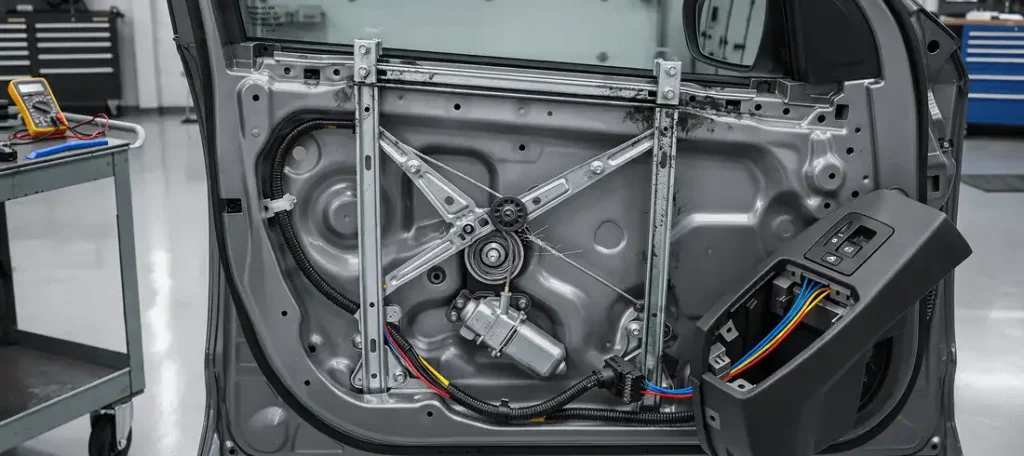
In practice, a shop will check scan-tool switch inputs on the body control module, verify battery voltage and ground at the motor connector, inspect the rubber door-jamb wiring boot for broken strands, and inspect the regulator tracks and rubber run channels once the trim is safely removed.
FAQs About Power Window Won’t Roll Up?
Why does my window motor make noise while the window refuses to move?
When you hear the motor whirring or grinding without glass movement, the electric motor is receiving power while the mechanical regulator has failed. A snapped lift cable, stripped plastic gear, or broken glass mounting clip is usually responsible. Stop pressing the switch so the cable does not bind further.
Why did only one power window stop working?
A single dead window usually points to a fault inside that specific door: a worn switch, a broken wire flexing inside the rubber door-jamb boot, a failed motor, or a jammed regulator. Checking whether the passenger switch works when the driver’s switch does not helps narrow the fault.
Can disconnecting the car battery stop a power window from working?
A battery disconnect rarely stops a window from moving completely, though it often erases one-touch auto-up memory and anti-pinch calibration. Check your owner’s manual for your model’s exact initialization steps rather than using a generic sequence from another brand.
Can I pull a stuck car window up by hand?
No. Never grip and pull the glass upward while someone operates the switch, and never pry the pane with a screwdriver. Regulator assemblies can snap suddenly under tension, risking severe hand injuries or shattered glass.
Is it safe to drive with a power window stuck down?
Driving short distances in dry weather is possible only if the glass is resting securely inside the door and does not rattle or block your view. If the pane is crooked, loose, or heavy rain and cold make driving unsafe, park the vehicle securely and arrange shop service.
Check the window lockout button, compare the driver and passenger switches, and note whether you hear silence, humming, or grinding before booking a repair. Skipping door-slam hacks and testing the circuit first protects your hands, your paint, and your wallet from unnecessary motor replacements. For more circuit-testing guides, explore our automotive electrical troubleshooting guides.