
This article was updated in May 5, 2026 with new products and information by Mark S. Taylor
You turn the key in the ignition, ready to start your day. Instead of the engine roaring to life, you hear a slow, struggling grunt. Silence follows. That sinking feeling is universal. A dead battery is one of the most frustrating car problems, but it rarely happens without warning. Your car usually gives you clues. I have seen hundreds of drivers stuck in parking lots because they ignored these small signs. Understanding bad car battery symptoms can save you time, money, and a massive headache. In this guide, I will walk you through the warning signs, how to test your battery at home, and exactly what to do about it. Let’s get you back on the road.

Contents
- 1 Top 6 Bad Car Battery Symptoms (Warning Signs)
- 2 Is It the Battery or the Alternator? (Critical Distinction)
- 3 Common Causes of Battery Failure
- 4 How to Diagnose a Bad Battery: Step-by-Step Guide
- 5 How to Fix or Replace a Bad Battery
- 6 Cost of Battery Replacement and Difficulty
- 7 Safety Risks and Precautions
- 8 Common Mistakes Drivers Make
- 9 Pro Tips to Extend Battery Life
- 10 FAQs About Bad Car Battery Symptoms
- 10.1 1. What are the first signs of a car battery going bad?
- 10.2 2. Can a car battery just die without warning?
- 10.3 3. How long should a car battery last?
- 10.4 4. Can a bad battery affect my car’s performance while driving?
- 10.5 5. Does AutoZone or Advance Auto Parts test batteries for free?
- 10.6 Quick Summary
Quick Answer
The most common bad car battery symptoms include a slow engine crank, clicking sounds when you turn the key, and dim headlights. You might also see a battery warning light on the dashboard or smell sulfur (rotten eggs). If your battery is over three years old, these signs mean it needs testing or replacement soon.
Top 6 Bad Car Battery Symptoms (Warning Signs)
You need to know what a failing battery looks and sounds like. Catching these signs early gives you time to fix the car battery problems before you get stuck.
1. Slow Engine Crank
This is the classic symptom. When you turn the key, the engine sounds tired. It makes a “rrr-rrr-rrr” sound that slowly turns over.
- What it means: Your battery lacks the power to spin the engine fast enough to start.
- Why it happens: The battery cannot deliver the high current (Cold Cranking Amps) needed for the starter motor.
- Real-world example: You notice the crank takes longer on cold mornings. It gets worse every day. Do not wait for the day it doesn’t start at all.
2. Illuminated Battery Warning Light
Most dashboards have a battery icon. It looks like a red rectangle with a positive (+) and negative (-) sign.
- What it means: The computer detected a voltage problem.
- The catch: This light often points to the alternator. However, a dying battery can also trigger it because the voltage is dropping too low.
- Action: If this light flickers or stays on, check your battery voltage immediately.
3. Dim Headlights and Electrical Issues
Your battery powers all the electronics when the engine is off. When it is weak, everything struggles.
- Look for:
- Headlights that look dim or yellow instead of bright white.
- Power windows that move slowly.
- A radio that flickers or resets itself.
- Weak windshield wipers.
- Why: The battery cannot hold a stable charge. Accessories starve for power.
4. Corroded or Loose Battery Connectors
Pop your hood and look at the battery terminals.
- Visual signs: You might see white, blue, or green ashy buildup on the metal posts.
- The problem: This is corrosion. It acts like a wall. It blocks electricity from flowing from the battery to the engine.
- The fix: Sometimes cleaning this fixes the issue. Other times, the corrosion is a symptom of an old, leaking battery.
5. Swollen or Bloated Battery Case
Look at the plastic sides of the battery.
- The sign: The case looks puffy, swollen, or distorted. It looks like it ate a big meal.
- The cause: This usually happens from extreme heat or overcharging.
- The verdict: A swollen battery is dangerous. It is dead and must be replaced right away. Do not try to charge it.
6. The “Rotten Egg” Smell
Do you smell sulfur? It smells like rotten eggs or a sewer.
- The cause: The battery is leaking gas.
- The danger: This is hydrogen sulfide. It is flammable and toxic.
- Action: If you smell this, do not smoke near the car. Have the battery inspected by a professional immediately.
Is It the Battery or the Alternator? (Critical Distinction)
Many drivers confuse a dead battery with a bad alternator. They work together, but they do different jobs.
The Battery’s Role
The battery is like a water tank. It stores energy. It provides a big burst of power to start the engine. Once the car runs, the battery takes a back seat.
The Alternator’s Role
The alternator is like a water pump. It generates electricity while the engine runs. It recharges the battery and powers the car’s electronics.
How to Tell the Difference
Use this simple rule of thumb:
- Scenario A: You jump-start the car. It runs fine. But when you turn it off and try to restart it, it is dead again.
- Verdict: It is likely the Battery. It holds no charge.
- Scenario B: You jump-start the car. The car runs for a few minutes, then the engine dies while you are driving.
- Verdict: It is likely the Alternator. The battery ran the car until it was empty because the alternator wasn’t charging it.
For a deeper look at charging system issues, check out our guide on alternator problems.
Common Causes of Battery Failure
Knowing why batteries fail helps you prevent it.
1. Age and Natural Degradation
Batteries do not last forever. Most last 3 to 5 years.
- Inside, chemical reactions break down the lead plates.
- If your battery is over 4 years old, it is living on borrowed time.
2. Extreme Weather Conditions
Temperature is the enemy.
- Heat: High heat evaporates battery fluid. It causes internal components to corrode faster. This is actually worse than cold.
- Cold: Cold weather slows down chemical reactions. It makes the battery work harder to crank the thick engine oil.
3. Parasitic Drain
Your car should use very little power when it is off.
- A “parasitic drain” happens when something stays on.
- Common culprits: A trunk light that won’t turn off, a bad aftermarket alarm, or a phone charger left in the socket.
4. Human Error
We all make mistakes.
- Leaving the headlights on overnight.
- Leaving the interior lights on.
- Leaving the key in the “accessory” position.
5. Short Trips
The battery needs time to recharge.
- If you only drive 5 minutes to the store, the alternator never fully recharges the battery from the starting process.
- Over time, the battery drains until it is empty.

How to Diagnose a Bad Battery: Step-by-Step Guide
You do not need to be a mechanic to test a battery. You can do this at home with simple tools.
Tools You Need
- Safety gear: Gloves and goggles.
- Digital Multimeter (Voltmeter): You can buy one for $20 at an auto store.
Step 1: Visual Inspection
Look before you test.
- Check for cracks or leaks.
- Look for the “swollen” case mentioned earlier.
- Check the terminals. Are they covered in white gunk?
- Note: If the case is cracked or leaking, stop here. You need a new battery.
Step 2: The “Headlight Test” (No Tools)
This test takes 2 minutes.
- Turn off the engine.
- Turn on the headlights.
- Have a friend watch the headlights while you try to start the car.
- Analyze:
- Lights go out completely: The battery is dead or has a bad connection.
- Lights dim but stay on: The battery is weak, but the starter might be drawing too much power.
- Lights don’t change: The battery and starter are likely fine. Look at fuel or ignition issues.
Step 3: The Multimeter Voltage Test
This is the most accurate home test.
- Turn the car off. Open the hood.
- Set your multimeter to “DC Volts” (20V range).
- Touch the Red probe to the Positive (+) terminal.
- Touch the Black probe to the Negative (-) terminal.
- Read the number:
- 12.6V to 12.8V: Battery is fully charged (Good).
- 12.4V: Battery is about 75% charged (Fair).
- 12.2V or lower: Battery is 50% or less (Needs attention).
- Under 11.9V: Battery is dead.
How to Fix or Replace a Bad Battery
Once you know the battery is bad, you have three paths.
The Temporary Fix: Jump-Starting
Jump-starting gets you running now. It does not fix the battery.
- Park a running car close to yours. Do not let them touch.
- Connect Red (+) to the dead battery’s positive post.
- Connect the other Red (+) to the good battery’s positive post.
- Connect Black (-) to the good battery’s negative post.
- Connect the other Black (-) to a bare metal bolt on your car’s engine (ground). Do not connect to the dead battery’s negative post if it is leaking.
- Start the good car, wait 2 minutes, then start yours.
- Safety: If the car dies again right after you remove the cables, do not keep jumping it. You likely have an alternator issue.
The Maintenance Fix: Cleaning Corrosion
Sometimes the battery is fine, but the connection is bad.
- Disconnect the cables (Negative first).
- Mix a tablespoon of baking soda with a cup of water.
- Pour it over the terminals. It will fizz.
- Scrub with a wire brush.
- Rinse with water and dry.
- Reconnect and apply a little grease or Vaseline to stop new corrosion.
The Permanent Fix: Battery Replacement
If the battery is old or fails the voltage test, replace it.
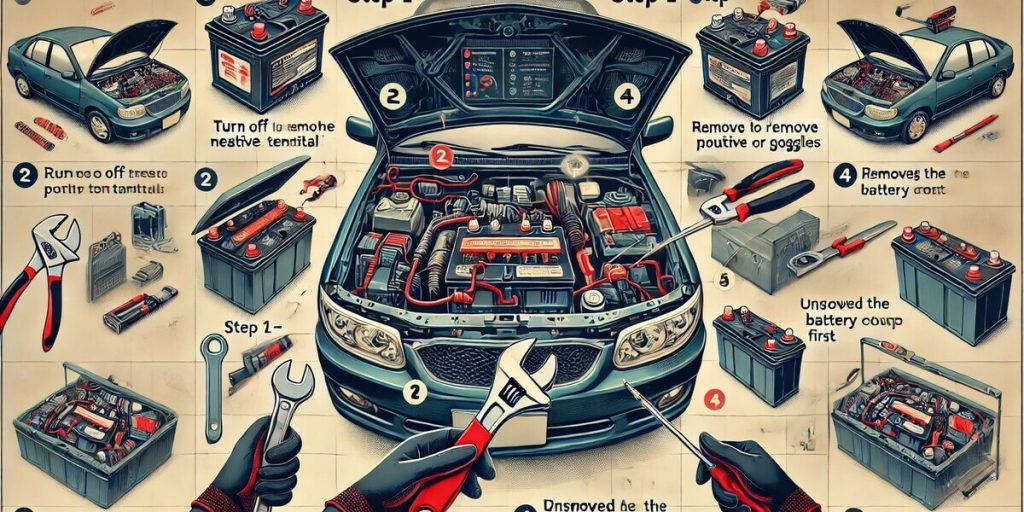
Step-by-Step Replacement Guide:
- Safety: Put on gloves and glasses. Make sure the car is off.
- Remove Cables: Loosen the nut on the Negative (-) cable first. Wiggly it off. Then do the Positive (+).
- Remove Hold-Down: There is a metal clamp holding the battery down. Unscrew it.
- Swap: Lift the old battery out (it is heavy). Place the new battery in the tray.
- Secure: Tighten the hold-down clamp.
- Connect Cables: Connect Positive (+) first. Then connect Negative (-).
- Test: Start the car.
According to the Battery Council International, recycling your old battery is crucial because 99% of a lead-acid battery is recyclable.
Cost of Battery Replacement and Difficulty
Replacing a battery is a standard cost of car ownership. Here is what you should expect to pay.
Battery Cost Breakdown (2026 Estimates)
| Battery Type | Price Range |
|---|---|
| Standard Lead-Acid | $100 – $200 |
| AGM / Start-Stop | $200 – $400 |
| Premium / EV | $400+ |
Labor Costs
- DIY: Free (just your time).
- Auto Shop: Usually $20 – $50 for labor.
- Dealership: $50 – $150 for labor.
- Pro Tip: Many auto parts stores offer free installation if you buy the battery from them.
Difficulty Level
- Rating: 2 out of 5 (Moderate).
- Note: On most cars, this is an easy DIY job. However, some European cars (like BMW or Mercedes) put the battery in the trunk or under the seat. They often need a computer to tell the car a new battery was installed. For these, go to a professional.
Safety Risks and Precautions
Batteries are safe if you respect them. They are dangerous if you are careless.
Handling Explosive Gases
Batteries release hydrogen gas.
- Risk: One spark can cause an explosion.
- Rule: Never smoke near a battery. Keep open flames away.
Sulfuric Acid Burns
The fluid inside is highly corrosive.
- Risk: It can burn skin and blind you instantly.
- Rule: Always wear safety goggles and acid-resistant gloves.
Short Circuits
- Risk: Dropping a metal wrench across the positive and negative terminals creates a massive arc. It can weld the wrench to the battery, explode the battery, or melt metal.
- Rule: Remove the negative cable first. When tightening, be careful not to touch the body of the car with the wrench.
Common Mistakes Drivers Make
Even experienced people make these errors. Avoid them to save money and frustration.
⭐ Mistake 1: Ignoring the Alternator You replace the battery, but it dies a week later.
- Why: The alternator was bad. It killed the old battery, and it killed the new one too.
- Fix: Always test the alternator when you replace a battery.
⭐ Mistake 2: Buying the Wrong Battery Type Buying a battery just because it is cheap.
- Why: Your car needs specific Cold Cranking Amps (CCA) and a specific Group Size.
- Fix: Check your owner’s manual or use the auto store guide to find the exact match.
⭐ Mistake 3: Poor Terminal Connection The battery is new, but the car won’t start.
- Why: You didn’t tighten the terminals enough, or you left corrosion on the cable ends.
- Fix: You should not be able to wiggle the cable clamp on the post.
⭐ Mistake 4: Installing a “Dead” Battery You buy a battery off the shelf and install it.
- Why: It sat on the shelf for a year and lost its charge.
- Fix: Ask the store to load-test the new battery before you leave the parking lot.
⭐ Mistake 5: Cleaning Terminals While Connected You try to scrub the posts with the cables attached.
- Why: You risk shorting out the car’s computer.
- Fix: Always disconnect the ground (negative) cable first before touching anything.

Pro Tips to Extend Battery Life
You can make your battery last longer with these habits.
⭐ Tip 1: The Trickle Charger Strategy If you park a car for the winter or a long trip, use a battery maintainer.
- Why: Batteries drain slowly just sitting there. A maintainer keeps it full without overcharging.
⭐ Tip 2: Minimize Short Trips Try to combine your errands.
- Why: A 20-minute drive recharges the battery better than five separate 4-minute drives.
⭐ Tip 3: Insulation and Temperature Control If you live in extreme heat or cold, consider a battery blanket or insulation sleeve.
- Why: It buffers the battery against the outside temperature, reducing stress.
⭐ Tip 4: Routine Cleaning Clean your terminals twice a year.
- Why: Preventing corrosion ensures a solid electrical connection for years.
FAQs About Bad Car Battery Symptoms
1. What are the first signs of a car battery going bad?
The first signs are usually a slow engine crank when starting and dimming headlights, especially when the engine is idling. You might also notice the clock resetting in your car.
2. Can a car battery just die without warning?
Yes, but it is rare. Most batteries show signs like slow starts for weeks. However, a sudden internal short circuit or a dead cell can cause instant failure.
3. How long should a car battery last?
Most car batteries last between 3 and 5 years. After 3 years, you should have it tested annually to monitor its health.
4. Can a bad battery affect my car’s performance while driving?
Yes. A weak battery forces the alternator to work harder to keep up with the electrical demand. This can reduce fuel economy and put strain on the alternator.
5. Does AutoZone or Advance Auto Parts test batteries for free?
Yes, almost all major auto parts stores (AutoZone, Advance, O’Reilly) will test your battery and alternator for free, usually right in the parking lot.
Quick Summary
- Watch for slow cranking and dim lights; these are the first warnings.
- Check the age of your battery; anything over 4 years is suspect.
- Test voltage with a multimeter (12.6V is good, 12.2V is weak).
- Clean corrosion with baking soda and water to fix connection issues.
- Replace immediately if the case is swollen or smells like rotten eggs.
- Disconnect Negative (-) first whenever you work on a battery for safety.
Don’t wait until you are stranded. Check your battery this weekend. It is a small task that can save your entire day. If you are unsure, visit your local auto parts store for a free test. Drive safe!