
This article was updated in October 22, 2026 with new products and information by Mark S. Taylor
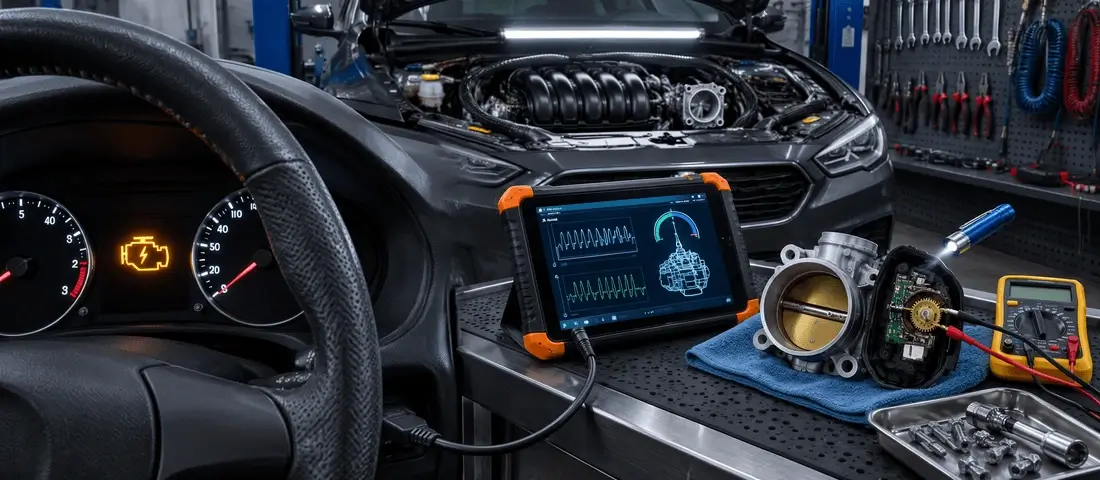
Your EPC light came on, and the car may feel weak, jerky, or slow to respond. Don’t replace the throttle body yet—read the fault codes first.
This guide walks you through the diagnosis in order, from checking symptoms and scan data to testing the throttle, accelerator pedal, brake switch, wiring, power supply, and related systems.
Contents
- 1 What Does the EPC Light Mean?
- 2 EPC Light Diagnosis: Step by Step
- 3 Scan the Engine Control Module
- 4 Check Battery Voltage and Power Supply
- 5 Check the Brake Lights and Brake Switch
- 6 Inspect the Accelerator Pedal
- 7 Inspect the Throttle Body
- 8 Check Throttle Position Data
- 9 Check for Air and Engine-Management Problems
- 10 Check for Misfires
- 11 Check the Wiring and Connectors
- 12 Check for Related ABS or Communication Faults
- 13 Check the Exact Fault Code
- 14 Common EPC Fault Areas
- 15 Why You Shouldn’t Clear the EPC Light First
- 16 What If the EPC Light Goes Away?
- 17 What If the EPC Light Comes On After a Battery Replacement?
- 18 Does the EPC Light Mean the Throttle Body Is Bad?
- 19 Can You Drive With the EPC Light On?
- 20 EPC Light With Reduced Power
- 21 EPC Light vs Check Engine Light
- 22 The Biggest EPC Diagnosis Mistake
- 23 Bottom Line
What Does the EPC Light Mean?
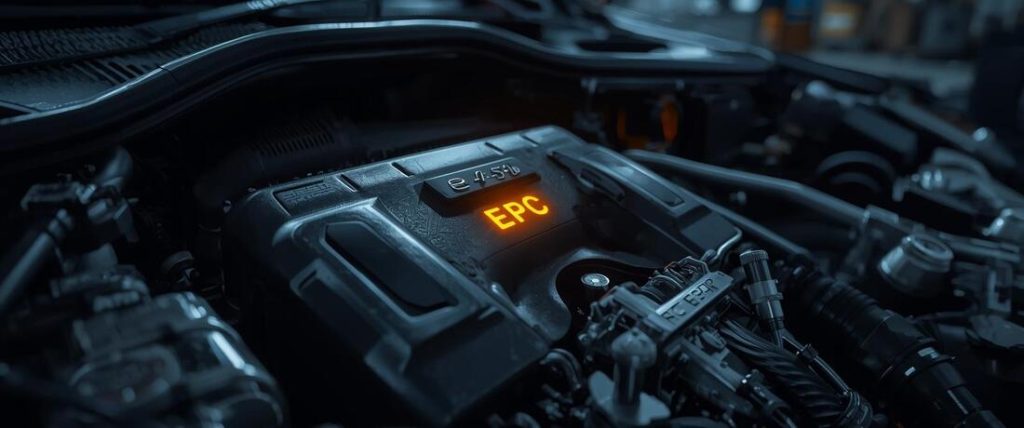
EPC stands for Electronic Power Control.
Volkswagen Group vehicles use the EPC warning lamp to flag faults involving electronic engine power control. The engine control unit monitors the system and stores diagnostic trouble codes when it detects a fault.
The EPC light doesn’t tell you which part failed.
That’s the first thing to understand.
A fault with the electronic throttle, accelerator pedal position sensors, brake-switch input, wiring, power supply, or another system that affects engine torque control can trigger the warning.
The exact fault depends on the vehicle, engine, model year, and stored diagnostic code.
EPC Light Diagnosis: Step by Step
Step 1: Check How the Car Behaves
Before touching a scan tool, pay attention to what the car is doing.
That’s useful diagnostic information.
Ask yourself:
- Did the EPC light appear during startup?
- Did it come on while driving?
- Did the engine lose power?
- Does the accelerator still respond normally?
- Is the engine running rough?
- Is the engine stalling?
- Did the transmission start shifting differently?
- Is the check engine light also on?
- Are the ABS or traction-control lights on?
- Did cruise control stop working?
- Did the problem start after rain, a repair, or a battery replacement?
Write down what happened.
A technician can learn a lot from the sequence of events.
Step 2: Decide Whether You Should Keep Driving
Don’t treat every EPC light the same way.
If the car has severe power loss, stalling, heavy misfiring, smoke, overheating, burning smells, or another serious warning, pull over somewhere safe and arrange further help.
If the car still runs normally, you may have enough control to move it somewhere safe for diagnosis.
Volkswagen manuals generally instruct drivers to have an EPC fault checked promptly. One Volkswagen manual specifically describes the EPC lamp as an engine-control fault and calls for immediate inspection.
The important point is simple:
The light itself doesn’t tell you the urgency. The symptoms do.
Scan the Engine Control Module
This is where real diagnosis starts.
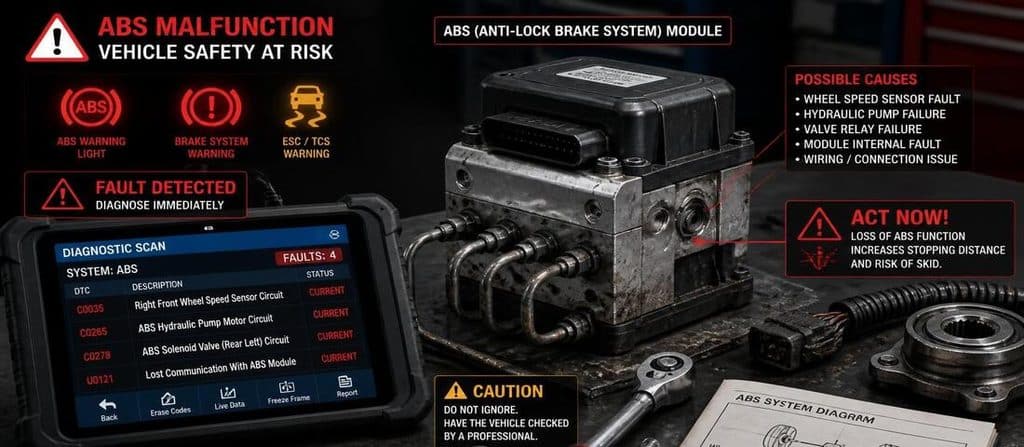
Connect a compatible scan tool and read the stored diagnostic trouble codes.
Don’t clear them yet.
Save the codes first.
The code gives you a direction. It doesn’t automatically condemn the related part.
For example, a code involving throttle-position correlation doesn’t mean you should immediately buy a throttle body.
You still need to test the circuit and compare the sensor signals with what the vehicle expects.
Record these items
- Stored codes
- Pending codes
- Freeze-frame data
- Engine RPM
- Engine temperature
- Vehicle speed
- Accelerator position
- Throttle position
- Battery voltage
- Other warning lights
Vehicle-specific diagnostic equipment can access more information than a basic generic OBD-II scanner. Ross-Tech notes that generic OBD-II tools are mainly aimed at emissions-related diagnostics, while VW/Audi-specific tools can communicate with additional vehicle control modules.
Check Battery Voltage and Power Supply
Don’t skip this.
Electronic throttle systems depend on stable electrical power.
A weak battery, poor ground, charging problem, or voltage interruption can create strange electronic faults.
Check:
- Battery condition
- Battery terminals
- Engine grounds
- Main power connections
- Charging-system output
- Relevant fuses
If several unrelated modules suddenly report communication or voltage faults, suspect the power supply before replacing individual components.
That’s a big clue.
Check the Brake Lights and Brake Switch
This one gets overlooked.
The engine control system uses brake-pedal information as part of its torque-control logic on many vehicles.
A faulty brake-light switch or inconsistent brake-pedal signal can therefore create an EPC fault on some VW/Audi applications.
Check whether:
- Brake lights stay on
- Brake lights don’t work
- Brake lights flicker
- Cruise control stopped working
- EPC appeared at the same time
Don’t assume every EPC light comes from the throttle.
The exact relationship depends on the vehicle and fault code.
Older VW/Audi service information specifically documents brake-light-switch faults among the diagnostic faults that can appear in these systems.
Inspect the Accelerator Pedal
Modern electronic accelerator pedals don’t use a traditional throttle cable on many vehicles.
The pedal assembly uses position sensors to tell the engine control unit how much power the driver is requesting.
If the sensor signals don’t agree or become unreliable, the system can set a fault.
Look for:
- Intermittent throttle response
- Hesitation
- No response from the accelerator
- Sudden reduced power
- A fault code pointing toward accelerator-pedal position
- Damaged wiring near the pedal
Don’t replace the pedal simply because an accelerator-related code appears.
Check the wiring and sensor data first.
Inspect the Throttle Body
The throttle body deserves close attention.
On gasoline engines with electronic throttle control, an electric motor moves the throttle plate while position sensors report its actual position to the engine control unit.
A problem can occur with:
- Throttle-plate movement
- Throttle-position sensors
- Throttle motor
- Wiring
- Connector pins
- Carbon buildup
- Power supply
A dirty throttle body isn’t automatically the cause of every EPC light.
That’s where parts swapping gets expensive.
Use the fault code and live data to decide whether the throttle body actually fits the evidence.
VW/Audi technical documentation describes EPC as part of the electronic throttle/power-control system and explains that the control unit monitors the relevant components and stores faults when it detects a problem.
Check Throttle Position Data
If your scan tool supports live data, watch the accelerator and throttle signals.
You want the readings to behave consistently as you slowly press and release the accelerator.
Look for:
- Dropouts
- Sudden jumps
- Signals that disagree
- A throttle position that doesn’t respond correctly
- Sensor values that don’t make sense for the operating condition
Don’t focus on one universal percentage.
Different vehicles report and interpret these values differently.
Use the manufacturer’s specifications for the specific vehicle.
Check for Air and Engine-Management Problems
The EPC system doesn’t operate in isolation.
The engine computer uses information from several sensors to control engine torque.
Depending on the vehicle, check relevant inputs such as:
- Mass airflow sensor
- Manifold pressure sensor
- Engine speed sensor
- Engine temperature sensor
- Throttle position
- Accelerator position
- Intake air information
- Ignition system
- Fuel system
A sensor fault may create an EPC warning even though the throttle body itself works correctly.
That’s why the stored code matters so much.
Check for Misfires
If the engine shakes, stumbles, or runs badly with the EPC light on, check for misfire codes.
Possible causes include:
- Failed ignition coil
- Worn spark plug
- Fuel-delivery problem
- Injector problem
- Vacuum or intake leak
- Engine mechanical problem
A severe misfire deserves prompt attention.
Don’t keep driving hard just because the car still moves.
Some Volkswagen documentation separately warns that a flashing engine warning associated with misfire can damage the catalytic converter.

Check the Wiring and Connectors
This is the boring part.
It’s also where plenty of real faults hide.
Inspect connectors and wiring around:
- Throttle body
- Accelerator pedal
- Engine control module
- Brake switch
- Relevant sensors
- Grounds
- Battery
- Charging system
Look for:
- Broken wires
- Chafing
- Corrosion
- Bent pins
- Loose terminals
- Water intrusion
- Poor previous repairs
A sensor can be perfectly good while its wiring is bad.
Replacing the sensor won’t fix that.
Check for Related ABS or Communication Faults
If the EPC light appears with ABS, traction-control, or stability-control warnings, scan those systems too.
Don’t only scan the engine computer.
Modern vehicles share information between control modules.
A communication fault or sensor problem in another system can affect engine torque management.
VW/Audi diagnostic systems can communicate with multiple control modules, while basic generic OBD-II scanning has more limited coverage.
This is especially important when several warning lights appear together.
Check the Exact Fault Code
Now interpret the code.
This is where the vehicle’s year, engine, transmission, and software version matter.
Don’t search a code online and blindly replace the part named in the search result.
Use the code as the beginning of the diagnostic path.
A good diagnostic question is:
What conditions caused the computer to set this code?
Then test those conditions.
That’s how you avoid the parts cannon.
Common EPC Fault Areas
| Area | Possible problem | What to check |
|---|---|---|
| Throttle body | Motor, sensor, contamination | Position data, wiring, operation |
| Accelerator pedal | Position sensor fault | Sensor signals and wiring |
| Brake switch | Incorrect pedal signal | Brake lights and switch data |
| Wiring | Open, short, corrosion | Harness and connectors |
| Battery/charging | Low or unstable voltage | Battery and charging system |
| Ignition | Misfire | Coils, plugs, misfire data |
| Air measurement | Sensor fault | MAF/MAP data and intake system |
| ABS/ESC | Sensor or communication issue | Scan related modules |
| ECU/software | Control or communication issue | Vehicle-specific diagnostic procedure |
This table is a starting point—not a universal fault chart.
Why You Shouldn’t Clear the EPC Light First
Clearing the code feels satisfying.
It doesn’t fix anything.
Worse, it can erase useful information.
The fault code and freeze-frame data can show what the vehicle was doing when the problem occurred.
Save the data first.
Then diagnose.
If you clear everything and the fault doesn’t immediately return, you may have just made the problem harder to trace.
What If the EPC Light Goes Away?
Still investigate it if the fault returns.
An intermittent EPC light can be caused by an intermittent electrical connection, sensor signal, voltage problem, or operating condition.
A warning that disappears doesn’t prove the problem fixed itself.
The fault may simply have stopped occurring for the moment.
What If the EPC Light Comes On After a Battery Replacement?
Don’t panic.
Low voltage during battery replacement or a power interruption can create temporary faults on some vehicles.
But don’t assume every EPC warning after a battery replacement is harmless.
Scan the car.
Look at the stored codes.
If you see multiple low-voltage or communication faults, investigate the power supply. If you see a specific throttle, pedal, or engine-management fault, follow that fault’s diagnostic path.
Some VW/Audi systems may also require specific adaptation or basic-setting procedures after certain repairs. Ross-Tech notes that some functions such as throttle-body alignment are vehicle-specific diagnostic procedures, and newer vehicles may have additional diagnostic security restrictions.
Does the EPC Light Mean the Throttle Body Is Bad?
No.
That’s one of the most common mistakes.
The EPC warning covers electronic power-control faults.
The throttle body is only one possible source.
A brake switch, accelerator pedal sensor, wiring fault, voltage problem, misfire, communication problem, or another engine-management issue may trigger the warning depending on the vehicle.
Read the code.
Test the circuit.
Then replace the part.
Can You Drive With the EPC Light On?
It depends on what the car is doing.
If the car has normal throttle response and no serious symptoms, you may be able to drive carefully to a safe location or repair facility.
If it has severe power loss, unpredictable throttle response, stalling, heavy misfire, overheating, smoke, burning smells, or another serious warning, don’t keep driving normally.
Pull over safely.
Volkswagen’s published guidance treats an EPC warning as an engine-control fault requiring prompt inspection.
EPC Light With Reduced Power
Reduced power is common enough to deserve its own check.
The engine computer may limit engine output when it detects a fault that affects electronic power control.
Older VW/Audi technical documentation describes an emergency running program being activated when certain electronic accelerator faults occur.
That’s why the car may suddenly feel like it won’t rev normally.
Don’t try to fix that by pressing harder on the accelerator.
Find the fault.
EPC Light vs Check Engine Light
They’re not the same warning.
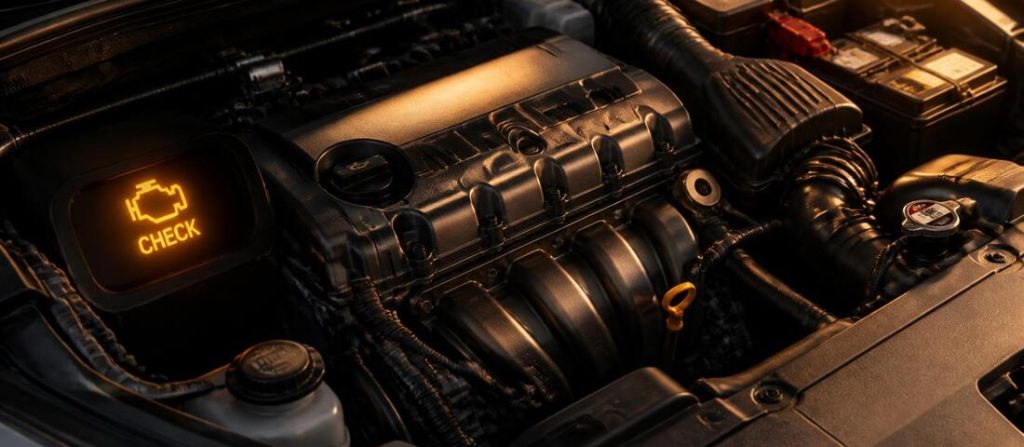
The check engine light generally points toward a fault monitored by the engine/emissions diagnostic system.
The EPC light relates to electronic power control on vehicles that use the system.
They can appear together.
If both lights are on, scan the vehicle rather than diagnosing either light in isolation.
The stored codes and symptoms tell you much more than the warning lamps alone.
The Biggest EPC Diagnosis Mistake
The biggest mistake is replacing the part named in a generic internet search without testing it.
A diagnostic code doesn’t always mean the component itself failed.
It may mean the computer saw an impossible signal.
The cause could be the sensor, wiring, connector, power supply, ground, mechanical movement, or another system feeding the calculation.
Follow the evidence.
That’s how you fix the car instead of playing parts roulette.
Bottom Line
The EPC light is a warning, not a diagnosis.
Start with the symptoms. Scan the vehicle. Save the codes. Check power supply, accelerator input, brake-switch operation, throttle control, wiring, and related systems before buying parts.
And remember the rule that saves the most money:
Don’t replace the part until the test proves the part is bad.