
This article was updated in August 4, 2026 with new products and information by Mark S. Taylor
There are few car noises as distinctly alarming as a rhythmic click, click, click, especially when it only happens under a very specific condition: turning right. It’s not a constant hum or a general rattle; it’s a pointed complaint, and it tells me, as a mechanic, exactly where to start looking. While your mind might jump to “something expensive,” this specific symptom is often a dead giveaway for one primary culprit, though there are other possibilities. Before you panic, or worse, ignore it, let’s break down exactly why your car is clicking when you turn right, how serious it is, and what you need to do about it.
Contents
- 1 The Right Turn Dynamic: Why it Clicks Then
- 2 Decoding the Click: What Kind of Noise Are You Hearing?
- 3 Common Culprits: What’s Clicking When You Turn Right?
- 4 Diagnosing the Right-Turn Click: A Mechanic’s Approach
- 5 Can You Drive With It? Safety & Urgency of a Clicking Turn
- 6 Repair Cost Breakdown: Silencing That Right-Turn Click
- 7 DIY vs Mechanic: Who Should Tackle the Click?
- 8 Prevention Tips: Keeping Your Turns Quiet
- 9 FAQs About Your Car Makes a Clicking Noise When Turning Right
- 9.1 Q: My car makes a clicking noise when turning right, but not when accelerating. What could it be?
- 9.2 Q: Why does my car only click when turning right, and not left?
- 9.3 Q: Can a clicking noise when turning right be caused by loose lug nuts?
- 9.4 Q: Is it okay to drive a short distance to the mechanic with a clicking CV joint?
- 9.5 Q: My AWD vehicle makes this clicking noise when turning right. Does the diagnosis differ?
- 10 Verdict: The Bottom Line
The Right Turn Dynamic: Why it Clicks Then
It seems odd, doesn’t it? Why would your car be perfectly quiet until you make a right turn? This isn’t some random coincidence; it’s a direct result of how your car’s weight shifts and how its components are stressed during cornering.
When you turn right, centrifugal force pushes the vehicle’s weight to the left side of the car. This means:
- The left front wheel (for front-wheel drive and most all-wheel drive vehicles) experiences significantly more vertical load.
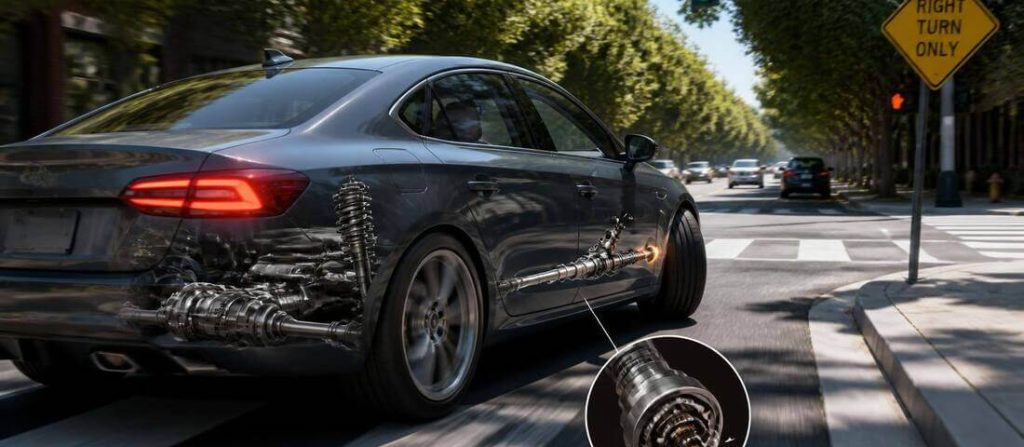
- The left outer CV (Constant Velocity) joint has to work at its most extreme angle while simultaneously transmitting maximum power to that heavily loaded wheel.
This combination of increased weight, power transmission, and a sharper articulation angle is the perfect storm to expose a weakness in the left-side components that might remain silent under less strenuous conditions. So, when your car clicks turning right, you’re almost always hearing a problem on the left side of your vehicle.
Decoding the Click: What Kind of Noise Are You Hearing?
Not all clicks are created equal. The specific nature of the clicking sound provides crucial diagnostic clues. Pay close attention to these details:
- Rhythmic, Metallic Clicking:
- Common: This is the classic sound of a failing CV joint. It’s usually a consistent, repetitive “click-click-click” that speeds up as your vehicle’s speed increases, and slows down as you slow.
- Conditions: Most noticeable when accelerating through a right turn, but can also be heard when coasting or decelerating through the turn as the joint’s angle is stressed. The sharper the turn, the louder and more frequent the clicks.
- Significance: Strongly points to a worn or damaged outer CV joint on the left side of your vehicle.
- Sharp, Single Click or Clunk:
- Common: A single, distinct “click” or “clunk” that happens just once as you begin to turn the steering wheel right, or as you settle into the turn.
- Conditions: May happen even at very low speeds, sometimes when just turning the wheel while stationary or rolling slowly.
- Significance: Could indicate play in a ball joint, tie rod end, control arm bushing, or even a loose strut mount bearing. Less likely to be a CV joint if it’s not rhythmic.
- Intermittent or Irregular Clicking:
- Common: A clicking that comes and goes, or isn’t perfectly rhythmic with wheel rotation.
- Conditions: Might be heard over bumps while turning right, or only at very specific steering angles.
- Significance: Could be something rubbing, like a loose backing plate behind the rotor, a loose lug nut, or even a piece of debris momentarily catching. While less critical than a CV joint, it still needs checking.
The more precisely you can describe the click – its rhythm, volume, and the exact conditions under which it occurs – the more accurately a mechanic can diagnose the problem.

Common Culprits: What’s Clicking When You Turn Right?
When you hear that specific clicking noise when turning right, the vast majority of the time, your car is pointing to one of these usual suspects:
- Outer CV Joint (Constant Velocity Joint) – Left Side: This is the star of the show. The CV joint is a flexible coupling that allows your drive wheels to articulate (turn and move up/down) while still receiving power from the transmission. They are protected by a rubber “boot” filled with grease. Over time, these boots can crack or tear, allowing the grease to escape and dirt/water to enter. This contaminates and washes away the lubrication, causing the internal bearings to wear rapidly. When turning right, the left outer CV joint is placed under its most extreme angle and load, magnifying any existing wear and causing that characteristic rhythmic clicking sound. It’s the most common cause by far for FWD and AWD vehicles.
- Ball Joints: These are pivot points in your suspension that allow the wheels to steer and move vertically. If a ball joint is worn, it develops play, and under the lateral stress of a right turn, it can produce a clunk or a sharp click as it moves within its worn housing. This is particularly noticeable if you hit a bump while turning.
- Tie Rod Ends: Part of your steering linkage, tie rod ends connect the steering rack to the steering knuckle. Similar to ball joints, wear here creates play, which can manifest as a single click or clunk when the steering wheel is turned, especially under load.
- Wheel Bearings: A failing wheel bearing typically produces a hum or growl, but if it’s severely worn, it can also develop enough play to allow the wheel assembly to shift, causing a clunk or click, particularly when cornering and loading that bearing.
- Loose Lug Nuts: This is a simple, but extremely dangerous, possibility. If one or more lug nuts on your left wheel are loose, the wheel can shift slightly on the studs under the stress of a right turn, causing a clicking or clunking sound.
- Strut Mount Bearing: On a strut-based suspension, a bearing at the top of the strut allows the strut assembly to rotate with the steering. If this bearing fails, it can cause a popping or clicking sound, especially when turning the wheel from a stop or at very low speeds.
While the CV joint is almost always the first suspect, a good mechanic will rule out these other possibilities with a thorough inspection.
Diagnosing the Right-Turn Click: A Mechanic’s Approach
Diagnosing a clicking noise that only happens when turning right requires a specific approach. You, the driver, are my first and best diagnostic tool by providing detailed observations.
- Driver’s Report (Your Role): Document everything: Is the click rhythmic? Is it loud or faint? Does it happen when accelerating, decelerating, or both? Is it a sharp turn or gentle? Does it change if you go over a bump while turning? Which side does it seem to come from?
- Visual Inspection (Initial DIY): While safe on flat ground, turn your steering wheel all the way to the left to expose the right front wheel well, and then all the way to the right to expose the left front wheel well. Look closely at the CV boots (the rubber accordion-like covers on the axle shafts). Are they torn, cracked, or leaking grease? Is there grease splattered on the inside of the wheel or suspension components? A torn boot is a major indicator of CV joint failure.
- Lug Nut Check (Safety First!): With the car parked and secured, try to tighten each lug nut on both front wheels with a lug wrench. If any feel loose, tighten them. This is a critical safety check before driving further.
When your car comes to my shop, here’s how I approach it:
- Test Drive to Reproduce: I’ll take the car for a test drive, specifically focusing on sharp right turns, usually in an empty parking lot, accelerating and decelerating through the turn. I’ll listen for the distinct clicking sound. This test drive is crucial; if I can’t replicate the noise, I can’t diagnose it.
- Lift and Inspect (The Deep Dive): Once the noise is confirmed, the car goes on the lift. I’ll first check the CV boots on both sides, especially the outer left CV joint. A torn boot with grease leakage is almost a guaranteed diagnosis. I’ll then grab the wheel and tire assembly and check for play in all directions (up/down, side-to-side) to identify worn ball joints, tie rod ends, or wheel bearings.
- Specific Checks: I’ll use a pry bar to check for movement in control arm bushings and sway bar links, and inspect strut mounts for any signs of failure. I might also check lug nut torque as a final confirmation. The first thing I check, almost every single time, when a customer complains of a clicking noise when turning right, is the left outer CV joint boot for tears and grease leaks. It’s usually the easiest and most common culprit.
Can You Drive With It? Safety & Urgency of a Clicking Turn
This is not a noise to ignore. A clicking noise when turning right, especially a rhythmic one, is usually a warning that a critical drivetrain or suspension component is failing.
- Immediate Danger (Stop Driving!): If the clicking becomes a loud clunking, or is accompanied by a severe vibration, a popping noise, or if you feel a loss of power or erratic steering, pull over immediately and do not drive the vehicle. This indicates a severely compromised CV joint, ball joint, or tie rod end that could fail catastrophically. A complete failure of a CV joint can cause the axle to separate, leading to a sudden loss of drive to that wheel and potential loss of control.
- Urgent Attention (Drive with Extreme Caution): A consistent, rhythmic clicking from a CV joint, even if not extremely loud, means the joint is worn. While it might continue to work for a while, it’s on borrowed time. Driving with it risks a sudden, complete failure of the joint, which can leave you stranded, or worse, cause an accident. Get it to a mechanic as soon as possible.
- Monitor (But Get It Checked Soon): A single, occasional click or a very faint, irregular noise might not be an immediate emergency, but it still warrants professional inspection. It could be a minor issue like a loose dust shield or the beginning stages of wear in a steering or suspension component. However, any new noise when turning right should be taken seriously. Your drivetrain and steering are fundamental to safe vehicle operation, and ignoring warnings can lead to dangerous and expensive consequences.
Repair Cost Breakdown: Silencing That Right-Turn Click
When you hear that distinct clicking when turning right, your mind probably jumps to the worst-case scenario for your wallet. While some repairs can be costly, understanding the typical ranges can help you prepare. The majority of the time, the culprit is a CV joint, but the cost can vary depending on whether it’s a boot repair or a full axle replacement.
| Component Causing Noise | Parts Cost (Estimated) | Labor Cost (Estimated) | Total Cost Range (Typical) | Key Factor Affecting Price |
|---|---|---|---|---|
| CV Boot Replacement (one) | $20 – $80 | $150 – $300 | $170 – $380 | If caught early before joint damage; FWD/AWD complexity |
| CV Axle Replacement (one side) | $70 – $300 | $150 – $350 | $220 – $650 | OE vs. aftermarket axle, FWD/AWD complexity, vehicle model |
| Ball Joint Replacement (one) | $50 – $200 | $150 – $400 | $200 – $600 | Press-in vs. bolt-in, associated component replacement |
| Tie Rod End Replacement (one) | $30 – $100 | $80 – $200 | $110 – $300 | Inner vs. outer, alignment needed after replacement |
| Wheel Bearing (hub assembly) | $100 – $400 | $200 – $450 | $300 – $850 | Press-in vs. bolt-on hub assembly, FWD/AWD complexity |
| Strut Mount Replacement (one) | $50 – $150 | $150 – $350 | $200 – $500 | Ease of access, associated strut replacement |
These figures are general estimates for a typical passenger vehicle in the USA and can fluctuate based on your location, vehicle make/model, whether you use OEM or aftermarket parts, and the specific labor rates of the shop.
Crucially, ignoring a torn CV boot will almost guarantee an expensive CV axle replacement. Grease loss and contamination will destroy the joint rapidly, turning a $200 boot job into a $500+ axle job. Always get a detailed, written estimate that clearly separates parts and labor.

DIY vs Mechanic: Who Should Tackle the Click?
Many of the components that cause a clicking noise when turning right are integral to your vehicle’s steering and suspension, making most repairs better suited for a professional mechanic.
- DIY Feasible (with caution and knowledge):
- Visual inspection of CV boots.
- Checking lug nut tightness.
- Listening and documenting the specific noise.
- Why: These are observational tasks or very basic safety checks that don’t require specialized tools or lifting the vehicle.
- Mechanic Recommended (or Required):
- CV joint boot replacement.
- CV axle replacement.
- Ball joint, tie rod end, or wheel bearing replacement.
- Strut mount replacement.
- Any repair involving pressing in components or requiring wheel alignment afterward.
- Why: These jobs require specific torque settings, specialty tools (e.g., axle nut sockets, ball joint presses, wheel bearing removal tools), a safe way to lift and support the vehicle, and an understanding of suspension and drivetrain geometry. Incorrect installation can lead to severe safety issues, premature failure of new parts, or costly damage to surrounding components. If you’re not 100% confident, well-equipped, and experienced in these types of repairs, it’s always safer and often more cost-effective in the long run to trust a certified mechanic.
Prevention Tips: Keeping Your Turns Quiet
While wear and tear are inevitable, you can significantly prolong the life of your drivetrain and suspension components, keeping those right turns quiet:
- Regular CV Boot Inspections: Every time you get an oil change or tire rotation, ask your mechanic to visually inspect your CV boots for cracks or tears. Catching a torn boot early is the most effective preventative measure against CV joint failure.
- Avoid Harsh Steering & Impacts: Try to avoid turning the steering wheel to full lock (all the way to the stop) frequently or holding it there for extended periods, especially while accelerating. Also, avoid hitting potholes or curbs, as these impacts can damage boots and other suspension components.
- Routine Suspension Checks: During regular maintenance, have your mechanic check for any play in ball joints, tie rod ends, and wheel bearings. Addressing minor play early can prevent more significant failures.
- Maintain Proper Alignment: Incorrect wheel alignment can put undue stress on steering and suspension components, accelerating wear.
- Drive Gently Over Bumps: Slow down for speed bumps and rough roads to minimize sudden shocks to your suspension and drivetrain.
FAQs About Your Car Makes a Clicking Noise When Turning Right
Q: My car makes a clicking noise when turning right, but not when accelerating. What could it be?
A: If the clicking occurs without acceleration, especially if you’re coasting or braking through the turn, it could still be a CV joint, as the extreme angle of the joint is what primarily causes the noise. However, it might also point to play in a ball joint, tie rod end, or a worn strut mount that’s exacerbated by the lateral forces of the turn.
Q: Why does my car only click when turning right, and not left?
A: This is due to weight transfer. During a right turn, the vehicle’s weight shifts to the left side. This puts maximum stress on the left-side suspension and drivetrain components, particularly the outer CV joint on the left wheel. If that component is worn, the right turn will be the first and most noticeable time you hear its protest.
Q: Can a clicking noise when turning right be caused by loose lug nuts?
A: Yes, it’s possible and extremely dangerous. If lug nuts on the left wheel are loose, the wheel can shift slightly on the studs under the stress of a right turn, creating a clicking or clunking sound. If you suspect this, check your lug nuts immediately and tighten them to specification.
Q: Is it okay to drive a short distance to the mechanic with a clicking CV joint?
A: If the clicking is consistent and rhythmic, indicating a worn CV joint, you can generally drive a short distance to a mechanic, but avoid sharp turns, sudden acceleration, and high speeds. If the noise becomes a loud clunking, grinding, or popping, or if you feel any loss of control or power, stop driving immediately and arrange a tow.
Q: My AWD vehicle makes this clicking noise when turning right. Does the diagnosis differ?
A: While AWD vehicles have more complex drivetrains, the principle for a clicking noise when turning right remains largely the same: the most likely culprit is still the outer CV joint on the heavily loaded side (typically the left front in a right turn). However, AWD systems also have a differential or transfer case which could rarely contribute, but a clicking that’s distinctly linked to a sharp turn is still usually a CV joint.
Verdict: The Bottom Line
A clicking noise when turning right is rarely just an annoying quirk; it’s a specific, localized warning from your car. While other components can mimic the sound, it is almost always a tell-tale sign of a failing CV joint, most commonly on the left side of your vehicle. This is not a problem to ignore, as a completely failed CV joint can lead to a sudden loss of drive, control, and potentially catastrophic damage. Take the detailed observations you’ve gathered to a trusted mechanic promptly. Addressing this issue early is crucial for your safety and can often prevent a more extensive and costly repair down the road.