
This article was updated in November 12, 2026 with new products and information by Mark S. Taylor
A P0456 code means the vehicle’s onboard diagnostic system has detected a very small leak in the evaporative emissions control system, commonly referred to as the EVAP system.
Answer Capsule: A P0456 trouble code indicates that the EVAP system monitor detected a very-small-leak result during self-testing. It does not identify a specific failed component or prove your gas cap is bad. Accurate diagnosis requires preserving freeze-frame data and following manufacturer service procedures rather than replacing parts blindly.
The EVAP system traps fuel vapors inside the fuel tank and routes them into the engine to be burned during combustion instead of venting them into the atmosphere. The engine computer periodically tests whether this sealed system maintains pressure or vacuum as expected.

Crucially, P0456 does not tell you where a leak is located. It does not automatically prove the gas cap is bad, nor does it isolate a specific hose, valve, or canister. The correct next step is to preserve your diagnostic data and follow the official factory service procedure for your specific vehicle. Replacing parts based on the code alone wastes money and leaves the root fault unresolved.
Contents
- 1 What Does the P0456 Code Mean?
- 2 P0456 vs. Other EVAP Codes
- 3 What Symptoms Can P0456 Cause?
- 4 Possible Causes of P0456
- 5 What Should You Check Before Replacing Parts?
- 6 How Does a Qualified Technician Diagnose P0456?
- 7 Can You Drive With a P0456 Code?
- 8 Will P0456 Affect an Emissions Inspection?
- 9 FAQs About P0456 Code
- 10 Bottom Line
What Does the P0456 Code Mean?
P0456 is formally defined as Evaporative Emission System Leak Detected — Very Small Leak.
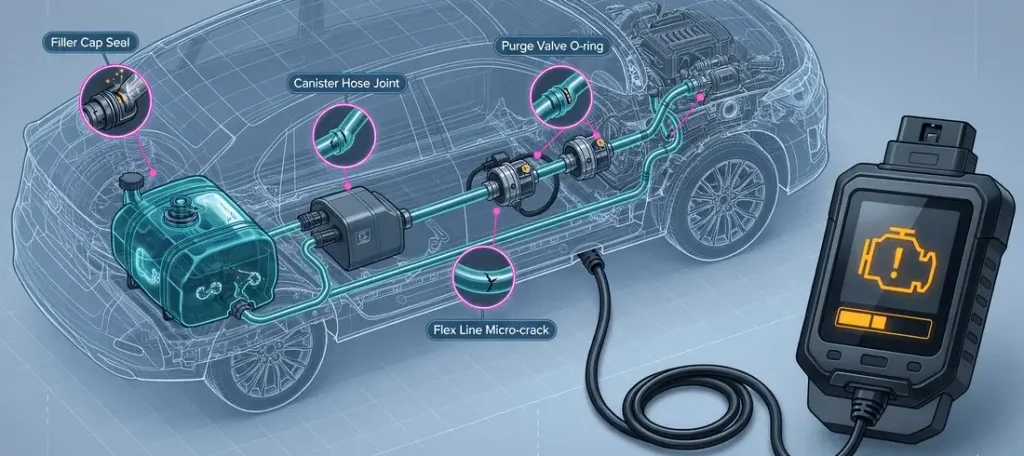
The EVAP system relies on several integrated components to contain vapors:
- Fuel tank and filler neck assembly
- Traditional fuel cap or capless filler door seal
- Vapor hoses and quick-connect fittings
- Charcoal vapor storage canister
- Purge valve (purge solenoid)
- Vent valve (vent solenoid)
- Fuel tank pressure sensor and leak-detection hardware
The exact physical layout and component locations vary by manufacturer and model year.
How the EVAP system checks for leaks
The engine computer utilizes an internal EVAP monitor to test whether the system can maintain pressure or vacuum under precise operating conditions. The monitor commands valves closed, creates or measures a pressure change, and analyzes how the sealed circuit responds. If the pressure decay falls outside factory specifications, the computer flags an EVAP leak code.
For example, service documentation from manufacturers like Mitsubishi describes an EVAP monitor that seals a specific section of the system, pulls a controlled vacuum, and watches pressure behavior inside the fuel tank. Other automakers utilize different electronic monitor strategies and hardware configurations.
Does P0456 mean there is a 0.020-inch hole?
Not necessarily. Many online automotive forums describe P0456 as a leak equivalent to a 0.020-inch opening. However, that figure is not a universal physical measurement of a defect.
According to technical reviews by the U.S. Environmental Protection Agency (EPA) on OBD evaporative-emissions monitoring, various certification standards and manufacturer designs have utilized reference orifice sizes such as 0.020 and 0.040 inches. Monitor logic, enabling criteria, and threshold parameters vary widely across model years and manufacturers. The code simply confirms that the monitor detected a pressure result matching its very-small-leak classification.
P0456 vs. Other EVAP Codes
Several diagnostic trouble codes relate to the EVAP system, but they represent entirely different faults:
| Code | General Description | Main Distinction |
| P0456 | EVAP System Leak Detected — Very Small Leak | Triggered by a small-leak monitor result |
| P0442 | EVAP System Small Leak Detected | Triggered by a medium/small leak category |
| P0455 | EVAP System Leak Detected (Gross/Large Leak) | Indicates a major sealing failure or open line |
| P0446 | EVAP Vent Control Circuit Malfunction | Indicates an electrical circuit or solenoid control fault, not a physical leak |
| P0457 | EVAP Leak Detected / Fuel Cap Associated | Refers to specific fuel-cap related manufacturer logic |
Do not replace a vent valve simply because you see P0456, and do not replace a gas cap because you see P0446. Read your specific code description and follow the manufacturer’s diagnostic chart. (For more information on electrical circuit faults, review TheCarBuzz P0446 code guide.)
What Symptoms Can P0456 Cause?
The most common visible sign of a P0456 code is an illuminated Check Engine Light.
Because the EVAP system manages invisible fuel vapors rather than regulating core engine combustion, many vehicles show zero noticeable changes in driveability or engine performance. However, a lack of symptoms does not mean the vehicle is exempt from emissions compliance.
Potential observations include:
- Illuminated check engine light
- Stored or pending P0456 trouble code
- EVAP readiness monitor incomplete during emissions testing
- Unexplained fuel odor near the rear of the vehicle (in certain cases)
- Secondary EVAP-related codes stored simultaneously
A fuel smell is not something to ignore
P0456 is primarily a vapor-monitor code. It is not definitive proof that liquid gasoline is actively leaking, nor is it proof that a liquid leak is impossible.
If you see liquid fuel, observe smoke, or notice a strong, sharp gasoline odor, shut off the engine immediately in a safe location. Keep all ignition sources away and contact professional roadside assistance rather than trying to track down a vapor leak with makeshift tests.
Possible Causes of P0456
This code can stem from several areas across the EVAP network. Below are the most common mechanical and sealing faults:
- Fuel Cap or Cap Seal (Cap-Equipped Vehicles): A cracked rubber seal, contaminated sealing lip, loose fit, or incorrect replacement cap prevents the system from maintaining pressure. Do not assume a new cap solves the issue without inspecting the filler neck.
- Capless Fuel Filler Seal: Modern capless filler doors rely on internal flapper doors and O-ring seals. Dirt, wear, or improper refueling tools can damage the sealing surface, triggering an EVAP code.
- Cracked or Leaking Vapor Hoses: Rubber and plastic vapor lines connect the tank, canister, and engine. A dry-rotted hose, loose quick-connect fitting, or cracked plastic junction creates a tiny pressure bleed-off point.
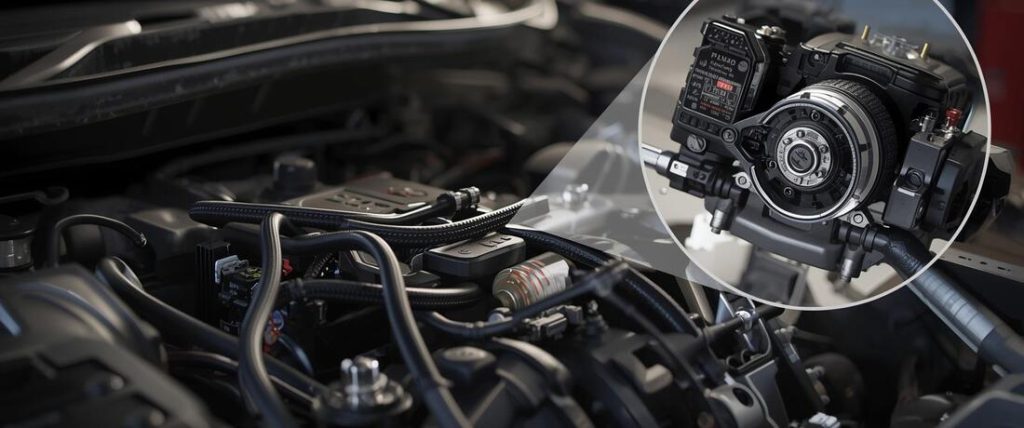
- Purge Valve Sealing Failure: The purge valve regulates vapor flow from the charcoal canister to the intake manifold. If it fails to close completely when commanded, air bleeds past it during monitor testing.
- Vent Valve Sealing Issue: The vent solenoid controls outside airflow into the charcoal canister. If internal seals degrade and fail to close tightly, pressure escapes. (This is mechanical, distinct from P0446 electrical circuit faults).
- Charcoal Canister or Fuel Tank Damage: A cracked polymer canister housing, damaged tank seam, or failed mounting seal can cause small vacuum losses.
- Pressure Sensor or Circuit Fault: A failing tank pressure sensor, corroded wiring harness, or corrupted reference voltage can mislead the computer into flagging a false leak.
What Should You Check Before Replacing Parts?
Start with diagnostic information before visiting the parts counter:
- Record All Diagnostic Codes: Connect a scan tool and note P0456 alongside any pending or permanent codes, freeze-frame operating data, and monitor readiness status. Do not clear codes prematurely, as clearing erases vital freeze-frame context and resets your OBD monitors.
- Confirm Vehicle Specifications: Note the exact model year, make, model, engine size, and VIN. Verify whether your vehicle utilizes a threaded gas cap or a capless filler neck.
- Inspect the Filler Interface: Check that your fuel cap is original, tight, and free of dirt or rubber degradation. For capless systems, inspect the flapper door for trapped debris without forcing foreign objects into the opening.
- Cross-Check Related Codes: Review secondary codes. A vent circuit fault (like P0446) points toward electrical diagnostics, while purge flow faults require separate valve testing.
- Check Current OEM Technical Service Bulletins (TSBs): Search factory service databases for model-specific bulletins. For example, specific Nissan models with capless fillers faced issues regarding lower fuel-filler-tube seals triggering P0456 (such as NTB26-006A), though bulletin statuses update frequently by VIN. Always verify current OEM documentation rather than applying blanket fixes.
How Does a Qualified Technician Diagnose P0456?
Professional diagnosis adheres strictly to OEM service workflows:
- Confirming stored and pending diagnostic trouble codes.
- Reviewing freeze-frame parameters and monitor completion status.
- Checking for related EVAP codes and active manufacturer TSBs.
- Inspecting fuel cap or capless sealing surfaces.
- Activating bi-directional scan-tool controls to command purge and vent solenoids.
- Performing controlled pressure or vacuum tests using factory-specified equipment and pressure limits.
- Verifying the repair and driving the vehicle through the specific drive cycle required to complete the EVAP readiness monitor.
Why you should not use a generic smoke-test pressure
EVAP systems operate within narrow, highly specific pressure thresholds. Pumping generic shop air pressure into a fuel tank or using an unregulated, improvised smoke machine can rupture delicate plastic components, deform fuel tanks, or create fire hazards. Fuel vapors are highly flammable; pressurizing fuel lines or tanks without proper safety controls belongs strictly in a professional shop environment.

Can You Drive With a P0456 Code?
There is no universal answer that applies to every vehicle.
If your check engine light is steady, the engine runs smoothly, and you notice no fuel odors, visible leaks, or drivability concerns, you can continue driving normally while scheduling a diagnostic appointment soon.
Stop driving and seek immediate professional help if you notice:
- Visible liquid fuel pooling under the vehicle
- Active smoke
- A heavy, unmistakable gasoline odor
- Severe engine stalling or rough running
- A flashing check engine light (which signifies active engine misfires that can destroy catalytic converters)
Will P0456 Affect an Emissions Inspection?
Yes. Most state and municipal emissions testing programs require all OBD readiness monitors to show “Complete” (Ready) and the Malfunction Indicator Lamp (MIL) to remain unlit. An active P0456 code or an incomplete EVAP monitor will cause an immediate emissions inspection failure.
Clearing the code with a scan tool does not solve the underlying mechanical fault; it merely resets the monitor to “Not Ready,” and the check engine light will illuminate again once the vehicle completes its drive cycle.
FAQs About P0456 Code
Does P0456 always mean a bad gas cap?
No. A fuel cap or cap seal is only one possible cause on cap-equipped vehicles. The code can also involve a capless filler seal, vapor hoses, purge or vent valves, a charcoal canister, tank seals, pressure sensors, or monitor conditions.
Is P0456 a serious diagnostic trouble code?
It is primarily an emissions-system fault rather than an immediate mechanical breakdown. However, a steady check-engine light with normal operation differs significantly from visible liquid fuel, strong gasoline odors, smoke, or stalling, which require immediate safety attention.
Can a capless fuel filler cause a P0456 code?
Yes. Sealing issues or debris in a capless fuel filler neck can prevent the EVAP system from holding pressure during monitor testing. Inspection and repair procedures for capless systems are strictly vehicle-specific.
Is P0456 the same diagnostic code as P0446?
No. P0456 indicates an EVAP very-small-leak monitor result, whereas P0446 typically points to an electrical vent-control-circuit malfunction. They represent completely separate diagnostic branches.
Will clearing code P0456 permanently fix the problem?
No. Clearing the code erases stored diagnostic data and resets readiness monitors without repairing the underlying leak. The check-engine light will return once the engine computer runs its EVAP monitor cycle again.
Bottom Line
A P0456 code indicates that your vehicle’s EVAP monitor detected a very small leak or sealing failure within the emissions system. It does not identify the exact failing part. While a worn fuel cap is a common suspect, the issue could equally stem from a capless filler seal, degraded vapor hose, sticking purge valve, or cracked canister.
Save your diagnostic data, verify your specific vehicle’s configuration, and consult official OEM service procedures. Avoid replacing parts blindly or using unsafe improvised pressure tests. A qualified technician equipped with proper diagnostic tools can accurately locate the fault and verify the repair. (Explore more troubleshooting guides in TheCarBuzz Diagnostic Codes archive.)