
This article was updated in June 2, 2026 with new products and information by Mark S. Taylor
When your headlights dim at idle, your alternator isn’t producing enough power at low RPM to keep up with demand. At idle, your alternator spins slowly and puts out less voltage. If it’s already marginal — or if your belt is slipping, your battery terminals are corroded, or your ground strap is loose — turning on headlights, AC, and the rear defroster overwhelms the system. Voltage drops. Your headlights get dim. The good news: this is one of the most diagnosable problems in car repair, and the fix is often cheaper than you think.
I’ve been turning wrenches for 20 years, and I can spot an alternator problem from across a parking lot just by watching headlights at a stoplight. But here’s the thing that shocks most customers: about half the time, the “alternator problem” is actually a $20 belt or a 5-minute terminal cleaning. Don’t guess. Test. This guide will show you exactly how.

Contents
- 1 What Causes Headlights to Dim at Idle?
- 2 The 5-Minute Multimeter Test (Diagnose It Yourself)
- 3 Common Causes (In Order of Likelihood and Cost)
- 4 Can You Drive With It?
- 5 Repair Cost Breakdown
- 6 DIY vs. Mechanic: Should You Fix It Yourself?
- 7 Prevention Tips
- 8 FAQs About Headlights Dimming While Idling
- 8.1 Q: Is it my alternator or my battery if my headlights dim at idle?
- 8.2 Q: Can I drive with dimming headlights?
- 8.3 Q: Will replacing the battery fix dimming headlights at idle?
- 8.4 Q: Why do my headlights dim when I use power windows or turn on the AC?
- 8.5 Q: What does it mean if my battery light comes on when idling?
- 9 The Bottom Line
What Causes Headlights to Dim at Idle?
Your car’s electrical system is simple in concept. The alternator generates power while the engine runs. The battery stores power for starting and buffers voltage spikes. Everything else — headlights, AC, radio, power windows — draws from that system.
Here’s the catch: alternators don’t produce constant power. Their output follows engine speed. At 2,000 RPM, a healthy alternator might pump out 14.5 volts and 100 amps. At 600 RPM idle, that same alternator might only manage 13.0 volts and 40 amps. If your electrical load at idle exceeds 40 amps, the system voltage drops. The battery tries to fill the gap, but it can’t sustain it for long.
Think of it like a water pump. At idle, the pump is running slowly. If you open one faucet (headlights), the pressure stays fine. Open three faucets (headlights + AC + defroster), and the pressure drops. Open five faucets, and the pump can’t keep up at all. The battery is a water tower that buffers pressure drops, but it drains while the pump catches up.
The critical distinction: Dimming at idle that improves when you rev the engine points to a weak alternator or slipping belt. Dimming at all speeds points to a bad battery, bad connections, or a failing voltage regulator. When and how the dimming happens tells me more than the dimming itself.
The 5-Minute Multimeter Test (Diagnose It Yourself)
You don’t need a $500 scan tool. A $20 digital multimeter from any hardware store will tell you exactly what’s wrong. Here’s the same test I run in my bay:
Step 1: Check Battery Voltage (Engine Off) Set your multimeter to DC volts. Touch the red probe to the positive battery terminal, black to negative. A healthy battery should read 12.4–12.7 volts. Below 12.2 volts means the battery is undercharged or weak. Below 12.0 volts means it’s significantly discharged.
Step 2: Check Voltage at Idle (No Accessories) Start the engine. Let it idle. Measure voltage at the battery again. A healthy charging system should read 13.5–14.5 volts. If it’s below 13.0 volts at idle, your alternator is weak or your belt is slipping.
Step 3: Check Voltage at Idle (All Accessories On) Turn on your headlights (high beam), AC to max, rear defroster, and blower fan on high. Watch the voltage. If it drops below 13.0 volts — or worse, below 12.5 volts — your charging system is overwhelmed. The alternator can’t keep up with the load at idle RPM.
Step 4: The 2,000 RPM Test Have a helper rev the engine to 2,000 RPM while you watch the meter. If voltage jumps up to 13.8–14.5 volts, your alternator is capable of producing power — it just can’t do it at idle. This points to a weak alternator, slipping belt, or worn tensioner. If voltage stays below 13.0 volts even at 2,000 RPM, your alternator is failing.
Step 5: The Voltage Drop Test (Find Hidden Resistance) With the engine running and accessories on, touch one probe to the battery negative terminal and the other to a clean metal spot on the engine block. You should see less than 0.1 volts. Now touch the negative terminal and a clean spot on the car’s body. Again, less than 0.1 volts. If you see 0.3 volts or more, you have a bad ground connection — likely a corroded or loose ground strap.
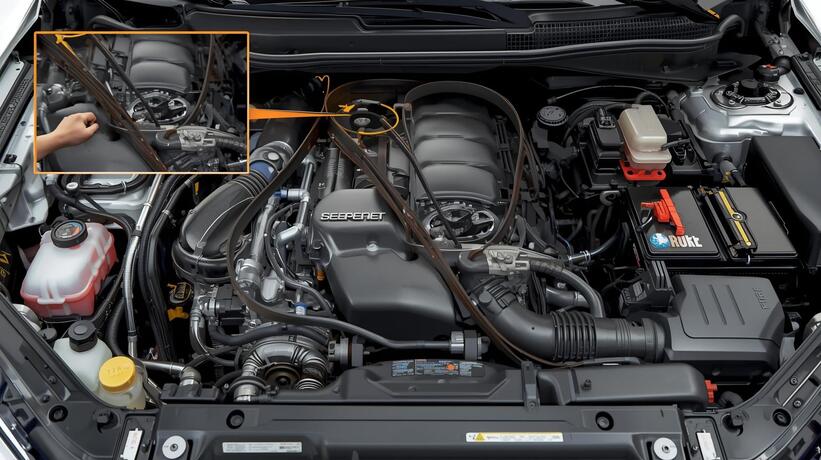
Step 6: Visual Inspection Look at your battery terminals. White or blue powdery buildup is corrosion. Look at your serpentine belt. Cracks, glazing, or wet spots from oil or coolant mean slippage. Look at the ground strap connecting the engine to the body. Is it loose? Rusted? Missing a bolt?
Common Causes (In Order of Likelihood and Cost)
1. Loose or Glazed Serpentine Belt (Most Common, Cheapest Fix)
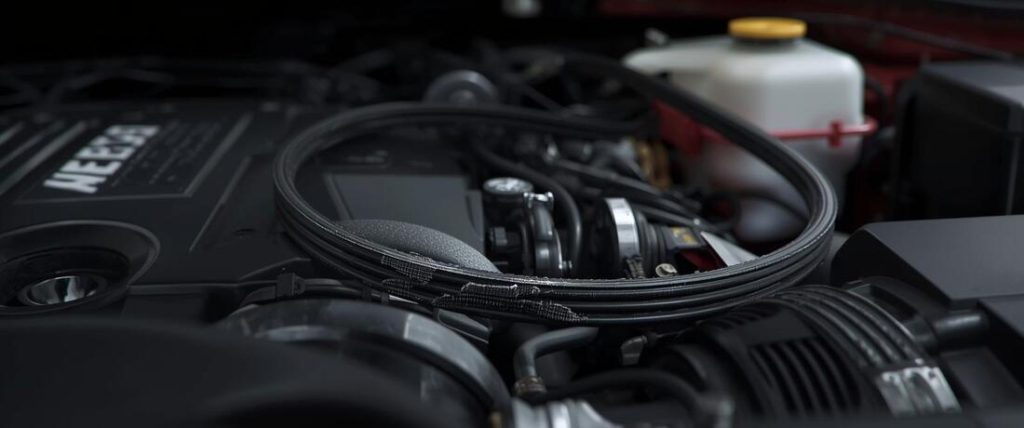
This is the #1 cause of idle dimming I see in my shop, and it’s the one customers never suspect. The serpentine belt drives your alternator. If it’s loose, worn, or contaminated with oil or coolant, it slips at low RPM. The alternator spins slower than it should. Output drops. Headlights dim.
I had a customer with a 2016 Honda Accord whose lights dimmed at every stoplight. The shop before me quoted $450 for an alternator. I popped the hood, saw a glazed belt with coolant contamination from a leaking water pump weep hole, and replaced the belt for $45. Problem solved.
Test: Look for belt glazing, cracks, or fluid contamination. Listen for a chirp or squeal when you turn on accessories. Fix: Replace the belt. If the tensioner is weak, replace it too. Cost: Belt $30–$80; tensioner $80–$200; labor $50–$150.
2. Corroded or Loose Battery Terminals
Corrosion creates electrical resistance. At high alternator output (high RPM), the system overcomes the resistance. At low output (idle), the voltage drop across the corrosion becomes significant. The lights dim.
Test: Wiggle the battery cables. If they move, they’re loose. Look for white/blue powder on the terminals. Fix: Remove cables, clean terminals with a wire brush and baking soda paste, tighten clamps. Cost: Free DIY; $30–$60 at a shop.
3. Bad Engine-to-Body Ground Strap
This is the hidden cause that stumps even some mechanics. Your engine is rubber-mounted to reduce vibration. The ground strap is the only electrical path between the engine (where the alternator is) and the car’s body (where the headlights are). If it’s corroded, loose, or broken, current can’t flow efficiently. At idle, the voltage drop across the bad ground is enough to dim your lights.
Test: The voltage drop test above. More than 0.1 volts between battery negative and engine block means trouble. Fix: Replace the ground strap or clean and tighten the connection. Cost: $15–$50 for the strap; free if just cleaning.
4. Weak or Failing Alternator
If the belt is good, the terminals are clean, and the ground is solid, but voltage still drops below 13.0 volts at idle, your alternator is weak. Inside, the brushes may be worn, the voltage regulator may be failing, or a diode in the rectifier may have burned out. A failed diode reduces output by about one-third and causes AC ripple that makes lights pulse.
Test: The 2,000 RPM test. If voltage doesn’t rise significantly, the alternator is failing. Many parts stores offer free charging system tests. Fix: Replace or rebuild the alternator. Cost: Rebuild $150–$300; replacement $300–$800 (parts + labor).
5. Failing Voltage Regulator
The voltage regulator controls alternator output. On older cars, it’s a separate component. On modern cars, it’s built into the alternator. If it responds slowly or erratically, voltage fluctuates — and your lights pulse or dim.
Test: Watch for voltage that jumps around (13.2V, 14.1V, 13.5V) rather than holding steady. Fix: Replace the regulator (if separate) or the alternator assembly. Cost: Regulator $50–$150; alternator assembly $300–$800.
6. Weak Battery (The Symptom, Not the Cause)
A weak battery can’t buffer voltage drops. But here’s the trap: a bad alternator can kill a good battery by undercharging it. If you replace the battery without fixing the alternator, your new battery will be dead in weeks.
Test: Load test at a parts store. A healthy battery should hold 9.6+ volts under load. Fix: Replace the battery — but only after confirming the charging system is healthy. Cost: $100–$300.
7. Excessive Accessory Load
Some drivers stack every electrical load at once: headlights, fog lights, AC max, rear defroster, seat heaters, phone chargers, aftermarket stereo with amplifier. At idle, even a healthy alternator can be overwhelmed. This is especially common on cars with undersized alternators from the factory.
Test: Turn off accessories one by one. If the lights brighten as you reduce load, the system is marginal but not broken. Fix: Manage loads at idle, or upgrade to a higher-output alternator if running heavy aftermarket equipment. Cost: Free (load management) or $400–$1,000 (alternator upgrade).
Can You Drive With It?
Here’s my traffic-light system for dimming headlights at idle:
Table
| Condition | Drive or Fix Now? | Action |
|---|---|---|
| Slight dim at idle, brightens when revving, no warning lights | GREEN — Drive | Schedule charging system test within a week. |
| Moderate dim at idle with AC on, battery light flickers | YELLOW — Fix Soon | Drive to a shop directly. Avoid night driving if possible. |
| Battery light on steady, heavy dimming at all speeds | RED — Stop | Alternator is not charging. Battery will drain. Tow or drive directly to shop. |
| Lights pulse heavily, engine stumbles at idle | RED — Stop | Voltage is unstable. Fuel and ignition systems are affected. Tow immediately. |
| Dimming + smell of burning rubber or electrical | RED — Stop | Belt is slipping severely or wiring is overheating. Tow immediately. |
If you’re driving at night and your headlights dim at every stoplight, you can keep driving if the lights brighten when you accelerate and no warning lights are on. But plan to test the system tomorrow. If the battery light comes on, you’re running on battery power alone. The engine will keep running until the battery dies — which could be 10 minutes or 2 hours depending on your electrical load. Don’t risk it.
Repair Cost Breakdown
Here’s what you’re actually looking at, based on 2026 national averages:
Table
| Repair | Cost Range | When It’s Needed |
|---|---|---|
| Battery terminal cleaning | Free DIY; $30–$60 shop | Corroded or loose terminals |
| Serpentine belt replacement | $50–$150 DIY; $100–$250 shop | Glazed, cracked, or contaminated belt |
| Belt tensioner replacement | $100–$250 DIY; $200–$400 shop | Weak tensioner causing belt slip |
| Ground strap replacement | $15–$50 DIY; $50–$100 shop | Corroded or broken ground connection |
| Alternator rebuild | $150–$300 | Weak alternator with good core |
| Alternator replacement | $300–$800 | Failed alternator (new or reman) |
| Voltage regulator replacement | $50–$200 | Erratic voltage (if separate from alternator) |
| Battery replacement | $100–$300 | Weak battery (after confirming charging system is good) |
The reality: 60% of idle dimming cases are fixed for under $100. The expensive mistake is replacing the battery ($150) or alternator ($500) when you actually needed a $40 belt or a free terminal cleaning. Test first, replace second.
DIY vs. Mechanic: Should You Fix It Yourself?
Table
| Task | DIY? | Skill Level | Tools Needed |
|---|---|---|---|
| Multimeter voltage test | Yes | Beginner | Digital multimeter ($20) |
| Battery terminal cleaning | Yes | Beginner | Wire brush, baking soda, wrench |
| Serpentine belt inspection | Yes | Beginner | Flashlight, visual inspection |
| Ground strap inspection | Yes | Beginner | Wrench set |
| Serpentine belt replacement | Yes | Intermediate | Socket set, belt routing diagram |
| Belt tensioner replacement | Maybe | Intermediate | Socket set, torque wrench |
| Alternator replacement | Maybe | Intermediate | Socket set, torque wrench, patience |
| Voltage regulator replacement | No | Advanced | Often integrated into alternator — shop job |
If you can check your oil and jump-start a battery, you can diagnose this problem yourself with a multimeter. The only jobs that need a shop are alternator replacement on some cars (tight engine bays) and voltage regulator work on integrated units.
Prevention Tips
The best charging system problem is the one that never happens:
- Clean your battery terminals twice a year. A $5 wire brush and 10 minutes prevents 50% of charging system issues. Corrosion is silent and gradual — by the time you see dimming, it’s already costing you voltage.
- Inspect your serpentine belt at every oil change. Look for cracks across the ribs, glazing (shiny spots), and contamination from oil or coolant. Replace the belt at the first sign of wear, not when it breaks.
- Check your ground straps. The engine-to-body ground strap is out of sight and out of mind. Make sure it’s tight and not rusted. On older cars, this is the #1 overlooked cause of electrical gremlins.
- Don’t stack every accessory at idle. If you’re sitting in traffic on a hot night, turn off the rear defroster and seat heaters. Your alternator will thank you.
- Get a free charging system test at any parts store. AutoZone, O’Reilly, Advance Auto Parts — all offer free battery and alternator testing. Do it twice a year. It takes 5 minutes and costs nothing.
- Address fluid leaks immediately. Oil or coolant on your serpentine belt causes slip, which kills alternator output and can cause the belt to fail entirely. A $20 gasket fix prevents a $200 belt/tensioner job.
FAQs About Headlights Dimming While Idling
Q: Is it my alternator or my battery if my headlights dim at idle?
A: Most likely the alternator or belt — but test both. At idle, the alternator should produce 13.5–14.5 volts. If it doesn’t, the battery tries to compensate and drains. A weak battery makes the problem worse, but it’s rarely the root cause. Test the charging system first. If the alternator is good and the battery is old, then replace the battery.
Q: Can I drive with dimming headlights?
A: If the dimming is slight, happens only at idle, and the lights brighten when you accelerate, you can drive carefully to a shop. If the battery light is on, or the dimming is severe at all speeds, stop driving. A failed alternator will drain your battery until the engine stalls.
Q: Will replacing the battery fix dimming headlights at idle?
A: Only if the battery is the actual problem — which is rare. A bad alternator will kill a new battery in weeks. I’ve seen customers replace three batteries in a year because nobody checked the alternator. Test the charging system before you buy a battery.
Q: Why do my headlights dim when I use power windows or turn on the AC?
A: Because you’re adding electrical load to a system that’s already marginal at idle. Power windows draw 15–30 amps. AC clutch draws 5–10 amps. Combined with headlights, you can overwhelm a weak alternator or slipping belt. The voltage drops, and everything dims.
Q: What does it mean if my battery light comes on when idling?
A: The battery light means your alternator output has dropped below what the car expects. It doesn’t mean the battery is bad — it means the alternator isn’t charging it. This is your “pull over soon” warning. You have minutes to hours before the battery drains and the engine stalls.
The Bottom Line
Headlights dimming at idle is your charging system’s way of telling you it can’t keep up when the engine is spinning slowly. The cause is almost always a cheap fix — a belt, a terminal, or a ground strap — not the expensive alternator replacement that shops love to sell. The key is testing in the right order: belt first, terminals second, ground third, alternator last.
The first thing I do when a customer rolls in with dimming headlights at idle? I grab my multimeter and check voltage at the battery before I even open the hood. In 30 seconds, I know if I’m looking at a charging system problem or a connection problem. Then I check the belt. Then the terminals. Then the ground. By the time I get to the alternator, I’ve already eliminated 80% of the cheap fixes. You can do the same thing in your driveway. Test methodically, fix the right part, and your headlights will stay bright at every stoplight.