
This article was updated in June 19, 2026 with new products and information by Mark S. Taylor
Your car battery is brand new. The alternator tested perfectly fine under load. Yet, the vehicle sits parked overnight and completely refuses to start in the morning. This is the exact mechanical pattern that drives car owners crazy—and it is almost always caused by a parasitic battery drain.
Every modern car draws a tiny, safe amount of current after the engine shuts off to keep the clock running, the alarm system active, and the keyless entry receiver listening for your key fob. The problem occurs when a component fails to shut down, causing the current draw to stay abnormally high. A stuck glove box light, a computer module that never enters sleep mode, or a miswired dashcam will easily flatten a healthy battery in just 8 to 10 hours.
As an ASE-Certified Master Technician, I know that most DIY tests for parasitic drain fail for the same reason: drivers pull fuses without ever waiting for the car’s computer networks to finish shutting down. In this comprehensive workshop guide, we will break down the exact milliamp limits, a step-by-step series multimeter test, and how to isolate a failed alternator diode bypass.
Contents
- 1 What Is Parasitic Battery Drain?
- 2 What You Need Before You Start (The Tools Checklist)
- 3 The One Step Most People Skip: Module Sleep Mode
- 4 How to Test for Parasitic Battery Drain — Step by Step
- 5 How to Find Which Component Is Draining the Battery
- 6 The Most Common Causes of Parasitic Battery Drain
- 7 What If the Draw Is Intermittent?
- 8 Is It the Alternator? The Diode Drain Test
- 9 DIY or Take It to a Shop?
- 10 FAQs About How to Find Parasitic Battery Drain
- 11 The Bottom Line
What Is Parasitic Battery Drain?
Every car draws some current after the engine shuts off. Your clock keeps running. The alarm system stays active. The keyless entry receiver listens for your fob. That’s normal, and it’s not what kills batteries.
The problem is when current draw stays abnormally high — because something that should have shut down didn’t. A stuck interior light, a module that never entered sleep mode, a miswired dashcam, a failed relay holding a circuit open. That kind of sustained draw depletes the battery over hours instead of days.
Normal parasitic draw sits between 25 and 85 milliamps (mA) once all modules have gone to sleep — less in older vehicles, up to 85 mA in newer ones loaded with electronics. Above 100 mA warrants investigation. A draw of 300–500 mA or more will drain a healthy battery overnight. A draw of 1–3 amps — from something like a stuck interior light — will flatten most batteries in a few hours.
What You Need Before You Start (The Tools Checklist)
- A digital multimeter with a minimum 10A or 20A DC Amperage measurement function.
- A plastic spring clip or tape to hold the door jamb switch depressed (to keep interior lights off while doors are open).
- Your vehicle’s owner’s manual (for fuse box layout diagrams).
- Universal battery terminal cleaning brush.
⚠️ Critical Multimeter Safety Rule: Before touching the vehicle, set your multimeter dial to DC Amperes and select the 10A or 20A range first. Never start this test on the milliamp (mA) range. The exact millisecond you connect a low-capacity meter in series with a live circuit drawing several amps, you will instantly blow the meter’s internal glass fuse. Start high, and switch to a lower mA range only after confirming the draw has stabilized below 1 Amp.
The One Step Most People Skip: Module Sleep Mode
Modern vehicles run dozens of electronic control modules — body control module, infotainment system, Bluetooth and telematics units, keyless entry receiver, parking assist modules, and more. These modules communicate over a shared network called the CAN bus.
When you turn off the ignition, those modules don’t all shut down at once. They go through a controlled shutdown sequence — saving data, completing communications, and gradually dropping into a low-power sleep state. That process can take anywhere from 10 minutes on a simple older vehicle to 45 minutes or more on a late-model vehicle loaded with connected features.
During that shutdown window, current draw can read 200–400 mA or higher — and that’s completely normal. If you connect your multimeter five minutes after shutting the car off and see 250 mA on the display, that does not mean you have a parasitic drain. It means the modules haven’t finished sleeping yet.
Run the test too early and you’ll be chasing a problem that doesn’t exist. Wait at least 20–30 minutes after the last time any door was opened or any switch was touched. On a modern vehicle with heavy electronics, 45 minutes is safer. Set a timer, step away from the car, and don’t open a door or touch anything — that resets the sleep cycle.
How to Test for Parasitic Battery Drain — Step by Step
Step 1 — Set up your multimeter correctly
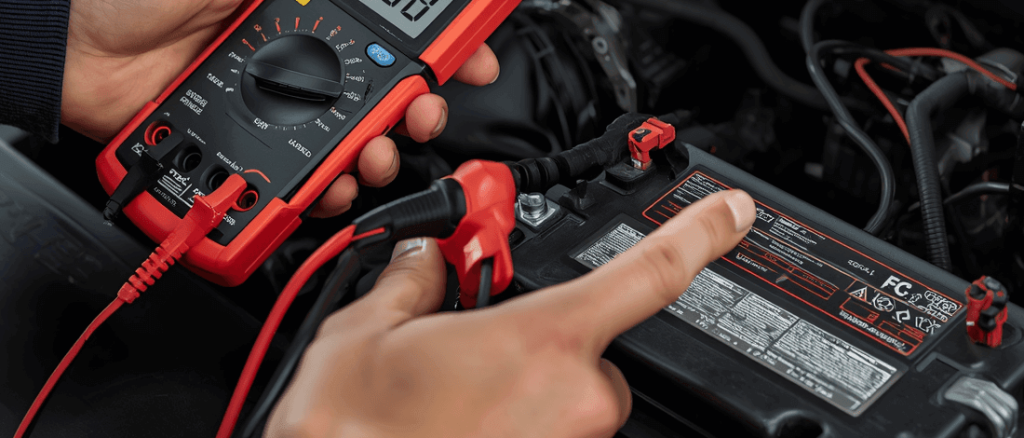
Set the dial to DC amperes. Select the 10A range (or 20A if available). Connect the red lead to the amperes input port and the black lead to the common (COM) port. Do this before you touch the battery.
Step 2 — Prepare the car
Turn everything off. Remove the key or place a keyless vehicle in full sleep mode. Close all doors — or use a clip or small piece of tape to hold each door’s jamb switch in the depressed position. This keeps interior lights from turning on while you work with the door open. You need them off.
Step 3 — Connect the meter in series
Disconnect the negative battery cable from the battery terminal. Now you have two ends that are no longer connected: the cable end and the battery post. Place one meter lead on the battery’s negative post and the other on the disconnected negative cable. Current must flow through the meter for it to read — this is called a series connection. Do not short the leads together.
Step 4 — Wait
Do not touch anything. Do not open a door. Do not turn on a light. Wait 20–30 minutes minimum. Watch the reading drop as modules enter sleep mode. When the reading stabilizes and stops dropping, that’s your actual parasitic draw number.
Step 5 — Read the measurement
Under 85 mA: normal. No parasitic drain.
85–100 mA: borderline — worth monitoring, especially on older batteries.
Above 100 mA: abnormal. Investigate.
Above 300 mA: significant drain. Battery will die in 24–48 hours.
Above 1,000 mA (1 amp): severe drain. Battery will likely be dead by morning.
Step 6 — Pull fuses to isolate the circuit
If the reading is abnormal, locate your fuse boxes — typically one under the hood and one inside the cabin. Start with the cabin fuse box. Pull one fuse at a time while watching the multimeter. When removing a fuse causes the reading to drop significantly, you’ve identified the circuit that contains the drain. Note that fuse and its label, reinstall it, and continue pulling other fuses — there may be more than one problem circuit.
Step 7 — Document your findings
Write down every fuse that caused a notable drop in reading. If one fuse drops the reading from 350 mA to 50 mA, you’ve likely found the primary source. If pulling several fuses each reduces the reading by 50–80 mA, you may have multiple simultaneous drains.

How to Find Which Component Is Draining the Battery
Finding the fuse is step one — not the finish line. A fuse protects a circuit, and a circuit can contain several components: switches, relays, modules, and accessories. You still need to identify which part on that circuit is actually drawing the excess current.
Once you know the circuit, the investigation changes depending on what the fuse label says:
Interior lights circuit: Check every light on that circuit physically — dome lights, vanity mirrors, glove box, trunk, under-hood light. Open each one and verify the bulb goes out. If one stays on, press the associated switch manually and see if it extinguishes. A door jamb switch that’s stuck, corroded, or misaligned will hold the circuit on continuously.
Accessory or power outlet circuit: Check everything plugged into 12V outlets — dashcams, phone chargers, tire inflators. Many vehicles power accessory outlets from a constant circuit rather than an ignition-switched one. Anything plugged in draws continuously.
BCM, infotainment, or module circuit: This is where it gets harder. If the drain is traced to a module circuit, the module may have a software glitch, a failed sleep routine, or a sensor that keeps waking the network. A professional scan tool that can monitor CAN bus traffic is the most reliable next step here.
Aftermarket accessories: Any circuit that feeds an alarm, remote start, dashcam, or audio system added after the factory build is a prime suspect. These are commonly wired to constant power rather than switched power — intentionally or by mistake.
The Most Common Causes of Parasitic Battery Drain
Interior Lights That Won’t Shut Off
A dome light, glove box light, trunk light, or vanity mirror light stuck in the on position draws 1–3 amps continuously — enough to drain most batteries in under 12 hours. The light itself is rarely the problem. Usually it’s a door jamb switch that’s stuck, corroded, or physically misaligned after a door repair or panel removal.
Walk around the car after dark and look for any illumination with all doors closed. A dome light that stays on is visible through the glass. A trunk light is harder to catch — open the trunk in a dark area and see if the light goes out when the lid closes.
Electronic Modules That Won’t Enter Sleep Mode
This is the most common cause in vehicles built in the last decade — and the hardest to catch. The BCM, infotainment head unit, Bluetooth module, telematics system, or any other control module can develop a fault that prevents it from entering sleep mode. Instead of dropping to 2–5 mA in standby, it stays at its full operating draw of 100–300 mA.
The module isn’t broken in the traditional sense — it powers on and runs normally. It just won’t go to sleep. This is why these modules pass every standard parts-store test and yet the battery keeps dying.
Aftermarket Accessories Wired to Constant Power
A dashcam running in parking mode, a remote start system with a wiring error, an aftermarket alarm, or a subwoofer amplifier wired directly to the battery instead of through an ignition-switched relay — all of these will draw continuously with the engine off. The clue is usually timing: the battery drain started right after an accessory was installed.
Stuck Relays
A relay is an electrically controlled switch. When it sticks in the closed (on) position, it holds whatever circuit it controls powered even with the key out of the ignition. Common relay-driven circuits include fuel pumps, cooling fans, fog lights, and accessory power. A stuck relay draws the current of whatever component it’s supposed to be switching — which can range from 50 mA to several amps.
Alternator Diode Failure
This one doesn’t come from a circuit at all — it comes from the alternator itself. See the dedicated section below.

What If the Draw Is Intermittent?
You ran the test correctly. You waited. The reading was 45 mA — well within normal range. Two days later, the battery is dead again.
This is an intermittent parasitic draw, and it’s the most difficult version to diagnose. The draw exists, but it doesn’t appear on demand. It might only happen after the car has been sitting for more than 24 hours. It might only trigger in cold weather, when a module’s sleep routine behaves differently at low temperatures. It might only occur when a specific CAN bus event — like an incoming Bluetooth ping or a faulty sensor reading — wakes a sleeping module and it never goes back down.
The sit test is the right move here. After fully charging the battery, set up your multimeter in series and leave it connected overnight — 24 to 48 hours without opening a door or disturbing the car. Check the reading periodically. If the draw spikes at some point during the sit, you’ve caught the intermittent event and can then begin pulling fuses to locate the circuit.
A few other things worth checking when the draw won’t reproduce:
Check whether the draw appears only with certain weather conditions — cold nights specifically. Some module sleep faults are temperature-sensitive.
Verify the most recent change to the vehicle before the problem started. A new accessory, a software update, a repair that involved electrical connectors — any of those is a reasonable starting point.
If the sit test keeps coming back normal but the battery keeps dying, consider that the battery itself may have reduced capacity from prior deep-discharge events. A battery that passes a standard load test can still have reduced cold-cranking amps from repeated draining. Have it tested with a conductance tester — a more thorough assessment than a simple load test.
Is It the Alternator? The Diode Drain Test
The fuse-pull method finds circuit draws — but there’s a category of parasitic drain that won’t respond to fuse pulling at all, because it doesn’t come from a fuse-protected circuit. It comes from the alternator.
Inside every alternator is a set of diodes — typically six, arranged in what’s called a rectifier bridge. Their job is to convert AC power from the alternator’s windings into DC power for the battery and electrical system. They also act as one-way valves: current flows from the alternator to the battery, not the other way. When a diode fails, that one-way valve fails with it. Current can now flow backward — from the battery, through the failed diode, and into the alternator’s windings. That reverse flow is a parasitic drain.
The result is a dead battery after sitting, with the fuse-pull test showing no significant change regardless of which fuse you pull.
Here’s how to test for it:
With your multimeter still connected in series showing the parasitic draw, locate the main output wire on the back of the alternator — the large wire connected to the B+ terminal. Disconnect it carefully. Watch the multimeter reading.
If the current draw drops significantly when the alternator is disconnected, the alternator is the drain source. Reconnect the cable and schedule an alternator replacement — not a battery. If the draw doesn’t change when the alternator is disconnected, the drain is elsewhere and the fuse-pull method is the correct path.
This test is worth doing early in the diagnostic process — before spending an hour pulling fuses — especially if the battery dies after sitting 48+ hours but the fuse test keeps coming back clean.

DIY or Take It to a Shop?
| Task | DIY | Take to a Shop |
|---|---|---|
| Running the multimeter draw test | ✅ Straightforward with basic tools | If you don’t own a multimeter |
| Fuse-pull circuit identification | ✅ Anyone can do this | — |
| Tracing a stuck light or door switch | ✅ Usually straightforward | — |
| Alternator diode isolation test | ✅ If comfortable with the B+ cable | If uncertain around battery cables |
| Identifying a module that won’t sleep | ⚠️ Possible but limited without scan tool | ✅ Scan tool needed for CAN bus monitoring |
| Intermittent draw that won’t reproduce | ❌ Extremely difficult without professional equipment | ✅ Shop with data logging capability |
| Wiring harness fault or damaged wire | ⚠️ Possible with wiring diagram | ✅ Wiring diagrams + experience required |
The fuse-pull test and the alternator isolation test are genuinely DIY-friendly. A $25 multimeter handles both. Where DIY runs into a wall is when the drain traces to a module that requires a scan tool to monitor network traffic — or when the draw is intermittent and only appears after the car sits for 48 hours in specific conditions.
Shop diagnostic rates run $75–$150 per hour. A parasitic draw diagnosis on a straightforward case — stuck light, clearly labeled fuse — might take an hour. A complex intermittent module drain can take 3–4 hours of diagnostic time and still not reproduce during the appointment. Budget $150–$300 for a standard diagnostic. Budget $400–$600 for a complex intermittent case. Those numbers don’t include the repair itself, which varies entirely by what’s found.
FAQs About How to Find Parasitic Battery Drain
Q: What is a normal parasitic battery drain?
Normal parasitic draw ranges from 25 to 85 milliamps (mA) once all modules have entered sleep mode — typically 20–30 minutes after the ignition is turned off. Older vehicles with fewer electronics usually fall under 50 mA. Newer vehicles with connected infotainment, telematics, and keyless entry systems can run up to 85 mA and still be within spec. Anything consistently above 100 mA after the sleep wait is abnormal and worth investigating.
Q: How long do I have to wait before testing for parasitic draw?
At minimum 20–30 minutes after the last time any door was opened or any switch was touched. On modern vehicles with heavy electronics — particularly trucks and SUVs with factory telematics or connected apps — wait 45 minutes to be safe. Opening a door resets the sleep cycle, so if you disturb the car during the wait, the clock starts over. Patience here prevents false positives that send you chasing problems that don’t exist.
Q: Can a dashcam cause parasitic battery drain?
Yes. Dashcams running in parking mode draw continuous current — typically 200–500 mA depending on the model and resolution. If the dashcam is hardwired to a constant-power circuit rather than an ignition-switched one, it draws that current 24 hours a day. A dashcam hardwire kit with a built-in low-voltage cutoff ($20–$40) automatically disconnects the camera when battery voltage drops below a set threshold — usually 12V — preventing complete drain. If the dashcam is the drain source, this is the correct fix.
Q: Can a bad alternator cause parasitic battery drain?
Yes, through failed diodes. A healthy alternator diode allows current to flow in one direction only — from the alternator to the battery. When a diode fails, reverse current flows from the battery into the alternator windings when the engine is off, slowly draining the battery. This won’t show up in the fuse-pull test because the drain bypasses the fuse panel entirely. The isolation test — disconnecting the alternator’s main B+ output cable while the multimeter reads the draw — confirms or rules it out.
Q: What if I pull every fuse and the draw doesn’t change?
If pulling all fuses leaves the reading unchanged, the drain is not in any fuse-protected circuit. The most likely sources at that point are a failed alternator diode (test the alternator isolation next), a battery with an internal fault that’s self-discharging, or a wiring short between the battery positive terminal and a chassis ground that bypasses the fuse panel entirely. Any of these scenarios is worth a shop visit — the equipment needed to pinpoint them goes beyond a basic multimeter.
The Bottom Line
Parasitic battery drain is solvable — but not by replacing the battery again. The battery is the victim, not the cause.
Run the test correctly: wait for modules to sleep, start your meter on the 10A range, connect it in series, and let the reading stabilize. If it’s above 100 mA, pull fuses one at a time until you find the circuit. If the fuse pull doesn’t change the reading, test the alternator isolation before going further.
Most parasitic drains trace back to one of a handful of causes — a stuck interior light, a module that won’t sleep, an aftermarket accessory on constant power, or a failed alternator diode. None of those require replacing the battery. They require finding the source and fixing it once.
If the draw is intermittent and won’t reproduce during a standard test, the sit test is your best move before paying a shop for hours of diagnostic time that might not catch it either.