
This article was updated in May 10, 2026 with new products and information by Mark S. Taylor
Your car won’t start. The dashboard lights up, the battery seems fine, but when you turn the key — nothing. No crank, no click, just silence. Then you try it in neutral instead of park, and the engine fires right up. You’ve got a neutral safety switch problem. Now you’re searching for how to reset it. Here’s the truth most articles won’t tell you upfront: most neutral safety switches can’t actually be “reset.” But they CAN be adjusted, and on newer vehicles, they can be recalibrated. Let me explain the difference and walk you through exactly what to do.
Quick Answer: You cannot reset a neutral safety switch in the traditional sense — there’s no reset button. On older vehicles with mechanical switches, you adjust the switch position instead of resetting it. On newer vehicles with electronic transmission range sensors, a calibration or relearn procedure using an OBD2 scanner may be required. If adjustment or calibration doesn’t work, the switch likely needs replacement.

Contents
- 1 Can You Actually Reset a Neutral Safety Switch?
- 2 Symptoms That Point to a Neutral Safety Switch Problem
- 3 Before You Adjust Anything: Check the Shift Cable First
- 4 How to Adjust a Mechanical Neutral Safety Switch
- 4.1 Tools you’ll need:
- 4.2 Step 1: Locate the switch
- 4.3 Step 2: Mark the original position
- 4.4 Step 3: Loosen the mounting bolts
- 4.5 Step 4: Put the transmission in Park or Neutral
- 4.6 Step 5: Adjust the switch position
- 4.7 Step 6: Test before tightening
- 4.8 Step 7: Tighten the bolts
- 4.9 Step 8: Test all positions
- 5 How to Calibrate an Electronic Transmission Range Sensor
- 6 How to Test a Neutral Safety Switch
- 7 When to Replace Instead of Adjust
- 8 How Much Does Neutral Safety Switch Replacement Cost?
- 9 Can You Bypass the Neutral Safety Switch?
- 10 DIY vs Mechanic: Should You Attempt This Yourself?
- 11 FAQs About Hot To Resetting Neutral Safety Switches
- 12 The Bottom Line
Can You Actually Reset a Neutral Safety Switch?
I get this question a lot in the shop. Someone googles “reset neutral safety switch” expecting a simple button press or battery disconnect fix.
That’s not how it works.
Mechanical neutral safety switches (most vehicles before 2010ish) are simple on/off switches. They don’t have computers, memory, or reset functions. When they fail, you either adjust their position or replace them. Period.
Electronic transmission range sensors (newer vehicles) are different. These are more sophisticated and communicate with the transmission control module. Some of these CAN be recalibrated or “relearned” using a scan tool after replacement or adjustment.
Disconnecting your battery will NOT reset a mechanical neutral safety switch. I’ve had customers try this. It doesn’t work because the switch has no electronics to reset.
So when people say “reset,” they usually mean one of three things:
- Adjust the switch position (mechanical)
- Calibrate the sensor (electronic)
- Replace the switch entirely
Let’s cover all three scenarios.
Symptoms That Point to a Neutral Safety Switch Problem
Before you start adjusting anything, make sure you’re actually dealing with a neutral safety switch issue. Here are the telltale signs:
The classic symptom: Car starts in neutral but not park
This is the number one indicator. Your engine cranks and starts fine when you move the shifter to neutral, but nothing happens in park. The switch has drifted out of alignment and no longer recognizes the “park” position.
Other symptoms include:
- No crank in park OR neutral (switch has failed completely)
- Intermittent no-start that seems random (switch contacts are worn)
- Backup lights don’t work (backup light circuit often runs through the same switch)
- Backup lights stay on constantly (misaligned switch)
- Gear selector indicator doesn’t match actual gear position
- Engine cranks when shifter is in reverse or drive (dangerous — stop driving immediately)
Quick diagnostic trick: Try starting the car while slowly moving the shifter between park and neutral. If it catches and starts somewhere in between, the switch is misaligned or failing.
If your car does absolutely nothing in ANY position — park, neutral, or anywhere in between — the problem might not be the neutral safety switch. It could be the battery, starter, or ignition switch. Check our complete no-start troubleshooting guide to narrow it down.
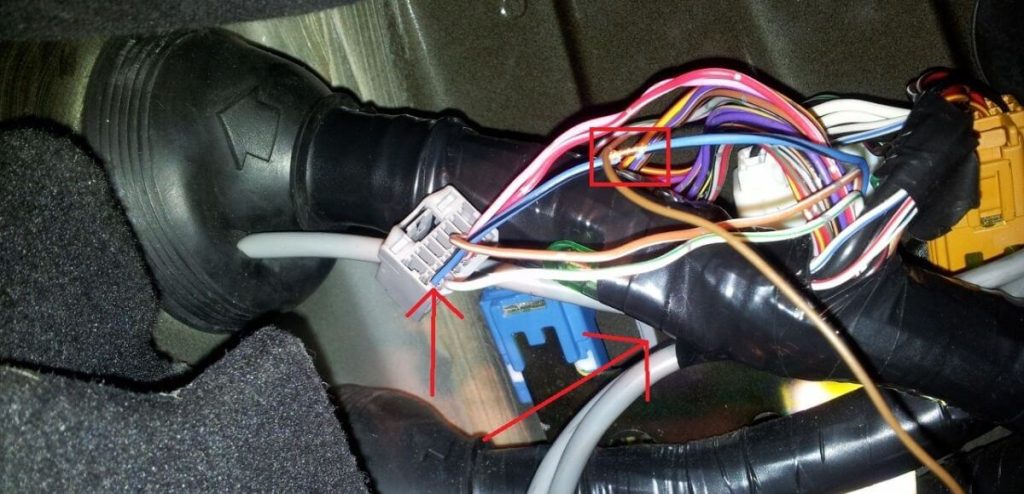
Before You Adjust Anything: Check the Shift Cable First
This is the step most people skip. And it’s often the actual fix.
The shift cable connects your gear selector to the transmission. Over time, this cable stretches. When it stretches, the shifter says “park” but the transmission isn’t quite in park. The neutral safety switch is doing its job — it’s not getting the park signal because the transmission isn’t actually there.
How to check shift cable alignment:
- Turn the key to ON (don’t start the engine)
- Move the shifter to park
- Look at the gear indicator on your dashboard — does it line up exactly with “P”?
- Now look at the transmission lever (you may need to look under the hood) — is it fully against the park stop?
- Try moving the shifter slightly toward reverse while holding the key in START — does it crank?
If the indicator is slightly off or you can start by nudging the shifter, your cable is probably stretched. This is a much simpler (and cheaper) fix than replacing the switch.
Shift cable adjustment varies by vehicle, but it typically involves loosening a lock nut on the cable attachment, moving the shifter to park, adjusting the cable until everything lines up, and tightening it back down. Some cables have an automatic adjuster; others need manual adjustment.
If the cable is properly adjusted and you’re still having problems, then move on to the neutral safety switch itself.
How to Adjust a Mechanical Neutral Safety Switch
This applies to most vehicles from the 1990s through early 2010s with traditional automatic transmissions. The procedure is similar across most vehicles, but always check a service manual for your specific make and model.
Tools you’ll need:
- Socket set (usually 10mm-14mm)
- Wrenches
- Jack and jack stands (if switch is on the side/bottom of transmission)
- Marker or paint pen (to mark original position)
- Helper (optional but helpful)
Time estimate: 30-60 minutes
Step 1: Locate the switch
The neutral safety switch is typically mounted on the side of the transmission where the shift linkage attaches. Follow the shift cable from the shifter to where it connects to the transmission — the switch is right there.
On some vehicles (especially front-wheel-drive), it’s accessible from above. On others (rear-wheel-drive trucks and SUVs), you’ll need to get underneath.
Step 2: Mark the original position
Before touching anything, use a marker or paint pen to mark the switch position relative to the transmission. This gives you a reference point if you need to go back to where you started.
Step 3: Loosen the mounting bolts
Most neutral safety switches are held by two bolts. The bolt holes are often slotted, which allows adjustment. Loosen the bolts — don’t remove them completely.
Step 4: Put the transmission in Park or Neutral
Some procedures specify park, others neutral. Check your service manual. I usually start with park since that’s the position causing problems.
Step 5: Adjust the switch position
Gently rotate or slide the switch until you feel it “click” into the detent position for park (or neutral). You’ll feel a definite notch where the switch aligns with that gear position.
Step 6: Test before tightening
Have your helper try to start the car while you hold the switch in position. If it cranks, you’re in the right spot. If not, try adjusting slightly one direction or the other.
Step 7: Tighten the bolts
Once you find the position where the car starts reliably, carefully tighten the mounting bolts while holding the switch in place. Don’t let it move.
Step 8: Test all positions
Start the car in park. Then try neutral. Then make sure it does NOT start in reverse or drive. If it starts in gear, you’ve adjusted it wrong and need to redo it. This is a safety-critical adjustment.

How to Calibrate an Electronic Transmission Range Sensor
Newer vehicles (roughly 2010 and up, though it varies by manufacturer) often use an electronic transmission range sensor instead of a simple mechanical switch. This sensor tells the computer what gear the transmission is in, and the computer decides whether to allow starting.
These sensors sometimes need calibration after replacement, after battery disconnection, or after transmission work.
Simple relearn (some vehicles):
Some vehicles have a basic relearn procedure that doesn’t require a scanner:
- Turn the key to ON (not start)
- Slowly move the shifter through all positions: P-R-N-D-3-2-1 (or whatever your pattern is)
- Hold each position for 3-5 seconds
- Return to park
- Turn key off
- Wait 30 seconds
- Start the engine and test
This works on some GM and Ford vehicles. Check your specific application.
Scan tool relearn (most vehicles):
Many newer vehicles require an OBD2 scanner with bi-directional control to perform the range sensor relearn. The procedure goes something like this:
- Connect scan tool and access the transmission control module
- Navigate to “Transmission Range Sensor Learn” or “TR Sensor Calibration”
- Follow the on-screen prompts (usually involves cycling through gears)
- The scanner will confirm when calibration is complete
If you don’t have a capable scanner, you have two options:
- Take it to a mechanic or dealership for calibration (they’ll charge 0.5-1 hour labor)
- Buy a scanner that can do it ( cheaper scanners can’t — you need one with bi-directional control, like an Autel or high-end OBDLink)
Vehicles that commonly require scan tool calibration:
- Most BMWs (2000+)
- Most Mercedes-Benz (2000+)
- Many newer Fords with electronic shifters
- GM vehicles with 6-speed+ transmissions
- Most Honda/Acura with push-button start
- Most Toyota/Lexus with electronic shifters
How to Test a Neutral Safety Switch
Before replacing anything, test the switch to confirm it’s actually bad.
What you’ll need:
- Digital multimeter ($20-30)
- Test leads with alligator clips (helpful)
- Wiring diagram for your vehicle (Google search or service manual)
Test 1: Continuity test
This is the most straightforward test for a mechanical switch.
- Disconnect the electrical connector from the neutral safety switch
- Set your multimeter to continuity mode (the beeping setting)
- Identify which terminals correspond to park and neutral (use your wiring diagram)
- Put the transmission in park
- Touch your meter leads to the park terminals
- You should have continuity (beep) in park
- Move to neutral — continuity should switch to the neutral terminals
- Move to reverse or drive — you should NOT have continuity on any circuit
If the switch shows continuity when it shouldn’t, or no continuity when it should, it’s bad.
Test 2: Voltage test
This tests the circuit while it’s connected.
- Turn the key to ON
- Back-probe the connector at the neutral safety switch
- You should have power on the input terminal
- With the transmission in park, check for power on the output terminal
- If you have power in but no power out in park (or neutral), the switch isn’t completing the circuit
Test 3: Backup light test
Since backup lights often run through the same switch, this is an easy clue:
- Turn the key to ON
- Put the transmission in reverse
- Check if backup lights come on
- If backup lights don’t work AND you have starting problems, the switch (or its wiring) is likely the culprit
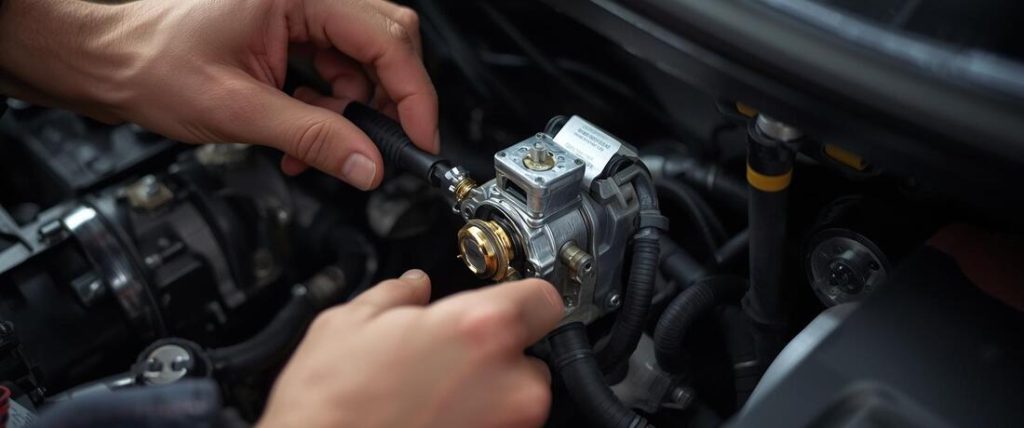
When to Replace Instead of Adjust
Adjustment works when the switch is fine but has drifted out of position. Replacement is necessary when the switch itself has failed internally.
Replace if you see:
- Corroded or damaged connector terminals
- Physical damage to the switch body (cracks, melted plastic)
- Oil or fluid contamination inside the switch
- Burnt smell or discoloration
- No continuity in any position (completely failed)
- Adjustment doesn’t fix the problem
Signs the switch is too far gone:
If you’ve adjusted the switch and it’s still intermittent, the internal contacts are probably worn or pitted. No amount of adjustment will fix that. Time for a new one.
Replacement difficulty varies:
- Easy (30 minutes): Switch is accessible from above, simple connector, two bolts
- Moderate (1-2 hours): Need to get underneath, may need to remove other components
- Hard (2+ hours): Buried under intake manifold, requires transmission removal (rare but possible on some vehicles)
How Much Does Neutral Safety Switch Replacement Cost?
Here’s what you’re looking at if adjustment doesn’t work and you need replacement.
| Vehicle Type | Parts Cost | Labor Cost | Total Range |
|---|---|---|---|
| Domestic compact/midsize | $30-$80 | $75-$150 | $105-$230 |
| Import compact/midsize | $50-$150 | $100-$200 | $150-$350 |
| Domestic full-size/truck | $40-$100 | $100-$200 | $140-$300 |
| Import full-size/luxury | $100-$300 | $150-$400 | $250-$700 |
| European luxury | $150-$500 | $200-$500 | $350-$1,000 |
Why such a wide range?
Parts pricing depends on whether you buy OEM, quality aftermarket, or cheap aftermarket. Labor depends on how hard the switch is to reach. A Honda Civic with the switch right on top of the transmission is cheap. A BMW with the sensor buried deep in the bell housing is expensive.
OEM vs aftermarket:
For neutral safety switches, I generally recommend OEM or quality name-brand aftermarket (Standard Motor Products, Dorman, etc.). Cheap no-name switches often have quality control issues and may not adjust properly or last long.
Can You Bypass the Neutral Safety Switch?
People ask me this all the time. They’re frustrated, stranded, or just don’t want to pay for the fix.
Technically yes. Practically, don’t do it.
The neutral safety switch exists to prevent your car from starting in gear. If you bypass it, you could:
- Lunge forward or backward when you turn the key
- Crash into your garage wall, another car, or a person
- Damage your starter or transmission
This is especially dangerous if you ever accidentally leave the car in gear, or if a child gets in and turns the key.
Legal implications: If you bypass the safety switch and your car injures someone, you could face liability. It’s a safety device, and disabling safety devices can be legally problematic.
That said, here’s how people do it (for informational purposes only):
On mechanical switches, the two terminals that close in park/neutral can be jumped with a wire, bypassing the switch. This allows starting in any position.
On electronic systems, it’s much harder to bypass and not recommended.
My advice: Don’t bypass it. If adjustment doesn’t work, replace the switch. The cost is reasonable compared to the risk.
DIY vs Mechanic: Should You Attempt This Yourself?
Easy jobs (difficulty 2/5):
- Older domestic vehicles with the switch accessible from above
- Simple two-bolt adjustment
- No special tools required
If you can change your own oil and own a basic socket set, you can probably handle this.
Moderate jobs (difficulty 3-4/5):
- Most import vehicles
- Switch requires getting underneath the vehicle
- May need to remove other components for access
- Electronic sensors requiring scan tool calibration
Fine for experienced DIYers, but you’ll need a jack, jack stands, and possibly a scan tool.
Hard jobs (difficulty 5/5):
- European luxury vehicles
- Sensors buried deep in the transmission
- Vehicles requiring dealer-level scan tools for calibration
- Anything that requires transmission removal
Unless you have professional experience, pay a mechanic for these.
Call a mechanic if:
- You can’t safely reach the switch
- You don’t have the right tools
- Adjustment doesn’t fix the problem and you’re unsure about replacement
- Your vehicle requires scan tool calibration you can’t perform
- You’ve already spent more than an hour without success
Sometimes paying $150-200 for a professional is smarter than spending your whole Saturday under a car, only to realize you need a special tool anyway.
FAQs About Hot To Resetting Neutral Safety Switches
Can you reset a neutral safety switch?
No, not in the traditional sense. Mechanical neutral safety switches have no reset function — they can only be adjusted or replaced. Electronic transmission range sensors on newer vehicles may require calibration or a relearn procedure using an OBD2 scanner.
How do I adjust a neutral safety switch?
Loosen the mounting bolts (which are in slotted holes), rotate or slide the switch until it aligns with the park or neutral detent position, then tighten the bolts while holding it in place. Test that the car starts in park/neutral but NOT in gear before finishing.
Why does my car start in neutral but not park?
This usually means the neutral safety switch is misaligned or failing. It could also indicate a stretched shift cable that isn’t fully engaging the park position. Check shift cable alignment first, as it’s a simpler fix.
Where is the neutral safety switch located?
It’s typically mounted on the side of the transmission where the shift linkage connects. Follow the shift cable from your gear selector to the transmission — the switch is at that connection point. On some vehicles, it’s accessible from above; on others, you’ll need to get underneath.
How much does it cost to replace a neutral safety switch?
For most vehicles, expect to pay $150-$350 total including parts and labor. Simple domestic vehicles may be as low as $100, while European luxury vehicles can exceed $700 due to parts cost and difficult access.
The Bottom Line
The term “reset neutral safety switch” is a misnomer that sends people down the wrong path. Most switches can’t be reset — they can be adjusted if they’ve drifted out of position, or replaced if they’ve failed internally. On newer vehicles with electronic sensors, calibration with a scan tool may be required.
Before assuming the switch is bad, check your shift cable. A stretched cable is a common cause of “starts in neutral but not park” symptoms, and it’s often a simpler fix.
If adjustment doesn’t solve the problem, test the switch with a multimeter to confirm failure before buying parts. And whatever you do, don’t bypass the safety switch — the risk isn’t worth it.
Most neutral safety switch issues are straightforward fixes that a competent DIYer can handle in under an hour. But if you’re unsure or your vehicle requires scan tool calibration, there’s no shame in letting a professional handle it.
Quick Summary
- You can’t “reset” a mechanical neutral safety switch — you adjust it or replace it
- Electronic transmission range sensors may require calibration with an OBD2 scanner
- Check the shift cable first — stretching is often the real cause of starting problems
- Classic symptom: car starts in neutral but not park
- Adjustment procedure: loosen bolts, align with detent, tighten, test all positions
- Replacement cost typically ranges from $150-$350 for most vehicles
- Don’t bypass the switch — it’s a critical safety device that prevents starting in gear