
This article was updated in April 29, 2026 with new products and information by Mark S. Taylor
You turn the key. Nothing happens. Your battery is fine. Your starter tested good. So what’s going on? The answer might be a small electrical component called the neutral safety switch. This switch is your car’s gatekeeper. It prevents the engine from starting unless the transmission is in Park or Neutral. When it fails, it creates symptoms that are easy to misdiagnose. This guide explains every warning symptoms of a bad neutral safety switch, shows you how to confirm the problem, and tells you exactly how much it will cost to fix.

⛔ SAFETY ALERT — Read This First: One failure mode of a bad neutral safety switch allows your engine to crank and start while in Drive or Reverse. If your car ever starts in gear — do not start it again until the switch is replaced. The vehicle could lurch forward or backward instantly, injuring people or causing an accident.
Contents
- 1 What Does a Neutral Safety Switch Do?
- 2 Is It the NSS, a Dead Battery, or a Bad Starter? — Check This First
- 3 7 Symptoms of a Bad Neutral Safety Switch
- 3.1 1. Engine Won’t Start in Park (But Starts Fine in Neutral)
- 3.2 2. Engine Won’t Start in Neutral (But Starts in Park)
- 3.3 3. Engine Won’t Crank in Any Gear — Complete No-Start
- 3.4 4. Engine Cranks and Starts in Drive or Reverse (Most Dangerous Symptom)
- 3.5 5. Intermittent No-Start — Works Sometimes, Fails Others
- 3.6 6. Reverse Lights Don’t Work (Or Stay On in Wrong Gear)
- 3.7 7. Gear Indicator (PRNDL) Not Displaying Correctly on Dashboard
- 3.8 Bonus Symptom — Sluggish Shifting or Transmission Acting Oddly
- 4 Symptom Urgency Scale — At a Glance
- 5 What Causes a Neutral Safety Switch to Fail?
- 6 Where Is the Neutral Safety Switch Located?
- 7 How to Test the Neutral Safety Switch (3 Methods)
- 8 Misalignment vs. Actual Failure — Should You Adjust or Replace?
- 9 Neutral Safety Switch Replacement Cost
- 10 Is It Safe to Drive With a Bad Neutral Safety Switch?
- 11 FAQs About Symptoms of a Bad Neutral Safety Switch
- 12 The Bottom Line
What Does a Neutral Safety Switch Do?
The neutral safety switch is a small electrical switch on your transmission. It allows the starter circuit to complete only when the gear selector is in Park or Neutral. It is also known as a park/neutral position (PNP) switch or inhibitor switch. On many vehicles, it also controls the reverse lights and the gear position indicator on your dashboard. You will find this on all automatic transmission vehicles. Manual transmissions use a clutch safety switch instead.
Is It the NSS, a Dead Battery, or a Bad Starter? — Check This First
It can be hard to tell which part is bad. Use this table to rule out a dead battery or bad starter first.
| Clue | Dead Battery | Bad Starter | Bad NSS |
|---|---|---|---|
| No crank + dim/dead lights | ✅ Battery | ❌ No | ❌ No |
| No crank + lights/radio fully work | ❌ No | ✅ Possible | ✅ Very likely |
| Single loud click, no crank | ❌ No | ✅ Starter | ❌ Sometimes |
| Rapid clicks + headlights dim | ✅ Battery | ❌ No | ❌ No |
| Slow crank, struggling to turn over | ✅ Battery | ✅ Starter | ❌ No |
| Starts in Neutral, not Park | ❌ No | ❌ No | ✅ NSS |
| Starts in Park, not Neutral | ❌ No | ❌ No | ✅ NSS |
| Starts in Drive or Reverse | ❌ No | ❌ No | ✅ NSS (dangerous) |
| Works after wiggling gear lever | ❌ Unlikely | ❌ No | ✅ NSS misalignment |
| Intermittent — sometimes works, sometimes doesn’t | ❌ Unlikely | ✅ NSS very common |
💡 Key rule from NAPA: If your engine is cranking in Park and Neutral but not starting, that isn’t the neutral safety switch’s fault. The switch only prevents power from reaching the starter motor, so if that’s cranking, look elsewhere for a culprit.
7 Symptoms of a Bad Neutral Safety Switch
1. Engine Won’t Start in Park (But Starts Fine in Neutral)
This is the most commonly reported NSS symptom. The Park position contact inside the switch is worn, corroded, or misaligned. This means the circuit stays open and no signal reaches the starter. Drivers often discover the problem by trying Neutral as a workaround. If you consistently need to shift into Neutral just to get the car started, your switch may be misaligned or failing.
Urgency: 🟠 Moderate — workable short-term; diagnose and fix soon.
2. Engine Won’t Start in Neutral (But Starts in Park)
The Neutral position contact fails independently of the Park contact. When the vehicle cranks in park but not neutral, it is typically due to a faulty neutral safety switch. In this case, the switch is experiencing an internal component failure where it activates in one gear but not the other. This can also be caused by a loose switch needing adjustment rather than full replacement.
Urgency: 🟠 Moderate — confirm alignment before buying a new switch.
3. Engine Won’t Crank in Any Gear — Complete No-Start
The NSS has failed in open circuit mode. No signal reaches the starter relay at all. The result is complete silence when you turn the key — no crank, no click from the starter. Sometimes the car won’t start at all, as there is no crank regardless of gear position. This is because the switch isn’t sending the correct signal to the engine. It can be confused with a dead battery. If the lights and radio work, it is likely the NSS.
Urgency: 🔴 Serious — vehicle is undrivable; diagnose promptly.
4. Engine Cranks and Starts in Drive or Reverse (Most Dangerous Symptom)
The NSS has failed in short circuit mode. It allows the starter signal through regardless of gear position. The most obvious symptom of a bad neutral safety switch is when you can crank the engine in any gear. You could have the gear set to Drive or Reverse and still be able to crank it. This could lead to a serious car accident if this happens while you’re driving.
⛔ Do NOT start the vehicle again. Do not “test” this further. Call a mechanic or tow the vehicle immediately.
Urgency: ⛔ Critical — immediate safety risk.
5. Intermittent No-Start — Works Sometimes, Fails Others
This is one of the most frustrating and most misdiagnosed NSS failure patterns. Road vibration, temperature changes, or minor gear selector movement temporarily disrupt the NSS contact. A failing neutral safety switch can cause frustrating and sometimes dangerous issues with starting. The car might not start at all in the morning, but start fine after lunch. A simple fix is often checking the alignment or adjustment first.
Urgency: 🟠 Moderate — degrades over time; don’t let it strand you.
6. Reverse Lights Don’t Work (Or Stay On in Wrong Gear)
On many vehicles, the NSS also controls the reverse light circuit. A failing switch can cause reverse lights to fail to illuminate in Reverse. They might also stay on while the car is in Drive or behave inconsistently. This is a safety issue because other drivers won’t know you are backing up. Don’t assume immediately that a bulb is blown or a fuse is bad. Confirm with a multimeter before replacing the NSS.
Urgency: 🟡 Minor — safety concern for reversing visibility; fix soon.
7. Gear Indicator (PRNDL) Not Displaying Correctly on Dashboard
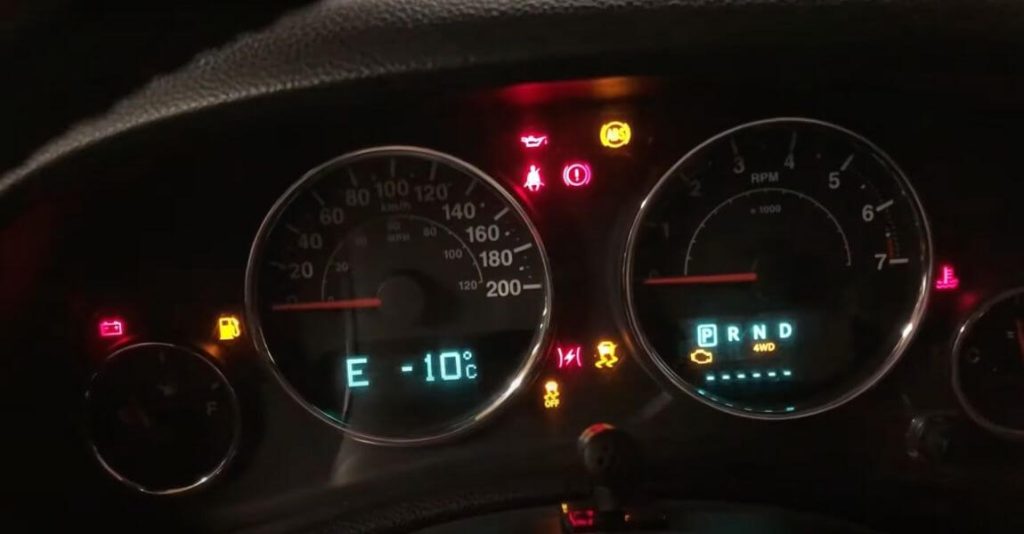
The NSS provides gear position data to the instrument cluster. A failing switch can cause P not lighting up when in Park. It might also show R when in Drive, or blink erratically while driving. This confirms the NSS diagnosis. The Check Engine light may also illuminate with specific error codes. This is a minor annoyance that confirms the switch needs work.
Urgency: 🟡 Minor-Moderate — confirms NSS diagnosis; fix when convenient.
Bonus Symptom — Sluggish Shifting or Transmission Acting Oddly
The NSS often doubles as or integrates with the Transmission Range Sensor (TRS). A failing switch can send incorrect gear position data to the ECU. This can lead to sluggish or unresponsive gear changes. The transmission might shift late, fail to engage, or get stuck in Neutral. These symptoms are often misdiagnosed as transmission problems. Check the NSS first before assuming a more expensive transmission repair.
Urgency: 🟠 Moderate — rule out NSS before transmission work.
Symptom Urgency Scale — At a Glance
| Symptom | Severity | Action |
|---|---|---|
| Reverse lights not working | 🟡 Minor | Verify cause; repair soon |
| PRNDL dash indicator off | 🟡 Minor | Confirms NSS; repair convenient |
| Starts in Park only (not Neutral) | 🟠 Moderate | Adjust or replace |
| Starts in Neutral only (not Park) | 🟠 Moderate | Adjust or replace |
| Intermittent no-start | 🟠 Moderate | Diagnose this week |
| Sluggish shifting / stuck in Neutral | 🟠 Moderate | Rule out NSS before transmission work |
| Complete no-crank, all positions | 🔴 Serious | Vehicle undrivable; repair ASAP |
| Starts in Drive or Reverse | ⛔ Critical | Stop starting car — tow immediately |
What Causes a Neutral Safety Switch to Fail?
Internal contact wear is the main cause. The position-sensing contacts degrade over thousands of gear shifts. Corrosion and moisture are also major factors. The switch is located near the transmission, which exposes it to road splash and salt. Misalignment is another cause. The switch slowly shifts position on the linkage over time. Wiring and connector failure is common too. Loose terminals, chafed wiring, or corroded connector pins can interrupt the signal. Road vibration can loosen connections. Age and high mileage also play a role. Most switches fail after the vehicle reaches high mileage.
Where Is the Neutral Safety Switch Located?
The location depends on your vehicle type.
- Automatic (RWD): Side of transmission case or on the shift linkage.
- Automatic (FWD): On the transmission case — often accessible from under the hood.
- Older vehicles (pre-1990s): Sometimes in the steering column near the shifter.
- Floor-mounted shifter (modern): Underneath the shifter mechanism.
- Manual transmission: Clutch safety switch — mounted near the clutch pedal; starts only when clutch is fully depressed.
💡 Unsure? Search “[Year Make Model] neutral safety switch location” or check your vehicle repair manual.
How to Test the Neutral Safety Switch (3 Methods)
You can do some basic tests at home. These methods help identify the problem.
Method 1 — Position Test (30 seconds): Try starting in Park. Note the result. Then try starting in Neutral. Note the result. Starts in one but not the other? NSS contact issue confirmed.
Method 2 — Wiggle Test (1 minute): With key held in START position, gently move the gear lever between P and N. If the engine cranks after wiggling, misalignment is confirmed. It may only need adjustment, not replacement.
Method 3 — Multimeter Continuity Test:
- Disconnect the NSS wiring harness.
- Set multimeter to continuity or resistance mode.
- With shifter in Park: test terminals — should show continuity.
- With shifter in Neutral: test terminals — should show continuity.
- With shifter in Drive or Reverse: should show no continuity. Any deviation from above = switch is faulty.
💡 Pro Tip: Plug in an OBD2 scanner and check for P0705, P0706, P0850, or P084F codes. These codes specifically point to the NSS/transmission range sensor circuit.

Misalignment vs. Actual Failure — Should You Adjust or Replace?
Deciding between adjusting and replacing can be tricky. Scenario analysis helps.
| Scenario | Likely Cause | Fix |
|---|---|---|
| Starts in one position only | Misalignment likely | Loosen mounting bolt, reposition, retighten |
| Works after wiggling gear lever | Misalignment | Adjustment — no new part needed |
| Completely dead — no crank any position | Open circuit failure | Replace switch |
| Starts in any gear | Short circuit failure | Replace switch — do not delay |
| Intermittent with no pattern | Internal wear or corrosion | Replace switch |
| New switch installed but still wrong | Improper adjustment | Re-adjust new switch carefully |
💡 Always try adjustment first for position-specific symptoms before buying a replacement. Skipping this risks paying for a part you don’t need.
Neutral Safety Switch Replacement Cost
The neutral safety switch is usually cheap to fix. Most repairs come in under $350.
| Cost Component | Estimated Range | Notes |
|---|---|---|
| NSS part (aftermarket) | $20 – $60 | Most standard vehicles |
| NSS part (OEM or integrated TRS) | $60 – $250 | Modern vehicles with combined TRS/NSS unit |
| Labor (1–2 hours typical) | $80 – $250 | Depends on vehicle accessibility |
| Total (shop, typical) | $150 – $350 | Most vehicles |
| DIY (parts only) | $20 – $100 | Externally accessible on most vehicles |
💡 Good news: Unlike most transmission repairs, the neutral safety switch is usually externally accessible — no transmission removal required on most vehicles. It is one of the more DIY-friendly jobs on a car.
Is It Safe to Drive With a Bad Neutral Safety Switch?
It depends entirely on which way it has failed. Driving with a failing switch is risky.
| Failure Type | Safe to Drive? | Risk |
|---|---|---|
| Won’t start in Park / Neutral only | 🟡 Yes, short-term | Minor; avoid if switch is slipping off stud |
| Stiff pedal / vibration | 🟠 Limited driving | Fork may break suddenly; avoid highway |
| Hard to get into gear | 🔴 Minimize driving | Syncro damage risk if forced |
| Pedal on floor, car won’t move | ⛔ Do not drive | Complete failure — tow it |
FAQs About Symptoms of a Bad Neutral Safety Switch
What happens when a neutral safety switch goes bad?
A bad neutral safety switch can stop your car from starting in park or neutral. You may see no crank, random starts, or wrong gear signals. Fix it fast to avoid being stuck or unsafe starts.
How to test if a neutral safety switch is bad?
To test a neutral safety switch, try starting in park and then in neutral. If it only starts in one, the switch may be bad. You can also check voltage with a multimeter for a clear result.
Will a car run without a neutral safety switch?
A car may run without a neutral safety switch, but it is not safe. The engine could start in gear and cause sudden movement. Always repair or replace it to keep safe driving.
What OBD2 codes does a bad neutral safety switch trigger?
A bad neutral safety switch may trigger codes like P0705 or P0850. These relate to gear range or input errors. Scan your car to confirm and fix the issue before it gets worse.
Is the neutral safety switch the same as the transmission range sensor?
The neutral safety switch and transmission range sensor are often the same part in modern cars. Both track gear position and stop unsafe starts. Some cars use one unit for both jobs.
The Bottom Line
A bad neutral safety switch is one of those problems that gives you plenty of warning. Sometimes it just won’t start in Park. Other times it acts sluggish. Pay attention to those early signals. The switch itself costs $20–$100. The labor is the expensive part because the transmission must be removed. But a $500 switch replacement caught early beats a $1,500 full clutch job or a $3,000 transmission repair caused by grinding forced gears. Know the signs, use the comparison table to confirm it’s the switch and not the starter, and act before the pedal hits the floor.
Quick Summary
- Distinctive Starting: Starts in one gear but not the other confirms the issue.
- Check Battery: If lights/radio work, the battery is likely fine.
- Test It: Try the wiggle test with the key in Start.
- Don’t Risk It: If it starts in Drive, stop driving immediately.
- Cheap Fix: The part costs little ($20-$60) compared to a starter.
- Check Alignment: Adjustment can fix it without a new part.
- Scanner Check: OBD2 codes P0705 or P0850 confirm the diagnosis.