
This article was updated in April 4, 2026 with new products and information by Mark S. Taylor
Your car seems to veer slightly to the left every time you brake. After parking, you notice a faint burning smell near one wheel. You check the tire, and it looks fine. You check the engine, and it seems okay. But the real culprit might be hidden behind the wheel. Recognizing the symptoms of a brake caliper sticking early can save you from a dangerous accident. A sticking caliper does not release the brake pad fully. It drags against the rotor, creating heat and destroying parts. We have seen this issue happen countless times. This guide walks you through the warning signs, how to test it, and what it costs to fix.

Contents
- 1 ⚠️ Safety Warning: A Sticking Caliper Is a Serious Hazard
- 2 How a Brake Caliper Is Supposed to Work
- 3 7 Symptoms of a Brake Caliper Sticking
- 3.1 1. Car Pulls to One Side While Driving or Braking
- 3.2 2. Burning Smell After Driving (Especially From One Wheel)
- 3.3 3. One Wheel Noticeably Hotter Than the Others
- 3.4 4. Grinding or Scraping Noise — Even When Not Braking
- 3.5 5. Uneven or Accelerated Brake Pad Wear
- 3.6 6. Car Feels Sluggish or Drags — Especially From a Stop
- 3.7 7. Spongy Brake Pedal or Brake Fade
- 4 Sticking Caliper vs Other Brake Problems — How to Tell the Difference
- 5 Front vs Rear Sticking Caliper — Different Symptoms
- 6 What Causes a Brake Caliper to Stick?
- 7 How to Test If Your Brake Caliper Is Sticking (DIY Methods)
- 8 Is It Safe to Drive with a Sticking Brake Caliper?
- 9 Sticking Brake Caliper Repair Cost
- 10 How to Prevent Brake Caliper Sticking
- 11 FAQs About Symptoms of a Brake Caliper Sticking
- 12 Bottom Line — Don’t Ignore a Sticking Brake Caliper
⚠️ Safety Warning: A Sticking Caliper Is a Serious Hazard
A caliper that won’t release creates constant friction. This generates extreme heat and can lead to complete brake failure.
When the caliper sticks, the brake pad stays pressed against the rotor. This creates drag. The brake system gets hotter and hotter. Eventually, the brake fluid can boil. When fluid boils, it creates gas bubbles. You press the pedal, and it goes to the floor. The car will not stop. If you smell burning brakes or feel excessive heat from a wheel, pull over immediately. Do not drive the car until it is fixed.
How a Brake Caliper Is Supposed to Work
The brake caliper is a hydraulic clamp. It uses fluid pressure to squeeze the brake pads against the rotor to slow the car.
When you press the brake pedal, the master cylinder sends fluid to the caliper. The fluid pushes a piston out of the caliper. The piston pushes the inner brake pad against the rotor. The caliper slides on pins, pulling the outer pad tight. When you release the pedal, the pressure drops. The piston pulls back slightly. The pads move away from the rotor. The wheel spins freely. If any part of this system fails, the caliper sticks.
7 Symptoms of a Brake Caliper Sticking
1. Car Pulls to One Side While Driving or Braking
This is the most common sign. The car steers toward the side with the stuck caliper because that brake is constantly applying force.
Imagine driving on a straight, flat road. You take your hands off the wheel, and the car drifts left or right. It feels like the steering wheel has a mind of its own. When you press the brake, the pull gets stronger. This happens because one wheel is slowing down faster than the others. If the car pulls only when you speed up, check your alignment. If it pulls when you brake, check the caliper.
2. Burning Smell After Driving (Especially From One Wheel)
A burning smell is a major red flag. This acrid, chemical smell comes from brake pad material overheating due to constant friction.
You might notice it after a short drive. It smells like burning plastic or rubber. It is very distinct from the smell of exhaust. If you smell this, stop the car. Check the wheels. The smell means the brakes are dangerously hot. In severe cases, this heat can start a fire if it ignites grease or debris nearby.
3. One Wheel Noticeably Hotter Than the Others
Heat is the direct result of friction. A sticking caliper creates so much drag that the affected wheel becomes much hotter than the others.
You can do a simple test after driving. Park the car. Do not touch the wheel rim directly; it might burn you. Hold your hand near the wheel, about six inches away. Feel for radiant heat. Compare all four wheels. If one feels like a furnace while the others are just warm, you have a problem. For a precise check, use an infrared thermometer. A difference of 50°F or more is a clear warning sign.
4. Grinding or Scraping Noise — Even When Not Braking
Brakes should be silent when you are not using them. A continuous grinding noise means the brake pad is rubbing against the rotor.
Listen carefully as you drive slowly with the windows down. If you hear a scraping sound that stops when you press the brake, the caliper might be sticking. As the pad wears down to the metal, the noise turns into a loud scream. This means the pad is destroying the rotor. If you ignore this, you will need to replace the rotor too.
5. Uneven or Accelerated Brake Pad Wear
A stuck piston pushes the inner pad against the rotor constantly. This wears the inner pad down much faster than the outer pad.
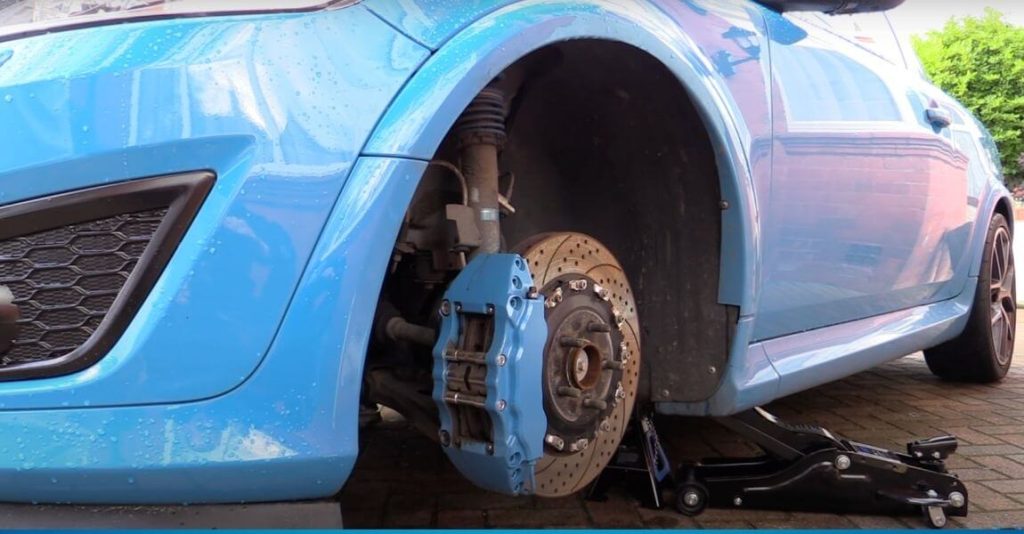
You can often see this through the wheel spokes. Look at the brake pads. If the inside pad is thin and the outside pad is thick, the caliper is likely stuck. Also, compare the left side to the right side. If one side is worn out and the other looks new, the caliper on the worn side is the culprit. Catching this early saves your rotors. We discuss this in our guide on brake pad replacement intervals.
6. Car Feels Sluggish or Drags — Especially From a Stop
It feels like you are driving with the parking brake on. The engine fights the constant drag of the stuck brake, making the car feel slow.
You step on the gas, but the car does not move quickly. It feels heavy. Your gas mileage will drop because the engine works harder. This drag is most obvious on cold mornings. As the parts heat up, they might expand and loosen slightly. Do not assume the problem is fixed just because the drag fades.
7. Spongy Brake Pedal or Brake Fade
This is the most dangerous stage. Extreme heat can boil the brake fluid, which makes the pedal feel soft and reduces stopping power.
Brake fluid is designed to handle high heat, but it has a limit. When it boils, it turns into gas. Gas is compressible. When you press the pedal, you compress the gas bubble instead of pushing the piston. The pedal feels spongy or goes to the floor. This is “brake fade.” If this happens, the car may not stop at all. Treat this as an emergency.
Sticking Caliper vs Other Brake Problems — How to Tell the Difference
It is easy to confuse a sticking caliper with other issues. Use this table to identify the specific problem based on sounds and symptoms.
| Problem | Key Sound | Pulling? | Heat Pattern | When Noise Occurs |
|---|---|---|---|---|
| Sticking Caliper | Grinding/Scraping | Yes (Strong) | One very hot wheel | Constant (Driving & Braking) |
| Warped Rotor | None / Pulsing | No | Even heat | Vibration during braking |
| Bad Wheel Bearing | Humming / Growling | No | Even heat | Changes with speed |
| Worn Brake Pads | Squealing | No | Normal | Only when braking |
| Loose Caliper Bolt | Clunking | Slight | Normal | When hitting bumps |
Front vs Rear Sticking Caliper — Different Symptoms
The location of the stuck caliper changes how the car feels. Front caliper issues are more noticeable in the steering, while rear issues feel like a heavy drag.
Front Sticking Caliper
The front brakes do about 70% of the stopping work. If a front caliper sticks, you feel it in the steering wheel immediately. The wheel will shake or pull hard. The burning smell will be strong from the front. Front rotors overheat faster and can warp quickly.
Rear Sticking Caliper
Rear brakes do less work, so the symptoms are subtler. The car may not pull as much. Instead, it feels lazy or slow. You might think the parking brake is stuck. In northern states, rear calipers often stick due to road salt or corroded parking brake cables. Check your rear pads if the car feels heavy.
What Causes a Brake Caliper to Stick?
Several things can make a caliper seize. The most common causes are corrosion, dirt, and lack of lubrication.
- Corroded Piston: Brake fluid absorbs water over time. This water rusts the inside of the caliper. The piston gets stuck.
- Seized Slide Pins: The caliper slides on metal pins. If the grease dries out or gets dirty, the pins seize. The caliper cannot float.
- Debris: Road grime can tear the rubber dust boot. Dirt enters the caliper and jams the piston.
- Inactivity: If a car sits for months, rotors rust. The pads stick to the rust.
- Old Fluid: Dirty fluid damages internal seals. Flush your fluid every two years. For more info, read our article on brake fluid maintenance.
How to Test If Your Brake Caliper Is Sticking (DIY Methods)
You can test your brakes at home. These simple tests can confirm if a caliper is dragging.
The Infrared Thermometer Test
This is the most accurate quick test. Drive for 15 minutes, then point a thermometer at each wheel.
An infrared thermometer costs about $20 at an auto parts store. Drive the car normally. Park safely. Shoot the laser at the center of each wheel or rotor. The temperatures should be close. If one wheel is 50 degrees hotter than the others, that caliper is sticking.
The Brake Drag Test
Find a flat, empty parking lot. Accelerate to 10 mph and let the car coast without touching the brakes.
Put the car in neutral if it is safe to do so. It should roll smoothly. If it slows down abruptly, like you are lightly braking, you have a drag issue. Do this test a few times to be sure.
The Visual Pad Wear Inspection
Look through your wheel spokes. Compare the inner and outer brake pads on the same wheel.
If the inner pad is much thinner than the outer pad, the caliper is not releasing. Also, compare the left side to the right side. Uneven wear across the axle confirms the issue.
The Wheel Turn Test (Vehicle On Jack)
Jack the car up safely. Spin the wheel by hand to feel for resistance.
The wheel should spin freely with just a slight rub from the pads. If the wheel is hard to turn or locks up, the caliper is seized. Make sure the car is in neutral with the parking brake off.

Is It Safe to Drive with a Sticking Brake Caliper?
It is not safe. Driving with a sticking caliper risks brake failure and costly damage to other parts.
If the symptoms are mild, like a slight pull, you might drive to a nearby shop. Do not drive on the highway. If you smell burning or see smoke, stop immediately. The heat can boil the fluid. This causes total brake loss. It can also damage the wheel bearing and tire. A $100 repair can turn into a $1,000 repair if you ignore it. According to RepairPal, ignoring brake drag often leads to rotor replacement.
Sticking Brake Caliper Repair Cost
The cost depends on the damage. You can spend as little as $65 for a cleaning or over $700 for a full replacement.
| Repair Type | DIY Parts Cost | Professional Cost | Difficulty |
|---|---|---|---|
| Slide Pin Lubrication | $5 – $15 | $65 – $115 | Easy |
| Caliper Rebuild Kit | $15 – $40 | $115 – $240 | Moderate |
| Single Caliper Replace | $50 – $150 | $150 – $350 | Moderate |
| Caliper + Rotor + Pads | $150 – $400 | $300 – $700 | Hard |
Note: Mechanics often recommend replacing calipers in pairs (both front or both rear) to ensure balanced braking.
How to Prevent Brake Caliper Sticking
Prevention is cheaper than the cure. Regular maintenance keeps your calipers moving freely.
- Flush Fluid: Change brake fluid every two years to remove moisture.
- Lube Pins: When you change pads, clean and grease the slide pins. Use synthetic brake grease, not regular grease.
- Drive Regularly: Do not let a car sit for months.
- Inspect Often: Check your brakes once a year. The Car Care Council recommends regular inspections to catch wear early.
FAQs About Symptoms of a Brake Caliper Sticking
How can I tell if my brake caliper is sticking?
Look for the car pulling to one side or a burning smell. The wheel on the stuck side will be much hotter than the others.
How to fix a caliper that is sticking?
You must remove the caliper. Clean and lubricate the slide pins. If the piston is seized, you must rebuild or replace the caliper.
Can WD-40 unstick a caliper?
No, do not use WD-40. It is not a high-temp lubricant. Use only brake caliper grease or silicone paste on the slide pins.
Will a brake caliper unstick itself?
No. Once a caliper sticks, it will not fix itself. It will only get worse. The heat and friction will eventually destroy the brake components.
How much does it cost to fix a sticking brake caliper?
Professional repair usually costs between $150 and $350 per caliper. If you need new rotors and pads too, the cost can reach $700.
Bottom Line — Don’t Ignore a Sticking Brake Caliper
A sticking brake caliper is a hazard you cannot ignore. The symptoms usually start small. The car pulls a little. You smell a slight burning odor. But these signs always get worse. The caliper destroys the brake pads, warps the rotor, and can boil your brake fluid. If you notice the warning signs, inspect it immediately. A simple cleaning and lubrication is cheap. A full brake overhaul is expensive. Check your brakes today to stay safe on the road. For more help, browse our other guides on TheCarBuzz.com.
Quick Summary
- A sticking caliper keeps the brake pad pressed against the rotor.
- The car will pull to one side when driving or braking.
- A burning smell or very hot wheel is a major warning sign.
- You may hear grinding noises even when not braking.
- Common causes include corroded slide pins and old brake fluid.
- Do not drive the car if you smell burning or feel a spongy pedal.
- Fixing it early saves money on rotors and pads.